
Pass Your Microsoft SQL Certification Easy!
Microsoft SQL Certification Exams Questions & Answers, Accurate & Verified By IT Experts
Instant Download, Free Fast Updates, 99.6% Pass Rate.

$69.99
Microsoft SQL Certification Exams Screenshots
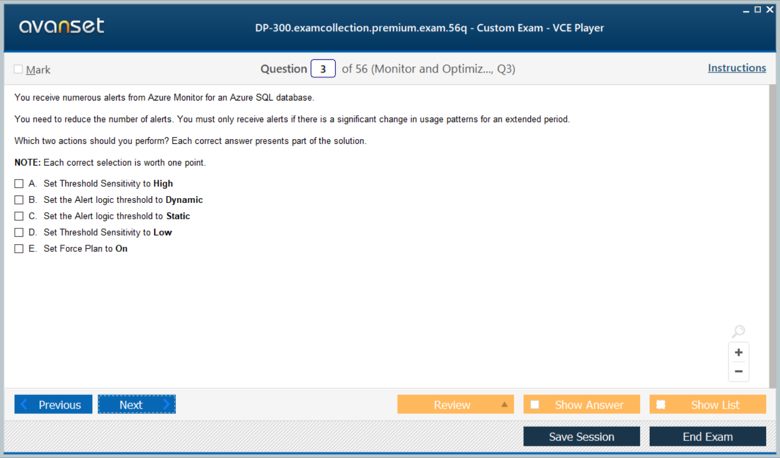
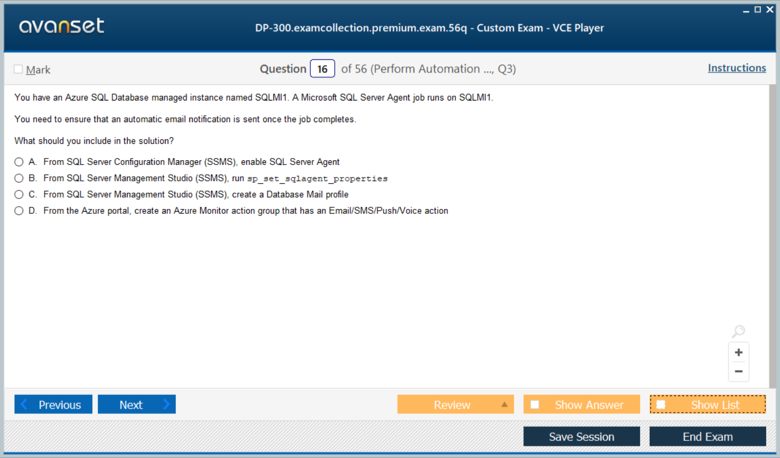
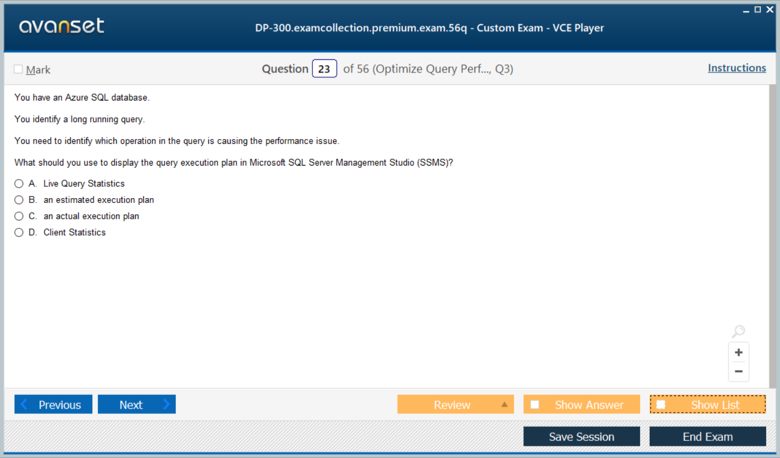
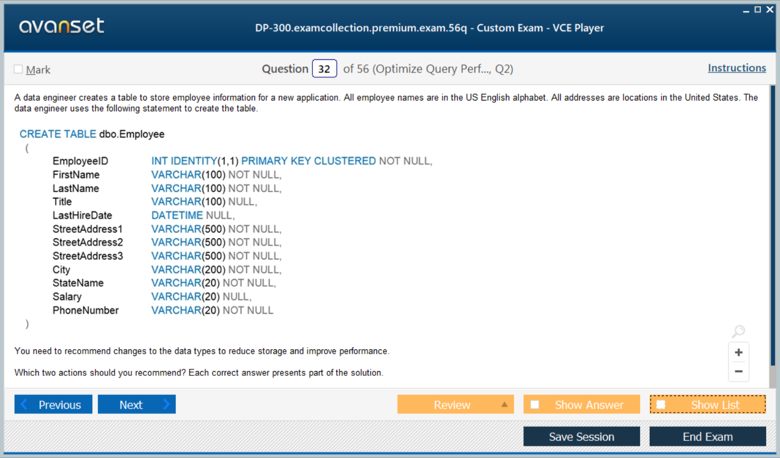
Microsoft SQL Product Reviews
Download Free Microsoft SQL Practice Test Questions VCE Files
| Exam | Title | Files |
|---|---|---|
Exam DP-300 |
Title Administering Microsoft Azure SQL Solutions |
Files 6 |
Microsoft SQL Certification Exam Dumps & Practice Test Questions
Prepare with top-notch Microsoft SQL certification practice test questions and answers, vce exam dumps, study guide, video training course from ExamCollection. All Microsoft SQL certification exam dumps & practice test questions and answers are uploaded by users who have passed the exam themselves and formatted them into vce file format.
Microsoft SQL Certification in the AI and Azure Era
“Microsoft SQL” is no longer the name of one current Microsoft certification track, even though it remains a useful category for people whose work centers on SQL Server, Azure SQL, Transact-SQL, database operations, and data application development. Microsoft’s current credential structure is role-based. That means the right path depends on whether the learner is building a foundation, administering relational databases, or developing SQL solutions that incorporate modern AI capabilities.
For a database administrator, the clearest current route is Azure Database Administrator Associate, earned through DP-300. For developers working at the intersection of SQL and AI, SQL AI Developer Associate and DP-800 represent a different skill profile. Newcomers who need the vocabulary of relational, non-relational, and analytical data can start with Azure Data Fundamentals before choosing a role-specific direction.
This makes the category more useful when it is treated as a map rather than as a single badge. SQL professionals still need the enduring fundamentals—data modeling, joins, transactions, indexing, query plans, security, backup and recovery—but Microsoft now tests those ideas inside specific operating roles. The practical question is therefore not “Which Microsoft SQL certification is current?” but “Which current Microsoft credential best matches the SQL work I actually perform?”
A role map also helps experienced people avoid unnecessary study. A SQL Server administrator who already manages backup, high availability, security, and performance may gain little from starting with a fundamentals exam, but may benefit from DP-300 because it forces those skills into Azure SQL and hybrid operating models. A developer who is strong in T-SQL but has never worked with embeddings, vector search, or AI-assisted database development faces a different gap. The credential should expose the next layer of responsibility rather than repeat knowledge the learner already uses every day. That makes an honest inventory of current work the best starting point for certification planning.
Database administration remains a distinct professional discipline
DP-300 is designed around the operational responsibility of keeping SQL Server and Azure SQL environments secure, available, observable, and performant. The administrator is expected to work across cloud-native and hybrid database estates, automate routine work, manage authentication and authorization, protect data, monitor workloads, tune performance, plan availability, and execute migrations without losing sight of recovery objectives. Those are different skills from merely writing correct SELECT statements.
A useful preparation plan therefore includes failure scenarios, not only configuration walkthroughs. Restore a database to a point in time, investigate blocking, compare index choices, rotate credentials, test a high-availability design, and verify that monitoring actually exposes the conditions you care about. The DP-300 preparation path is most valuable when it pushes study toward operational evidence rather than memorized portal screens.
SQL development is being reshaped by AI-enabled database features
DP-800 adds a different layer to the Microsoft SQL story. The credential is aimed at developers who design and build database solutions, secure and optimize them, deploy them through repeatable engineering practices, and use AI-assisted tools or AI capabilities where they make architectural sense. That includes the modern intersection of relational data with embeddings, vector search, model integration, and AI-assisted development workflows.
The important distinction is that AI features do not remove ordinary database engineering. A vectorized workload still needs correct schemas, permissions, capacity planning, observability, and deployment discipline. The strongest SQL AI developer understands when semantic retrieval improves a design and when a conventional relational query is simpler, cheaper, and more reliable.
T-SQL fluency still separates superficial familiarity from real competence
Current Microsoft credentials may be role-based, but Transact-SQL remains one of the most transferable skills in the SQL ecosystem. Candidates should be able to reason about joins, set operations, aggregation, window functions, common table expressions, transactions, locking, isolation, indexing, and execution behavior. Query syntax matters less than understanding why two logically equivalent queries can produce very different operational consequences.
A practical drill is to take a set of frequently used SQL queries and make them progressively less comfortable: add skewed data, larger tables, concurrent updates, missing indexes, or stricter correctness requirements. The goal is to learn to predict how a database engine behaves rather than to collect snippets.
Query tuning also becomes more meaningful when it is connected to service objectives. A five-second report may be acceptable in one workflow and disastrous in another. The same query can behave differently as cardinality, concurrency, statistics, parameter values, and hardware change. Candidates should therefore learn to capture a representative workload, identify the expensive part, and explain the trade-off behind a proposed fix. Adding an index can improve reads while increasing storage and write cost; forcing a plan can stabilize one case while hiding a deeper design issue. Professional SQL work is largely about choosing which compromise is appropriate for the workload in front of you.
Security starts with identity and reaches all the way into query design
Database security spans more than logins. Administrators and developers need to understand authentication, least privilege, role design, encryption, network access, secrets, auditing, row- or column-level controls, and the implications of dynamic SQL. Application architecture matters because insecure parameter handling can turn ordinary query logic into an attack surface.
That is why SQL professionals should connect certification study with the mechanics of preventing SQL injection. The broader lesson is architectural: secure systems make the safe path the normal path. Parameterized access, narrowly scoped identities, sensible network boundaries, and auditable changes reduce dependence on perfect human behavior.
Performance tuning is evidence work, not folklore
SQL performance problems are often blamed on the database before the workload has been measured. Effective troubleshooting starts by defining the symptom: latency, throughput, resource saturation, locking, memory pressure, I/O, plan regression, or inefficient application behavior. From there, the administrator or developer can use execution plans, wait information, query telemetry, resource metrics, and workload history to isolate the limiting factor.
Certification preparation should reinforce that sequence. Changing an index, compatibility level, or configuration setting without a hypothesis can hide the real problem or create a new one. A good lab preserves a baseline, changes one meaningful variable, and checks both the expected improvement and unintended side effects.
Migration is a business continuity problem disguised as a technical task
Moving SQL workloads between servers, data centers, or cloud services involves more than copying database files. Compatibility, logins, jobs, encryption keys, network dependencies, performance baselines, maintenance windows, recovery design, and rollback all matter. A migration is successful only when the application and its operational controls work after the move.
The same reasoning applies whether the destination is a new SQL Server instance, Azure SQL Managed Instance, or another supported architecture. A detailed SQL Server migration approach should therefore include discovery and validation before cutover, not only the transfer mechanism itself.
Recovery testing is another place where certification knowledge should become operational habit. A backup that has never been restored is only an assumption. Teams need to know which databases can be rebuilt from code, which contain irreplaceable state, how long restoration takes, which credentials and encryption keys are required, and how application traffic will be redirected during recovery. Those details connect database administration with continuity planning. They also expose gaps that a configuration-only study plan misses, such as a job, login, linked service, or secret that exists outside the database backup itself.
Fundamentals are useful when they clarify the shape of a workload
DP-900 is not an administrator or developer credential. Its value is conceptual: relational versus non-relational data, transactional versus analytical workloads, and the roles played by Azure data services. That foundation helps a learner understand why a normalized transactional database, an analytical platform, an object store, and a globally distributed NoSQL system solve different problems.
For someone entering the field, this reduces tool-first thinking. The question becomes what consistency, latency, query pattern, scale, governance, and lifecycle the workload requires. Only then does product selection make sense.
The Microsoft data path should follow the work you want to own
A learner targeting operational database responsibility should go deeper on DP-300. A software engineer who expects to build AI-enabled SQL applications should prioritize DP-800. Someone still learning the language of modern data platforms can use DP-900 as orientation before committing to a role. Microsoft certifications also include analytics, data engineering, security, and cloud administration paths that may be closer to the actual job.
This role-first approach prevents a common mistake: choosing an exam because its title contains a familiar technology name. SQL appears in many jobs, but the surrounding responsibilities determine which credential has the most professional value.
A durable study plan combines schema reasoning, operations, and automation
The best SQL preparation environment is small enough to rebuild and realistic enough to fail. Create databases with representative data, write queries, secure access, automate deployment, collect telemetry, introduce performance problems, test backup and recovery, and document decisions. Repeat the same scenario in more than one deployment model when the certification covers hybrid or Azure services.
That approach makes study resilient to product updates. Interfaces and individual features change, but the underlying questions remain: Is the data model sound? Is access controlled? Can the workload recover? Can it scale? Can changes be deployed safely? Can operators explain what the system is doing? Those questions define modern SQL competence more accurately than any legacy “Microsoft SQL” label.
Modern SQL teams also work across organizational boundaries. Developers care about schema evolution and deployment safety, administrators care about availability and performance, security teams care about access and auditability, and data teams care about downstream consumption. A certification path is more valuable when it improves those handoffs. The learner should be able to describe a database change in terms that each group understands: what is changing, which risk it introduces, how the change will be measured, how it can be rolled back, and what evidence will prove that the system is healthy afterward.
The Microsoft SQL category remains useful because SQL is still central to business applications, analytics pipelines, operational systems, and AI-enabled workloads. What has changed is the certification architecture around it. Current learners should map their goals to fundamentals, administration, or development, then build hands-on evidence around the responsibilities of that role rather than chasing an outdated umbrella credential.
ExamCollection provides the complete prep materials in vce files format which include Microsoft SQL certification exam dumps, practice test questions and answers, video training course and study guide which help the exam candidates to pass the exams quickly. Fast updates to Microsoft SQL certification exam dumps, practice test questions and accurate answers vce verified by industry experts are taken from the latest pool of questions.

Microsoft Microsoft SQL Video Courses







Top Microsoft Certifications























Top Microsoft Certification Exams
- AZ-104
- AI-103
- AB-100
- AI-901
- SC-500
- DP-700
- SC-300
- AZ-305
- AB-900
- GH-300
- AB-620
- MD-102
- PL-300
- AZ-900
- SC-401
- DP-600
- SC-200
- SC-100
- MS-102
- DP-800
- AB-730
- AB-731
- AZ-700
- AI-200
- AB-410
- AZ-801
- AZ-400
- DP-750
- PL-400
- SC-900
- AZ-500
- MS-700
- AZ-140
- AI-300
- DP-300
- PL-900
- MB-310
- AZ-800
- DP-900
- MB-800
- GH-600
- PL-200
- MB-230
- MB-330
- AZ-802
- MB-820
- AI-900
- AZ-204
- MS-721
- GH-900
- GH-200
- AI-500
- GH-100
- AB-250
- MB-500
- AI-102
- AB-650
- GH-500
- DP-420
- AZ-120
- MB-280
- PL-600
- SC-400
- MB-910
- MS-900
- MB-700
Site Search:




@ayuf,...when you say valid it depends with the percentage....most of the sql premium files i have used here are 85-95% valid which is enough for you to pass...use them and you gonna pass.
hello....i passed exams after using ms sql braindump....they are very close to the actual exam ...do not miss it
who has valid ms sql prep materials... i am tired because sometimes we get very invalid materials which can lead us to failure
i had failed my exam during the first attempt because of insufficient preparation...after taking sql training and certification was laying in my pocket…I knew I’d do it! i realized that the things that made me failed were just easy...you need to prepare well
woow! i have received the ms sql certification after a series of sleepless nights of revision never be cheated that there is anything good that comes easy in this life.
plz pals...if you are already certified but you hve not seen how different sql server 2016 certification is updated....please update yourself by taking respective exam. it is one way of keeping yourself relevant in the industry
@radel, hey pal. i can advice you to use sql certification course u will get all you need to know before you do an exam
i passed the microsoft sql server certification exam....i cant wait to receive my certification....it is the dream i have been having since i became a database designer
i needed to do the sql server certification but i realized that the exams are so hard,,need to prepare first. who has valid materials....plz upload here
with microsoft sql certification....i bet you will never miss a job. i just got hired once the hiring managers saw this cert...struggle for it guyz