

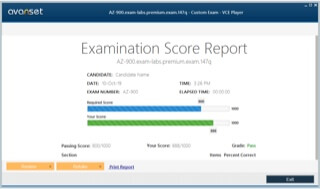

Premium File
187 Q&A
$98.99$89.99
Microsoft AI-103 Exam Questions & Answers, Accurate & Verified By IT Experts
Instant Download, Free Fast Updates, 99.6% Pass Rate
187 Questions & Answers
Last Update: Sep 04, 2026
$89.99
Microsoft AI-103 Practice Test Questions in VCE Format
| File | Votes | Size | Date |
|---|---|---|---|
File Microsoft.pass4sures.AI-103.v2026-08-18.by.ida.7q.vce |
Votes 1 |
Size 303.92 KB |
Date Aug 18, 2026 |
Microsoft AI-103 Practice Test Questions, Exam Dumps
Microsoft AI-103 (Developing AI Apps and Agents on Azure) exam dumps vce, practice test questions, study guide & video training course to study and pass quickly and easily. Microsoft AI-103 Developing AI Apps and Agents on Azure exam dumps & practice test questions and answers. You need avanset vce exam simulator in order to study the Microsoft AI-103 certification exam dumps & Microsoft AI-103 practice test questions in vce format.
AI-103, Developing AI Apps and Agents on Azure, is a current Microsoft exam for Azure AI engineers who build, manage, and deploy AI applications and agents using Microsoft Foundry and Azure AI services. The role combines generative AI with established AI workloads such as computer vision, text analysis, speech, and information extraction. Python experience and familiarity with Azure services are important because the exam is about implementing solutions, not only identifying concepts.
The AI-103 exam replaces the retired AI-102 as Microsoft’s current associate path for this style of AI application work. Its objectives emphasize planning and managing Azure AI solutions, implementing generative and agentic solutions, building retrieval-augmented generation, evaluating models and applications, and implementing other AI workloads. The exam expects candidates to connect model behavior with application architecture, data, security, monitoring, and user experience.
Preparation should revolve around a small number of complete projects rather than dozens of disconnected tutorials. One grounded assistant, one tool-using agent, one document or multimodal extraction workflow, and one language or vision service can cover many objectives if each project includes provisioning, authentication, code, evaluation, error handling, monitoring, and responsible AI considerations.
Foundry brings models, projects, evaluation, agent capabilities, and development tooling into one working environment. Candidates should be comfortable creating or connecting to a project, selecting a model for a workload, configuring deployments, and interacting through SDKs rather than treating the portal as the entire solution. The important skill is understanding which parts belong to the model, which belong to Foundry, and which remain responsibilities of your application.
Build a minimal chat application using the Foundry SDK and then deliberately change one layer at a time. Swap the model, alter system instructions, change authentication, add logging, and introduce a structured response format. Observe which changes affect behavior and which affect operational reliability. This creates a much stronger mental model than following a single happy-path tutorial from start to finish.
Model selection should be treated as a measured decision. Compare at least two candidate models on the same representative tasks and record quality, latency, context needs, cost proxy, and failure behavior. A larger or newer model is not automatically the right production choice. The ability to justify a model based on the workload is more valuable than remembering a long catalog of model names that may change faster than the certification objectives.
Retrieval-augmented generation is central because many enterprise assistants need current or private knowledge. The RAG pattern provides a useful conceptual starting point: retrieve relevant material, place it into model context, and generate a grounded response. In production, however, quality depends on chunking, indexing, query formulation, filtering, ranking, permissions, context limits, and how the prompt instructs the model to use evidence.
Create a test corpus with authoritative documents, duplicates, outdated versions, and restricted material. Build questions that require one document, several documents, or no available answer. Evaluate retrieval separately from generation: did the right evidence appear, and did the model use it correctly? This diagnostic split is essential because a poor answer can originate from retrieval failure even when the model is behaving exactly as instructed.
Permission-aware retrieval deserves its own tests. If two users ask the same question but have access to different document sets, the retrieval layer should return different evidence before generation even begins. Build role-specific test accounts and verify both positive and negative access cases. A correct answer that was produced from information the user was not authorized to retrieve is still a security failure.
An agent becomes useful when it can move beyond a single response and coordinate goals, tools, knowledge, and state. AI-103 expects candidates to define agent roles and goals, integrate tools such as APIs and knowledge stores, manage conversation context, and build orchestrated workflows. The engineering challenge is to give the agent enough capability to complete useful work without granting uncontrolled autonomy.
The discussion of AI agent behavior helps clarify the conceptual pieces. In a lab, define an agent that can retrieve policy information and open a service request through a mock API. Require human approval before the write action, restrict the tool schema, log the call, and test what happens when the agent receives ambiguous or malicious instructions.
Tool failure handling is another core lab. Make the agent call an API that returns an error, times out, or supplies malformed data. The agent should not invent success or continue as though the action completed. Define retry limits, user messaging, fallback behavior, and escalation. This is where agent engineering becomes ordinary reliable software engineering: external dependencies fail, and the conversational layer must represent that uncertainty accurately.
Generative AI applications cannot be judged only by whether a demo response “looks good.” AI-103 expects evaluation of models and applications, including fabrication detection, relevance, quality, and safety. Agentic systems also need behavioral evaluation: did the agent choose the right tool, preserve context, stop at an approval boundary, and recover correctly from a failed tool call?
Build a small evaluation set before tuning prompts. Include normal questions, edge cases, adversarial instructions, insufficient-context cases, and prompts that should be refused or escalated. Record expected behavior and compare versions after changing prompts, retrieval, model settings, or tools. This makes improvement measurable and helps prevent a fix for one example from silently degrading another part of the system.
Use version labels for prompts and evaluation data so results can be reproduced. If a score improves after a change, you should be able to identify exactly which prompt, retrieval configuration, model deployment, and test set produced it. This basic experiment discipline prevents teams from tuning through anecdote. It also makes later regressions diagnosable because a previously successful configuration can be reconstructed rather than remembered vaguely.
AI-103 still includes non-generative AI responsibilities. Vision, text analysis, speech, and information extraction often provide structured inputs to larger applications. For example, an image or document can be analyzed, extracted fields can be validated, and the resulting information can become context for a generative workflow. The value comes from composing capabilities, not from demonstrating each service in isolation.
The document intelligence workflow is a useful example. Build a pipeline that extracts document fields, checks confidence, normalizes values, and passes only validated information downstream. Add a human-review branch for uncertain cases. Then compare that deterministic extraction path with a generative interpretation and decide which output should be trusted for which business action.
AI applications introduce several trust boundaries: the user, the application, the model endpoint, retrieval stores, tools, and downstream services. Use managed identities and least-privilege permissions where possible, keep secrets out of code, and separate user authorization from application authorization. An agent should not gain broader tool access simply because the underlying app can technically call an API.
Create an access matrix for a multi-user assistant. List which documents each role can retrieve, which tools each role can invoke, and which operations require approval. Then test authorization at every boundary rather than only hiding interface controls. This security model becomes increasingly important as applications move from answering questions to taking actions that change systems or data.
Logging should avoid becoming a new privacy problem. Traces may contain prompts, retrieved passages, tool arguments, or model outputs with sensitive information. Decide what must be recorded for debugging and compliance, what should be redacted, how long logs are retained, and who can access them. Observability is essential, but collecting every token indefinitely is not a neutral choice.
AI-103 focuses on the AI experience, but production systems depend on cloud application and operations skills. AI-200 Azure AI Cloud Developer goes deeper into containers, data services, messaging, serverless components, security, and monitoring for AI back ends. AI-300 Machine Learning Operations Engineer goes deeper into MLOps and GenAIOps infrastructure, deployment automation, evaluation, and lifecycle management.
This separation is useful when designing labs. Build the AI feature first, then ask how it would scale, deploy, monitor, and recover in production. Which queues absorb spikes? Where does state live? How are model versions promoted? How are evaluation results tracked? You do not need to become expert in every adjacent exam, but understanding the interfaces between roles will make AI-103 architecture decisions much more realistic.
Learners coming from the current AI-901 Azure AI Fundamentals exam will recognize responsible AI, Foundry, common workloads, and basic model interaction, but AI-103 expects implementation depth. At the other end, AI-500 Multi-Agent AI Solutions moves into expert-level architecture, orchestration, observability, governance, and deployment of complex multi-agent systems.
A strong AI-103 project portfolio should therefore demonstrate breadth and integration: a grounded assistant, a tool-using agent, an extraction or multimodal workflow, and an evaluation harness. For each project, document identity, data, model choice, failure handling, monitoring, and safety. That evidence mirrors what a real Azure AI engineer needs to operate beyond the exam environment.
When planning exam practice, also vary the deployment context. Test one local development client, one hosted API, and one background process or scheduled workflow. The AI behavior may be similar, but authentication, concurrency, telemetry, and failure handling differ. Seeing the same capability in multiple application shapes helps separate durable AI engineering principles from assumptions that belong only to a specific demo environment.
AI-103 is not a prompt-engineering test. It is an application-engineering exam in which models, retrieval, agents, multimodal services, identity, evaluation, and operations have to work together. Hands-on projects that expose failure modes are the most reliable preparation.
Go to testing centre with ease on our mind when you use Microsoft AI-103 vce exam dumps, practice test questions and answers. Microsoft AI-103 Developing AI Apps and Agents on Azure certification practice test questions and answers, study guide, exam dumps and video training course in vce format to help you study with ease. Prepare with confidence and study using Microsoft AI-103 exam dumps & practice test questions and answers vce from ExamCollection.
Purchase Individually
Top Microsoft Certifications






















Top Microsoft Certification Exams
Site Search:
SPECIAL OFFER: GET 10% OFF

Pass your Exam with ExamCollection's PREMIUM files!
SPECIAL OFFER: GET 10% OFF
Use Discount Code:
MIN10OFF
A confirmation link was sent to your e-mail.
Please check your mailbox for a message from support@examcollection.com and follow the directions.

Download Free Demo of VCE Exam Simulator
Experience Avanset VCE Exam Simulator for yourself.
Simply submit your e-mail address below to get started with our interactive software demo of your free trial.