Pass Your Microsoft Certified: Azure Data Fundamentals Certification Easy!
Microsoft Certified: Azure Data Fundamentals Certification Exams Questions & Answers, Accurate & Verified By IT Experts
Instant Download, Free Fast Updates, 99.6% Pass Rate.
Microsoft Certified: Azure Data Fundamentals Certification Exams Screenshots
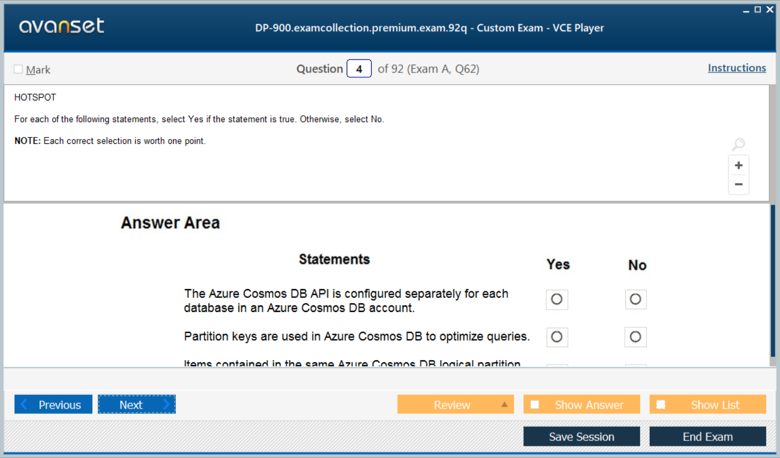
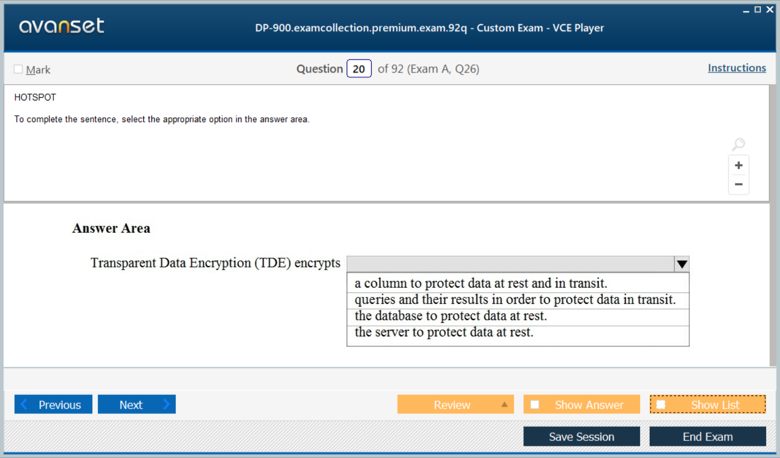
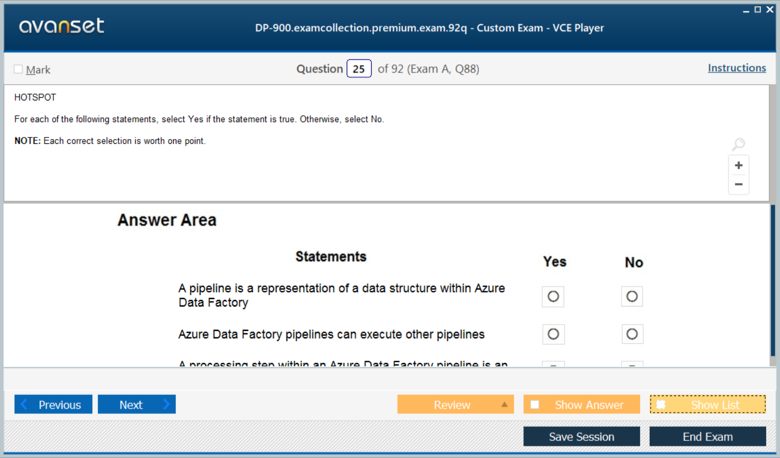
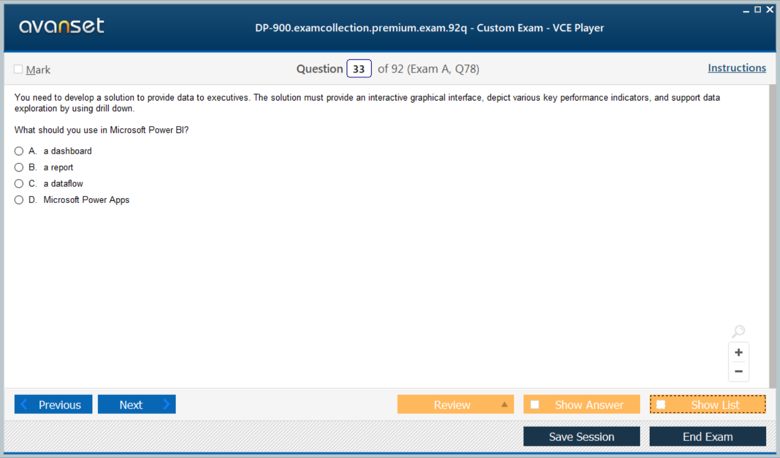
Microsoft Certified: Azure Data Fundamentals Product Reviews
Download Free Microsoft Certified: Azure Data Fundamentals Practice Test Questions VCE Files
| Exam | Title | Files |
|---|---|---|
Exam DP-900 |
Title Microsoft Azure Data Fundamentals |
Files 6 |
Microsoft Certified: Azure Data Fundamentals Certification Exam Dumps & Practice Test Questions
Prepare with top-notch Microsoft Certified: Azure Data Fundamentals certification practice test questions and answers, vce exam dumps, study guide, video training course from ExamCollection. All Microsoft Certified: Azure Data Fundamentals certification exam dumps & practice test questions and answers are uploaded by users who have passed the exam themselves and formatted them into vce file format.
Azure Data Fundamentals and the Current DP-900
Microsoft Certified: Azure Data Fundamentals is a current beginner credential built around the DP-900 exam. The English skills outline was updated on July 21, 2026, and the certification remains aimed at people beginning to work with data in the cloud. It is not a database-administration or data-engineering credential; its purpose is to establish a reliable vocabulary for data types, storage models, transactional and analytical workloads, and the Azure services that support them.
Within the broader Microsoft certifications, DP-900 is useful because it gives technical and nontechnical learners a common model of the data landscape. Microsoft explicitly notes that Azure Data Fundamentals can help prepare someone for role-based credentials such as Azure Database Administrator Associate, but it is not a prerequisite. That distinction keeps the certification useful without overstating what a fundamentals exam proves.
The current blueprint gives meaningful weight to core data concepts, relational data, non-relational data, and analytics workloads. A good preparation plan should therefore move repeatedly between business scenarios and platform choices. The goal is to recognize why a workload needs a particular data model or analytical approach, not simply to memorize service names.
Start with the shape and purpose of the data
DP-900 begins with foundational distinctions: structured, semi-structured, and unstructured data; common file formats; transactional versus analytical workloads; and the responsibilities associated with modern data roles. These categories are practical because they influence almost every later design choice. A point-of-sale transaction, a JSON event stream, a document archive, and a reporting warehouse may all contain valuable data, but they are organized and consumed in very different ways.
A concise explanation of DP-900 data fundamentals can help organize the vocabulary, but candidates should test each term against a scenario. Ask what needs to be stored, how often it changes, how it will be queried, whether relationships are important, and whether the workload prioritizes transactional consistency or large-scale analysis. That reasoning is more durable than remembering a list.
The role vocabulary is worth learning as well. Database administrators concentrate on availability, security, performance, and operational health of data platforms. Data engineers build reliable movement and transformation pipelines. Data analysts shape data into usable models and reports, while data scientists develop statistical and machine learning solutions. Real projects overlap, but these role boundaries help a beginner understand why Microsoft offers different credentials instead of one broad data exam.
Relational data is about structure, constraints, and dependable transactions
Relational systems organize data into tables with defined schemas and relationships. Candidates should understand primary and foreign keys, normalization at a conceptual level, SQL as a language for working with relational data, and why transactional systems value consistency and predictable updates. They should also know that Azure offers several ways to run relational workloads, depending on how much platform management the customer wants to retain.
Studying Azure SQL is useful when it connects these principles to managed cloud databases. Azure SQL Database, Azure SQL Managed Instance, and SQL Server running in Azure do not represent identical operating models. Fundamentals candidates do not need administrator-level depth, but they should understand why a managed database service can reduce infrastructure responsibility while preserving familiar relational concepts.
Non-relational models trade fixed structure for workload-specific flexibility
Non-relational data is not simply data without order. Key-value, document, column-family, and graph models are designed around different access patterns. A document database can keep related fields together even when records vary, while a graph model expresses relationships directly. Candidates should learn why these choices can improve scalability or developer productivity for particular workloads and why they may be a poor fit for others.
The contrast becomes clearer through a practical relational and NoSQL data models. The important lesson is not that one model is modern and another is old. It is that the data model should follow how the application stores, updates, and queries information. DP-900 questions often become easier once the candidate identifies that access pattern first.
Azure Cosmos DB represents a globally distributed NoSQL option
Azure Cosmos DB is one of the important non-relational services in the Azure data ecosystem. At fundamentals level, candidates should understand that it is designed for highly available, globally distributed applications and supports multiple data models and APIs. They do not need to master every consistency level or partitioning detail, but they should recognize the kinds of requirements that lead an architect toward a globally distributed operational database.
The same reasoning applies to Azure storage services. Blob storage suits object data such as files and media; Azure Files exposes managed file shares; Table storage provides a simple key-attribute store. DP-900 rewards the ability to distinguish these services by workload rather than by memorized definitions. A scenario that mentions huge binary objects points in a different direction from one that requires relational joins.
Analytics separates operational questions from historical insight
Transactional systems are optimized to record business events accurately and quickly. Analytical systems are optimized to scan, aggregate, compare, and explore larger bodies of data. That difference explains why organizations build warehouses, lakehouses, and analytical models instead of running every dashboard directly against the operational database. Candidates should understand the purpose of ETL or ELT and why data may be transformed into a model suited to reporting.
The current DP-900 scope also reaches large-scale analytics in services such as Azure Databricks and Microsoft Fabric. At fundamentals level, the task is not to configure a Spark cluster or build an enterprise semantic model. It is to understand the roles these platforms play: ingesting, transforming, organizing, and analyzing data at scale for analysts, data engineers, data scientists, and business intelligence workloads.
Batch and streaming solve different timing problems
Batch processing works on bounded collections of data at intervals, while streaming processes events continuously or with very low latency. The choice is driven by how quickly the business needs insight and how the source emits data. A nightly financial consolidation and a real-time fraud signal are both analytical problems, but the acceptable delay and processing model are very different.
Candidates should practice identifying the timing requirement hidden in a scenario. Words such as continuous, telemetry, events, near real time, and immediate response often point toward streaming. Large scheduled imports, month-end processing, and periodic historical aggregation usually favor batch. The exam does not require deep stream-processing engineering, but it does expect learners to understand why both models exist.
Power BI belongs at the consumption end of the data chain
Data platforms create value only when people or applications can use the results. Power BI appears in the fundamentals landscape because analytical data often needs to be modeled, visualized, and shared. Candidates should understand the difference between preparing data, building a semantic model, and presenting insights. A dashboard is not the data platform itself; it is one layer that consumes governed analytical data.
This separation helps avoid an overly tool-centric view. A report may depend on a warehouse, lakehouse, or other model that was populated by pipelines and protected by governance controls. Understanding those layers makes later role-based learning much easier because the learner can see where a database administrator, data engineer, analyst, and data scientist each contribute.
DP-900 can lead toward database and engineering specializations
A learner attracted to relational operations can continue toward Azure Database Administrator Associate, where DP-300 goes much deeper into security, performance, automation, migration, and high availability. Someone more interested in movement, transformation, lakehouse patterns, and pipeline operations can explore data-engineering credentials instead. DP-900 provides context for both directions without requiring either one.
This is also why the certification works well for developers, project managers, cloud administrators, and business analysts who will collaborate with data teams. They may never administer a database or tune a Spark job, but understanding the difference between operational and analytical stores, relational and non-relational models, and batch and streaming processing improves design conversations.
The transition does not need to happen immediately. Many learners benefit from doing a small project after DP-900: create a relational dataset, store a few semi-structured objects, move data into an analytical form, and build a simple visualization. That experience reveals which part of the lifecycle is most interesting. The next certification can then follow genuine curiosity and job requirements rather than a predetermined ladder.
Preparation should connect every service to a workload decision
A productive study plan can be built as a set of comparisons: relational versus non-relational, transactional versus analytical, structured versus semi-structured, batch versus streaming, object storage versus database storage, and self-managed versus managed platform options. For each pair, write a short business scenario where one choice is clearly better and explain the trade-off.
Then use the live July 2026 skills outline as the final checklist. Fundamentals exams are vulnerable to stale preparation because service names and analytics platforms evolve. Current objectives should decide what deserves study time, while older explanations are useful only when they still describe the same concept accurately. If a learner can explain why a service fits a workload, rather than only naming the service, DP-900 has done its job.
ExamCollection provides the complete prep materials in vce files format which include Microsoft Certified: Azure Data Fundamentals certification exam dumps, practice test questions and answers, video training course and study guide which help the exam candidates to pass the exams quickly. Fast updates to Microsoft Certified: Azure Data Fundamentals certification exam dumps, practice test questions and accurate answers vce verified by industry experts are taken from the latest pool of questions.

Microsoft Microsoft Certified: Azure Data Fundamentals Video Courses
Top Microsoft Certifications













































Top Microsoft Certification Exams
- AZ-104
- AI-103
- AB-100
- SC-500
- AI-901
- DP-700
- SC-300
- AZ-305
- AB-900
- GH-300
- AB-620
- MD-102
- PL-300
- AZ-900
- SC-401
- SC-200
- DP-600
- SC-100
- MS-102
- DP-800
- AB-730
- AB-731
- AZ-700
- AI-200
- AB-410
- AZ-801
- AZ-400
- DP-750
- SC-900
- PL-400
- AZ-140
- MS-700
- AZ-500
- AI-300
- DP-300
- PL-900
- AZ-800
- GH-600
- MB-800
- MB-310
- DP-900
- PL-200
- AZ-802
- MB-330
- MB-230
- MB-820
- AI-900
- GH-900
- MS-721
- AI-500
- GH-200
- AB-650
- AZ-204
- AB-250
- GH-100
- MB-500
- DP-420
- AI-102
- AZ-120
- MB-280
- GH-500
- MB-910
- SC-400
- MS-900
- PL-600
- AB-210
- MB-700
Site Search: