

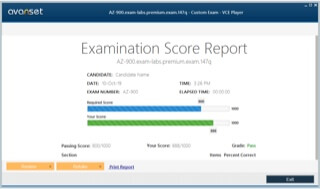

Premium File
999 Q&A
$76.99$69.99
Amazon AWS Certified Cloud Practitioner CLF-C02 Exam Questions & Answers, Accurate & Verified By IT Experts
Instant Download, Free Fast Updates, 99.6% Pass Rate

AWS Certified Cloud Practitioner CLF-C02 Premium File: 999 Questions & Answers
Last Update: Aug 25, 2026
AWS Certified Cloud Practitioner CLF-C02 Training Course: 274 Video Lectures
AWS Certified Cloud Practitioner CLF-C02 PDF Study Guide: 472 Pages
$79.99
Amazon AWS Certified Cloud Practitioner CLF-C02 Practice Test Questions in VCE Format
| File | Votes | Size | Date |
|---|---|---|---|
File Amazon.certkey.AWS Certified Cloud Practitioner CLF-C02.v2026-06-30.by.sebastian.7q.vce |
Votes 1 |
Size 13.19 KB |
Date Jun 30, 2026 |
Amazon AWS Certified Cloud Practitioner CLF-C02 Practice Test Questions, Exam Dumps
Amazon AWS Certified Cloud Practitioner CLF-C02 (AWS Certified Cloud Practitioner CLF-C02) exam dumps vce, practice test questions, study guide & video training course to study and pass quickly and easily. Amazon AWS Certified Cloud Practitioner CLF-C02 AWS Certified Cloud Practitioner CLF-C02 exam dumps & practice test questions and answers. You need avanset vce exam simulator in order to study the Amazon AWS Certified Cloud Practitioner CLF-C02 certification exam dumps & Amazon AWS Certified Cloud Practitioner CLF-C02 practice test questions in vce format.
AWS Certified Cloud Practitioner remains the entry-level certification for people who need broad AWS Cloud literacy without being tied to a single engineering role. The CLF-C02 exam is current in 2026 and tests whether a candidate can explain cloud value, shared responsibility, security and compliance basics, major AWS service categories, global infrastructure, and the financial model behind consuming cloud services.
The exam is deliberately broad. It does not ask candidates to design a production VPC from scratch or troubleshoot a failing Kubernetes cluster. Instead, it rewards accurate distinctions: who secures what, when a managed service reduces operational burden, how Regions differ from Availability Zones, why elasticity changes capacity planning, and which pricing or support option fits a stated business need.
The natural certification context is AWS Certified Cloud Practitioner within the wider Amazon AWS certifications. For a focused current review, the CLF-C02 preparation can help organize preparation without replacing the official AWS exam guide.
Cloud computing changes the relationship between demand and infrastructure. Instead of purchasing enough hardware for an uncertain peak and carrying the unused capacity, organizations can provision resources as demand appears, scale them up or down, and pay for consumption. That flexibility matters only when teams understand which resources are elastic and which still create commitments or persistent costs.
Candidates should connect business terms to technical consequences. Agility means faster experimentation and provisioning. Elasticity means matching capacity to changing load. Global reach means deploying closer to users without building physical data centers. Managed services can reduce undifferentiated operational work, but they do not remove architecture, security, governance, or financial responsibility.
One useful way to test cloud-value claims is to ask what the organization can stop doing. A move to a managed database may reduce patching and backup administration, while serverless execution can reduce capacity management. The value is not simply “cloud is cheaper”; it may be faster delivery, global reach, lower operational burden, better experimentation, or more flexible spending.
Cloud adoption also introduces new disciplines. Easy provisioning can create sprawl, inconsistent tagging, forgotten resources, and unexpected bills. The same elasticity that makes growth easier makes governance important. Practitioner-level cloud knowledge therefore includes both benefits and the operating controls needed to prevent flexibility from turning into disorder.
The shared responsibility model is one of the most important CLF-C02 concepts because it prevents a common misconception: moving to AWS does not transfer every security duty to the provider. AWS secures the physical facilities, hardware, foundational networking, and other components of the cloud. Customers remain responsible for the data, identities, permissions, configurations, and workload-level controls they choose.
The boundary changes with the service model. A customer running software directly on Amazon EC2 has more responsibility for guest operating systems and application configuration than a customer using a more heavily managed service. The exam often tests this by presenting an incident and asking which party should act. Focus on the layer where the problem exists rather than memorizing a slogan.
AWS Identity and Access Management provides the core language for users, roles, policies, and least privilege. Root credentials should be protected and used sparingly, while everyday access should rely on appropriately scoped identities. Multi-factor authentication, credential hygiene, centralized account management, and logging all reinforce identity governance.
Compliance questions usually test responsibility and evidence rather than obscure regulations. AWS may provide certifications, reports, and services that support compliance, but the customer still has to configure workloads appropriately and determine which obligations apply. Governance also includes account structures, policy boundaries, tagging, audit trails, and controls that keep cloud adoption consistent as usage grows.
Organizations often use multiple AWS accounts to separate teams, environments, or risk boundaries. That does not change the shared-responsibility model; it gives governance a larger structure. Central identity, organization policies, consolidated billing, and common logging can make many accounts manageable while preserving isolation between workloads.
Compute, storage, databases, networking, analytics, security, and management services form recurring service families. Amazon EC2 provides flexible virtual machines; AWS Lambda runs event-driven code without server management; Amazon S3 provides durable object storage; EBS provides block storage for EC2; managed database services reduce database administration compared with self-managing database engines on virtual machines.
Candidates do not need to memorize every AWS service. They should know the purpose and trade-offs of commonly tested services. The distinction between object, block, and file storage is especially useful; so is the difference between relational databases and key-value or document databases. The broader comparison of Amazon EC2 and Amazon S3 reinforces why service categories should not be treated as interchangeable.
Availability requirements should influence service choice as well. A managed service may include replication or automatic replacement that a self-managed EC2 design would have to implement manually. Candidates should therefore ask not only what a service does, but which operational responsibilities it removes and which still remain with the customer.
An AWS Region is a geographic area containing multiple isolated Availability Zones. Designing across Availability Zones can reduce the impact of a single data-center failure, while multi-Region strategies address larger geographic failures or data-residency requirements. Edge services place content or network entry points closer to users to improve latency and availability for specific workloads.
The exam often rewards proportional design. Not every workload needs multi-Region active-active architecture. A low-cost internal system and a global customer-facing platform have different recovery and latency requirements. The AWS Well-Architected design principles are useful because they frame reliability, security, performance, cost, sustainability, and operations as connected design concerns.
AWS pricing questions are rarely about memorizing a table. Candidates should understand on-demand consumption, long-term commitments, savings mechanisms, data-transfer charges, storage classes, and the financial difference between steady and variable workloads. A service can be inexpensive per unit and still create waste if it is oversized, idle, or moving large volumes of data unnecessarily.
Cost management includes budgets, allocation, tagging, forecasts, and tools that explain where money is going. The AWS billing and cloud-cost management discussion is useful for seeing how technical architecture and financial governance meet. Cost optimization is an ongoing operational practice, not a one-time discount search.
AWS Support plans, re:Post, documentation, Trusted Advisor capabilities, service health information, migration services, and architecture guidance solve different problems. A small team experimenting with a noncritical workload may need different support coverage from an enterprise running revenue-critical systems around the clock.
Migration choices should also reflect constraints. Some systems can be rehosted quickly, while others benefit from replatforming or refactoring. The practitioner-level lesson is that cloud adoption is not simply moving servers. It involves operating model changes, governance, cost visibility, security controls, and application decisions that influence long-term value.
When two answers look plausible, identify the requirement the question is actually emphasizing: lowest operational effort, lowest latency, highest resilience, strongest isolation, predictable cost, or fastest deployment. Then eliminate choices that optimize a different objective. This is more reliable than associating a keyword with a favorite AWS service.
Build small comparison tables for common distinctions such as Region versus Availability Zone, security group versus network ACL, S3 versus EBS, EC2 versus Lambda, RDS versus DynamoDB, and on-demand versus commitment-based pricing. The purpose is not rote recall; it is to explain when one model fits better than another.
A good final review starts with the four official domains and asks what business question each concept answers. For every service you study, record the problem it solves, who manages which layer, how it scales, and what cost or security consideration usually accompanies it. That method produces usable cloud literacy instead of a disconnected glossary.
Use the CLF-C02 domain changes as historical context, but let the current AWS exam guide control the final checklist. If you can explain the cloud operating model clearly to a nontechnical stakeholder and still distinguish the major AWS service patterns, you are preparing at the right level.
Before the exam, practice explaining ten common AWS decisions without jargon. For example: why object storage differs from a virtual machine disk, why a second Availability Zone improves resilience, why least privilege matters, and why unused capacity still costs money. If you can explain those ideas clearly, you are less likely to be distracted by unfamiliar wording on exam day.
CLF-C02 also rewards knowing what not to over-engineer. A small static site, a globally distributed application, and a regulated database do not need the same architecture or support model. Practice identifying the minimum set of AWS capabilities that satisfies each scenario before considering more elaborate options. Simplicity is often part of cost, reliability, and operational excellence.
Go to testing centre with ease on our mind when you use Amazon AWS Certified Cloud Practitioner CLF-C02 vce exam dumps, practice test questions and answers. Amazon AWS Certified Cloud Practitioner CLF-C02 AWS Certified Cloud Practitioner CLF-C02 certification practice test questions and answers, study guide, exam dumps and video training course in vce format to help you study with ease. Prepare with confidence and study using Amazon AWS Certified Cloud Practitioner CLF-C02 exam dumps & practice test questions and answers vce from ExamCollection.
Purchase Individually

Amazon AWS Certified Cloud Practitioner CLF-C02 Video Course

Top Amazon Certifications





Top Amazon Certification Exams
Site Search:

SPECIAL OFFER: GET 10% OFF

Pass your Exam with ExamCollection's PREMIUM files!
SPECIAL OFFER: GET 10% OFF
Use Discount Code:
MIN10OFF
A confirmation link was sent to your e-mail.
Please check your mailbox for a message from support@examcollection.com and follow the directions.

Download Free Demo of VCE Exam Simulator
Experience Avanset VCE Exam Simulator for yourself.
Simply submit your e-mail address below to get started with our interactive software demo of your free trial.