Pass Your Isaca CISM Certification Easy!
Isaca CISM Certification Exams Questions & Answers, Accurate & Verified By IT Experts
Instant Download, Free Fast Updates, 99.6% Pass Rate.

$69.99
Isaca CISM Certification Exams Screenshots
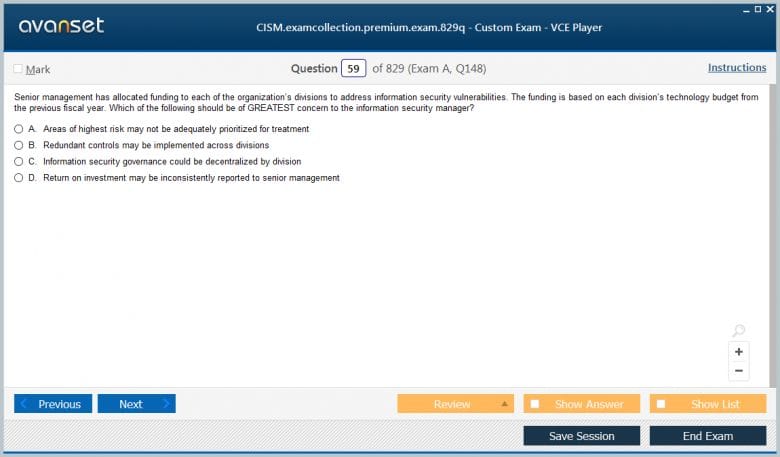
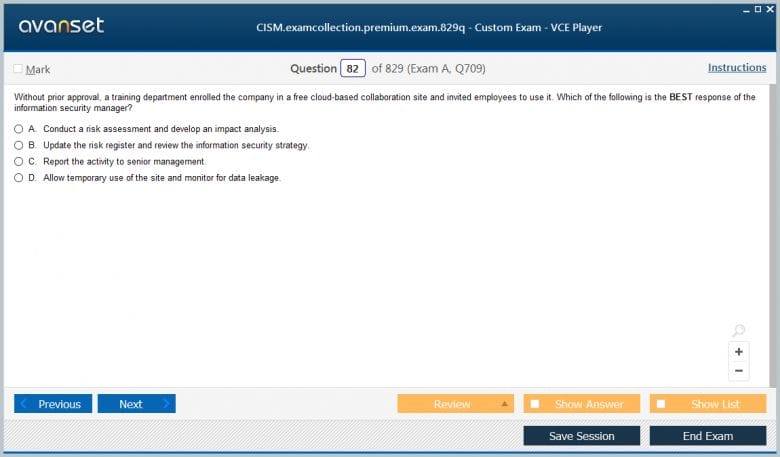
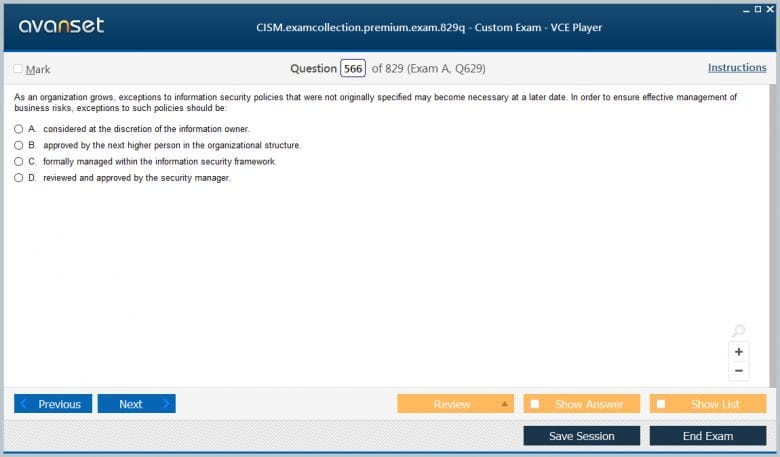
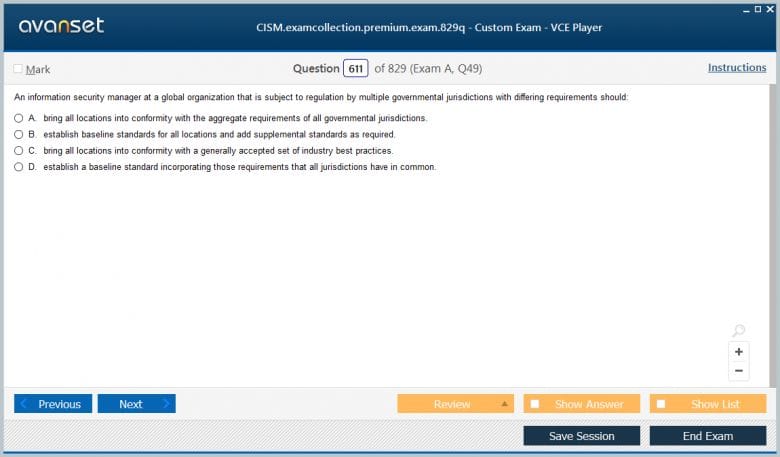
CISM Product Reviews
Download Free CISM Practice Test Questions VCE Files
| Exam | Title | Files |
|---|---|---|
Exam CISM |
Title Certified Information Security Manager |
Files 28 |
Isaca CISM Certification Exam Dumps & Practice Test Questions
Prepare with top-notch Isaca CISM certification practice test questions and answers, vce exam dumps, study guide, video training course from ExamCollection. All Isaca CISM certification exam dumps & practice test questions and answers are uploaded by users who have passed the exam themselves and formatted them into vce file format.
CISM in 2026: Security Leadership Between Today's Exam and the November Update
The Certified Information Security Manager credential is built for professionals responsible for turning security from a collection of technical controls into a managed enterprise program. The current CISM exam contains 150 questions across Information Security Governance, Information Security Risk Management, Information Security Program, and Incident Management. Those four domains remain the organizing structure of the certification, but candidates preparing in late 2026 need to pay attention to timing: ISACA will introduce an updated CISM exam content outline on November 3, 2026.
CISM sits within the broader ISACA certifications and is deliberately management-oriented. It is less concerned with whether a candidate can configure a particular firewall than whether the candidate can establish strategy, secure executive support, manage risk, build an effective security program, coordinate resources, and guide the organization through incidents. That professional perspective is the key to both the current and updated exam.
The November 2026 update changes emphasis, not the identity of CISM
ISACA has confirmed that the four domains will remain, but the weighting will change slightly from the current distribution to 18 percent governance, 20 percent risk management, 33 percent information security program, and 29 percent incident management. The update also adds stronger emphasis on enterprise architecture and information security architecture, reflecting the reality that security managers need to understand the technology landscape they are governing.
This creates a practical study decision. The revised outline becomes effective November 3, 2026. Candidates testing before that date should prepare to the current exam outline; candidates testing on or after November 3 should use the updated preparation material ISACA released in September. Mixing old and new percentages is less useful than understanding which blueprint applies to the scheduled test date.
Governance turns security priorities into enterprise decisions
Security governance is about authority, accountability, alignment, and oversight. A security strategy should support business objectives rather than exist as a technical wish list. Candidates should understand organizational structures, regulatory and contractual requirements, culture, roles, policies, standards, business cases, budgets, metrics, and the mechanisms through which senior leadership and boards receive security information.
A recurring CISM principle is that security leaders influence risk decisions but do not own every business risk. Business owners and senior management ultimately decide whether risk is accepted, transferred, avoided, or mitigated within the organization's governance structure. The security manager's job is to make the exposure understandable and to ensure decision-makers have reliable information.
Strategic security leadership helps explain why CISM questions often favor answers that align security with enterprise priorities rather than answers that simply deploy the strongest technical control.
Risk management connects threat information to business impact
CISM candidates should be able to distinguish threats, vulnerabilities, assets, likelihood, impact, inherent risk, residual risk, risk appetite, and risk tolerance. More importantly, they should understand how these concepts support decisions. A vulnerability is not automatically the highest priority because its severity score is large. The surrounding asset value, exposure, compensating controls, exploitability, dependencies, and business consequences all matter.
Risk treatment also requires ownership. Security may recommend a control, but the cost, operational impact, residual exposure, and business objective need to be considered. This is why CRISC is a natural adjacent credential: CRISC goes deeper into enterprise IT risk identification, assessment, response, controls, metrics, and reporting, while CISM places risk management inside the broader responsibility of leading a security program.
A security program is more than a portfolio of tools
The Information Security Program domain is the largest area of the current CISM exam. Candidates need to understand how strategy becomes policy, standards, processes, architecture, controls, awareness, third-party oversight, resources, testing, metrics, reporting, and continuous improvement. A program has to be sustainable, measurable, and integrated with the organization.
Asset classification illustrates the management perspective. The goal is not merely to label data. Classification should influence handling requirements, access, retention, encryption, monitoring, sharing, and disposal. If labels do not drive decisions, the program creates administration without reducing risk.
Metrics deserve similar scrutiny. Counting blocked attacks or completed training sessions may be easy, but management needs measures that show exposure, control effectiveness, trend, and business significance. Strong metrics help leaders decide where to invest and whether risk is moving in the desired direction.
Architecture is becoming more explicit in CISM
The November 2026 update gives enterprise and information security architecture more visibility. This is a logical evolution. Security managers do not need to design every network segment or application component, but they do need enough architectural understanding to see dependencies, concentration risk, trust boundaries, identity flows, data movement, cloud responsibility, and the consequences of major technology decisions.
This does not turn CISM into CISSP. CISSP remains broader and more technical across architecture, networks, identity, software security, operations, assessment, assets, and risk. CISM continues to ask what a manager should govern, prioritize, resource, communicate, and improve.
Incident management starts long before the incident
CISM treats incident management as a program responsibility rather than a purely technical response activity. Preparation includes plans, roles, communication paths, business impact analysis, continuity and recovery arrangements, classification criteria, exercises, training, external contacts, and decision authority. Organizations that improvise these elements during a crisis lose time when time matters most.
During an incident, the security manager must coordinate investigation, containment, communication, recovery, escalation, and business decision-making. Technical responders may determine how an intrusion occurred, but management must also consider legal notification, customer impact, regulatory obligations, operational continuity, public communication, and executive reporting.
The incident-response program lifecycle is therefore valuable context for CISM candidates. The exam frequently rewards preparedness and clear governance rather than heroic technical improvisation.
An incident is not finished when systems are restored. CISM expects organizations to learn from events. Root-cause analysis, lessons learned, corrective actions, risk reassessment, control improvement, and updates to plans or training are part of mature incident management. Without that loop, the organization can repeatedly experience variations of the same failure.
Security leaders should also distinguish the immediate cause from deeper contributing conditions. A phishing email may trigger an incident, but excessive privilege, weak segmentation, incomplete monitoring, or poor recovery capability may determine the scale of damage. Management-level analysis looks beyond the first technical event.
CISM, CISA, and AAISM represent different stages of responsibility
CISA approaches technology from an audit and assurance perspective. CISM approaches it from the position of the leader responsible for the security program. AAISM then extends experienced security management into AI-specific governance, risk, technologies, and controls; active CISM holders are directly eligible for that advanced path.
This progression is useful for understanding CISM itself. The exam expects candidates to think like accountable managers, not independent auditors and not frontline specialists. When an answer choice describes implementing a technical fix personally while another describes establishing the right ownership, process, and risk-based response, the management-oriented option is often closer to the CISM role.
How to prepare during the 2026 transition window
Start with the exam date. If it falls before November 3, use the current outline and current question weighting. If it falls on or after November 3, use the revised 2026 materials. Then build study around decisions rather than definitions. For each domain, create scenarios that force tradeoffs involving business priorities, regulation, limited resources, risk appetite, third parties, architecture, and incident pressure.
Practice asking what the security manager should do first. Sequence is critical. Strategy precedes technology selection. Risk assessment precedes treatment. Requirements precede control design. Preparation precedes response. Evidence precedes executive conclusions. Root-cause analysis precedes durable corrective action.
The lasting value of CISM is that it forces technical professionals to widen their field of view. Enterprise security succeeds through governance, risk decisions, people, architecture, policy, investment, operations, communication, and continuous improvement. A technically elegant control can still fail if it is unsupported, poorly owned, badly communicated, or misaligned with the business.
Enterprise-level security leadership depends on turning security knowledge into repeatable governance and decisions. Candidates who prepare from that perspective will be well positioned for both the current exam and the November update. The details evolve, but the managerial question remains stable: how should an experienced security leader organize people, decisions, controls, and resources so the enterprise can pursue its objectives with risk understood and managed?
Third-party security has to be managed as part of the program
Security programs increasingly depend on cloud providers, managed security services, software suppliers, data processors, and specialized technology partners. CISM candidates should therefore treat third-party security as a lifecycle responsibility: due diligence before selection, contractual requirements, onboarding, access control, continuous monitoring, performance review, incident coordination, change management, and secure termination.
Outsourcing a service does not outsource accountability. Management still needs to know which risks remain with the enterprise, what evidence demonstrates provider performance, and how quickly the organization can respond if a supplier suffers an incident. Concentration risk matters as well; multiple critical processes relying on the same provider can turn one supplier outage into an enterprise event.
This program-level view reinforces why CISM is not primarily a technical certification. The manager must create repeatable governance that works across internal teams and external dependencies, then communicate residual exposure to leaders in business terms.
Security culture is a management outcome. Policies and awareness are necessary, but culture is revealed by decisions: whether leaders fund remediation, whether teams report mistakes, whether exceptions are challenged, and whether business owners accept responsibility for risk. CISM candidates should view culture as something influenced by incentives, accountability, communication, and leadership behavior rather than by training campaigns alone.
The updated exam's stronger architecture emphasis does not change this human reality. Programs succeed when responsibilities are understood and security objectives are integrated into ordinary business decisions, not when security operates as a separate technical department that appears only during audits or incidents.
ExamCollection provides the complete prep materials in vce files format which include Isaca CISM certification exam dumps, practice test questions and answers, video training course and study guide which help the exam candidates to pass the exams quickly. Fast updates to Isaca CISM certification exam dumps, practice test questions and accurate answers vce verified by industry experts are taken from the latest pool of questions.

Isaca CISM Video Courses

Top Isaca Certifications


Top Isaca Certification Exams
Site Search: