



Premium File
1228 Q&A
$76.99$69.99
Isaca CISM Exam Questions & Answers, Accurate & Verified By IT Experts
Instant Download, Free Fast Updates, 99.6% Pass Rate

CISM Premium File: 1228 Questions & Answers
Last Update: Sep 15, 2026
CISM Training Course: 388 Video Lectures
CISM PDF Study Guide: 817 Pages
$79.99
Isaca CISM Exam Screenshots
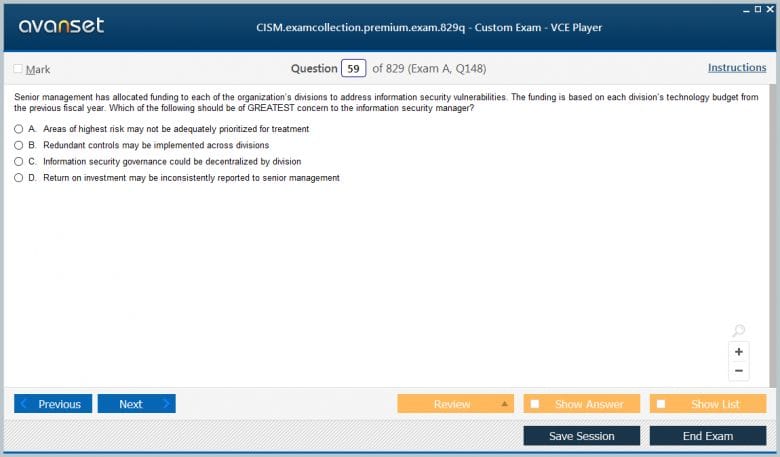
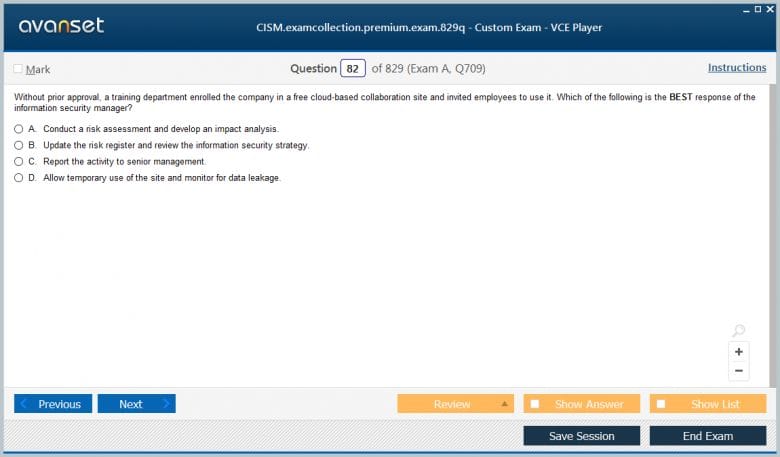
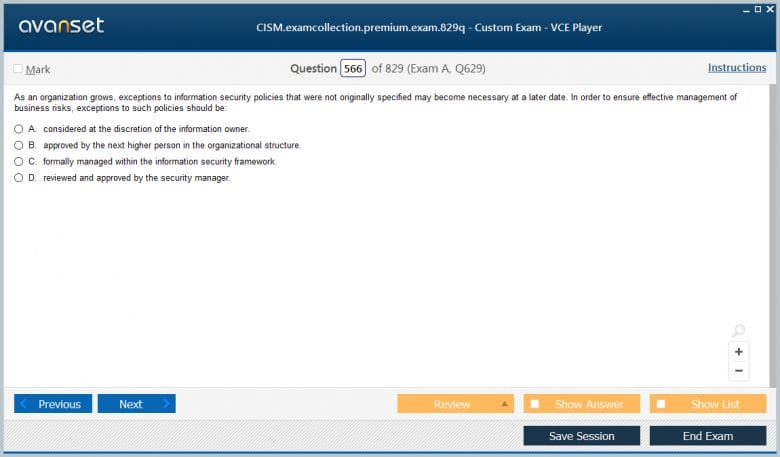
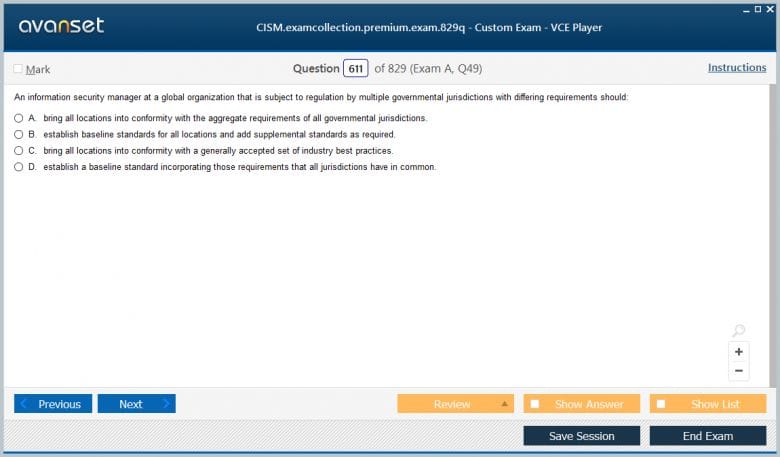
Isaca CISM Practice Test Questions in VCE Format
Archived VCE files
| File | Votes | Size | Date |
|---|---|---|---|
File ISACA.Certkey.CISM.v2011-06-10.by.steffy.305q.vce |
Votes 3 |
Size 308.29 KB |
Date Jun 13, 2011 |
File ISACA.ActualTests.CISM.v2009-11-30.300q.vce |
Votes 1 |
Size 316.94 KB |
Date Jan 06, 2010 |
Isaca CISM Practice Test Questions, Exam Dumps
Isaca CISM (Certified Information Security Manager) exam dumps vce, practice test questions, study guide & video training course to study and pass quickly and easily. Isaca CISM Certified Information Security Manager exam dumps & practice test questions and answers. You need avanset vce exam simulator in order to study the Isaca CISM certification exam dumps & Isaca CISM practice test questions in vce format.
Certified Information Security Manager (CISM) is ISACA’s management-focused security certification, covering governance, risk, security-program management, and incident management in a 150-question exam. There is an important 2026 transition: as of 2 October 2026, the live outline still weights the four domains at 17%, 20%, 33%, and 30%. ISACA has announced a revised exam effective 3 November 2026 with weights of 18%, 20%, 33%, and 29%, plus greater emphasis on enterprise architecture and information-security architecture.
Candidates should therefore study for the exam date they will actually sit. The domain names remain the same, so the transition is not a complete redesign, but someone testing on or after 3 November should use the updated preparation materials. CISM certification also requires a minimum of five years of professional information-security management experience within the CISM job-practice areas, gained within the ten years before application, and candidates have five years after passing to apply.
Governance establishes why the security program exists, who is accountable, what risk the enterprise is willing to accept, and how security supports business objectives. A CISM candidate should think in terms of strategy, policy, roles, decision rights, legal and contractual obligations, culture, resources, and communication. Technical controls matter, but they should follow direction rather than become the strategy by themselves.
A strong security strategy connects enterprise goals to current-state assessment, target capabilities, priorities, budgets, metrics, and a roadmap. It also identifies constraints such as regulation, architecture, legacy technology, acquisitions, outsourcing, or scarce skills. The current COBIT 2019 framework can provide broader governance context, while CISM focuses on how security leadership operates within that enterprise system.
Security governance also has to define exception and risk-acceptance authority. Standards inevitably encounter business cases that cannot comply immediately, but informal exceptions can create invisible residual risk. A mature process records the requirement being waived, business justification, affected assets, compensating controls, owner, approval level, expiration date, and review condition. That gives leadership a portfolio view of accepted exposure and prevents temporary deviations from turning into undocumented permanent architecture. CISM scenarios often reward this governance discipline over an immediate technical workaround.
CISM expects candidates to understand threats, vulnerabilities, assets, likelihood, impact, control deficiencies, risk appetite, treatment, ownership, and monitoring. The important management skill is prioritization. A security team can find thousands of technical weaknesses; leadership must determine which exposures threaten objectives and allocate resources accordingly. Risk analysis should support decisions rather than produce a register that is updated only before audits.
Risk treatment may involve mitigation, avoidance, transfer, acceptance, or changes to business activity. Residual risk should have an accountable owner with authority to accept it. This distinction is important in exam scenarios: the security manager can recommend controls and communicate exposure, but business or risk owners often make the final acceptance decision. CRISC is the deeper ISACA path for enterprise IT risk, while CISM integrates risk into security-program leadership.
Program development includes policies, standards, architectures, control objectives, resources, roles, training, metrics, and an implementation roadmap. The program should be proportionate to business risk and integrated with enterprise architecture, IT operations, development, procurement, privacy, legal, and continuity. The 2026 CISM update makes architecture even more explicit, reflecting the need for managers to understand how technology choices affect security strategy.
Program management then keeps those capabilities operating. Controls need owners, budgets, testing, maintenance, exception handling, and performance measures. Security awareness must reflect real roles and threats rather than annual generic training. External services require ongoing oversight. A mature program can explain which controls exist, why they exist, how effectiveness is measured, and which risks remain unresolved.
Third-party and supply-chain security belong in the program because critical services increasingly depend on cloud platforms, software suppliers, outsourcers, contractors, and managed security providers. Governance should establish due-diligence criteria, contract requirements, minimum control expectations, monitoring, incident notification, and exit arrangements. Management then needs a way to distinguish a vendor questionnaire from real assurance and to escalate concentration or dependency risks that cannot be fixed through a single technical control.
Enterprise architecture describes how business capabilities, information, applications, and technology fit together; security architecture defines trust boundaries, identity patterns, protection mechanisms, monitoring, resilience, and security services that support that environment. A manager does not need to configure every firewall, but must be able to evaluate whether architecture decisions support the security strategy and whether exceptions create material risk.
The upcoming November 2026 outline specifically adds greater emphasis on enterprise and information-security architecture. Candidates testing after the transition should be comfortable connecting architecture principles to cloud adoption, identity, data protection, segmentation, third parties, resilience, and emerging technologies. The correct managerial response is often to establish design requirements and governance before selecting a product.
Security programs can produce enormous quantities of operational data: vulnerabilities, alerts, incidents, patch rates, phishing results, control tests, audit findings, and tool coverage. CISM candidates need to distinguish activity metrics from decision metrics. The number of blocked attacks may say little about risk if asset criticality and trend are unknown. Useful reporting connects performance to objectives, thresholds, risk, cost, and corrective action.
Metrics should also reveal whether the program is improving. Time to remediate critical exposure, repeated control failures, unresolved exceptions, detection coverage for priority threats, recovery performance, vendor risk, and risk acceptance trends can be more useful than raw event counts. Reporting should be tailored: operational teams need detail, executives need trends and decisions, and boards need strategic exposure and accountability.
Culture and awareness should also be measured as risk treatment rather than as a count of completed training modules. Different populations face different threats: developers need secure engineering practices, finance staff may face payment fraud, administrators need privileged-access discipline, and executives may be targeted for social engineering. Effective programs combine education with usable processes, simulations where appropriate, reporting channels, leadership behavior, and feedback from real incidents. Completion rates alone do not show whether risky behavior changed.
Incident readiness includes plans, roles, escalation, communication, business impact analysis, continuity, disaster recovery, training, exercises, and relationships with legal, privacy, HR, communications, regulators, insurers, and external responders. A plan that has never been tested may fail during a real event because contact paths, authority, evidence handling, or recovery assumptions are wrong. Managers should use exercises to expose those weaknesses before pressure is high.
During an incident, leadership balances containment, investigation, continuity, legal obligations, and stakeholder communication. The approved incident-response program discussion adds operational depth, while CISM emphasizes governance of the response. Afterward, root-cause analysis and lessons learned should drive changes to controls, architecture, monitoring, training, and risk assessments rather than closing the case once systems are restored.
Business continuity and incident management intersect when cyber events disrupt critical services. Security leaders need to know recovery priorities, dependencies, manual workarounds, backup assumptions, communication responsibilities, and when a cyber incident should activate broader crisis management. Ransomware, destructive attacks, identity compromise, or cloud outages can challenge both security containment and operational recovery. Plans should therefore be exercised with business and technology stakeholders instead of being tested only inside the security team.
Exam questions may mention malware, encryption, cloud, identity, logs, vulnerabilities, or network architecture, but the candidate should ask what responsibility belongs to the security manager. The best answer may be to assess risk, establish policy, define requirements, obtain stakeholder approval, or ensure a process exists before directing a technical action. Jumping immediately to a specific tool can be wrong when the underlying problem is governance or ownership.
This distinction also separates CISM from the more operational CCOA. Analysts may investigate alerts and preserve evidence; CISM-level leaders ensure the organization has a funded, governed, tested capability and that incidents are escalated and communicated appropriately. Both perspectives are valuable, but they solve different layers of the problem.
Post-incident learning closes the loop back into governance and program management. Root-cause analysis, control gaps, detection delays, decision bottlenecks, vendor issues, and communication failures should produce tracked improvements with owners and deadlines. Lessons should also influence risk scenarios, metrics, architecture standards, training, and investment priorities. A program that restores service but does not change after recurring incidents may be operationally active while still being poorly governed.
Anyone sitting before 3 November 2026 should prepare against the currently active 17/20/33/30 outline. Anyone testing on or after 3 November should use the updated 18/20/33/29 materials and pay special attention to the added architecture emphasis. The four domain names do not change, so most core knowledge remains relevant, but relying on an older review manual after the transition can leave gaps in emphasis and examples.
CISM exam preparation, AAISM for experienced AI-security leaders, and other ISACA security certifications can help place the credential in context. For exam decisions, however, candidates should use ISACA’s live content outline and transition notice because the effective date is more important than the date printed on a third-party study page.
Go to testing centre with ease on our mind when you use Isaca CISM vce exam dumps, practice test questions and answers. Isaca CISM Certified Information Security Manager certification practice test questions and answers, study guide, exam dumps and video training course in vce format to help you study with ease. Prepare with confidence and study using Isaca CISM exam dumps & practice test questions and answers vce from ExamCollection.
Purchase Individually


Isaca CISM Video Course

Top Isaca Certifications


Top Isaca Certification Exams
Site Search:

SPECIAL OFFER: GET 10% OFF

Pass your Exam with ExamCollection's PREMIUM files!
SPECIAL OFFER: GET 10% OFF
Use Discount Code:
MIN10OFF
A confirmation link was sent to your e-mail.
Please check your mailbox for a message from support@examcollection.com and follow the directions.

Download Free Demo of VCE Exam Simulator
Experience Avanset VCE Exam Simulator for yourself.
Simply submit your e-mail address below to get started with our interactive software demo of your free trial.
Is the premium is valid dump?
Valid, passed with premium 1519Q
@Riveria, was it the premium file you used to pass the exam please?
Can anyone confirm the latest dumps are good?
You really need to study and understand the concepts else gonna end with fail. Done exam today and the it's enough tough and mainly tricky
Any Successes recently?
can someone who has recently passed CISM please confirm that the premium file is valid and it was what they used?
Hey guy, Are these dumps valid?
Are these dumps valid....Anyone who has passed most recently, can you comment please....
Hello I am interested in CIMA questions and answers. kindly let me know how to get good preparation materials
I passed the exam using cism premium VCE file and earned CISM certification. just waiting to showcase my wide array of skills as a certified information security manager in the IT field.
@Kaylee, I used cism vce file provided on the website. It’s valid. just study before the exam and you’ll succeed.
Guys, I am taking my exam tomorrow. I need good questions and answers for CISM exam which I can go through them as quick as possible while am waiting for the exam. Anybody can assist!
I completed my exam last month. I performed extraordinarily well. I am now isaca cism certified. Thank you guys for offering excellent premium files for CISM cert exam.
@bentesh, I am going to sit my CISM exam very soon. Did you get reliable cism practice exam?
Hi good people, I need of your assistance! I sat my cism exam two weeks ago and I failed. Any individual with valid cism questions and answers. please! kindly share.
I think CISM practice test is not valid because even after using it I ended up failing. None of the exam questions was in the dump.
I passed my exam last week. cism questions contained in the practice tests have the capability to help you emerge victorious in CISM exam. Utilize them to avoid failure.
@hazard, …use the files you find on this website. Cism cert exam is very easy with the help CISM premium file.
I very excited that I qualified to become a certified information security manager. CISM dumps really played a crucial role in my success! Thank you for the dumps!
cism practice questions have assisted me so much in the preparation for the actual exam. i used them to test myself whether am fully prepared to conquer the long awaited exam. they helped me to improve the areas which I felt they needed more attention.
+Hey guys, I urgently need cism exam dumps.
Is used these cism exam questions to prepare for the certification exam. i was astonished to find that they resembled those I encountered in the real exam. They helped me pass the cert exam! Very happy and satisfied. recommend!