



Premium File
700 Q&A
$76.99$69.99
Isaca CGEIT Exam Questions & Answers, Accurate & Verified By IT Experts
Instant Download, Free Fast Updates, 99.6% Pass Rate
700 Questions & Answers
Last Update: Oct 29, 2026
$69.99
Isaca CGEIT Exam Screenshots
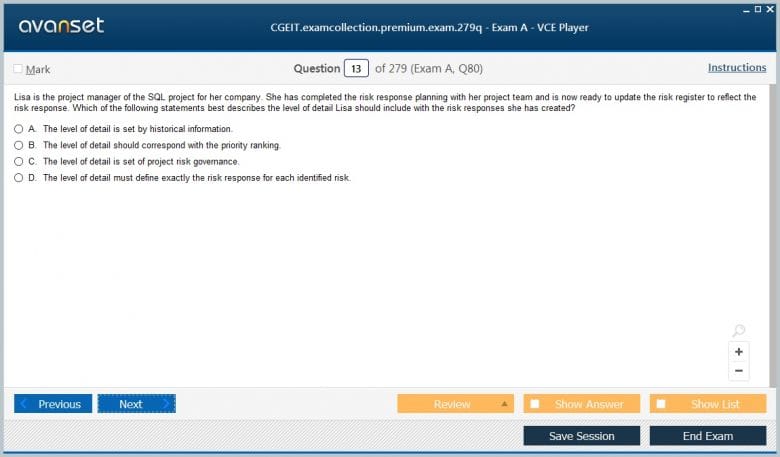
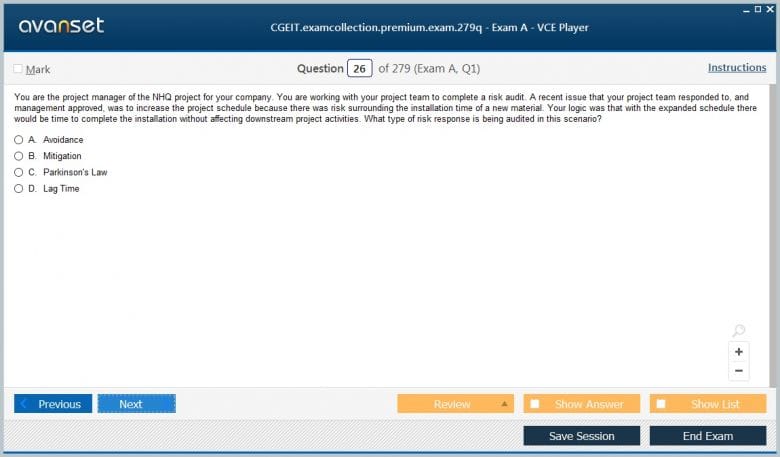
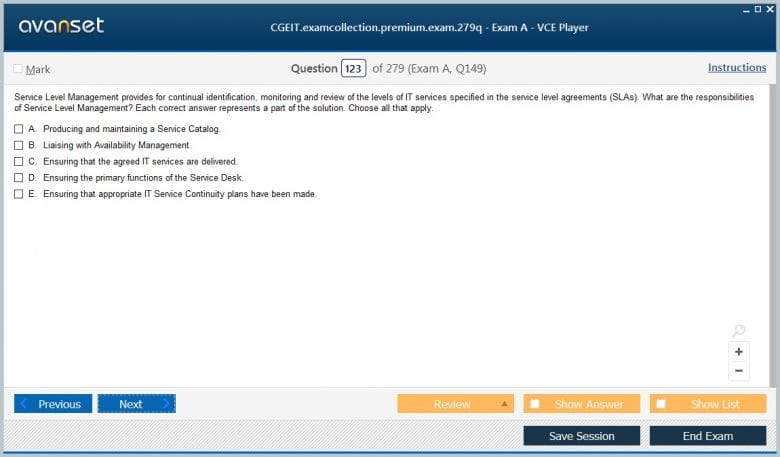
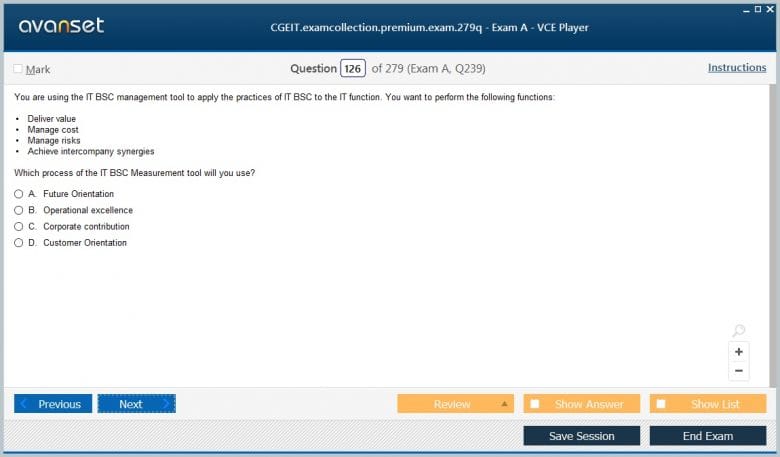
Isaca CGEIT Practice Test Questions in VCE Format
| File | Votes | Size | Date |
|---|---|---|---|
File Isaca.examdumps.CGEIT.v2026-08-30.by.thed.279q.vce |
Votes 1 |
Size 309.11 KB |
Date Aug 30, 2026 |
File Isaca.pass4sures.CGEIT.v2021-11-05.by.jayden.268q.vce |
Votes 1 |
Size 299.72 KB |
Date Nov 05, 2021 |
File Isaca.test-inside.CGEIT.v2021-10-05.by.stanley.241q.vce |
Votes 1 |
Size 273.34 KB |
Date Oct 05, 2021 |
File Isaca.examquestions.CGEIT.v2021-07-20.by.hunter.215q.vce |
Votes 1 |
Size 241.2 KB |
Date Jul 20, 2021 |
File Isaca.pass4sures.CGEIT.v2021-04-27.by.david.188q.vce |
Votes 1 |
Size 212.14 KB |
Date Apr 28, 2021 |
Isaca CGEIT Practice Test Questions, Exam Dumps
Isaca CGEIT (Certified in the Governance of Enterprise IT) exam dumps vce, practice test questions, study guide & video training course to study and pass quickly and easily. Isaca CGEIT Certified in the Governance of Enterprise IT exam dumps & practice test questions and answers. You need avanset vce exam simulator in order to study the Isaca CGEIT certification exam dumps & Isaca CGEIT practice test questions in vce format.
Certified in the Governance of Enterprise IT (CGEIT) is ISACA’s current senior-level governance certification. The exam contains 150 questions across four domains: Governance of Enterprise IT (40%), IT Resources (15%), Benefits Realization (26%), and Risk Optimization (19%). The credential is aimed at professionals who manage, advise on, oversee, or otherwise support the governance of technology’s contribution to the enterprise rather than specialists responsible for one product or control.
Certification requires experience as well as exam success. ISACA currently requires at least five years of governance-related work across at least three of the four domains, including a minimum of one year related to the Governance of Enterprise IT domain. That requirement explains the exam’s perspective: candidates are expected to reason from enterprise objectives, stakeholder needs, decision rights, investment, performance, and risk—not simply from what is technically possible.
Governance evaluates stakeholder needs, sets direction, and monitors whether objectives are achieved. Management plans, builds, runs, and monitors activities within that direction. In practice, the boundary can blur because executives and technology leaders participate in both, but the distinction matters for accountability. A governing body should not need to approve routine server changes, while management should not unilaterally redefine enterprise risk appetite or strategic investment priorities.
CGEIT candidates should be able to identify where a decision belongs and what information the decision-maker needs. A governance forum may need evidence about strategic alignment, value delivery, risk, resources, compliance, and performance. Management teams then translate those expectations into portfolios, architectures, budgets, services, policies, projects, and operational measures.
Decision rights make that distinction visible. Boards and governing bodies may set direction, approve risk appetite, challenge major investment assumptions, and monitor outcomes; executives translate that direction into priorities; management teams operate processes and services. Committees are useful only when their authority, escalation paths, information requirements, and relationship to accountable executives are clear. Adding another committee without clarifying who can decide can increase delay while leaving accountability unchanged.
Frameworks create common language, processes, roles, and measurement structures, but governance cannot be copied unchanged from another organization. Industry, regulation, size, sourcing, risk appetite, operating model, technology dependence, culture, and strategy all affect the right design. The current COBIT 2019 Foundation material is especially relevant because COBIT formalizes governance systems, components, objectives, design factors, and performance management.
The value of a framework appears when it improves decisions. If governance adds meetings and templates without clarifying ownership, priorities, or evidence, the organization has created bureaucracy rather than control. Candidates should therefore judge mechanisms by whether they help the enterprise select investments, resolve conflicts, manage risk, allocate resources, and monitor outcomes.
Architecture translates business capability needs into principles, standards, platforms, information structures, integration patterns, and roadmaps. Governance uses architecture to prevent local decisions from creating long-term fragmentation or risk. A project can meet its immediate delivery target while increasing technical debt, duplicating data, weakening security, or locking the organization into an unsustainable platform. Governance should make those trade-offs visible before approval.
Architecture governance also needs room for exceptions. Standards should guide decisions, but an enterprise may need to deviate for regulatory, acquisition, legacy, innovation, or market reasons. A mature process documents the rationale, owner, risk, compensating controls, review date, and exit plan rather than pretending every system can conform immediately.
Architecture governance becomes especially important when enterprises modernize through cloud platforms, acquisitions, product teams, or extensive SaaS adoption. Local teams can make individually rational choices that collectively increase integration cost, data duplication, identity complexity, and supplier dependency. Governance does not require one technology for every need; it requires principles and exception mechanisms that make trade-offs visible. Architecture decisions should record why an exception is justified, who accepts the resulting risk or cost, and when the decision will be reviewed so temporary compromises do not become permanent by default.
IT resources are broader than budget. The enterprise depends on skilled people, reliable information, applications, infrastructure, external services, intellectual property, and vendor relationships. Governance must ensure these resources are available, protected, and used in a way that supports strategy. Capacity constraints can derail value even when funding exists—for example, when critical skills are concentrated in one team or a transformation depends on an overstretched platform.
Sourcing decisions require attention to concentration and exit risk. A managed service or cloud provider can improve capability, but it can also create dependency, data-location issues, contractual constraints, or recovery complexity. Governance should require enough transparency to understand performance and risk without attempting to micromanage the provider’s internal operations.
Information deserves the same governance attention as technology assets because poor data can undermine strategy even when platforms are reliable. Enterprises need ownership for critical data, standards for quality and classification, lifecycle rules, and mechanisms for resolving conflicting definitions. Governance also has to consider knowledge concentration: a technically sound service can still be fragile if only one employee understands the architecture, one supplier controls a critical component, or key operational knowledge is undocumented.
Projects do not create value merely by delivering scope on time. Benefits may depend on adoption, process change, data quality, customer behavior, training, operating-model changes, or retirement of old systems. Governance should require a clear business case, benefit owner, baseline, target, measurement method, and review schedule. If no one owns the benefit after delivery, the organization may celebrate completion without knowing whether the investment actually improved performance.
Portfolio governance compares investments rather than evaluating each proposal in isolation. Leaders need to consider strategic fit, expected value, risk, dependencies, capacity, mandatory work, technical debt, and opportunity cost. A high-return project can still be the wrong choice if it consumes resources needed for regulatory obligations or critical resilience work.
Portfolio governance helps prevent local project success from obscuring enterprise failure. Investments compete for funding, scarce specialists, change capacity, and management attention. A portfolio view can expose duplicated capabilities, initiatives whose dependencies make their schedules unrealistic, projects that no longer support strategy, or benefits that are being counted more than once. Governance should create explicit mechanisms to stop, reshape, defer, or accelerate investments when evidence changes rather than treating initial approval as a permanent commitment.
Metrics should help stakeholders understand whether governance objectives are being achieved. Key goal indicators, performance indicators, risk indicators, financial measures, service measures, benefit measures, and maturity or capability assessments can all be useful. The challenge is selecting a small enough set that trends, exceptions, and trade-offs are visible. Large dashboards can obscure important signals if every metric is treated as equally significant.
Good reporting also explains causality and uncertainty. A service-level breach may come from demand growth, supplier failure, technical debt, or an unrealistic target. A declining project metric may be a temporary investment to reduce long-term risk. Governance discussions should interpret measures in context and decide whether direction, resources, risk treatment, or expectations need to change.
Assurance gives decision-makers confidence that reported conditions are real. Internal audit, risk functions, compliance teams, external assurance providers, security testing, and management self-assessment can all contribute, but their independence and scope differ. Governance should understand what each assurance source covers, how recent it is, what limitations remain, and whether important risks fall between functions. The goal is coordinated confidence, not a larger collection of dashboards and reports.
Governance needs a consistent view of technology-related risk: cyber threats, privacy, availability, third parties, projects, data, compliance, skills, obsolescence, and strategic dependency. Risk appetite and tolerance help management decide which exposures require treatment or escalation. The objective is not zero risk; it is informed risk-taking that supports enterprise goals without exceeding acceptable boundaries.
This is where CRISC provides a complementary risk-management perspective, while CGEIT remains focused on governance-level decisions. The governing body needs aggregated information about major scenarios, concentrations, trends, accepted residual risk, and whether management actions are effective. It should not have to interpret every vulnerability scan or control test.
Risk appetite becomes useful when it changes decisions. Broad statements such as having a low appetite for cyber risk are difficult to operationalize unless leaders translate them into tolerances, escalation triggers, investment criteria, and authority for accepting residual exposure. Governance should also recognize upside risk: taking no technology risk can prevent innovation and value creation. The objective is informed risk-taking aligned with enterprise priorities, not the elimination of uncertainty.
Candidates should practice situations where several answers are technically reasonable but only one reflects governance responsibility. Ask who is accountable, what stakeholder outcome matters, what evidence should be reviewed, and whether the proposed action belongs to governance or management. The COBIT Design & Implementation path can deepen the mechanics of tailoring a governance system, but CGEIT tests broader judgment across strategy, resources, benefits, and risk.
Because CGEIT is experience-based, study should connect the outline to real decisions: business cases, portfolio reviews, architecture exceptions, outsourcing, performance dashboards, risk acceptance, and benefit tracking. Candidates who merely memorize framework terms can struggle when the exam asks what an enterprise should do first or which stakeholder should own an outcome. The strongest preparation repeatedly translates governance principles into decision rights and evidence.
Go to testing centre with ease on our mind when you use Isaca CGEIT vce exam dumps, practice test questions and answers. Isaca CGEIT Certified in the Governance of Enterprise IT certification practice test questions and answers, study guide, exam dumps and video training course in vce format to help you study with ease. Prepare with confidence and study using Isaca CGEIT exam dumps & practice test questions and answers vce from ExamCollection.
Purchase Individually
Top Isaca Certifications




Top Isaca Certification Exams
Site Search:

SPECIAL OFFER: GET 10% OFF

Pass your Exam with ExamCollection's PREMIUM files!
SPECIAL OFFER: GET 10% OFF
Use Discount Code:
MIN10OFF
A confirmation link was sent to your e-mail.
Please check your mailbox for a message from support@examcollection.com and follow the directions.

Download Free Demo of VCE Exam Simulator
Experience Avanset VCE Exam Simulator for yourself.
Simply submit your e-mail address below to get started with our interactive software demo of your free trial.