



Premium File
190 Q&A
$76.99$69.99
Isaca COBIT 5 Exam Questions & Answers, Accurate & Verified By IT Experts
Instant Download, Free Fast Updates, 99.6% Pass Rate

COBIT 5 Premium File: 190 Questions & Answers
Last Update: Sep 11, 2026
COBIT 5 Training Course: 8 Video Lectures
$74.99
Isaca COBIT 5 Exam Screenshots
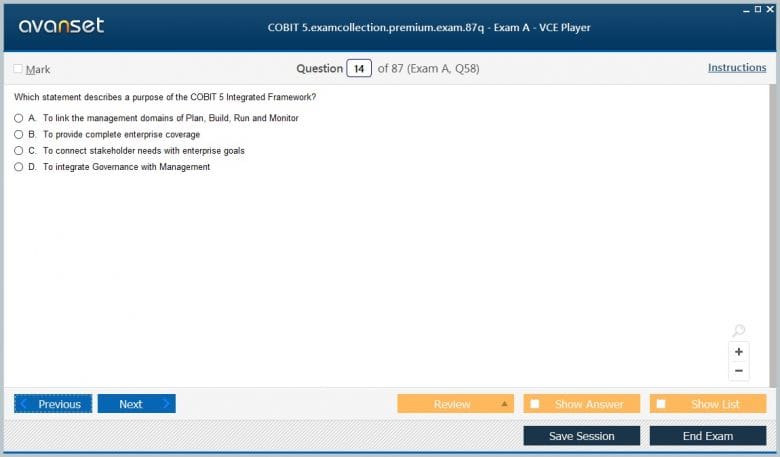
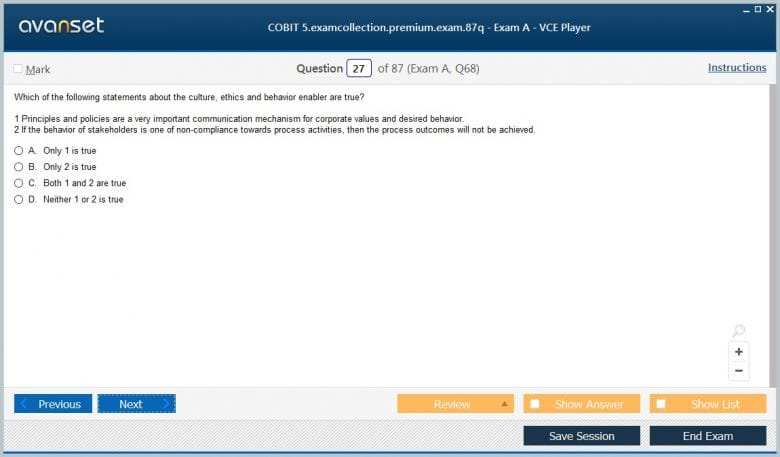
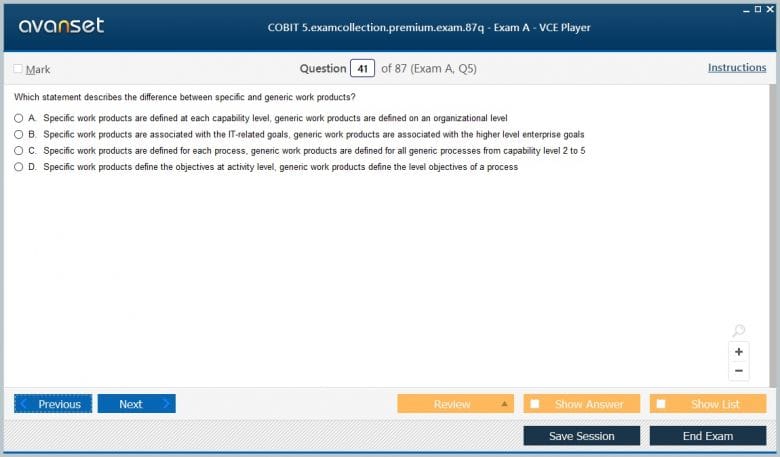
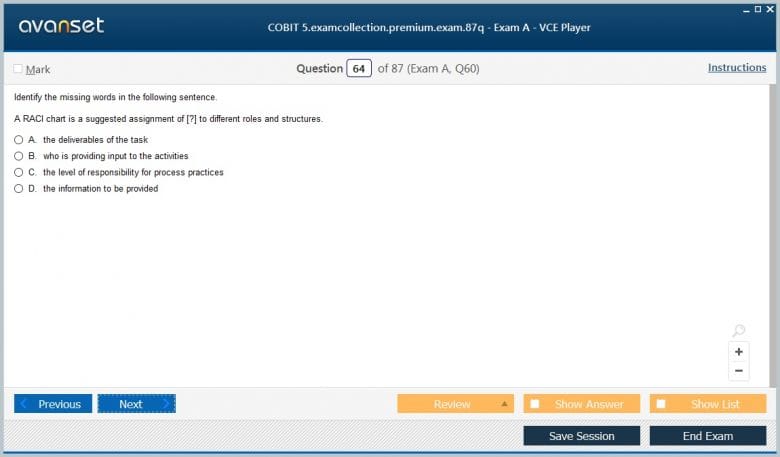
Isaca COBIT 5 Practice Test Questions in VCE Format
| File | Votes | Size | Date |
|---|---|---|---|
File Isaca.realtests.COBIT 5.v2026-08-20.by.aleksandr.88q.vce |
Votes 1 |
Size 96.18 KB |
Date Aug 22, 2026 |
File Isaca.questionspaper.COBIT 5.v2020-10-08.by.holly.67q.vce |
Votes 2 |
Size 74.21 KB |
Date Oct 08, 2020 |
File Isaca.Braindumps.COBIT 5.v2015-03-30.by.Adelia.50q.vce |
Votes 5 |
Size 57.15 KB |
Date Mar 30, 2015 |
File Isaca.Actualtests.COBIT 5.v2014-12-29.by.Gresham.46q.vce |
Votes 21 |
Size 102.6 KB |
Date Dec 29, 2014 |
Isaca COBIT 5 Practice Test Questions, Exam Dumps
Isaca COBIT 5 (A Business Framework for the Governance and Management of Enterprise IT) exam dumps vce, practice test questions, study guide & video training course to study and pass quickly and easily. Isaca COBIT 5 A Business Framework for the Governance and Management of Enterprise IT exam dumps & practice test questions and answers. You need avanset vce exam simulator in order to study the Isaca COBIT 5 certification exam dumps & Isaca COBIT 5 practice test questions in vce format.
COBIT 5 is the predecessor framework to COBIT 2019 and remains important for professionals working with older governance programs, historical training, legacy assessments, or organizations that have not fully transitioned. ISACA still maintains a page describing COBIT 5 Foundation, Implementation, and Assessor certificates and points learners toward accredited training partners. At the same time, ISACA’s current foundation and design programs are built around COBIT 2019, so candidates should distinguish historical COBIT 5 material from the current framework.
COBIT 5 was released in 2012 and brought governance and management guidance into one integrated framework. Many of its ideas remain recognizable today: stakeholder value, end-to-end enterprise coverage, integrated frameworks, a holistic approach, and separation of governance from management. COBIT 2019 builds on that foundation but changes terminology and structure, expands the core model, introduces explicit design factors, and updates performance management.
COBIT 5 described five principles: meeting stakeholder needs, covering the enterprise end to end, applying a single integrated framework, enabling a holistic approach, and separating governance from management. These principles helped shift technology governance away from isolated IT controls toward enterprise value, accountability, and integrated decision-making. They remain useful historical context because many organizations built policies and governance processes around this vocabulary.
COBIT 2019 changes the principle model rather than rejecting the earlier logic. The newer framework separates governance-system principles from governance-framework principles and adds greater emphasis on dynamism and tailoring. Professionals working with both versions should understand the conceptual continuity without assuming that terms, counts, or structures are identical.
Those principles made COBIT 5 broader than an IT control catalog. Meeting stakeholder needs linked governance to value; covering the enterprise end-to-end pushed technology governance beyond the IT department; applying a single integrated framework encouraged compatibility with other standards; enabling a holistic approach emphasized multiple organizational elements; and separating governance from management clarified different responsibilities. That conceptual foundation explains why many COBIT 5 ideas remain recognizable in later COBIT versions even though terminology and structure changed.
COBIT 5 used seven enablers: principles, policies and frameworks; processes; organizational structures; culture, ethics and behavior; information; services, infrastructure and applications; and people, skills and competencies. The message was that governance depends on more than documented processes. Roles, information, culture, skills, and technology services all influence whether a control or decision structure actually works.
COBIT 2019 retains this holistic idea but refers to governance-system components instead of enablers. That terminology shift is important in transition work. A team can preserve the underlying purpose while updating mappings, documentation, and assessment language to the current framework.
The enabler model was particularly useful because it discouraged organizations from treating process documentation as the whole governance system. Principles and policies, processes, organizational structures, culture and behavior, information, services and infrastructure, and people and skills had to work together. COBIT 2019 renamed and evolved this idea into governance-system components, but the underlying lesson remains: changing one process rarely succeeds when authority, information, tooling, skills, or behavior continue to pull in a different direction.
COBIT 5 organized 37 governance and management processes. Evaluate, Direct and Monitor represented governance; Align, Plan and Organize; Build, Acquire and Implement; Deliver, Service and Support; and Monitor, Evaluate and Assess represented management. The domain pattern remains recognizable in COBIT 2019, which expands the core model to forty governance and management objectives and updates terminology.
Practitioners should avoid mechanical one-to-one migration. Some names change, new objectives appear, and the newer framework places more emphasis on design and performance. A transition should start by understanding what the organization currently does and why, then map those practices to the newer model rather than simply renaming documents.
COBIT 5 used a goals-cascade mechanism to translate stakeholder needs into enterprise goals, IT-related goals, and enabler goals. This helped practitioners explain why a governance or management activity mattered. Rather than implementing a process because COBIT listed it, the organization could connect the process to outcomes such as value, risk optimization, compliance, service continuity, or strategic alignment.
COBIT 2019 updates the goals model and terminology, but the direction of reasoning remains important. Governance should begin with stakeholder and enterprise objectives, then select and tailor mechanisms that support them. That principle remains useful when interpreting legacy COBIT 5 documentation.
COBIT 5 process capability was associated with the ISO/IEC 15504 and later ISO/IEC 33000 family of process-assessment concepts. Organizations used capability levels and process attributes to evaluate how consistently processes achieved their purpose. The assessment model was distinct from simply declaring that a process existed.
COBIT 2019 uses a CMMI-based performance-management approach and applies performance ideas to governance-system components more broadly. Candidates studying historical material should therefore avoid carrying COBIT 5 assessment terminology directly into a COBIT 2019 question without checking the current framework.
COBIT 5 process capability was associated with the ISO/IEC 15504-derived process assessment approach used at the time, with capability levels describing how well a process achieved attributes beyond basic performance. That is different from simply assigning a generic maturity score to an organization. Candidates working with older assessment material should therefore identify which model and publication the evidence uses before comparing scores. COBIT 2019 introduced a different performance-management approach and should not be treated as a cosmetic renaming of the older assessment scheme.
One of the most significant changes is the design-factor approach in COBIT 2019. Enterprise strategy, goals, risk profile, I&T issues, threat landscape, compliance requirements, role of IT, sourcing, implementation methods, technology adoption, and enterprise size can influence which governance objectives deserve greater priority. COBIT 5 expected tailoring, but did not provide the same explicit design-factor mechanism.
The newer framework also expands from 37 processes to 40 governance and management objectives, introduces objectives such as Managed Data and Managed Assurance, and changes terminology from enablers to components. These changes make the framework easier to customize and keep current, while preserving substantial conceptual continuity with COBIT 5.
The change from 37 COBIT 5 processes to 40 COBIT 2019 governance and management objectives also reflects a broader structural update rather than a simple numerical expansion. Newer material gives more explicit treatment to areas such as managed data, programs and projects, and assurance while reorganizing terminology around objectives and components. Historical mappings are useful, but a one-to-one conversion can hide changes in intent, scope, and performance expectations.
An organization already using COBIT 5 does not need to discard every policy, role, metric, or process. It should assess what is working, identify gaps against COBIT 2019, update terminology and mappings, evaluate the new objectives, and use design factors to reconsider priorities. A transition is an opportunity to remove obsolete controls and clarify accountability rather than performing a document-renaming exercise.
The current COBIT Design & Implementation material is the more appropriate reference for practitioners building or refreshing a governance system today. COBIT 5 remains valuable when an audit, contract, training program, or existing operating model explicitly references the older framework.
A sensible transition does not discard effective governance because the framework version changed. Existing RACI assignments, policies, metrics, controls, risk practices, and assurance mechanisms can be mapped to newer objectives and components, then reviewed for gaps created by changed strategy or technology. The update becomes an opportunity to challenge stale assumptions, add design factors, reconsider target capability, and improve measures rather than a document-renaming project. Organizations should prioritize changes that improve decisions or risk outcomes instead of rewriting every artifact at once.
ISACA still publishes a COBIT 5 certificates page describing Foundation, Implementation, and Assessor credentials, so it would be inaccurate to pretend the older framework has disappeared. However, current ISACA COBIT learning and certificate pages center on COBIT 2019. Someone preparing for a current governance role should therefore learn the 2019 framework while using COBIT 5 knowledge to interpret legacy environments and migration history.
For broader governance practice, CGEIT remains relevant because it is framework-agnostic at the enterprise level. The key preparation discipline is version awareness: know which framework a question, organization, contract, or assessment references, and do not mix COBIT 5 counts, terminology, or assessment assumptions with the current COBIT 2019 model.
COBIT has also traditionally been used alongside specialized standards rather than as a replacement for them. An enterprise may use COBIT for governance structure while relying on security, service-management, architecture, privacy, or industry-specific frameworks for deeper practices. The integrated-framework principle in COBIT 5 and the continued openness of COBIT 2019 to other standards make this relationship important: governance determines how specialized practices fit enterprise objectives, ownership, performance, and assurance.
ISACA still maintains information about COBIT 5 certificates, so older study records and credentials should not be described as if they never existed or suddenly became meaningless. The critical distinction is that COBIT 5 is the predecessor framework and COBIT 2019 is the newer governance model used for current foundation and design-and-implementation learning. A legacy-focused page should help readers interpret historical material and understand the transition, not imply that COBIT 5 is the current framework baseline.
Go to testing centre with ease on our mind when you use Isaca COBIT 5 vce exam dumps, practice test questions and answers. Isaca COBIT 5 A Business Framework for the Governance and Management of Enterprise IT certification practice test questions and answers, study guide, exam dumps and video training course in vce format to help you study with ease. Prepare with confidence and study using Isaca COBIT 5 exam dumps & practice test questions and answers vce from ExamCollection.
Purchase Individually

Isaca COBIT 5 Video Course
Top Isaca Certifications


Top Isaca Certification Exams
Site Search:

SPECIAL OFFER: GET 10% OFF

Pass your Exam with ExamCollection's PREMIUM files!
SPECIAL OFFER: GET 10% OFF
Use Discount Code:
MIN10OFF
A confirmation link was sent to your e-mail.
Please check your mailbox for a message from support@examcollection.com and follow the directions.

Download Free Demo of VCE Exam Simulator
Experience Avanset VCE Exam Simulator for yourself.
Simply submit your e-mail address below to get started with our interactive software demo of your free trial.

is the premium file is valid for COBIT 2019?
Is the Premium file still valid ?
Premium is 80% valid in SA i passsed yesterday
@ sanio, was it the premium file on this site you used to pass the exam?
Dump still valid ?
FILE PREMIUM IS VALID