
Pass Your Google Professional Cloud Architect Certification Easy!
Google Professional Cloud Architect Certification Exams Questions & Answers, Accurate & Verified By IT Experts
Instant Download, Free Fast Updates, 99.6% Pass Rate.

Professional Cloud Architect Exam:
Google Cloud Certified - Professional Cloud Architect
Includes 360 Questions & Answers
$69.99
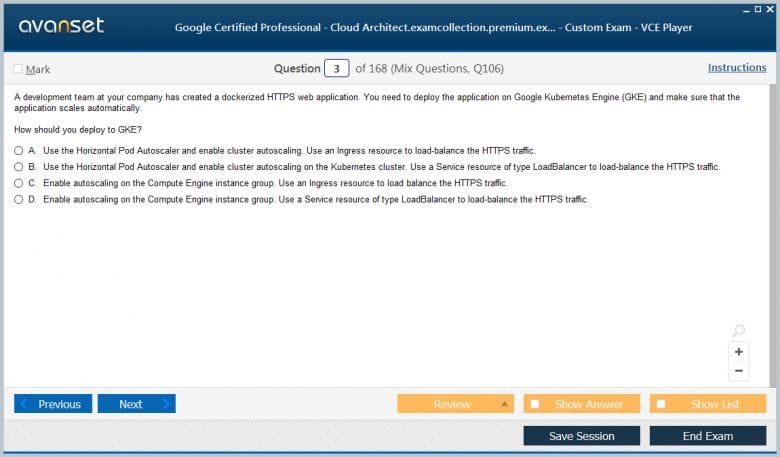
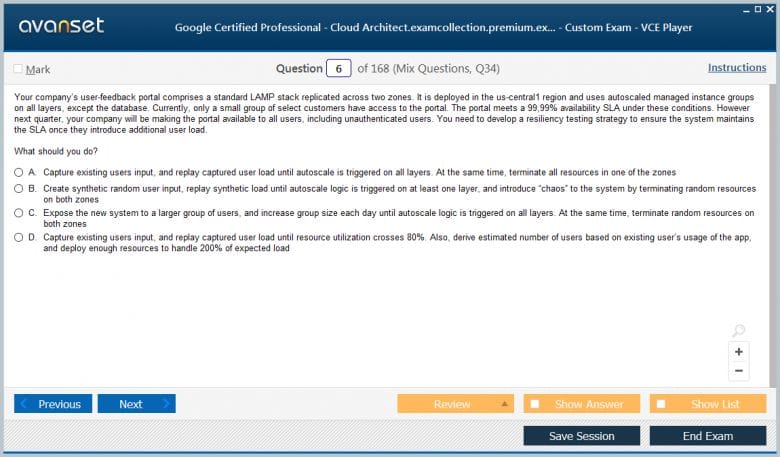
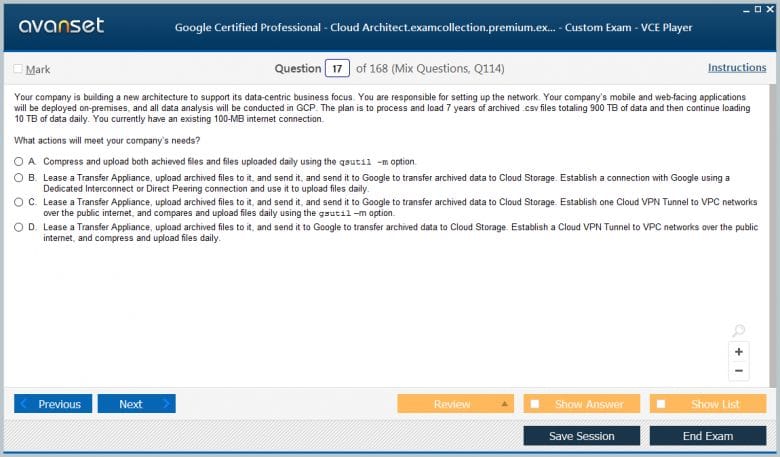
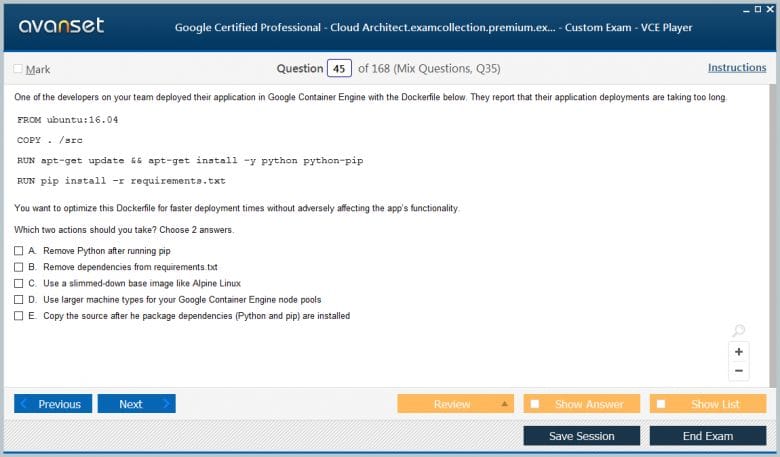
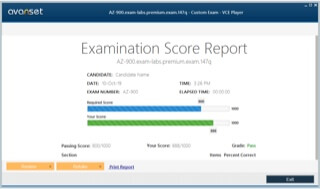
Google Professional Cloud Architect Certification Exams Screenshots
Professional Cloud Architect Product Reviews
Download Free Professional Cloud Architect Practice Test Questions VCE Files
| Exam | Title | Files |
|---|---|---|
Exam Professional Cloud Architect |
Title Google Cloud Certified - Professional Cloud Architect |
Files 11 |
Google Professional Cloud Architect Certification Exam Dumps & Practice Test Questions
Prepare with top-notch Google Professional Cloud Architect certification practice test questions and answers, vce exam dumps, study guide, video training course from ExamCollection. All Google Professional Cloud Architect certification exam dumps & practice test questions and answers are uploaded by users who have passed the exam themselves and formatted them into vce file format.
Professional Cloud Architect: Designing for Reality
The Professional Cloud Architect credential is Google Cloud’s broadest test of technical judgment. It is not simply an inventory of products, and it is not a narrow implementation exam. The Professional Cloud Architect exam asks candidates to translate business requirements into architectures that remain secure, reliable, scalable, operable, and economically sensible. That means understanding individual services, but also understanding the consequences of choosing one design over another.
The certification sits at the center of Google certifications. Architects routinely intersect with networking, security, databases, data engineering, application development, DevOps, and machine learning. A candidate who studies each of those areas as an isolated product list will struggle. The exam rewards systems thinking: where data lives, how traffic flows, how identities are controlled, how failure is contained, how teams deploy change, and how the architecture can evolve without becoming fragile.
Architecture begins with requirements, not services
A common study mistake is to start with a favorite product and then search for a use case. Professional architecture works in the opposite direction. Begin with the business objective, constraints, service-level expectations, regulatory obligations, existing systems, team skills, and budget. Only then should you decide whether the workload belongs on virtual machines, containers, serverless platforms, managed databases, or another pattern.
Google’s current role description explicitly emphasizes enterprise strategy, workload migration, deployment and orchestration, optimization, and the Well-Architected Framework. That is a useful study lens because the framework forces trade-offs into the open. Operational excellence, security, reliability, performance, cost, and sustainability can reinforce one another, but sometimes they compete. A multi-region design may improve resilience while increasing complexity and cost. A highly managed service may reduce operations effort while limiting low-level control.
The Google Cloud platform overview is useful as a map, but certification-level preparation must go deeper. For every major architectural choice, you should be able to explain why it fits the workload and what new operational responsibilities it creates.
Choose the right compute abstraction
Compute design is rarely about raw CPU alone. It is about control, scaling behavior, deployment model, operational effort, portability, and workload shape. Compute Engine gives teams virtual-machine control. Google Kubernetes Engine offers a container orchestration layer for workloads that benefit from Kubernetes. Cloud Run fits stateless containerized services that can use a serverless operating model. App Engine remains relevant for certain application patterns where platform management should be minimized.
Comparisons such as Cloud Functions, App Engine, Cloud Run, and GKE are valuable because the architect’s question is not “which service is best?” It is “which service creates the best balance of control and operational simplicity for this workload?” The answer changes with traffic predictability, portability requirements, deployment frequency, networking constraints, and team capability.
Architects also need to think about failure domains and scaling. A service that can scale rapidly may still depend on a database or downstream system that cannot. A regional design may need explicit disaster recovery. Stateless front ends are easy to recreate; stateful systems and data consistency require more careful recovery planning.
Data design is architecture, not an afterthought
Data choices shape the entire system. Relational transactions, globally distributed consistency, document access patterns, analytical queries, streaming pipelines, and object storage all have different requirements. A Professional Cloud Architect should be able to recognize those patterns without forcing every workload into one database.
Google Cloud database choices are a useful starting point. Cloud SQL can fit conventional relational applications. Spanner supports globally distributed relational workloads with strong consistency. Bigtable fits high-throughput wide-column patterns. Firestore supports document-oriented application data. BigQuery is designed for analytical workloads rather than transactional application serving.
Storage choices matter as well. The Google Cloud storage options illustrate how object, block, local, and file storage solve different problems. Architecture questions often become easier once you classify the access pattern, durability need, latency requirement, and lifecycle of the data.
For deeper specialization, the Professional Cloud Database Engineer and Professional Data Engineer paths extend the same decisions into database operations and data-platform engineering.
Network design sets the boundaries of the system
Networking is one of the areas where architecture diagrams can look deceptively simple. Real designs must account for address planning, routing, name resolution, egress, hybrid connectivity, load balancing, service exposure, segmentation, and observability. The Professional Cloud Network Engineer track covers this domain in more depth, but architects still need to make correct high-level decisions.
VPC design is foundational. Shared VPC can separate network ownership from project-level application ownership. Hybrid connectivity may use Cloud VPN or Cloud Interconnect. Global applications may need load-balancing choices that align with traffic patterns and failover goals. DNS is part of the architecture, not merely a configuration detail; Cloud DNS connects name resolution to hybrid and service-discovery scenarios.
Network design also affects security. Private service access, firewall policies, egress controls, and service perimeters can reduce exposure, but overly complex controls can become difficult to operate. Architecture must make secure behavior the easiest behavior for teams to maintain.
Security and identity must be designed into the hierarchy
Google Cloud security begins with the resource hierarchy and identity model. Organizations, folders, projects, service accounts, groups, IAM roles, and policies determine who can do what and where. The architect should understand inherited policy behavior and avoid using broad project-level roles when more precise access is appropriate.
The Google Cloud IAM model provides essential context. The goal is not simply to “turn on security.” It is to design boundaries that match organizational responsibility while preserving operability. Encryption, key management, secrets, audit logging, network controls, and data-classification requirements all need to align.
For sensitive environments, the Google Cloud key-management model and Secret Manager are natural extensions of that architecture. Candidates should understand when an organization needs stronger control over keys, credentials, separation of duties, or auditability. The Professional Cloud Security Engineer path deepens those controls.
Reliability is an operating model
Highly available architecture is not created by drawing two zones on a diagram. Reliability depends on how services fail, how data is recovered, how deployments are performed, what is monitored, and how teams respond to incidents. Architects need to think in terms of service-level objectives, redundancy, graceful degradation, recovery objectives, capacity, and operational ownership.
This is where architecture meets the Professional Cloud DevOps Engineer discipline. Delivery pipelines, observability, error budgets, and production feedback loops influence architecture choices. A design that cannot be deployed safely or observed clearly is not operationally complete.
Cost optimization belongs in the same conversation. Rightsizing, autoscaling, storage lifecycle policies, managed services, commitment models, and data-transfer patterns can materially change operating cost. Google Cloud pricing reinforces that architecture choices create recurring financial consequences.
Migration requires sequencing, not just destination architecture
Many architecture scenarios begin with an existing estate rather than a clean-slate cloud design. The architect must understand what can be rehosted, replatformed, refactored, replaced, or retired—and in what order. Dependencies matter. A database migration may need application changes. Identity integration may need to precede workload movement. Network connectivity may be required before data transfer or cutover testing can begin.
Good migration plans reduce irreversible risk. They use pilots, measurable acceptance criteria, rollback strategies, and staged changes. They also recognize organizational constraints such as maintenance windows, compliance evidence, vendor contracts, and teams that need time to learn new operating models.
The exam’s case-study style makes this particularly important. Case studies contain more information than is needed for every question. Strong candidates learn to identify the decisive requirement—availability, compliance, migration speed, operational simplicity, or cost—and choose the architecture that best satisfies it.
Current exam strategy
Google currently lists the standard Professional Cloud Architect exam as two hours, $200 before applicable tax, and 50–60 multiple-choice and multiple-select questions. Each standard exam includes two case studies that account for 20–30% of the exam, and the certification is valid for two years. Eligible holders can renew through the standard exam, designated Google Skills coursework or skill badges, or a one-hour, 25-question renewal exam built around a generative-AI case study. That reinforces an important point: the certification is intended to represent current architectural practice rather than a one-time snapshot.
Preparation should therefore be scenario-driven. Professional Cloud Architect preparation can help organize review, but spend equal time asking why a design is appropriate. Practice eliminating choices that violate a stated requirement even if they are technically possible.
The standard to aim for
A strong Professional Cloud Architect candidate can move from an ambiguous business problem to a defensible technical decision. They can explain why a particular compute platform fits, why the data model is appropriate, how the network is segmented, how identity is controlled, how the system fails safely, how it will be operated, and what it will cost to run.
That is why this remains a broad professional credential. The architecture is not the diagram. The architecture is the set of trade-offs that makes the system viable in the real world.
One more useful preparation habit is to redraw architectures in terms of decision boundaries. Mark which team owns each component, which identities cross each boundary, where state is stored, what happens when a dependency is unavailable, and which requirement would force the design to change. This exposes weaknesses that product-by-product study often hides. It also mirrors the way experienced architects review designs: not by admiring the diagram, but by asking what assumptions the diagram depends on.
Current Google Cloud architecture work also increasingly intersects with AI-enabled workloads. Even when an architect is not an ML specialist, they should understand how model endpoints, enterprise data, retrieval, security controls, and application services fit into the wider platform. The Generative AI Leader credential offers business context for those initiatives, while the Professional Machine Learning Engineer path covers the implementation depth. The architect's job is to make sure those capabilities enter the system without bypassing governance, reliability, or cost discipline.
ExamCollection provides the complete prep materials in vce files format which include Google Professional Cloud Architect certification exam dumps, practice test questions and answers, video training course and study guide which help the exam candidates to pass the exams quickly. Fast updates to Google Professional Cloud Architect certification exam dumps, practice test questions and accurate answers vce verified by industry experts are taken from the latest pool of questions.

Google Professional Cloud Architect Video Courses

Top Google Certifications











Top Google Certification Exams
- Professional Cloud Architect
- Professional Data Engineer
- Generative AI Leader
- Professional Machine Learning Engineer
- Associate Cloud Engineer
- Professional Cloud Security Engineer
- Professional Security Operations Engineer
- Professional Cloud Network Engineer
- Professional Cloud Database Engineer
- Professional Cloud DevOps Engineer
- Professional Cloud Developer
- Cloud Digital Leader
- Associate Google Workspace Administrator
- Associate Data Practitioner
- Professional ChromeOS Administrator
- Professional Google Workspace Administrator
Site Search:




today i pass the exam with the premium dump, is valid feb 21