Pass Your Google Professional Cloud Developer Certification Easy!
Google Professional Cloud Developer Certification Exams Questions & Answers, Accurate & Verified By IT Experts
Instant Download, Free Fast Updates, 99.6% Pass Rate.
Google Professional Cloud Developer Certification Exams Screenshots
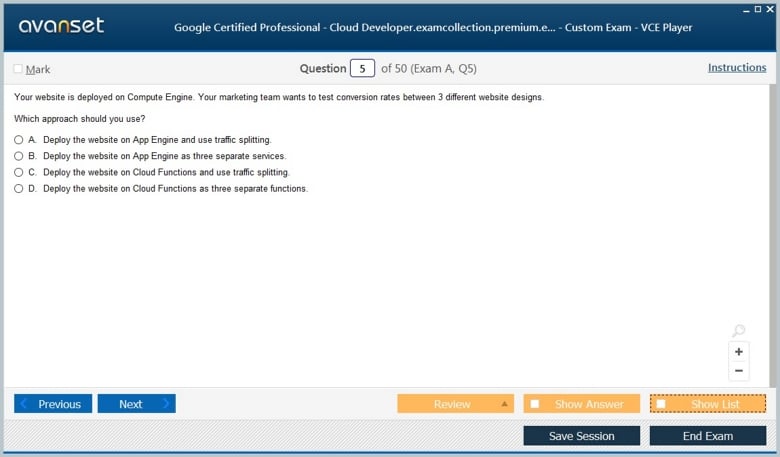
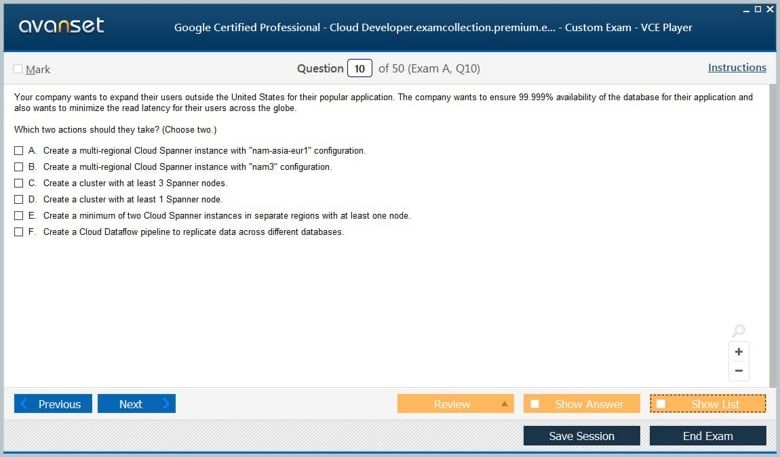
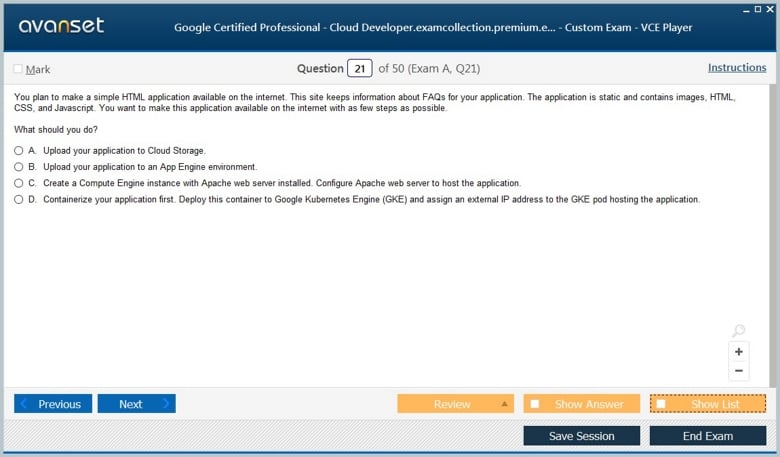
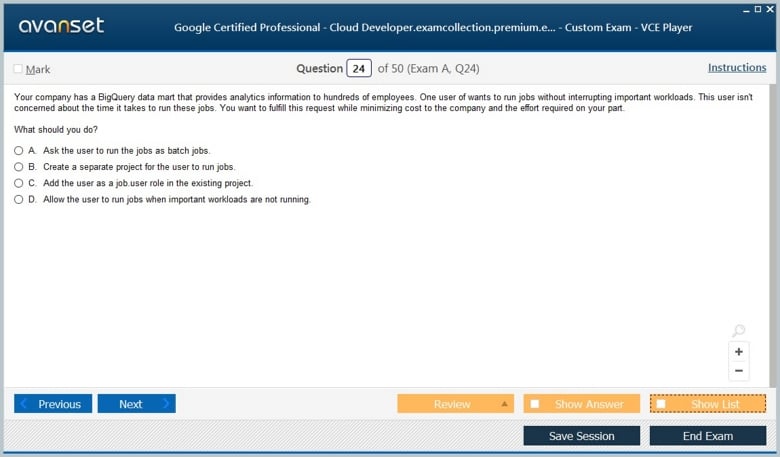
Professional Cloud Developer Product Reviews
Download Free Professional Cloud Developer Practice Test Questions VCE Files
| Exam | Title | Files |
|---|---|---|
Exam Professional Cloud Developer |
Title Professional Cloud Developer |
Files 5 |
Google Professional Cloud Developer Certification Exam Dumps & Practice Test Questions
Prepare with top-notch Google Professional Cloud Developer certification practice test questions and answers, vce exam dumps, study guide, video training course from ExamCollection. All Google Professional Cloud Developer certification exam dumps & practice test questions and answers are uploaded by users who have passed the exam themselves and formatted them into vce file format.
Professional Cloud Developer: Building for Production
The Professional Cloud Developer credential is about turning application requirements into software that behaves well on Google Cloud. The Professional Cloud Developer exam covers design, development, testing, deployment configuration, and service integration, but the underlying theme is production readiness. Candidates need to understand how code interacts with identity, data, messaging, observability, deployment pipelines, and increasingly AI-assisted development and generative AI services.
Google’s current role description explicitly includes scalable secure applications, generative AI APIs, AI coding assistants, context engineering, and automated debugging agents. That makes the certification broader than a traditional “write an application and deploy it” exam. A modern cloud developer has to choose the right runtime, integrate managed services cleanly, design for failure, automate delivery, and ensure the application can be operated by someone other than the original author.
Choose a runtime that matches the application
Developers should be able to reason across multiple application platforms rather than treating one as the default. Compute Engine offers virtual-machine control. Google Kubernetes Engine fits applications that benefit from Kubernetes orchestration and container portability. Cloud Run provides a serverless container model for stateless services. App Engine supports platform-managed application deployment. Event-driven functions can fit focused reactive tasks.
The Cloud Functions, App Engine, Cloud Run, and GKE is useful because it makes the trade-off explicit. The choice depends on deployment model, scaling behavior, state, runtime requirements, operational control, and team experience. Developers should prefer the simplest platform that satisfies the workload rather than assuming more control is always better.
Cloud Run is a good example. It can scale containerized services without requiring a Kubernetes control plane, but developers still need to design statelessness, request handling, concurrency, cold-start behavior, service-to-service authentication, and external dependencies.
Application architecture is about boundaries
Cloud-native applications become easier to evolve when responsibilities are separated cleanly. APIs should expose stable contracts. Background work should not block interactive requests unnecessarily. Stateful components should be isolated behind services designed for state. Asynchronous messaging can decouple producers and consumers. Idempotency can make retries safer.
These patterns matter because distributed systems fail differently from single-process applications. Requests time out. Messages may be delivered more than once. Dependencies become temporarily unavailable. Network latency varies. A production developer designs for those realities instead of assuming a happy path.
The Professional Cloud Architect discipline sits one level above these decisions, but developers still need enough architectural literacy to recognize when local code choices create system-level problems. Service decomposition, data ownership, dependency direction, and failure isolation all affect maintainability.
Data access should match the workload
Developers do not need to be database specialists, but they do need to choose and use data services appropriately. Relational transactions, document access, globally distributed relational data, object storage, analytical queries, and caching have different requirements. The Google Cloud database choices overview helps frame these differences.
Cloud SQL can suit conventional transactional applications. Spanner can support relational workloads that require horizontal scale and global consistency. Firestore can simplify document-oriented application patterns. Bigtable fits high-throughput key-based access. Cloud Storage is not a database, but it is often the correct place for objects, media, exports, and durable files.
Developers should understand connection management, transactions, retries, pagination, schema evolution, and how client libraries handle authentication. They should also avoid coupling application logic too tightly to infrastructure details when an abstraction can preserve portability and testability.
Identity is part of application design
Security begins with understanding which identity is making a request. User identity, workload identity, and service accounts solve different problems. Applications should avoid broad credentials and instead use least-privilege service identities. The Google Cloud IAM model is therefore core developer knowledge, not just an administrator concern.
Secrets require similar discipline. API keys, database credentials, signing material, and other sensitive values should not be embedded in source code or container images. Secret Manager provides a controlled mechanism for storing and retrieving secrets, with access governed through IAM.
Developers also need to think about authorization inside the application. An authenticated user is not automatically entitled to every operation. Application-level roles, resource ownership, tenant boundaries, and auditability remain necessary even when infrastructure access is correctly configured.
Build pipelines should make safe change routine
A production application changes continuously. The delivery system should make small, tested, observable changes safer than large manual releases. Google Cloud Build shows how source changes can trigger builds, tests, artifact creation, and deployment workflows.
Good pipelines verify more than compilation. Unit tests, integration tests, dependency checks, policy checks, container scanning, and deployment validation can all reduce risk. Artifacts should be versioned and reproducible. Configuration should be separated from application code. Rollback or progressive deployment strategies should exist for changes that affect critical services.
This is where the developer role overlaps with the Professional Cloud DevOps Engineer path. Developers create deployable software; DevOps and SRE practices help the organization deliver and operate it reliably. Strong teams design these responsibilities together.
Observability is a development feature
Logs, metrics, traces, and error reporting are not operational decorations added after launch. They are part of the application contract. Developers need enough context in logs to diagnose failures without leaking sensitive data. Metrics should reflect both system health and meaningful application behavior. Distributed tracing becomes important when requests cross multiple services.
Production debugging is fundamentally different from local debugging. You may not be able to reproduce a failure immediately. You may need to infer the cause from a request ID, trace, structured log, latency distribution, or error-rate change. Google Cloud logging gives operators evidence rather than guesses when applications are instrumented well.
Developers should also understand graceful degradation. If a noncritical downstream dependency fails, can the application continue with reduced functionality? Are timeouts explicit? Are retries bounded? Do retry storms amplify an outage? These questions belong in code design.
Generative AI changes application integration patterns
Google now includes generative AI APIs and AI-assisted development in the role description. Developers therefore need a working understanding of prompts, context, grounding, model output variability, token usage, safety controls, and evaluation. The application should not assume model output is deterministic or inherently correct.
AI features often need retrieval from enterprise data, access control, output validation, and clear user expectations. A conversational interface may call traditional APIs behind the scenes. Agents may invoke tools to complete tasks. The Generative AI Leader credential provides the business-level counterpart to this implementation work, while the Professional Machine Learning Engineer path goes deeper into production AI systems.
The developer’s responsibility is to turn AI capability into a reliable product experience. That means handling failure, latency, cost, permissions, and feedback just as carefully as any other external dependency.
Source control and developer workflow still matter
Cloud development does not eliminate basic engineering discipline. Code review, branching strategy, dependency management, build reproducibility, secure configuration, and automated tests remain foundational. Source-code management still matters because cloud-native delivery begins with controlled changes to source.
Infrastructure definitions may also live alongside application code. When infrastructure is versioned and reviewed, environments become easier to recreate. Developers do not need to own every infrastructure decision, but they should understand how application dependencies are provisioned and how environment differences can cause defects.
Preparing for the current exam
Google currently lists the Professional Cloud Developer exam as two hours, $200 before applicable tax, and 50–60 multiple-choice and multiple-select questions, with no formal prerequisite. Google recommends three or more years of industry experience including at least one year designing and managing solutions on Google Cloud. The current role definition explicitly includes generative AI APIs, AI coding assistants, context engineering, and automated debugging agents, so candidates relying on older preparation material should refresh their study plan.
Preparation is strongest when organized around end-to-end application scenarios. Take a service from design through deployment: choose the runtime, data store, identity, secret handling, messaging, observability, build pipeline, and scaling strategy. Then ask how the design behaves when a dependency fails, traffic spikes, a credential is rotated, or a release introduces an error.
The real standard is not whether you can create a resource in the console. It is whether you can build an application that another team can deploy, operate, secure, troubleshoot, and evolve with confidence.
Testing strategy deserves the same architectural attention. Unit tests give fast feedback on local behavior, but cloud applications also depend on managed services, IAM, network policies, event delivery, and deployment configuration. Integration and contract tests help expose failures that local mocks cannot. Developers should know when to use test doubles and when a real service dependency is necessary to validate behavior. They should also design test data so that production-sensitive information is not copied casually into lower environments.
Another practical skill is dependency discipline. Client libraries, frameworks, base images, and third-party packages change independently of your application. Pinning, update automation, vulnerability review, and reproducible builds reduce surprises. A cloud-native application may scale automatically, but an unsafe dependency can scale the impact of a defect just as quickly. The best Professional Cloud Developer candidates therefore think about the complete software supply chain, not only the code they personally wrote.
One additional preparation angle is configuration and environment parity. Developers should separate deploy-time configuration from code, understand how environment variables and secret references are injected, and know why production-only fixes create drift. Staging environments do not need to duplicate every production resource at full scale, but they should reproduce the behaviors most likely to fail: identity, networking, data access, concurrency, and deployment configuration. That discipline makes releases less dependent on last-minute manual intervention.
ExamCollection provides the complete prep materials in vce files format which include Google Professional Cloud Developer certification exam dumps, practice test questions and answers, video training course and study guide which help the exam candidates to pass the exams quickly. Fast updates to Google Professional Cloud Developer certification exam dumps, practice test questions and accurate answers vce verified by industry experts are taken from the latest pool of questions.

Google Professional Cloud Developer Video Courses

Top Google Certifications







Top Google Certification Exams
- Professional Cloud Architect
- Professional Data Engineer
- Generative AI Leader
- Professional Machine Learning Engineer
- Associate Cloud Engineer
- Professional Cloud Security Engineer
- Professional Security Operations Engineer
- Professional Cloud Network Engineer
- Professional Cloud Database Engineer
- Professional Cloud DevOps Engineer
- Cloud Digital Leader
- Professional Cloud Developer
- Associate Google Workspace Administrator
- Associate Data Practitioner
- Professional ChromeOS Administrator
- Professional Google Workspace Administrator
Site Search: