
Pass Your Google Professional Cloud Security Engineer Certification Easy!
Google Professional Cloud Security Engineer Certification Exams Questions & Answers, Accurate & Verified By IT Experts
Instant Download, Free Fast Updates, 99.6% Pass Rate.
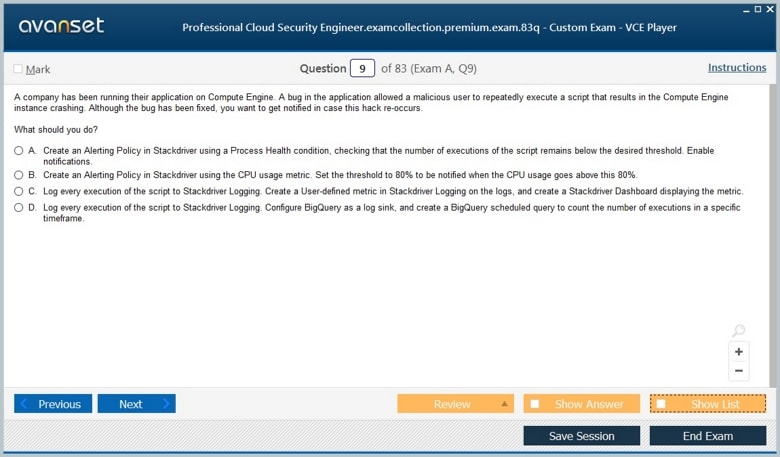
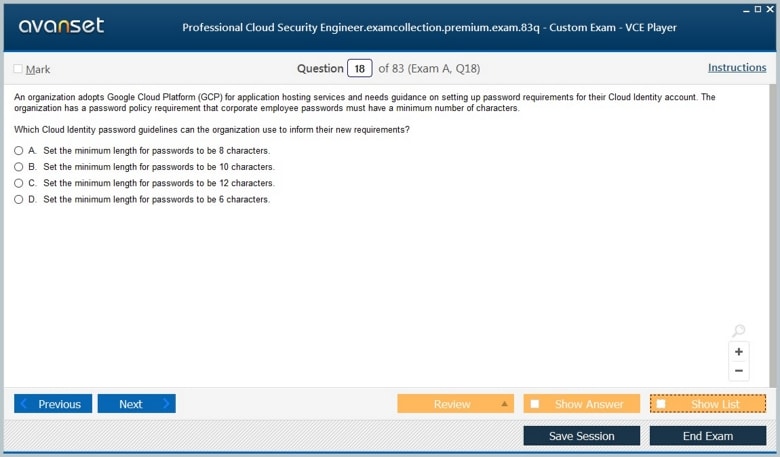
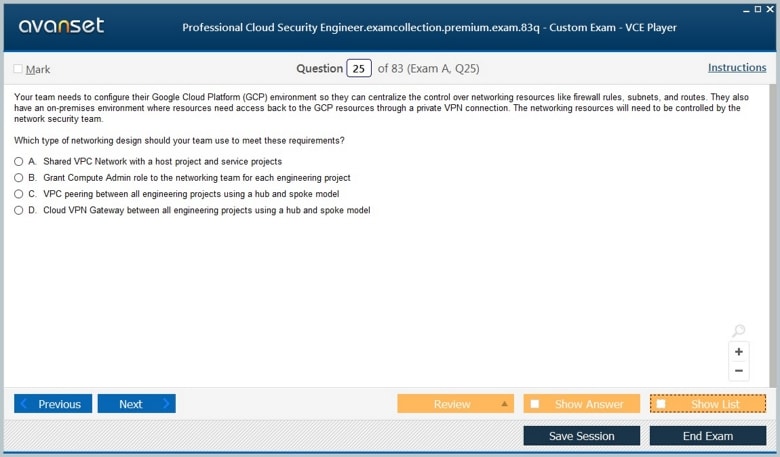
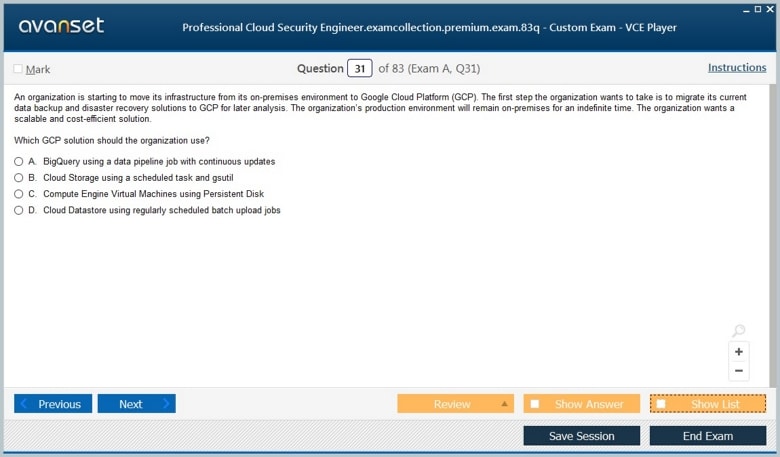
Google Professional Cloud Security Engineer Certification Exams Screenshots
Professional Cloud Security Engineer Product Reviews
Download Free Professional Cloud Security Engineer Practice Test Questions VCE Files
| Exam | Title | Files |
|---|---|---|
Exam Professional Cloud Security Engineer |
Title Professional Cloud Security Engineer |
Files 5 |
Google Professional Cloud Security Engineer Certification Exam Dumps & Practice Test Questions
Prepare with top-notch Google Professional Cloud Security Engineer certification practice test questions and answers, vce exam dumps, study guide, video training course from ExamCollection. All Google Professional Cloud Security Engineer certification exam dumps & practice test questions and answers are uploaded by users who have passed the exam themselves and formatted them into vce file format.
Professional Cloud Security Engineer: Engineering Trust Into Google Cloud
The Professional Cloud Security Engineer certification tests whether you can turn security requirements into controls that actually work across Google Cloud. The Professional Cloud Security Engineer exam covers access, boundary protection, data protection, security operations, and compliance. Google’s current role definition also includes securing AI workloads, software supply chains, automation, and regulatory controls, reflecting how much the cloud security role has expanded.
This credential belongs inside the wider Google certifications, but it is not simply the security chapter of the architect exam. A security engineer must be able to design controls, implement them, monitor them, and explain the operational consequences. The work crosses identity, networking, encryption, data governance, logging, incident response, and platform architecture.
Identity is the first security boundary
Most cloud resources are reached through an identity decision before they are reached through a network decision. Users, groups, service accounts, workforce identities, workload identities, and organization policies all shape access. The Google Cloud IAM model is foundational because least privilege is implemented through resource hierarchy, roles, policies, and identity design.
Security engineers should understand the difference between predefined, custom, and basic roles; how policy inheritance works; and why broad owner or editor access is dangerous. They should also design service-account usage carefully. Long-lived keys should be avoided where better workload-identity mechanisms exist. Privileged access should be deliberate, time-bounded where possible, and auditable.
Identity design also includes federation and lifecycle. Joiner, mover, and leaver processes determine whether stale access accumulates. Enterprise environments need controls that work at scale rather than requiring manual cleanup in every project.
Resource hierarchy is a governance control
Organizations, folders, and projects are not just billing containers. They are policy boundaries. A well-designed hierarchy lets central teams apply guardrails while delegating ownership to application groups. Security engineers should understand where organization policies, IAM, logging, and network structures belong so that controls inherit predictably.
Projects can isolate workloads and blast radius, but too many ad hoc projects without governance create fragmentation. Too few projects can make separation difficult. The design should reflect environments, teams, data sensitivity, compliance boundaries, and operational ownership.
The Professional Cloud Architect path provides the broader architecture context, but security engineers should be able to challenge a hierarchy that makes least privilege or evidence collection unnecessarily difficult.
Protect data through access, encryption, and lifecycle
Data protection is layered. IAM determines who can use a service. Database or application controls may add another authorization layer. Encryption protects data at rest and in transit, but organizations may require additional control over keys. The Google Cloud key-management model helps candidates understand customer-managed encryption keys, rotation, separation of duties, and audit expectations.
Secrets are a separate category from encryption keys. Passwords, tokens, certificates, and API credentials need secure storage, controlled retrieval, and rotation. Secret Manager matters because hard-coded credentials remain one of the most avoidable security failures in cloud applications and pipelines.
Data lifecycle also matters. Where organizations need controls around sensitive information leaving approved channels, data loss prevention becomes part of the design rather than a separate afterthought. Retention, deletion, backup, export, replication, and cross-region placement can all have regulatory consequences. A security engineer needs to understand where sensitive data is copied and which services or identities can reach those copies.
Network security is more than firewall rules
Google Cloud network security combines VPC firewall controls with private access patterns, load-balancer protection, Cloud Armor, Secure Web Proxy, Cloud NGFW capabilities, VPC Service Controls, and hybrid connectivity controls. The Professional Cloud Network Engineer path goes deeper into connectivity, but the security engineer must understand how network controls reduce exposure and enforce trust boundaries.
One useful distinction is between network reachability and service authorization. A private IP does not make a request authorized. An IAM role does not guarantee the network path is appropriately restricted. VPC Service Controls can reduce certain data-exfiltration paths around supported services, but they do not replace identity controls or application security.
Defense in depth means using multiple independent controls when the risk justifies it, while avoiding so much complexity that teams cannot operate the system reliably.
Logging and detection must be designed before the incident
Security operations depend on evidence. The Professional Security Operations Engineer path extends this part of the work into detection engineering, investigation, and security-operations workflows. Audit logs, VPC Flow Logs, firewall logs, load-balancer logs, service-specific logs, Security Command Center findings, and application telemetry can all contribute to detection and investigation. If important logs were never enabled or retained, an incident team cannot recreate history after the fact.
Google Cloud logging supports both operational and security monitoring. The difference is the question being asked: operations may look for latency and failure; security may look for unusual access, privilege changes, suspicious network behavior, or data movement.
Alert quality matters. A flood of low-value findings can hide meaningful incidents. Security engineers should tune detections, establish ownership, and integrate alerts with response workflows. Automation can enrich or contain incidents, but destructive automated actions need safeguards.
Cloud security includes the software supply chain
Modern attacks can enter through dependencies, build systems, container images, or compromised deployment identities. Security therefore extends into source control, build pipelines, artifact registries, vulnerability scanning, provenance, and deployment policy. The security engineer should understand where trust is established and how an artifact moves from source to production.
This creates a natural overlap with the Professional Cloud DevOps Engineer discipline. DevOps engineers build delivery systems; security engineers ensure those systems preserve identity, integrity, and policy. Neither role succeeds if security checks are performed manually only at the end of a release.
Supply-chain security should also include secrets and dependency management. A clean production environment can still be compromised if the build process used an exposed token or a malicious package.
AI workloads introduce familiar risks in new forms
Google’s current security-engineer scope explicitly mentions securing AI workloads. The underlying principles remain familiar—identity, data protection, network boundaries, monitoring, and least privilege—but model systems introduce additional concerns. Training data, prompts, retrieved enterprise context, model endpoints, agent tools, and evaluation results may all contain sensitive information.
AI systems can also create new authorization problems. A conversational interface should not allow a user to retrieve information they could not access through the underlying system. An agent that can call tools needs carefully scoped credentials. Prompt injection and untrusted content can influence tool use, so security controls must exist outside the model itself.
The Generative AI Leader path provides the broader adoption context, while the security engineer focuses on the controls required to make those solutions trustworthy.
Compliance is evidence, not a label
Compliance requirements should be translated into technical and operational controls. Data residency, access review, encryption, logging, retention, separation of duties, vulnerability management, and incident-response evidence may all be relevant depending on the standard or regulation. A service being “compliant” does not make an organization’s specific deployment compliant automatically.
Security engineers need to know how to produce evidence that a control exists and is operating. Configuration snapshots, audit logs, policy assignments, key rotation, access reviews, and monitoring records can all support that evidence. Automation helps when controls need to be applied consistently across many projects.
The broader Certificate of Cloud Security Knowledge perspective can be useful for vendor-neutral cloud-security concepts, but the Google credential expects candidates to apply those principles using Google Cloud services and organizational controls.
Preparing for the current exam
Google currently lists the Professional Cloud Security Engineer exam as two hours, $200 before applicable tax, and 50–60 multiple-choice and multiple-select questions. There is no formal prerequisite. Google recommends three or more years of industry experience, including more than one year designing and managing solutions with Google Cloud. The current role definition explicitly includes securing AI workloads, the software supply chain, security automation, and regulatory controls, so preparation should be scenario-based rather than limited to older IAM-and-networking outlines.
Take one workload and trace the security model end to end: who can administer it, which service identity runs it, where secrets live, how data is encrypted, which network paths are possible, what policies prevent exfiltration, what logs are retained, which alerts indicate abuse, and how an incident would be investigated. Then change the scenario for a regulated workload, a hybrid environment, or an AI-enabled application.
A strong candidate does not just know which security products exist. They can explain which control belongs at which boundary, how the controls reinforce one another, and how the organization will prove that those controls keep working.
Security posture management adds another layer to the role. Large organizations need a way to identify misconfiguration, vulnerable workloads, excessive privilege, exposed services, and policy drift across many projects. Security Command Center and related findings can help central teams prioritize risk, but the engineer still needs a triage model. Not every finding has the same business impact, and remediation should account for asset criticality, exposure, exploitability, and compensating controls.
Incident response should also be rehearsed before it is needed. Teams need defined escalation paths, evidence-preservation procedures, credential-rotation plans, containment playbooks, and a process for restoring trustworthy service. A compromised service account, suspicious data export, malicious image, or exposed endpoint may each require different containment actions. The security engineer should understand how to reduce attacker access without destroying the evidence needed to understand what happened.
Finally, security engineering must preserve usability. Controls that routinely block legitimate delivery will be bypassed. Good platform security gives developers secure defaults, reusable patterns, and clear exception processes. The strongest candidates recognize that security is most durable when it is integrated into normal architecture and delivery rather than enforced as a separate obstacle.
ExamCollection provides the complete prep materials in vce files format which include Google Professional Cloud Security Engineer certification exam dumps, practice test questions and answers, video training course and study guide which help the exam candidates to pass the exams quickly. Fast updates to Google Professional Cloud Security Engineer certification exam dumps, practice test questions and accurate answers vce verified by industry experts are taken from the latest pool of questions.


Google Professional Cloud Security Engineer Video Courses

Top Google Certifications









Top Google Certification Exams
- Professional Cloud Architect
- Generative AI Leader
- Professional Data Engineer
- Professional Machine Learning Engineer
- Associate Cloud Engineer
- Professional Cloud Security Engineer
- Professional Cloud Network Engineer
- Professional Security Operations Engineer
- Professional Cloud Database Engineer
- Professional Cloud Developer
- Associate Data Practitioner
- Associate Google Workspace Administrator
- Professional Cloud DevOps Engineer
- Cloud Digital Leader
- Professional Agentic Architect
- Professional ChromeOS Administrator
- Professional Google Workspace Administrator
Site Search:



