
Pass Your CSA Cloud Security Knowledge Certification Easy!
CSA Cloud Security Knowledge Certification Exams Questions & Answers, Accurate & Verified By IT Experts
Instant Download, Free Fast Updates, 99.6% Pass Rate.
CSA Cloud Security Knowledge Certification Exams Screenshots
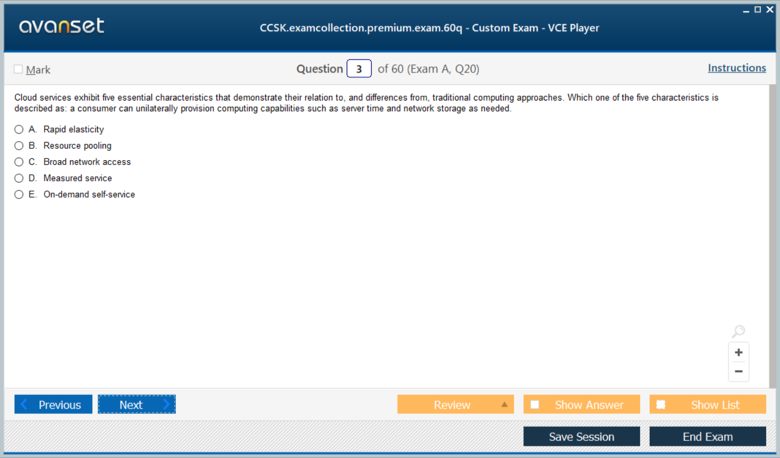
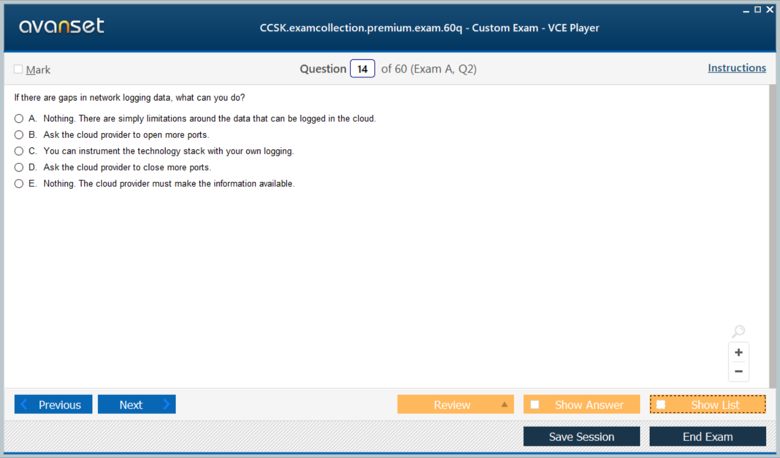
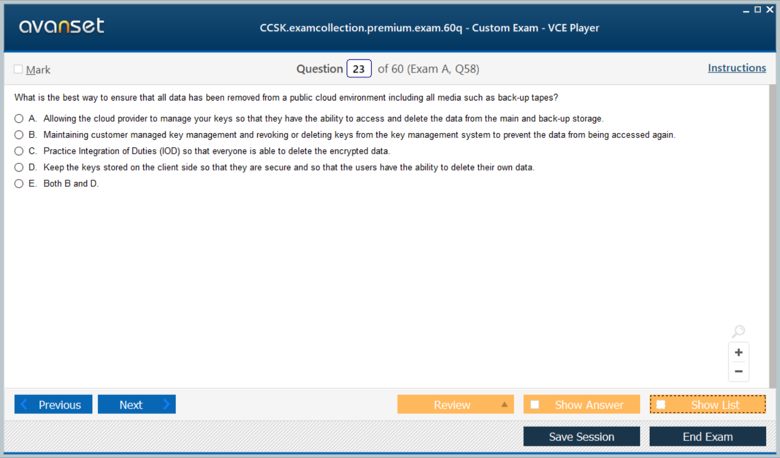
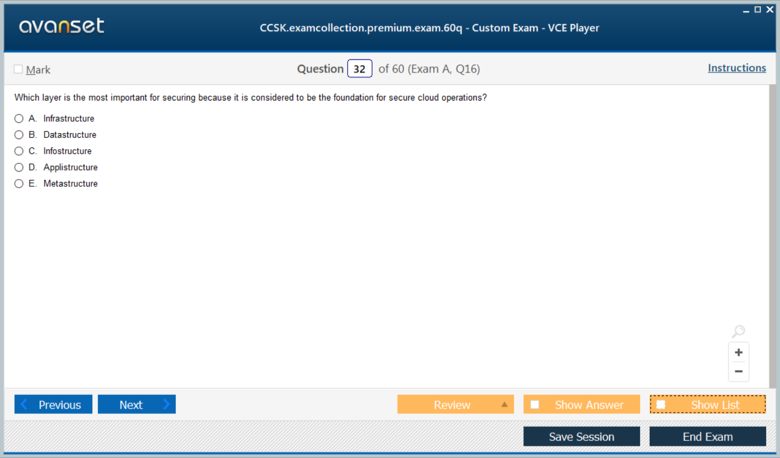
Cloud Security Knowledge Product Reviews
Download Free Cloud Security Knowledge Practice Test Questions VCE Files
| Exam | Title | Files |
|---|---|---|
Exam CCSK |
Title Certificate of Cloud Security Knowledge |
Files 2 |
CSA Cloud Security Knowledge Certification Exam Dumps & Practice Test Questions
Prepare with top-notch CSA Cloud Security Knowledge certification practice test questions and answers, vce exam dumps, study guide, video training course from ExamCollection. All CSA Cloud Security Knowledge certification exam dumps & practice test questions and answers are uploaded by users who have passed the exam themselves and formatted them into vce file format.
CCSK v5: Building Vendor-Neutral Cloud Security Judgment
The Certificate of Cloud Security Knowledge (CCSK) is Cloud Security Alliance's vendor-neutral cloud security certificate. The current curriculum is CCSK v5, released on July 16, 2024 and still current in September 2026. It expands the certificate beyond traditional cloud governance and architecture to include subjects such as Zero Trust, DevSecOps, cloud telemetry, security analytics, artificial intelligence, data lakes, and modern workload protection. The exam is open book and online, and the current v5 assessment uses 60 multiple-choice questions in 120 minutes with an 80% passing score.
Candidates may encounter material labeled CCSK as well as CCSK v5. That distinction is useful for readers arriving through older terminology: historical CCSK material can still explain durable cloud-security principles, but current candidates should anchor preparation to v5 because the domain structure and emphasis changed materially. CCSK training can add study context, while the current CSA curriculum should remain the controlling source for exam scope.
Vendor-neutral does not mean cloud-generic
CCSK is sometimes described as “conceptual” because it does not certify one cloud platform. That description can be misleading. The certificate expects candidates to understand concrete cloud architectures, service models, shared responsibility, identity, workload design, data protection, logging, incident response, governance, and assurance. What it avoids is dependence on one provider's feature names. A candidate should be able to recognize the security objective whether the implementation uses AWS, Azure, Google Cloud, a private cloud, or a mixed environment.
This approach makes the certificate useful for architects, security engineers, risk professionals, auditors, governance teams, and technical managers who need to evaluate cloud systems across providers. It also forces candidates to separate principles from product branding, which is valuable when cloud portfolios change faster than certification cycles.
Shared responsibility and governance must be mapped, not memorized
The shared-responsibility model is one of the most important cloud-security ideas, but memorizing a generic diagram is not enough. Responsibility changes with the service model. In infrastructure services, customers may control operating systems, network configuration, identities, and applications. In managed platforms, the provider controls more of the stack. In SaaS, customers still retain meaningful responsibility for identity, configuration, data governance, endpoint access, and usage even when infrastructure is fully managed.
Candidates should practice mapping responsibility for real services and asking who owns patching, logging, encryption configuration, identity lifecycle, data classification, backups, vulnerability management, and incident response. The AWS shared-responsibility model is provider-specific, but the reasoning pattern transfers well: every control needs an explicit owner, and assumptions become gaps.
Governance defines how cloud services are selected, configured, monitored, and changed. It includes policy, accountability, risk, architecture standards, cost controls, data requirements, exception processes, and assurance. Without governance, teams can deploy quickly but create inconsistent identity models, unmanaged accounts, unapproved data locations, duplicated controls, and weak logging.
CCSK v5 treats governance as part of security architecture rather than as an administrative afterthought. Candidates should understand how organizational policies become technical guardrails and how evidence is collected to show that those guardrails are working. Cloud governance also needs to be adaptive. Static approval processes often fail in environments where infrastructure can be created through APIs in seconds.
Governance becomes practical when policy is translated into ownership, measurable controls, exception handling, and evidence. A useful complement is a NIST-aligned cloud risk framework, not because CCSK is an AWS credential, but because the exercise shows how a general control objective can be mapped to cloud responsibilities and technical mechanisms. The same reasoning applies across providers: first define the risk and accountable party, then select the control and evidence that demonstrate the requirement is being met.
Identity is the new control plane
Cloud platforms are heavily API-driven, which makes identity central to nearly every security decision. Human users, workloads, service accounts, automation pipelines, third-party integrations, and federated identities can all receive privileges. The question is not simply whether authentication is enabled, but whether authorization is narrowly scoped, credentials are protected, privilege is temporary where possible, and activity is visible.
CCSK candidates should be comfortable with least privilege, federation, strong authentication, role design, privileged access, machine identity, lifecycle management, and separation of duties. Broader cloud identity-management foundations help explain why identity architecture has become more important as traditional network perimeters weaken.
Data security follows the information, not the server
Cloud data can move through object stores, databases, data lakes, queues, analytics services, backups, replicas, caches, logs, and third-party integrations. Protecting a virtual machine while ignoring those data paths is incomplete. CCSK v5 expects candidates to reason about classification, lifecycle, residency, encryption, access, retention, deletion, backup, and data-loss controls across distributed services.
Encryption deserves particular care. symmetric and asymmetric encryption in cloud security solve different problems, and key management determines whether encrypted data is actually protected. Candidates should ask who owns keys, how keys are rotated, where secrets are stored, what services can use them, and what recovery looks like if access to a key is lost.
Zero Trust is an operating model, not a product
CCSK v5 integrates Zero Trust because cloud access frequently crosses organizational and network boundaries. The useful principle is to reduce implicit trust and make access decisions using identity, device or workload context, policy, least privilege, and continuous verification. Network location can still contribute context, but it should not be the only reason access is allowed.
The Zero Trust architecture is useful because it frames the model around access and architecture rather than a single vendor technology. For CCSK, the candidate should be able to apply the same reasoning to administrators, applications, APIs, service-to-service traffic, and remote users.
DevSecOps moves security into the delivery system
Cloud workloads are increasingly deployed through code and automation. That changes where security controls belong. If infrastructure, policies, container definitions, and application releases move through pipelines, then code repositories, build systems, artifact stores, secrets, testing stages, and deployment permissions all become security-sensitive components. Security needs to be integrated into those workflows rather than appended after release.
Candidates should understand the purpose of automated testing, policy-as-code, secrets management, dependency checks, image scanning, infrastructure validation, and controlled deployment. They should also understand the limits of automation. A pipeline can consistently enforce the wrong policy, so governance, review, and monitoring still matter.
Telemetry turns cloud scale into something observable
Cloud services generate enormous amounts of activity, but logging volume is not the same as visibility. Effective telemetry requires the right sources, consistent timestamps, centralized collection, retention aligned to risk, useful identity context, and analytics that distinguish normal behavior from meaningful deviation. CCSK v5 gives greater attention to telemetry and security analytics because cloud resources are dynamic and traditional perimeter monitoring is insufficient.
The operational goal is to answer questions quickly: who created a resource, which identity changed a policy, where data was accessed, why a workload became public, and what happened before an alert fired? This connects directly to incident-response framework design, because investigations fail when logs are missing, inaccessible, or poorly contextualized.
Artificial intelligence changes cloud risk in both directions
CCSK v5 explicitly adds AI and generative AI because cloud platforms now host models, training data, inference services, vector stores, agents, and AI-assisted development workflows. These systems introduce familiar risks—identity, data exposure, supply-chain dependencies, logging, isolation—alongside model-specific concerns such as prompt manipulation, data leakage through model interactions, unsafe tool use, and governance of generated outputs.
At the same time, AI can support security analytics and operations. Candidates should avoid treating AI as automatically beneficial or automatically dangerous. The CCSK perspective is to place AI services inside the same governance, risk, data, identity, and monitoring discipline used for other cloud technologies, then add controls for the new behavior AI introduces.
How to prepare for the open-book exam
An open-book exam rewards organization, not complacency. CCSK contains enough material that searching every answer during the test is inefficient. Candidates should know the 12 v5 domains, understand the relationships among them, and use reference material to confirm detail rather than discover concepts for the first time. Build a concise index of major topics and know where key definitions and guidance live.
Study by comparing scenarios across service models and providers. Take one requirement—such as protecting regulated data—and map governance, identity, encryption, logging, workload design, backup, incident response, and assurance. That exercise reflects how CCSK knowledge is used in real cloud-security work and prevents the domains from becoming isolated chapters.
Open book should change study technique, not reduce study depth. Build a mental map of the domains first, then use the reference material to confirm details. Candidates who want to connect the body of knowledge to day-to-day responsibilities can also review the scope of cloud security engineering. That role-oriented view reinforces why CCSK spans governance, architecture, identity, data protection, operations, application security, and incident handling instead of treating cloud security as a single technical specialty.
The certificate's value comes from giving professionals a common architecture for thinking about cloud risk. Providers will keep adding services, but organizations will still need clear responsibility, strong identity, protected data, secure workloads, effective telemetry, controlled change, incident readiness, and evidence that policies are working. CCSK v5 organizes those concerns without binding them to one console.
For candidates, the goal should be to leave preparation able to explain not only what a cloud control is, but where it fits, who owns it, what risk it reduces, how it is monitored, and what happens when it fails. That is the vendor-neutral judgment the certificate is designed to validate.
ExamCollection provides the complete prep materials in vce files format which include CSA Cloud Security Knowledge certification exam dumps, practice test questions and answers, video training course and study guide which help the exam candidates to pass the exams quickly. Fast updates to CSA Cloud Security Knowledge certification exam dumps, practice test questions and accurate answers vce verified by industry experts are taken from the latest pool of questions.


CSA Cloud Security Knowledge Video Courses

Top CSA Certifications
Site Search:



