



Premium File
484 Q&A
$76.99$69.99
ISC CISSP Exam Questions & Answers, Accurate & Verified By IT Experts
Instant Download, Free Fast Updates, 99.6% Pass Rate

CISSP Premium File: 484 Questions & Answers
Last Update: Aug 07, 2026
CISSP Training Course: 62 Video Lectures
CISSP PDF Study Guide: 2003 Pages
$79.99
ISC CISSP Exam Screenshots
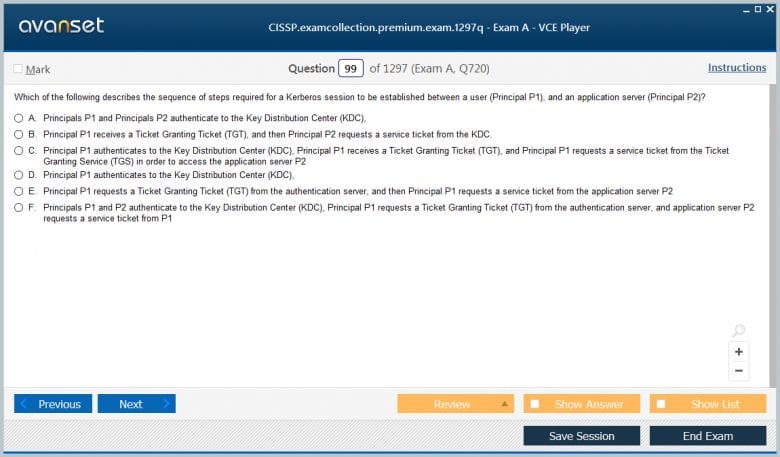
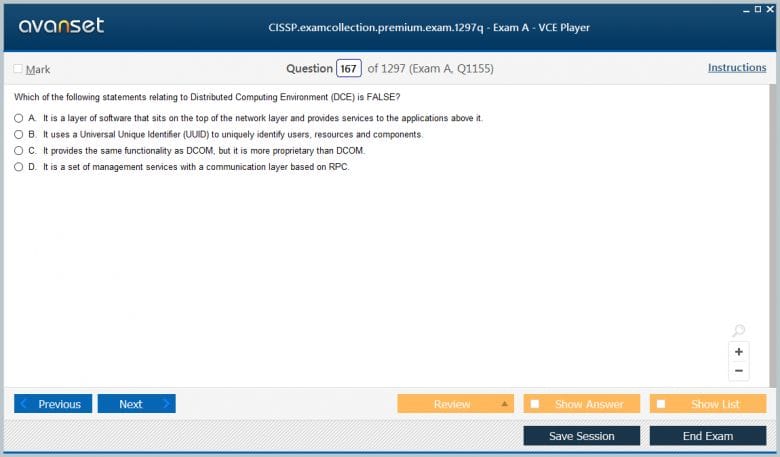
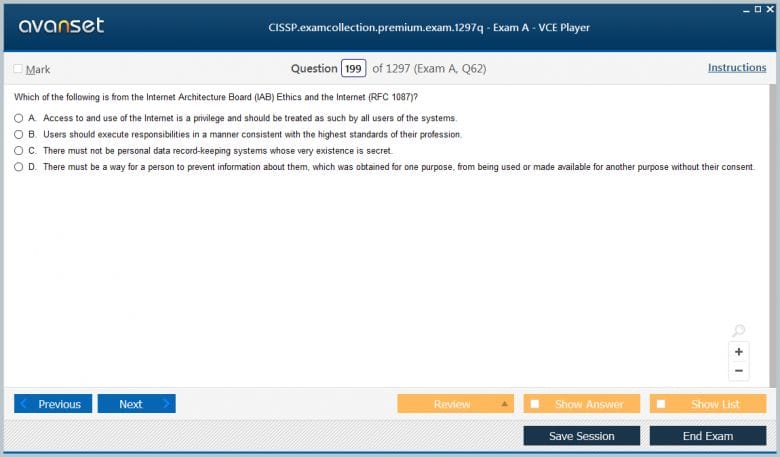
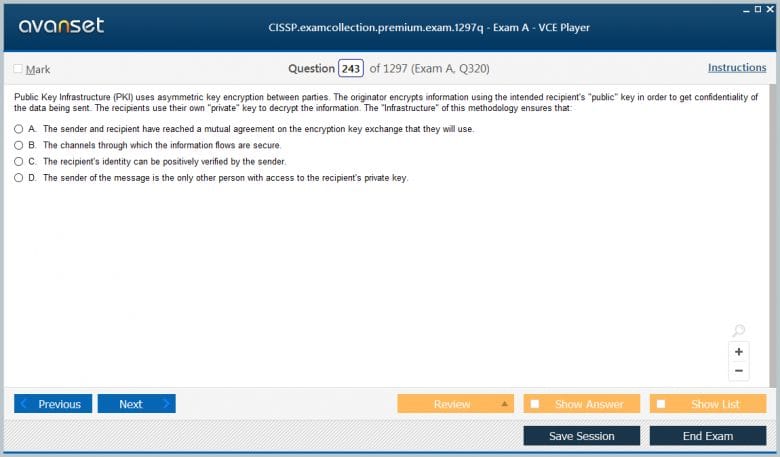
ISC CISSP Practice Test Questions in VCE Format
Archived VCE files
ISC CISSP Practice Test Questions, Exam Dumps
ISC CISSP (Certified Information Systems Security Professional) exam dumps vce, practice test questions, study guide & video training course to study and pass quickly and easily. ISC CISSP Certified Information Systems Security Professional exam dumps & practice test questions and answers. You need avanset vce exam simulator in order to study the ISC CISSP certification exam dumps & ISC CISSP practice test questions in vce format.
The Certified Information Systems Security Professional certification, widely known as CISSP, is one of the most respected and recognized credentials in the global information security industry. Offered by ISC2, formerly known as the International Information System Security Certification Consortium, this certification validates a professional's deep technical and managerial competence across a broad range of cybersecurity domains. It is designed for experienced security practitioners who have moved beyond entry-level roles and want to demonstrate that their expertise meets an internationally accepted standard of excellence.
Earning the CISSP is not a simple task, and that difficulty is precisely what makes it so valuable. The certification requires candidates to demonstrate not only theoretical knowledge but also the kind of practical judgment that comes from years of working in real security environments. Organizations across the globe, from financial institutions and healthcare providers to government agencies and technology firms, treat the CISSP as a gold standard credential when hiring for senior security roles. For professionals serious about building a lasting and impactful career in cybersecurity, the CISSP represents a defining milestone that separates experienced practitioners from the broader workforce.
The CISSP exam is structured around eight domains that together form what ISC2 calls the Common Body of Knowledge, or CBK. These domains cover Security and Risk Management, Asset Security, Security Architecture and Engineering, Communication and Network Security, Identity and Access Management, Security Assessment and Testing, Security Operations, and Software Development Security. Each domain represents a distinct area of cybersecurity practice, and together they reflect the full scope of responsibilities that senior security professionals are expected to manage across their careers.
Understanding all eight domains at a sufficient depth requires a significant investment of study time and practical exposure. Some domains such as Security and Risk Management and Security Operations carry higher weightings in the exam and therefore demand proportionally greater attention during preparation. Others such as Software Development Security may feel less familiar to candidates whose backgrounds are primarily in infrastructure or operations roles, requiring deliberate study to fill knowledge gaps. Successful candidates approach the CBK as an interconnected body of knowledge rather than eight separate subjects, recognizing that real-world security decisions routinely draw on multiple domains simultaneously.
Before sitting for the CISSP exam, candidates must meet specific professional experience requirements that distinguish this certification from entry-level credentials. ISC2 requires a minimum of five years of cumulative paid work experience in two or more of the eight CISSP domains. This experience requirement ensures that the certification remains meaningful as a signal of seasoned expertise rather than academic knowledge alone. Candidates who have completed a four-year college degree or an approved credential from ISC2's list of accepted certifications may waive one year of the experience requirement, reducing the minimum to four years.
Candidates who pass the exam but have not yet met the full experience requirement become an Associate of ISC2 and have six years to accumulate the necessary experience before earning the full CISSP designation. This pathway makes the certification accessible to talented professionals who are progressing rapidly through their careers but have not yet reached the five-year threshold. All CISSP candidates must also agree to adhere to the ISC2 Code of Ethics, which establishes professional conduct standards that credential holders are expected to uphold throughout their careers. The endorsement process, which requires a current CISSP in good standing to verify the candidate's professional experience, is completed after passing the exam.
The CISSP exam uses Computerized Adaptive Testing, commonly referred to as CAT, for English-language administrations. This format dynamically adjusts the difficulty of questions based on the candidate's performance throughout the test, delivering a more precise assessment of competency than a fixed-length exam would provide. The CAT version of the exam contains between 125 and 175 questions and must be completed within four hours. A passing score of 700 out of 1000 points is required, and the adaptive nature of the exam means that candidates cannot predict their result based on the number of questions they have answered.
For non-English administrations, the exam is delivered in a traditional linear format containing 250 questions with a six-hour time limit. Both formats cover all eight domains, though the weighting of questions across domains differs slightly. The CISSP exam is known for its scenario-based question style, which asks candidates to choose the best answer from options that may all be technically correct in some context. This approach tests the kind of risk-based judgment and situational reasoning that experienced security professionals apply in their work every day, rather than simple recall of definitions or procedures. Candidates who approach the exam expecting straightforward factual questions often find themselves unprepared for this higher-order thinking requirement.
A well-structured study plan is essential for CISSP success given the breadth and depth of material the exam covers. Most candidates spend between three and six months preparing, depending on their existing knowledge base and the amount of time they can dedicate to study each week. Beginning with a thorough review of the official ISC2 CISSP Study Guide gives candidates a comprehensive baseline across all eight domains and helps identify areas where their existing experience has left knowledge gaps that need to be addressed through focused study.
After building a foundational understanding of each domain, candidates should shift their focus toward practice questions and simulated exams that replicate the scenario-based format of the actual test. Working through thousands of practice questions not only reinforces content knowledge but also trains the analytical thinking style required to interpret CISSP questions correctly. Many experienced candidates recommend reading each answer option from the perspective of a senior security manager rather than a hands-on technical practitioner, because the exam consistently rewards strategic, policy-oriented thinking over purely technical responses. Scheduling study sessions consistently rather than cramming in the final weeks produces better retention and deeper conceptual integration across domains.
The market for CISSP preparation materials is large and varied, giving candidates many options for supplementing their study approach. The official ISC2 CISSP Study Guide, authored by Mike Chapple, James Michael Stewart, and Darril Gibson, remains the most widely recommended primary reference and covers all eight domains with sufficient depth to build a solid knowledge foundation. The Official ISC2 Practice Tests book from the same authors provides hundreds of domain-specific and mixed practice questions that align closely with the exam's style and difficulty level.
Beyond official materials, many candidates find significant value in Destination Certification's CISSP MindMap video series, which presents each domain visually and helps candidates see the relationships between concepts that written study guides sometimes obscure. Kelly Handerhan's CISSP course on Cybrary is another highly regarded free resource that many candidates cite as instrumental in helping them adopt the right mindset for exam questions. Thor Pedersen's CISSP course and Pete Zerger's thorough video content also enjoy strong reputations in the CISSP community. Combining written study guides with video instruction and extensive practice testing gives candidates multiple exposures to each concept in different formats, which strengthens retention and deepens comprehension across the full scope of the CBK.
Security and Risk Management is the largest and most heavily weighted domain in the CISSP exam, accounting for approximately 15 percent of the total question weight. It covers a wide range of foundational topics including security governance principles, compliance and legal requirements, professional ethics, security policies and frameworks, risk identification and treatment, threat modeling, business continuity planning, and personnel security. Because so many other security decisions flow from risk management principles, a strong command of this domain tends to improve performance across the entire exam.
Candidates should develop a thorough understanding of qualitative and quantitative risk analysis techniques, including how to calculate Annualized Loss Expectancy, Single Loss Expectancy, and Annualized Rate of Occurrence. The domain also requires familiarity with major security frameworks such as NIST, ISO 27001, COBIT, and ITIL, and the ability to distinguish when each framework is most applicable. Business continuity and disaster recovery concepts appear frequently in exam scenarios that test whether candidates can prioritize actions appropriately during crisis situations. The risk management domain rewards candidates who can think at a strategic level and evaluate security decisions through the lens of organizational risk tolerance rather than purely technical capability.
Cryptography is a technically demanding area of the CISSP curriculum that requires candidates to develop a solid conceptual understanding of how encryption systems work, even if they do not need to implement cryptographic algorithms at a mathematical level. The exam tests knowledge of symmetric and asymmetric encryption, hashing algorithms, digital signatures, public key infrastructure, certificate management, and the application of cryptographic controls to protect data confidentiality, integrity, and authenticity across various scenarios.
Candidates must understand the strengths, weaknesses, and appropriate use cases for major algorithms including AES, RSA, ECC, SHA-2, and SHA-3, as well as deprecated algorithms like DES and MD5 that remain relevant for exam purposes because they appear in questions about legacy systems and migration decisions. PKI concepts including certificate authorities, registration authorities, certificate revocation lists, and the Online Certificate Status Protocol are tested in the context of real-world scenarios involving secure email, SSL/TLS, code signing, and remote access systems. Understanding how cryptographic controls fit within a broader security architecture, and how failures in key management can undermine even technically strong encryption implementations, is the kind of integrated thinking the exam rewards in this domain.
The Communication and Network Security domain covers the protocols, technologies, and architectural principles that protect data as it moves across networks of all types. Candidates must demonstrate knowledge of the OSI and TCP/IP models, common network protocols and their security implications, network segmentation strategies, secure network design principles, and the technologies used to protect network infrastructure including firewalls, intrusion detection systems, VPNs, and network access control solutions.
Wireless security receives significant attention in this domain, with questions covering authentication protocols, encryption standards, and common attack vectors against wireless networks. Candidates should be familiar with the evolution from WEP through WPA to WPA3 and understand why earlier standards are considered insecure. Software-defined networking, cloud networking concepts, and the security implications of converged protocols are also tested, reflecting the reality that modern network environments are increasingly virtualized and distributed. The exam consistently tests whether candidates can evaluate network architecture decisions from a security perspective, identify weaknesses in proposed designs, and recommend improvements that reduce risk without unnecessarily constraining legitimate business operations.
Identity and Access Management is a domain that has grown substantially in importance as cloud adoption has shifted the security perimeter away from the network and toward user identities. The CISSP exam tests knowledge of identification and authentication mechanisms, authorization models including mandatory access control, discretionary access control, and role-based access control, as well as the technologies and protocols that implement these models in enterprise environments. Candidates must understand how identity federation, single sign-on, and directory services work and how they can be secured and configured correctly.
Privileged access management receives particular attention given the outsized risk that compromised administrative accounts represent in any environment. The exam tests concepts such as just-in-time access provisioning, credential vaulting, session monitoring, and the separation of duties controls that prevent any single individual from having unchecked access to critical systems. Identity lifecycle management, including provisioning, modification, and timely deprovisioning of access rights, is tested through scenarios that highlight the risks of orphaned accounts and excessive accumulated privileges. Candidates who have practical experience managing identity systems in enterprise environments will find this domain relatively intuitive, while those coming from more technical backgrounds may need to study the governance and policy dimensions more deliberately.
The Security Assessment and Testing domain covers the techniques, tools, and processes that security professionals use to evaluate the effectiveness of security controls and identify vulnerabilities before attackers can exploit them. This includes penetration testing methodologies, vulnerability scanning, code review practices, log review processes, and the management of security assessment programs. Candidates must understand the differences between various assessment types including vulnerability assessments, penetration tests, red team exercises, and security audits, as well as when each is appropriate given specific organizational goals and risk contexts.
Software testing concepts such as unit testing, integration testing, regression testing, fuzz testing, and interface testing appear in questions that connect the security assessment domain to software development security. Candidates should also be familiar with the OWASP Top Ten and common application vulnerabilities, not at the level of exploitation technique but at the level of understanding what controls prevent these vulnerabilities and how testing programs verify those controls are working. The exam tests whether candidates can design comprehensive assessment programs that provide meaningful assurance about security posture rather than simply checking compliance boxes, reflecting the mature, risk-focused perspective that distinguishes CISSP-level professionals from more junior practitioners.
The Software Development Security domain addresses the integration of security principles into the software development lifecycle, a topic that has become increasingly critical as applications have become the primary attack surface in most organizations. Candidates must understand secure coding principles, common software vulnerabilities and their root causes, security testing techniques specific to software, and the governance structures that organizations use to ensure developers follow secure development standards. The domain covers both traditional waterfall development models and modern agile and DevSecOps approaches to security integration.
Database security, including controls for protecting data stored in relational and non-relational databases, is an important subtopic within this domain. Candidates should understand injection attack types, improper input validation vulnerabilities, and the controls such as parameterized queries and stored procedures that prevent them. The software development security domain also covers acquired software security, including the evaluation and procurement of third-party software, open-source components, and software as a service offerings. As supply chain attacks have become an increasingly significant threat vector, the ability to evaluate and manage the security risks associated with software dependencies has taken on greater importance in both the exam and in real-world security programs.
Security Operations is one of the most experience-heavy domains in the CISSP curriculum, covering the day-to-day activities that keep security programs functioning effectively once controls are in place. This includes incident response procedures, evidence collection and handling, digital forensics principles, disaster recovery operations, patch and vulnerability management, and the management of security services such as logging, monitoring, and alerting. Candidates must understand how these operational activities connect to broader risk management goals and how to prioritize them effectively given the resource constraints that real organizations face.
The chain of custody concept, which governs how evidence is collected, documented, transferred, and preserved to ensure its admissibility in legal proceedings, is a critical topic within this domain. Candidates should also understand the differences between various types of recovery sites including hot, warm, and cold sites, as well as more modern approaches such as cloud-based disaster recovery. The exam tests incident response through multi-step scenarios that require candidates to identify the correct sequence of actions, recognizing that mistakes in the early stages of incident response such as failing to contain an incident before beginning eradication can significantly worsen the ultimate outcome. Strong operational instincts developed through real-world experience are a significant advantage in this domain.
Earning the CISSP is not the end of a professional commitment but the beginning of an ongoing relationship with ISC2 that requires active maintenance. Certified professionals must earn 120 Continuing Professional Education credits, known as CPE credits, over each three-year certification cycle and pay an Annual Maintenance Fee to keep their credential in good standing. CPE credits can be earned through a wide variety of activities including attending security conferences, completing training courses, writing security-related articles, participating in volunteer activities, and contributing to security research or professional associations.
The CPE requirement serves an important function beyond simple credential maintenance. It ensures that CISSP holders remain engaged with the evolving security landscape and continue to develop their knowledge as new threats, technologies, and regulatory requirements emerge. Many certified professionals find that the CPE process naturally aligns with their existing professional development activities, making it less of a burden than it initially appears. ISC2's own events, including the Security Congress conference held annually, offer substantial CPE opportunities alongside valuable networking and learning experiences. Treating the CPE requirement as a professional development planning tool rather than an administrative obligation keeps certified professionals growing consistently throughout their careers.
The financial rewards associated with the CISSP certification are among the most compelling reasons professionals pursue it. According to multiple industry compensation surveys, CISSP-certified professionals consistently earn significantly higher salaries than their non-certified peers, with the premium ranging from 15 to 25 percent depending on role, location, and years of experience. In major technology markets such as the United States, United Kingdom, Singapore, and Australia, senior security professionals holding the CISSP regularly command six-figure salaries, with roles such as Chief Information Security Officer, Security Architect, and Security Consultant often reaching well above that threshold.
Beyond direct compensation, the CISSP opens access to opportunities that are simply not available to uncertified candidates. Many government contracts and defense industry positions in the United States require security professionals to hold specific certifications including CISSP, and the same is true for positions involving certain compliance frameworks that specify credential requirements for personnel in key security roles. International career mobility is also enhanced by the CISSP's global recognition, as the credential carries consistent prestige across different national markets in a way that regionally specific certifications cannot match. For professionals with global ambitions, the CISSP provides a universally understood signal of competence that facilitates career transitions across borders and industries.
Despite the high caliber of most CISSP candidates, a significant portion fail on their first attempt, often due to avoidable preparation mistakes. One of the most common reasons for failure is approaching the exam with a purely technical mindset and answering questions based on what is technically correct rather than what is most appropriate from a senior management perspective. Many candidates with strong hands-on technical skills struggle when questions ask them to choose between two technically valid options and the correct answer is the one that prioritizes risk management, business continuity, or policy considerations over operational efficiency.
Another frequent failure mode is insufficient practice with scenario-based questions. Candidates who study predominantly from textbooks and lecture videos without completing thousands of practice questions often find the actual exam's question style disorienting, because understanding concepts and applying them under exam conditions to ambiguous real-world scenarios are fundamentally different cognitive tasks. Time management is also a factor, as the pressure of the adaptive format can cause candidates to second-guess themselves and spend excessive time on individual questions. Developing a consistent approach to eliminating wrong answers systematically, maintaining a steady pace, and committing to an answer without excessive deliberation are skills that practice exams develop but textbook study alone cannot provide.
The CISSP certification represents one of the most significant professional investments a cybersecurity practitioner can make, and the returns on that investment extend far beyond a salary increase or a credential to display on a resume. It fundamentally changes how professionals think about security, shifting their perspective from the tactical and technical toward the strategic and organizational. Candidates who complete the preparation process thoroughly emerge with a coherent mental framework for evaluating security decisions that integrates risk management, business context, legal compliance, and technical capability into a unified approach that serves them throughout the remainder of their careers.
The journey to CISSP certification is demanding by design, and that demand is the source of its value. Organizations that require or prefer CISSP-certified professionals do so because they have learned from experience that the credential reliably identifies individuals who can be trusted with significant security responsibilities, who communicate effectively with both technical teams and executive leadership, and who bring a structured, principled approach to solving complex security challenges. These qualities are difficult to assess through job interviews alone, and the CISSP provides a credible third-party validation that reduces hiring uncertainty for employers and opens doors for candidates.
For professionals currently in the early or middle stages of their cybersecurity careers, the path to CISSP begins with deliberate accumulation of experience across multiple security domains, followed by systematic preparation that combines comprehensive study with extensive practical application of concepts. Those who treat the certification as a long-term goal and build steadily toward it through consistent professional development, active community involvement, and ongoing hands-on work will find that the preparation process itself makes them more capable practitioners before they ever sit for the exam. The skills sharpened during CISSP preparation, including risk-based decision making, cross-domain integration of security concepts, and the ability to evaluate security trade-offs from an organizational perspective, are precisely the skills that distinguish security leaders from security technicians.
In a field where threats evolve rapidly and the stakes of security failures are measured in regulatory penalties, reputational damage, and genuine harm to individuals whose data is compromised, the value of proven, certified expertise has never been greater. The CISSP is not simply a career credential. It is a commitment to professional excellence, ethical conduct, and continuous growth in service of the organizations and individuals that security professionals are trusted to protect. For those willing to make that commitment and invest the effort required to earn it honestly, the CISSP remains an unmatched accelerant for a long, impactful, and rewarding career in information security.
Go to testing centre with ease on our mind when you use ISC CISSP vce exam dumps, practice test questions and answers. ISC CISSP Certified Information Systems Security Professional certification practice test questions and answers, study guide, exam dumps and video training course in vce format to help you study with ease. Prepare with confidence and study using ISC CISSP exam dumps & practice test questions and answers vce from ExamCollection.
Purchase Individually

ISC CISSP Video Course
Top ISC Certifications
Top ISC Certification Exams
Site Search:

SPECIAL OFFER: GET 10% OFF

Pass your Exam with ExamCollection's PREMIUM files!
SPECIAL OFFER: GET 10% OFF
Use Discount Code:
MIN10OFF
A confirmation link was sent to your e-mail.
Please check your mailbox for a message from support@examcollection.com and follow the directions.

Download Free Demo of VCE Exam Simulator
Experience Avanset VCE Exam Simulator for yourself.
Simply submit your e-mail address below to get started with our interactive software demo of your free trial.
Does any pass CISSP exam with this CISSP Dump Q384
Why are there no comments for 2022. How can you validate the content is still valid?
@Addison, congratulations! Was it the premium dump of 289Q you used to study and pass the exam please?
doesnt look right
@Lily, congratulations! Are you saying you only used the premium 289Q to study and pass the exam?
I was recommended to use Examcollection. The dump is valid and it helped mw to pass the exam with high score!
CISSP is great! Plenty questions. However i still recommend to use others books and courses.
I didn't understand first how to open it, you need to use additional software! But the file is valid. I like how convenient it is!
This course is helpful and valid. I'm happy I've passed the exam! No doubts will use Examcollection again!
i failed the exam before, will retake it soon, hope this dump is valid.
Is this Premium Exam Still Valid?? Did anyone pass with these??
Is this question still valid?
Hi, Is anyone passed the exam using this premium version of this dump? Thank you.
Is premium valid?
Is the premium file valid?
Does anyone know if this is valid?
guys, any update on the validity of the premium file? anyone passed using it?
Scheduled to take the test in a week - is this dump valid still for March 2019? I've studied and hope I'm ready but every little bit helps!
anyone passed ?
anyone passed used the premium dump?
See is this valid on tmr exam
@Peter, CISSP 2018 and the other CISSP exam are the same. CISSP 2018 exam is believe to be about the material that came out in 2018 and the other one came before that.....
How does CISSP 2018 differ from the other CISSP exam? I see one have 289 Questions and the other over a 1000
anyone too the cissp cat exam recently in past 2-3 months? are the questions accurate? please guide
@kirmani, you pass with the premium dump
Kirmani, did you take the CAT format exam?
Brian did you pass using this dump?
excellent!! all Qns from this dumps. i passed.
Lmao valid with 32 questions?
Did anyone pass with this dumps
Wow!! it's valid
@moreal, just have a piece of mind. go thru’ all the materials here and i can assure you cissp exam files are just with you right there. That is how I passed.
hi guys,,,how is cissp certification exam for those who did.i am preparing currently,,,besides you can help with the best materials you have.
anyone with the manual on how to use vce player to handle premium files for cissp. i have got a problem.dont know whether it is the installation or my computer configurations are not compatible with the software.
who has used some materials here and found out the validity, i have revised using cissp braindumps and i can confirm they are valid.i recommend it to you guys.
ooh,I like how cissp questions and answers are set because as an individual you can come up with a pattern that will enable you to predict the main exam setting at last.
hey…comrades. do not try to use cissp premium files before training. the questions are so though that you need to familiarize with the concepts first. do not mess up early before main exam.
i consider very beneficial to use cissp braindump 2018 while training so that you can identify concept regarding the questions. i have found out that it works.
how beneficial is vce player when used with cissp dumps 2018. i am trying to figure out the best alternative to use during my revision.
i usually trust this site for the best revision of IT exams. i think the staff that is concerned with updating cissp exam should do a lot of work in ensuring the quality of this website is maintained.
anyone with a success story of cissp practice test? Where to get them? i ned someone to motivate me as i am preparing for this particular exam.
great moments are associated with success. i have passed my first IT exam after going through several cissp dumps. they are the key of my success at the exam.