



Premium File
1081 Q&A
$76.99$69.99
ISC SSCP Exam Questions & Answers, Accurate & Verified By IT Experts
Instant Download, Free Fast Updates, 99.6% Pass Rate

SSCP Premium File: 1081 Questions & Answers
Last Update: Nov 01, 2026
SSCP Training Course: 94 Video Lectures
SSCP PDF Study Guide: 814 Pages
$79.99
ISC SSCP Exam Screenshots
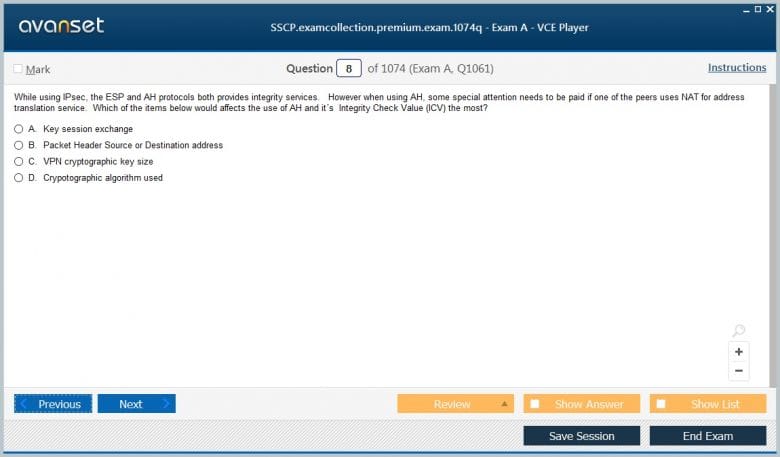
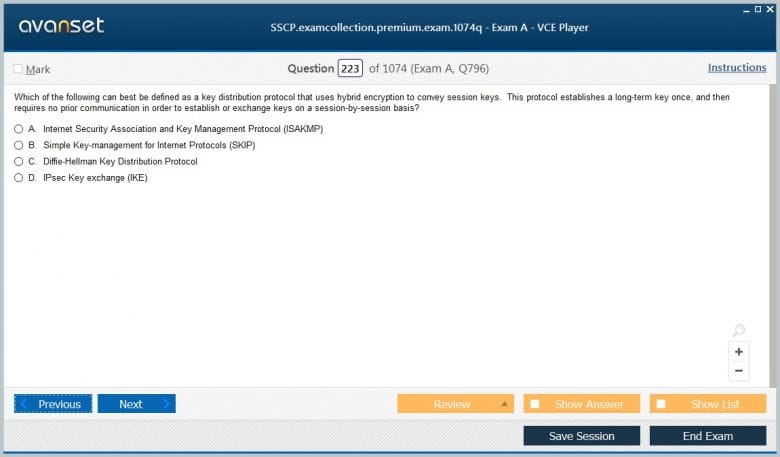
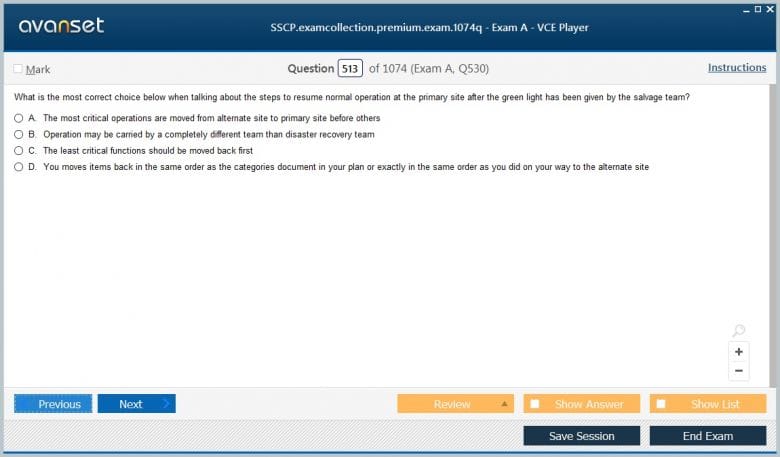
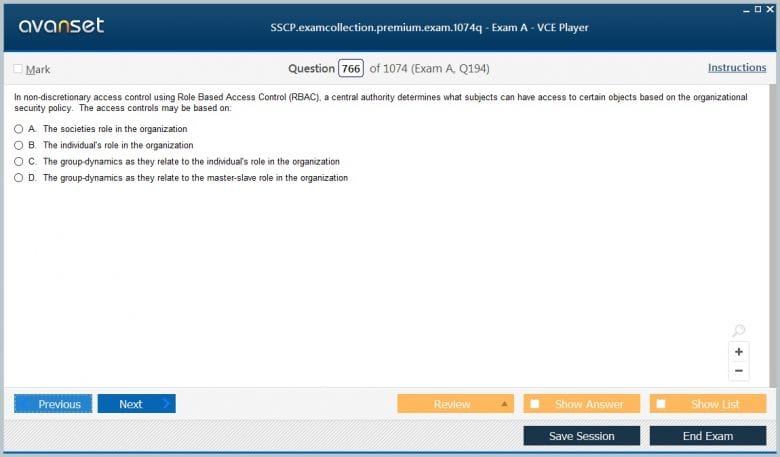
ISC SSCP Practice Test Questions in VCE Format
| File | Votes | Size | Date |
|---|---|---|---|
File ISC.testkings.SSCP.v2026-08-18.by.clara.570q.vce |
Votes 1 |
Size 3.15 MB |
Date Aug 18, 2026 |
File ISC.Train4sure.SSCP.v2019-06-08.by.Monika.560q.vce |
Votes 6 |
Size 2.47 MB |
Date Jun 10, 2019 |
File ISC2.SelfTestEngine.SSCP.v2011-04-21.by.Albert.265q.vce |
Votes 4 |
Size 111.96 KB |
Date Apr 21, 2011 |
Archived VCE files
| File | Votes | Size | Date |
|---|---|---|---|
File ISC2.SelfTestEngine.SSCP.v2010-08-02.by.Reavan.260q.vce |
Votes 2 |
Size 108.17 KB |
Date Aug 04, 2010 |
ISC SSCP Practice Test Questions, Exam Dumps
ISC SSCP (System Security Certified Practitioner (SSCP)) exam dumps vce, practice test questions, study guide & video training course to study and pass quickly and easily. ISC SSCP System Security Certified Practitioner (SSCP) exam dumps & practice test questions and answers. You need avanset vce exam simulator in order to study the ISC SSCP certification exam dumps & ISC SSCP practice test questions in vce format.
SSCP, the Systems Security Certified Practitioner, is a current ISC2 credential aimed at hands-on security and infrastructure professionals. The current exam outline took effect on October 1, 2025. ISC2 uses computerized adaptive testing for the English exam: candidates receive 100–125 items in two hours and need a scaled score of 700 out of 1000. The seven domains cover Security Concepts and Practices, Access Controls, Risk Identification/Monitoring/Analysis, Incident Response and Recovery, Cryptography, Network and Communications Security, and Systems and Application Security.
SSCP sits between entry-level security knowledge and broader senior credentials. It requires one year of qualifying experience in at least one current domain, although an approved degree can satisfy that experience pathway and candidates without the required experience can first become an Associate of ISC2. The wider ISC2 certifications include CISSP, but SSCP is more operational: the exam repeatedly asks what a practitioner should implement, monitor, configure, investigate, or recover in a working environment.
Operational security is where governance becomes configuration and daily behavior. Policies may require least privilege, secure change, asset protection, logging, and incident handling, but administrators and analysts must translate those requirements into accounts, permissions, baselines, monitoring rules, patch cycles, backup routines, and response procedures. SSCP candidates should be able to recognize the difference between a governance statement and an implementation control, and they should know when an issue requires escalation rather than an improvised technical workaround.
Security concepts also include confidentiality, integrity, availability, privacy, nonrepudiation, accountability, and defense in depth. These principles help prioritize decisions when a question presents several technically possible actions. For example, a change that improves confidentiality but creates a single point of failure may reduce one risk while increasing another. SSCP rewards balanced operational judgment: secure systems must remain usable, recoverable, supportable, and aligned with organizational requirements.
Access management begins before authentication. Organizations need identity proofing, account provisioning, appropriate role or attribute assignment, periodic review, privileged-access control, and timely deprovisioning. Authentication factors strengthen confidence in identity, while authorization determines what the authenticated subject may actually do. Candidates should understand why multi-factor authentication does not correct excessive permissions and why disabling an account is different from revoking application tokens, service credentials, or cached access.
Operational teams also manage shared accounts, service identities, emergency access, remote access, and administrative sessions. Least privilege is strongest when privileges are bounded by task, time, and system scope. Logs should provide enough evidence to attribute important actions, but collecting logs without review does not create accountability. The approved SSCP and other security certifications is useful for understanding why this practical access-control emphasis distinguishes the credential from broader or more management-oriented security paths.
Risk identification is not limited to annual assessments. Operational teams observe vulnerabilities, failed controls, configuration drift, vendor advisories, threat intelligence, anomalous activity, and changes to assets or business processes. Those observations may change likelihood or impact and should feed the organization’s risk process. Candidates should understand qualitative and quantitative concepts, but the practical emphasis is on recognizing meaningful indicators and escalating them with enough context for owners to act.
Vulnerability management illustrates the difference between data and decision. A scanner produces findings, not priorities. Teams need asset context, exploitability, exposure, control coverage, business criticality, remediation options, and exception handling. A lower-severity issue on an internet-facing identity service may deserve faster action than a higher score on an isolated lab host. SSCP also expects awareness of baseline compliance, change monitoring, and continuous improvement because operational risk changes whenever systems, threats, or dependencies change.
Monitoring becomes useful only when events can be interpreted in context. A failed login from a known user may be routine, while repeated failures followed by a privileged success from an unusual location may justify investigation. Asset criticality, identity, vulnerability state, network position, and recent change history can all affect the meaning of the same alert. SSCP scenarios often reward this operational judgment: collect enough evidence to understand significance, preserve what may be needed later, and escalate according to risk rather than responding mechanically to every event at the same severity.
An incident plan should define roles, communications, escalation, evidence handling, containment authority, and coordination with legal, privacy, business, and external parties. When an alert arrives, analysts need to distinguish events from incidents, preserve relevant evidence, establish scope, and choose containment actions that reduce harm without unnecessarily destroying forensic value or critical operations. The sequence of preparation, detection and analysis, containment, eradication, recovery, and lessons learned is useful, but real incidents often move between phases as new evidence appears.
Recovery is part of response rather than a separate afterthought. Teams need clean restoration points, validated backups, known-good configurations, and criteria for returning systems to production. Monitoring should continue after recovery because attackers may have created persistence or compromised credentials that survive a rebuild. Lessons learned should generate tracked improvements to controls, logging, documentation, training, and architecture. The goal is not just to close the ticket; it is to reduce the probability or impact of recurrence.
SSCP candidates should understand the purpose of symmetric and asymmetric encryption, hashing, digital signatures, certificates, key exchange, and public key infrastructure without treating cryptography as pure mathematics. Operational failures often come from key management rather than broken algorithms: weak generation, poor storage, excessive access, expired certificates, unplanned rotation, lost recovery material, or continued use of deprecated protocols can undermine otherwise strong cryptography.
The correct protection depends on the objective. Encryption provides confidentiality, hashes support integrity checks, signatures can provide integrity and origin assurance, and certificates bind public keys to identities through a trust model. Transport encryption protects data in motion but may not protect it after decryption at an endpoint. Full-disk encryption protects lost devices but does not prevent an authenticated user from accessing data. SSCP questions often reward candidates who identify the actual threat and choose the control that addresses it.
Networks expose systems to one another, so segmentation, routing, filtering, secure protocols, wireless controls, remote access, and monitoring all shape attack paths. Candidates should understand firewalls, proxies, intrusion detection and prevention, network access control, VPNs, DNS security considerations, secure management interfaces, and the security implications of common protocols. The point is not memorizing port numbers in isolation; it is understanding what trust a connection creates and how that trust can be constrained.
Availability and resilience also matter. Redundant links, load balancing, denial-of-service protection, failover, and capacity planning help maintain service during faults or attacks. Cloud and software-defined networking change implementation details but not the core operational questions: which source may reach which destination, through what control, using which identity, and what telemetry records the decision. A secure network is one whose intended paths are explicit and whose unexpected behavior can be detected and investigated.
Operating systems, endpoints, servers, mobile devices, applications, containers, and cloud services all need configuration baselines. Hardening typically removes unnecessary services, restricts privilege, applies secure settings, protects management interfaces, and enables appropriate logging. Patching then addresses known vulnerabilities, but patching must be balanced with testing, maintenance windows, compatibility, and emergency-change procedures. Configuration drift is a risk because a system can become insecure without any software vulnerability being newly discovered.
Application security is also operational. Teams manage web servers, databases, middleware, authentication services, secrets, APIs, and dependencies after deployment. Secure development practices help, but production protections such as web application firewalls, runtime monitoring, backup, input validation configuration, and database permissions still matter. SSCP candidates should understand where operational teams can reduce risk even when they do not control application source code.
Operational security depends on knowing what normal configuration looks like and controlling the ways it changes. Baselines should cover operating systems, services, administrative interfaces, logging, network exposure, identity settings, patch state, and other controls relevant to the environment. A change that improves functionality can still weaken security by opening a port, changing a service account, disabling logging, or introducing a dependency with different privilege requirements. SSCP candidates should therefore connect configuration management, change approval, vulnerability information, testing, and post-change monitoring rather than treating patching as an isolated maintenance activity.
The same reasoning applies to cloud and virtualized environments where configuration can be created through templates and automation. Speed does not remove the need for accountability. Teams need to know who can change infrastructure definitions, how changes are reviewed, how secrets are handled, what evidence is retained, and how drift is detected after deployment. Good operational practice uses repeatable configuration to reduce variance while preserving a controlled exception process for systems that cannot follow the default baseline.
The most effective review method is to build scenarios that cross domains. Consider a compromised administrator account: access control explains the privilege, monitoring reveals suspicious behavior, risk analysis prioritizes affected systems, incident response contains the account, cryptography may require certificate or key rotation, network controls restrict lateral movement, and system hardening closes the exploited path. Cross-domain reasoning is closer to real operations than memorizing seven separate lists.
Candidates comparing SSCP with CISSP should also be clear about level and role. The approved SSCP and CISSP discussion provides additional context, while SSCP training can support structured review. The exam itself is best approached from an operator’s perspective: implement controls correctly, observe systems continuously, preserve evidence, recover safely, and know when operational findings must become enterprise risk decisions.
Go to testing centre with ease on our mind when you use ISC SSCP vce exam dumps, practice test questions and answers. ISC SSCP System Security Certified Practitioner (SSCP) certification practice test questions and answers, study guide, exam dumps and video training course in vce format to help you study with ease. Prepare with confidence and study using ISC SSCP exam dumps & practice test questions and answers vce from ExamCollection.
Purchase Individually


ISC SSCP Video Course

Top ISC Certifications
Top ISC Certification Exams
Site Search:

SPECIAL OFFER: GET 10% OFF

Pass your Exam with ExamCollection's PREMIUM files!
SPECIAL OFFER: GET 10% OFF
Use Discount Code:
MIN10OFF
A confirmation link was sent to your e-mail.
Please check your mailbox for a message from support@examcollection.com and follow the directions.

Download Free Demo of VCE Exam Simulator
Experience Avanset VCE Exam Simulator for yourself.
Simply submit your e-mail address below to get started with our interactive software demo of your free trial.
@lewis003, practice tests for ISC SSCP exam are also helpful. They make you familiar with exam questions, answers, as well as exam structure. What I like most is the vce player that simultaes the real exam environment. The feeling was as if I was taking the real test. Great tools, use them together!
@alex, don’t take ISC SSCP exam dumps for granted. they are the best materials to complement your training or the options you’ve chosen and completed. these dumps are great to identify your weak areas and pay attention to them. as for me, they are valid since they helped me pass the exam.
@lewis003, i have used them in my preparation for the exam and scored above the pass mark. in my opinion, they contain reliable ISC SSCP questions and answers that can help you perform excellently in the exam. I can say that these files are the best tool to prepare for the certification exam.
are the ISC SSCP dumps valid and can they help me pass the exam or should i just ignore them?
hey guys? is there anyone who has used the ISC SSCP vce files and passed the exam? were they helpful?
hi! i used everything available on this website for preparation pass SSCP exam. I started from the study guide and training courses. Having enough knowledge I started practicing free ISC SSCP braindumps. from them, i learned how to answer different types of questions that are frequently tested in the actual exam. examcollection, thanks for helping me pass the test!