



Premium File
212 Q&A
$76.99$69.99
ISC CISSP-ISSEP Exam Questions & Answers, Accurate & Verified By IT Experts
Instant Download, Free Fast Updates, 99.6% Pass Rate
212 Questions & Answers
Last Update: Oct 21, 2026
$69.99
ISC CISSP-ISSEP Exam Screenshots
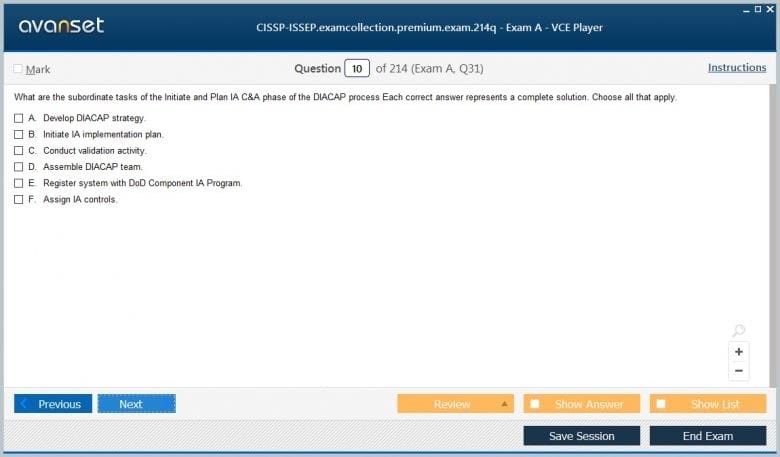
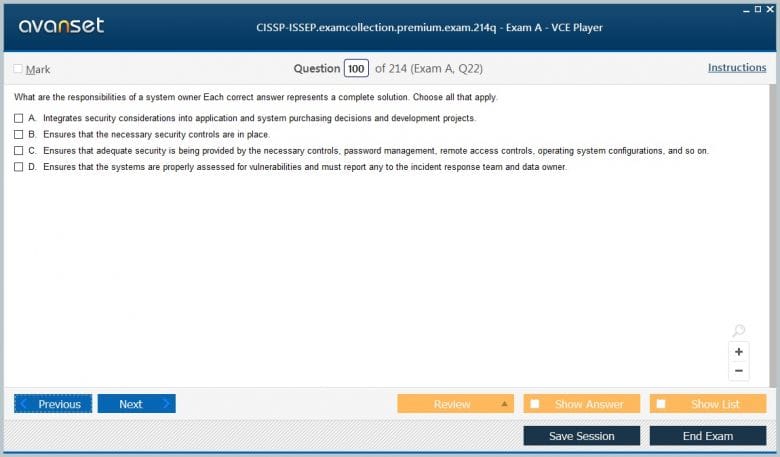
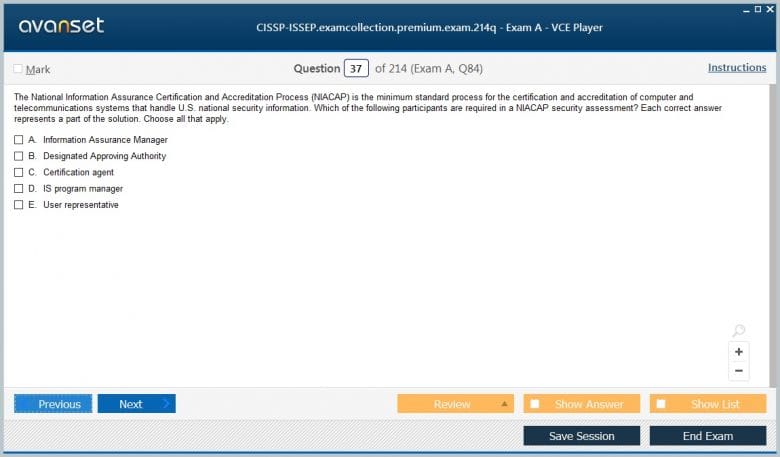
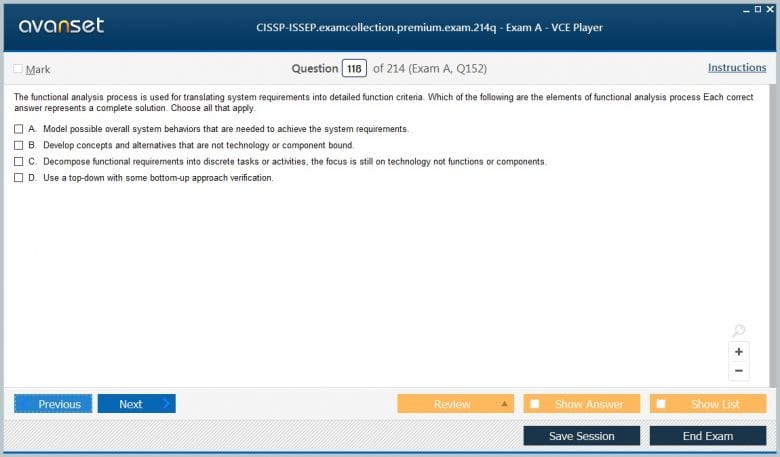
ISC CISSP-ISSEP Practice Test Questions in VCE Format
| File | Votes | Size | Date |
|---|---|---|---|
File ISC.actualtests.CISSP-ISSEP.v2026-10-06.by.chloe.118q.vce |
Votes 1 |
Size 128.16 KB |
Date Oct 07, 2026 |
ISC CISSP-ISSEP Practice Test Questions, Exam Dumps
ISC CISSP-ISSEP (Information Systems Security Engineering Professional) exam dumps vce, practice test questions, study guide & video training course to study and pass quickly and easily. ISC CISSP-ISSEP Information Systems Security Engineering Professional exam dumps & practice test questions and answers. You need avanset vce exam simulator in order to study the ISC CISSP-ISSEP certification exam dumps & ISC CISSP-ISSEP practice test questions in vce format.
ISSEP is ISC2’s Information Systems Security Engineering Professional concentration. The current exam outline took effect on 1 August 2025. The examination is three hours with 125 items and a passing score of 700 out of 1000. Its five domains are Systems Security Engineering Foundations at 24%, Risk Management at 20%, Security Planning and Engineering at 22%, Systems Security Implementation, Verification and Validation at 20%, and Secure Operations, Change Management and Disposal at 14%. The structure emphasizes engineering discipline across a complete system lifecycle.
Candidates may qualify with CISSP in good standing plus two years of relevant experience, or through ISC2’s longer direct experience route. ISSEP differs from ISSAP in emphasis: architecture defines structures and design direction, while systems security engineering focuses on requirements, traceability, integration, verification, validation, operations, and controlled change. Within ISC2 credentials, it is the concentration for professionals who need security to survive the transition from concept to implemented, tested, maintained system.
Security engineering is strongest when it is part of the same lifecycle used to define, build, integrate, test, operate, and retire the system. Parallel security paperwork created after design decisions have already been made is less effective because constraints and interfaces are already fixed. ISSEP candidates should understand how security activities align with systems engineering, project management, configuration management, quality assurance, and information management.
The engineering view also treats hardware, software, data, people, procedures, facilities, and external services as parts of one system. Security requirements can fail at interfaces even when individual components are strong. A secure software module may still rely on an insecure update channel or a poorly protected administrator workstation. The engineer’s task is to reason across the system boundary and keep security objectives traceable as the design evolves.
Weak requirements such as “use strong security” cannot be verified. Engineering turns stakeholder needs, mission objectives, threats, regulations, and risk constraints into requirements that state what protection is needed and under what conditions. Requirements should be traceable to sources and later to design elements, implementation evidence, and verification results. Traceability makes change impact visible because teams can see which security objective depends on an altered component.
Requirements analysis also exposes conflict. Security may compete with latency, safety, usability, cost, or maintainability. The engineer should identify those tensions early and document the trade-off rather than allowing implementation teams to resolve them informally. Risk management supports that decision by showing which consequences matter most and what residual exposure remains if a requirement is relaxed.
Requirement traceability also supports assurance arguments. When an auditor, authorizing official, customer, or safety stakeholder asks why a particular control exists, the team should be able to trace it back to a threat, regulation, mission need, or design constraint. Conversely, every critical requirement should map forward to an implementation element and verification evidence. Gaps in either direction reveal requirements that were never implemented or controls that exist without a clear objective.
ISSEP treats risk as an engineering input and a recurring activity. Threats, vulnerabilities, likelihood, impact, mission consequences, and constraints inform requirements and design. As the system becomes more concrete, new information can change the assessment. A prototype may reveal a performance limitation; supplier information may reveal a dependency; testing may expose an attack path. Risk documents therefore need to evolve with the design rather than remain fixed at project initiation.
Risk treatment can influence architecture, component selection, interfaces, verification effort, redundancy, monitoring, and operational procedures. The engineer also needs to distinguish accepted residual risk from unresolved defects. A known weakness may be acceptable under documented constraints and compensating controls, while an untracked finding simply represents unmanaged uncertainty. Engineering discipline makes those states visible to decision-makers.
Security planning develops concepts of operation, security contexts, requirements baselines, allocation of functions, and detailed design. Principles such as least privilege, layered defense, fail-safe defaults, separation of duties, resilience, and secure-by-default behavior should be applied to specific system elements. The design needs enough detail that implementers can build it consistently and testers can verify the intended behavior.
Trade studies are part of the work. One design may offer stronger isolation but higher latency; another may simplify maintenance while concentrating privilege. Engineers compare alternatives against requirements, lifecycle cost, reliability, threat exposure, and verification complexity. This is where ISSEP and architecture overlap, but ISSEP keeps the engineering lifecycle visible: the chosen design must be buildable, testable, supportable, and traceable to requirements.
Even a sound design can fail during implementation. Configuration errors, interface assumptions, undocumented defaults, build dependencies, and integration shortcuts can create vulnerabilities. ISSEP candidates should understand secure implementation, supply-chain considerations, configuration baselines, version control, deployment processes, and the need to protect build and integration environments. Security engineers need evidence that components were assembled according to the approved design.
DevSecOps can support this by automating tests and policy checks inside delivery pipelines, but automation is not a substitute for engineering judgment. The approved discussion of secure software development is useful where software is a major system component. ISSEP extends the concern to hardware, infrastructure, data, interfaces, and operational procedures that may not live in the application source repository.
Integration testing should focus on assumptions between components. One subsystem may validate input while another assumes it was already validated; two products may use different interpretations of identity or time; a failover component may not enforce the same policy as the primary. These interface failures are difficult to discover by testing components independently. Systems security engineering therefore emphasizes end-to-end behavior and the conditions under which components interact.
Verification asks whether the system was built according to specified requirements and design; validation asks whether the resulting system satisfies stakeholder needs in its intended environment. Both matter. A control can be implemented exactly as specified yet fail to reduce the real operational risk if the requirement was incomplete. Test plans should map to requirements and include appropriate methods such as analysis, inspection, demonstration, automated testing, penetration testing, or formal techniques where justified.
Findings should feed back into risk analysis and configuration control. If a change is required, teams need to know which requirements, interfaces, documentation, and tests are affected. Acceptance criteria should be defined before testing so results are not rationalized after the fact. The strongest engineering evidence creates a traceable chain from stakeholder need to security requirement to implementation to verified result.
Verification planning should start early enough to influence design. A requirement that cannot be practically tested may need to be rewritten, instrumented, or supported with additional evidence. Testability is an engineering property. Systems with strong logging, diagnostic interfaces, deterministic configurations, and controlled test environments are easier to assure than systems where security behavior is opaque. Designing for verification reduces later uncertainty and can lower the cost of accreditation or acceptance.
After deployment, operations introduce patches, new users, new interfaces, scaling changes, emergency fixes, and new threats. Change management evaluates whether those changes alter security assumptions or invalidate previous evidence. Continuous monitoring, incident response, vulnerability management, maintenance procedures, and configuration management help keep the operational system aligned with the engineered baseline.
Operations also provide feedback that design teams could not know in advance. Incident patterns, false positives, performance constraints, and user workarounds can reveal weaknesses in requirements or controls. Engineers should use that information to refine the system. Secure maintenance is therefore part of engineering continuity, not a separate operations concern handed off after acceptance.
Configuration drift is an engineering problem because it changes the system that was actually verified. Baselines, automated configuration checks, signed artifacts, controlled deployment paths, and change records help operations demonstrate that the production system still corresponds to approved requirements. When drift is necessary, the new state should become an explicit engineering decision rather than an undocumented exception that silently invalidates previous assurance.
Systems eventually reach end of life, but their data, credentials, licenses, hardware, cloud resources, and external integrations can remain risky after users stop accessing the service. ISSEP includes disposal because secure engineering must define how sensitive information is retained or destroyed, how cryptographic material is revoked, how interfaces are disabled, how records are preserved, and how dependencies are removed without breaking other systems.
A practical way to prepare is to follow one system from concept through retirement. Write security requirements, allocate them to components, identify risks, design controls, define verification methods, introduce implementation defects, handle change requests, respond to an incident, and then decommission the system. That exercise makes the five domains feel like one engineering process and clarifies why ISSEP is more lifecycle-oriented than a general security architecture or management certification.
Decommissioning should also remove trust relationships. DNS entries, API keys, certificates, service accounts, firewall rules, federated applications, monitoring exceptions, and supplier access can survive after a system is retired. Those remnants may become attack paths because nobody expects them to be active. A secure disposal plan includes dependency discovery and post-removal validation so the organization knows the retired system no longer has operational authority or sensitive data.
Go to testing centre with ease on our mind when you use ISC CISSP-ISSEP vce exam dumps, practice test questions and answers. ISC CISSP-ISSEP Information Systems Security Engineering Professional certification practice test questions and answers, study guide, exam dumps and video training course in vce format to help you study with ease. Prepare with confidence and study using ISC CISSP-ISSEP exam dumps & practice test questions and answers vce from ExamCollection.
Purchase Individually
Top ISC Certifications
Top ISC Certification Exams
Site Search:

SPECIAL OFFER: GET 10% OFF

Pass your Exam with ExamCollection's PREMIUM files!
SPECIAL OFFER: GET 10% OFF
Use Discount Code:
MIN10OFF
A confirmation link was sent to your e-mail.
Please check your mailbox for a message from support@examcollection.com and follow the directions.

Download Free Demo of VCE Exam Simulator
Experience Avanset VCE Exam Simulator for yourself.
Simply submit your e-mail address below to get started with our interactive software demo of your free trial.