



Premium File
349 Q&A
$76.99$69.99
ISC CSSLP Exam Questions & Answers, Accurate & Verified By IT Experts
Instant Download, Free Fast Updates, 99.6% Pass Rate

CSSLP Premium File: 349 Questions & Answers
Last Update: Sep 18, 2026
CSSLP PDF Study Guide: 557 Pages
$74.99
ISC CSSLP Exam Screenshots
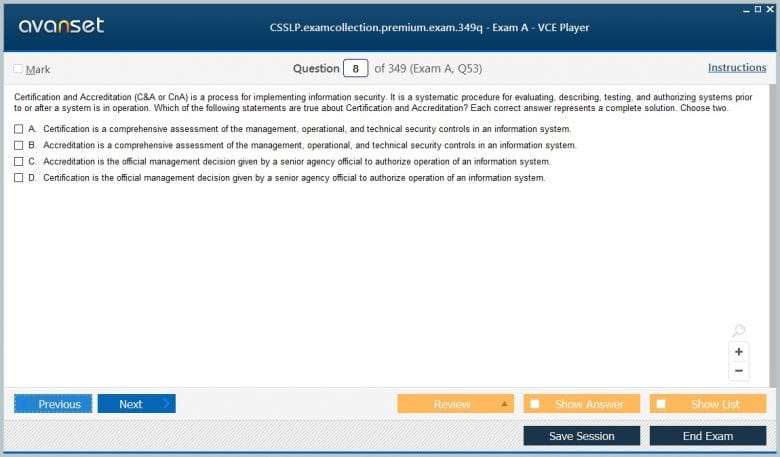
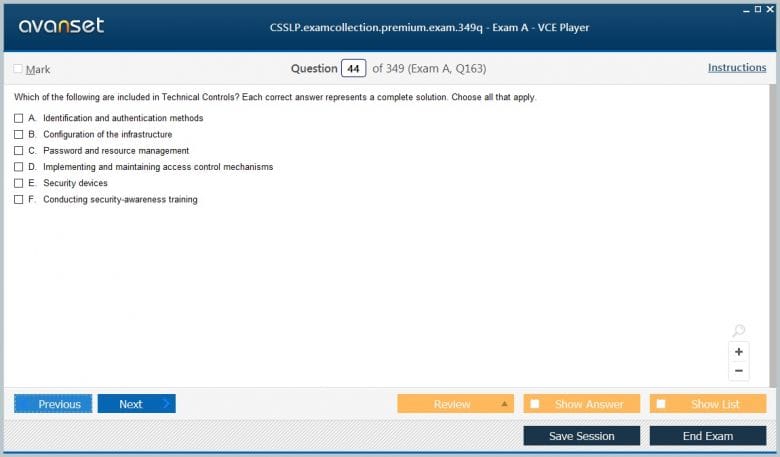
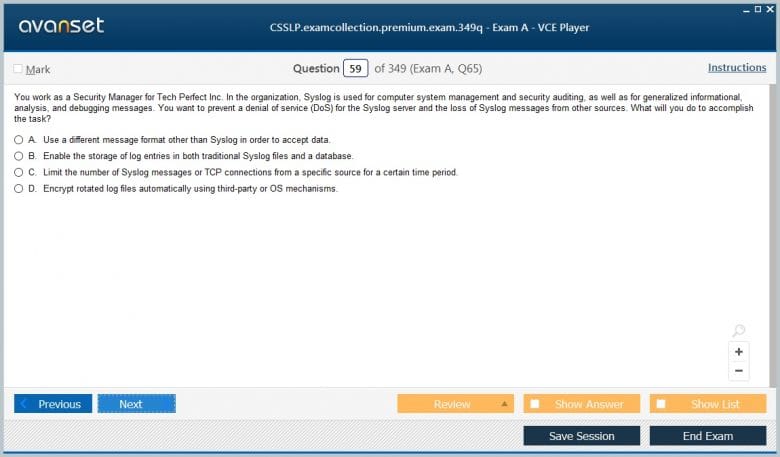
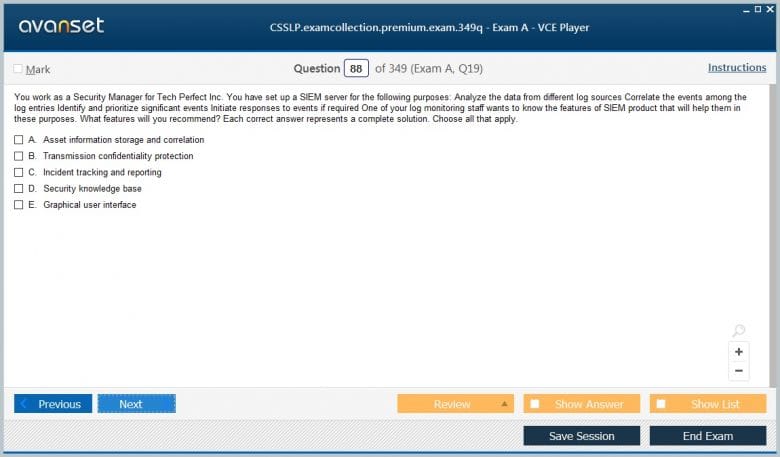
ISC CSSLP Practice Test Questions in VCE Format
| File | Votes | Size | Date |
|---|---|---|---|
File ISC.vceplayer.CSSLP.v2026-09-08.by.lilly.192q.vce |
Votes 1 |
Size 691.31 KB |
Date Sep 10, 2026 |
File ISC.Passcertification.CSSLP.v2019-02-08.by.Travis.220q.vce |
Votes 4 |
Size 940.21 KB |
Date Feb 14, 2019 |
ISC CSSLP Practice Test Questions, Exam Dumps
ISC CSSLP (Certified Secure Software Lifecycle Professional) exam dumps vce, practice test questions, study guide & video training course to study and pass quickly and easily. ISC CSSLP Certified Secure Software Lifecycle Professional exam dumps & practice test questions and answers. You need avanset vce exam simulator in order to study the ISC CSSLP certification exam dumps & ISC CSSLP practice test questions in vce format.
CSSLP, the Certified Secure Software Lifecycle Professional, is a current ISC2 certification for experienced professionals who need to integrate security into the way software is specified, designed, built, tested, deployed, operated, and supplied. The current exam is three hours with 125 items and a 700-out-of-1000 passing score. Its eight domains span Secure Software Concepts, Lifecycle Management, Requirements, Architecture and Design, Implementation, Testing, Deployment/Operations/Maintenance, and the Secure Software Supply Chain. The emphasis makes CSSLP a lifecycle credential rather than a narrow secure-coding test.
Within the broader ISC2 certifications, CSSLP is unusually focused on the decisions that connect software engineering and security governance. A developer can write safe code while the product still fails because requirements omitted abuse cases, architecture created an unsafe trust boundary, the build system was compromised, or operational teams deployed insecure defaults. CSSLP preparation is strongest when candidates follow risk through the complete software system instead of treating each domain as an isolated checklist.
Security work starts when stakeholders decide what the software is expected to do, what data it will process, which users and systems it must trust, and what harm would result from failure or abuse. Threat modeling, misuse and abuse cases, privacy considerations, regulatory obligations, and business risk should shape early requirements. Waiting until implementation creates expensive redesign because security properties such as tenant isolation, cryptographic boundaries, authorization models, or auditability may depend on architecture choices that are difficult to retrofit.
CSSLP therefore rewards candidates who can translate general security principles into software decisions. Least privilege, defense in depth, fail-safe defaults, complete mediation, separation of duties, secure defaults, and minimizing attack surface are not slogans; they are design constraints. The approved discussion of security across the software development lifecycle provides useful context for how governance and engineering intersect. For CSSLP, the key is to ask where each principle becomes an actionable requirement, architecture rule, coding standard, test condition, or operational control.
A secure lifecycle needs defined roles, checkpoints, artifacts, risk ownership, measurement, and feedback. Organizations may use waterfall, Agile, DevOps, or hybrid delivery, but the security activities still need a place in planning and execution. Teams should know when threat modeling occurs, who approves exceptions, how security requirements enter the backlog, which tests block a release, and how unresolved findings are accepted or escalated. Without that operating model, security depends on individual initiative and becomes inconsistent across products.
Metrics should measure meaningful behavior rather than activity volume. Counting scan findings, code reviews, or training completions can be useful, but those numbers do not automatically show that risk is decreasing. Better questions include whether critical requirements are traceable, whether severe vulnerabilities are escaping into production, whether security defects recur after root-cause fixes, and whether exceptions remain open beyond their approved period. CSSLP candidates should connect governance, process maturity, and technical evidence rather than assume that a tool creates a secure lifecycle by itself.
Security requirements should be specific enough to drive design and verification. “The application must be secure” is not testable. Requirements for authentication, authorization, session behavior, logging, data retention, cryptographic protection, error handling, privacy, recovery, and administrative access should identify the condition and expected outcome. Requirements should also capture negative behavior: what the system must prevent when a user submits malformed input, exceeds privilege, manipulates workflow state, replays a request, or attempts to access another tenant’s data.
Traceability matters because software changes continuously. A requirement linked to threat assumptions, design components, code, tests, and operational controls makes change impact visible. If a service interface changes, teams can identify which security expectations and tests require review. Risk-based prioritization is also important: not every requirement deserves equal verification effort. High-value data paths, privileged functions, safety-sensitive operations, and externally exposed interfaces generally warrant stronger assurance than low-impact features.
Requirements also need ownership and a change path. A control that exists only in a requirements document is weak if product managers can change the feature without triggering security review. Mature teams connect high-impact requirements to acceptance criteria, architecture decisions, verification evidence, and release gates. When a requirement changes, reviewers should be able to see which threat assumptions, tests, data flows, or operational safeguards are affected. This traceability is especially important for long-lived products because risk accumulates across releases, dependencies, and exceptions rather than resetting at every sprint.
Candidates should also distinguish security requirements from implementation choices. A requirement might state that sensitive administrative actions need strong authentication and auditable authorization, while the design decides how identity is federated, where policy is evaluated, and how evidence is retained. Keeping those layers separate allows teams to change technology without losing the protection objective. It also makes reviews more useful because failures can be traced to missing requirements, weak design, incorrect implementation, or inadequate verification instead of being labeled generically as a security problem.
Software architecture determines where identity is established, where authorization decisions occur, how data moves, which components share privilege, and what happens when a dependency fails. CSSLP candidates should reason about trust boundaries, segmentation, secure interfaces, cryptographic services, isolation, resilience, and secure state management. A microservices design can reduce some forms of coupling while introducing service-to-service identity, secret distribution, API authorization, observability, and supply-chain complexity. Architecture choices move risk; they do not make it disappear.
The relationship with broader security architecture becomes clear here. ISSEP approaches security through systems engineering, while CSSLP stays centered on software lifecycle practices. The two can overlap around requirements, design assurance, verification, and lifecycle integration, but CSSLP candidates should keep the software delivery system in view. The approved secure software development discussion is a useful supporting reference where architecture and implementation choices meet.
Secure implementation includes input handling, memory safety, authentication and authorization enforcement, error behavior, secrets handling, cryptography, dependency management, logging, concurrency, serialization, and the use of secure libraries and frameworks. Coding standards and peer review help make expectations consistent. Static analysis, software composition analysis, and compiler or language protections can catch classes of defects, but candidates should understand tool limitations and the need for human review around business logic, trust assumptions, and authorization decisions.
Secure builds are also part of implementation. Source repositories, CI/CD identities, build runners, artifact stores, package registries, signing keys, and deployment credentials create a path from code to production. A development team can write secure code and still ship a compromised artifact if an attacker controls the pipeline. Modern CSSLP preparation should therefore connect implementation to the supply chain, provenance, reproducible or controlled builds where appropriate, dependency pinning, signed artifacts, and protected release workflows.
Security testing combines several methods because no single technique provides complete assurance. Static analysis examines code without execution; dynamic testing observes running behavior; interactive techniques combine runtime and code context; fuzzing stresses parsers and interfaces; penetration testing explores exploitable paths; code review and architecture review can find logic flaws that scanners miss. The testing strategy should be based on risks and requirements rather than on using every available tool.
Verification and validation are different questions. Verification asks whether the software satisfies specified security requirements; validation asks whether those requirements and controls actually address stakeholder needs and real threats in the intended environment. A product can pass all scripted tests and still fail validation if the threat model was incomplete. Candidates should also understand test data protection, environment fidelity, defect triage, retesting, regression testing, and how test evidence supports release decisions.
Production configuration determines whether secure design survives contact with reality. Default accounts, cloud permissions, runtime secrets, TLS settings, network exposure, logging, feature flags, containers, orchestration policy, and administrative tooling can all alter the effective security posture. Deployment should therefore include secure baselines, controlled change, configuration validation, rollback planning, and protection of release credentials. Infrastructure as code can improve repeatability, but insecure templates simply automate insecure configuration.
Operations add vulnerability management, monitoring, incident response, patching, backup, recovery, and maintenance. Security telemetry should help detect abuse without exposing sensitive data unnecessarily. Incident lessons should feed back into requirements and design so recurring weaknesses are engineered out rather than patched repeatedly. CSSLP’s lifecycle perspective means the product remains a security responsibility after launch; maintenance releases, third-party updates, and changing threat conditions can create new risk long after the original development team has moved on.
Applications depend on open-source packages, commercial components, build tools, cloud services, container images, external APIs, and outsourced development. Each dependency introduces provenance and maintenance questions. Teams need processes for inventory, vulnerability intake, component approval, version control, license and support considerations, and response when a supplier or package becomes unsafe. A software bill of materials can improve visibility, but visibility only helps if the organization has a process for acting on what it discovers.
CSSLP is best prepared as one continuous case study. Take a representative application and trace a security objective from stakeholder need to requirement, architecture, code, build, test, release, monitoring, incident response, and dependency management. That exercise exposes the connections the exam is designed to test. It also explains why CSSLP remains distinct from broad credentials such as CISSP: the focus is not simply knowing security topics, but engineering security into the complete software lifecycle.
Go to testing centre with ease on our mind when you use ISC CSSLP vce exam dumps, practice test questions and answers. ISC CSSLP Certified Secure Software Lifecycle Professional certification practice test questions and answers, study guide, exam dumps and video training course in vce format to help you study with ease. Prepare with confidence and study using ISC CSSLP exam dumps & practice test questions and answers vce from ExamCollection.
Purchase Individually

Top ISC Certifications
Top ISC Certification Exams
Site Search:

SPECIAL OFFER: GET 10% OFF

Pass your Exam with ExamCollection's PREMIUM files!
SPECIAL OFFER: GET 10% OFF
Use Discount Code:
MIN10OFF
A confirmation link was sent to your e-mail.
Please check your mailbox for a message from support@examcollection.com and follow the directions.

Download Free Demo of VCE Exam Simulator
Experience Avanset VCE Exam Simulator for yourself.
Simply submit your e-mail address below to get started with our interactive software demo of your free trial.
@Pi Shadow, was it the premium dump you used to pass the exam and were they word for word?
This is a really nice certification if you want to become an application security engineer.