



Premium File
218 Q&A
$76.99$69.99
ISC CISSP-ISSMP Exam Questions & Answers, Accurate & Verified By IT Experts
Instant Download, Free Fast Updates, 99.6% Pass Rate
218 Questions & Answers
Last Update: Sep 27, 2026
$69.99
ISC CISSP-ISSMP Exam Screenshots
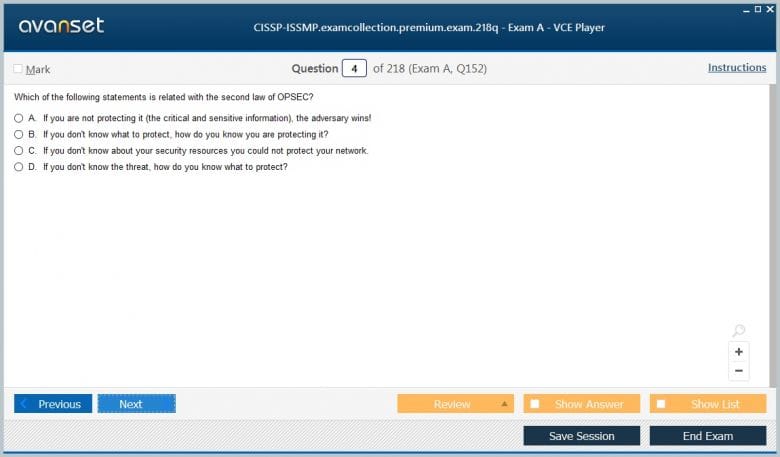
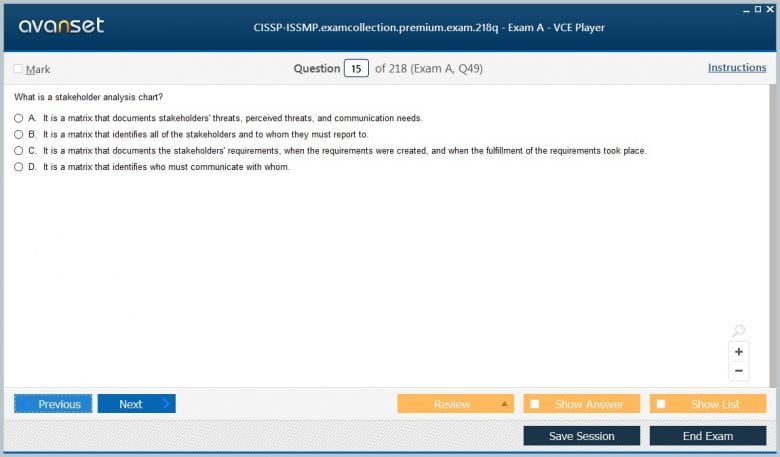
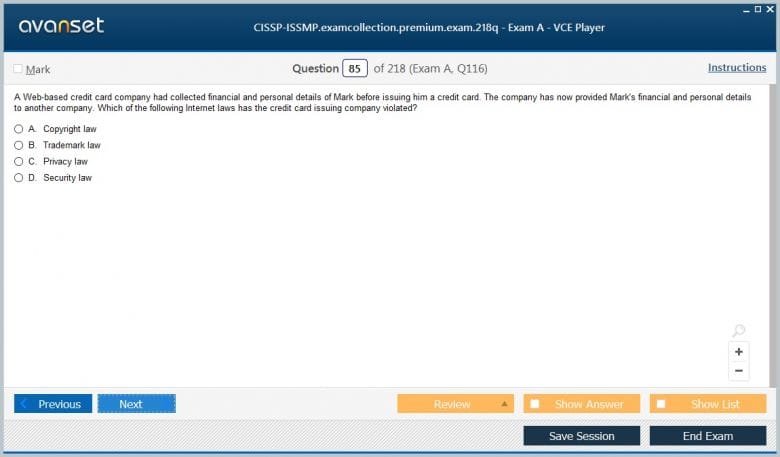
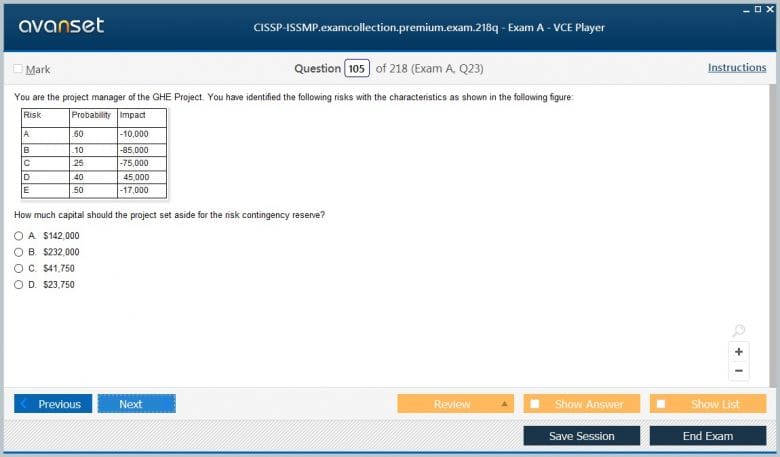
ISC CISSP-ISSMP Practice Test Questions in VCE Format
| File | Votes | Size | Date |
|---|---|---|---|
File ISC.testking.CISSP-ISSMP.v2026-09-11.by.millie.120q.vce |
Votes 1 |
Size 156.81 KB |
Date Sep 13, 2026 |
File ISC.Train4sure.CISSP-ISSMP.v2019-03-13.by.Daan.135q.vce |
Votes 3 |
Size 170.9 KB |
Date Mar 14, 2019 |
ISC CISSP-ISSMP Practice Test Questions, Exam Dumps
ISC CISSP-ISSMP (Information Systems Security Management Professional) exam dumps vce, practice test questions, study guide & video training course to study and pass quickly and easily. ISC CISSP-ISSMP Information Systems Security Management Professional exam dumps & practice test questions and answers. You need avanset vce exam simulator in order to study the ISC CISSP-ISSMP certification exam dumps & ISC CISSP-ISSMP practice test questions in vce format.
ISSMP is ISC2’s Information Systems Security Management Professional concentration. The current outline took effect on 1 August 2025. The exam is three hours with 125 items and a 700-out-of-1000 passing score. Its six domains are Leadership and Organizational Management at 21%, Systems Lifecycle Management at 15%, Risk Management at 20%, Security Operations at 18%, Contingency Management at 12%, and Law, Ethics, and Security Compliance Management at 14%. The weighting makes ISSMP a security-leadership credential grounded in operating a real enterprise program.
Candidates can qualify with CISSP in good standing plus two years of experience in the current ISSMP domains, or through ISC2’s longer direct experience route. Within ISC2 certifications, ISSMP is distinct from architecture and engineering concentrations because its central problem is organizational: how to align security with mission, allocate resources, govern risk, direct operations, prepare for disruption, and demonstrate compliance. Technical knowledge matters, but leadership decisions determine whether the program works at enterprise scale.
An information security program should exist to support the organization’s objectives, not to maximize the number of controls deployed. ISSMP candidates need to understand governance structures, executive sponsorship, decision rights, organizational culture, stakeholder influence, and the relationship between security and other business functions. A technically correct initiative can fail if it lacks funding, ownership, authority, or alignment with business priorities.
Leadership also requires communicating differently with different audiences. Executives need business impact, risk trend, resource decisions, and strategic trade-offs. Engineers need clear requirements and priorities. Legal and compliance teams need evidence and accountability. Managers need objectives, staffing expectations, and escalation paths. The security leader creates a common operating model so these groups make consistent decisions rather than treating security as a series of isolated projects.
Organizational design influences security outcomes. A centralized team can create consistency and scarce expertise, while embedded security roles can improve product context and speed. Many enterprises use a hybrid model, combining central policy and specialist capabilities with business-aligned teams. ISSMP candidates should evaluate governance based on accountability, escalation, and decision quality rather than assume one org chart is universally best.
A strategy describes desired outcomes and priorities; a program turns those priorities into capabilities, projects, processes, metrics, staffing, and budgets. ISSMP candidates should understand roadmaps, capability assessment, resource planning, sourcing, skills development, vendor use, and the need to sequence initiatives around dependencies. Trying to mature every security function simultaneously can spread resources so thin that none becomes reliable.
Measurement should show whether the program reduces meaningful risk and supports objectives. Counts of blocked attacks or training completions may be useful operational data, but leadership metrics should connect activity to outcomes. Time to contain high-impact incidents, privileged-access review completion, recovery-test success, critical remediation age, and risk-treatment progress can be more decision-relevant when tied to targets and ownership. Metrics should lead to action, not merely populate a quarterly slide.
Portfolio management helps leaders choose between competing investments. Funding an identity modernization program, expanding detection coverage, replacing an unsupported platform, or improving recovery may all be justified, but resources are finite. A strong business case connects the initiative to material risk, regulatory obligations, operational efficiency, customer expectations, or strategic enablement. Security leaders need to explain both the cost of action and the consequence of delay.
ISSMP leaders need to integrate security risk with enterprise risk rather than operate a separate technical scoring system. That means identifying critical assets and services, evaluating threats and vulnerabilities, understanding business impact, defining appetite and tolerance, and presenting treatment options in language decision-makers can use. The goal is not to eliminate all risk but to make exposure visible and governed.
This creates overlap with credentials such as CRISC, yet the perspective differs. CRISC specializes in enterprise technology risk practice; ISSMP treats risk management as one leadership domain inside a wider security program. An ISSMP candidate should be able to challenge a risk assessment, assign ownership, secure resources for treatment, track residual risk, and explain the consequence of accepting or delaying remediation.
New products, acquisitions, cloud migrations, outsourcing, software releases, and infrastructure changes alter the security posture. Leadership needs governance that inserts security requirements and review into planning, architecture, procurement, development, deployment, and retirement without turning every change into a bottleneck. Risk-based gates, reusable standards, reference architectures, automated checks, and clear exceptions can make security more predictable.
The security leader should also plan for technology obsolescence and technical debt. Unsupported systems may remain because migration is expensive or operationally risky. The correct response is not simply to declare them non-compliant; leadership needs a treatment plan, interim controls, funding path, owners, and an explicit residual-risk decision. Lifecycle management connects strategic planning to the daily reality of systems that cannot all be replaced at once.
Operational security covers monitoring, threat response, vulnerability management, identity administration, change control, investigations, and coordination with technical teams. Leaders define objectives and escalation thresholds so analysts know when an event becomes an incident and when business owners or executives need to be involved. Tooling matters, but process clarity and decision authority often determine response quality during high-pressure events.
Incident management should be rehearsed before a crisis. Roles, communications, evidence preservation, legal involvement, customer notification, third-party coordination, and recovery decisions can be difficult to improvise. The approved incident-response lifecycle provides useful operational context. ISSMP candidates should extend it to leadership questions: who declares a crisis, who accepts operational risk during containment, and how lessons become funded program improvements.
Operational maturity also depends on learning loops. Post-incident reviews should identify process, architecture, staffing, and governance changes rather than end with a single technical fix. Repeated alert fatigue may indicate weak detection design; recurring privileged-access findings may reveal an ownership problem; slow containment may reflect unclear authority. Leaders turn these patterns into program priorities and track whether the corrective action actually changes future performance.
Business continuity and disaster recovery are not storage projects. Leaders need business impact analysis, recovery priorities, alternate processes, communications, facilities, supplier plans, technology recovery, and exercises. Recovery time and recovery point objectives should be based on business needs and technical feasibility. A plan that has never been tested may contain hidden assumptions about people, credentials, network access, vendor availability, or data integrity.
Cyber incidents have made recovery security-sensitive. Attackers may target backups, administrative systems, identity infrastructure, or monitoring tools to prevent restoration. Programs should consider isolation, immutability, recovery credentials, clean-room environments, and criteria for trusting restored systems. The approved business continuity planning discussion can deepen this area, while ISSMP keeps attention on governance, funding, testing, and executive decision-making.
Security leaders operate under laws, regulations, contracts, industry standards, privacy requirements, intellectual-property rules, and professional ethics. They need processes to identify applicable obligations, translate them into controls, collect evidence, manage exceptions, and coordinate audits. Compliance is not identical to security, but ignoring mandatory requirements can create legal, financial, and reputational consequences even when technical risk appears low.
Ethics is especially important for leaders who hold privileged information and influence. Decisions about monitoring, investigations, disclosure, employee activity, artificial intelligence, and risk acceptance can affect rights and trust. ISC2’s professional code provides a framework, but candidates should practice resolving conflicts between stakeholder pressure and professional obligations. A manager who can explain why a decision is lawful, ethical, and aligned with organizational values builds stronger long-term security than one who relies only on authority.
Audit relationships require preparation beyond producing documents on request. Security leadership should know which controls are relied upon, where evidence originates, who can attest to it, and how findings are tracked. A mature program treats audits as another source of assurance and improvement while preserving independence. Defensive behavior toward auditors can hide weak controls; uncritical acceptance of every finding can waste resources. Leaders need evidence-based judgment in both directions.
Practice with situations where several technically reasonable actions compete for limited resources. A major vulnerability affects a legacy system, an acquisition introduces an immature security program, a cloud incident disrupts customers, or an audit finds repeated exceptions. Ask which stakeholder owns the decision, what information is needed first, what short-term action reduces exposure, what long-term capability is missing, and how leadership should communicate the trade-off.
Candidates comparing management paths may also encounter CISM, which covers security governance, risk, program management, and incident management from ISACA’s perspective. The credentials overlap in senior security management but have different bodies of knowledge and experience rules. For ISSMP, keep the ISC2 concentration lens: lead an enterprise program that connects strategy, lifecycle governance, risk, operations, continuity, law, ethics, and compliance into one accountable management system.
A strong answer should usually preserve governance before jumping to a tool purchase. If the scenario describes repeated failures, unclear ownership, or risk above tolerance, the manager may need to establish authority, priorities, and accountability before selecting technology. That ordering reflects senior leadership work: tools can enable a program, but they cannot substitute for decisions about who owns the outcome and what level of risk the organization accepts.
Go to testing centre with ease on our mind when you use ISC CISSP-ISSMP vce exam dumps, practice test questions and answers. ISC CISSP-ISSMP Information Systems Security Management Professional certification practice test questions and answers, study guide, exam dumps and video training course in vce format to help you study with ease. Prepare with confidence and study using ISC CISSP-ISSMP exam dumps & practice test questions and answers vce from ExamCollection.
Purchase Individually
Top ISC Certifications
Top ISC Certification Exams
Site Search:

SPECIAL OFFER: GET 10% OFF

Pass your Exam with ExamCollection's PREMIUM files!
SPECIAL OFFER: GET 10% OFF
Use Discount Code:
MIN10OFF
A confirmation link was sent to your e-mail.
Please check your mailbox for a message from support@examcollection.com and follow the directions.

Download Free Demo of VCE Exam Simulator
Experience Avanset VCE Exam Simulator for yourself.
Simply submit your e-mail address below to get started with our interactive software demo of your free trial.