Pass Your ISC SSCP Certification Easy!
ISC SSCP Certification Exams Questions & Answers, Accurate & Verified By IT Experts
Instant Download, Free Fast Updates, 99.6% Pass Rate.

$69.99
ISC SSCP Certification Exams Screenshots
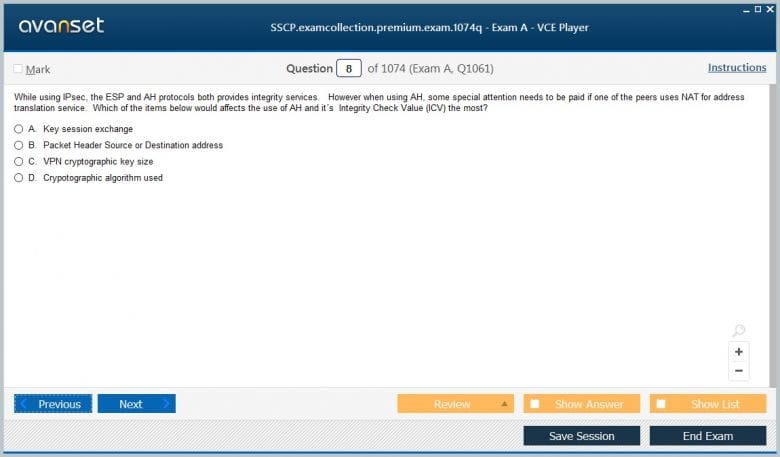
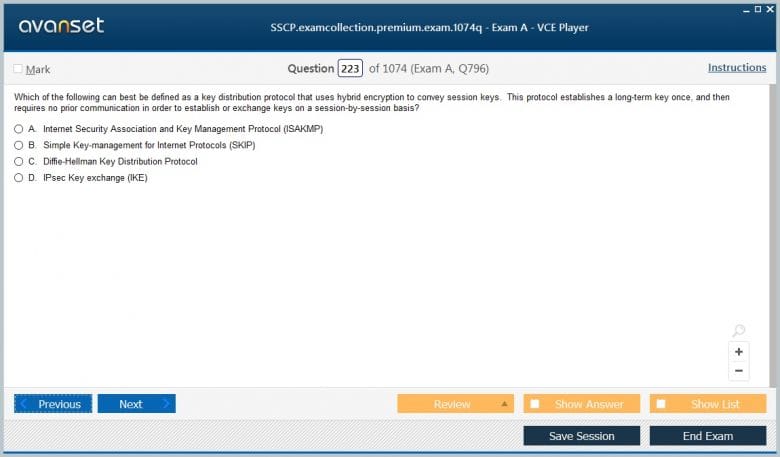
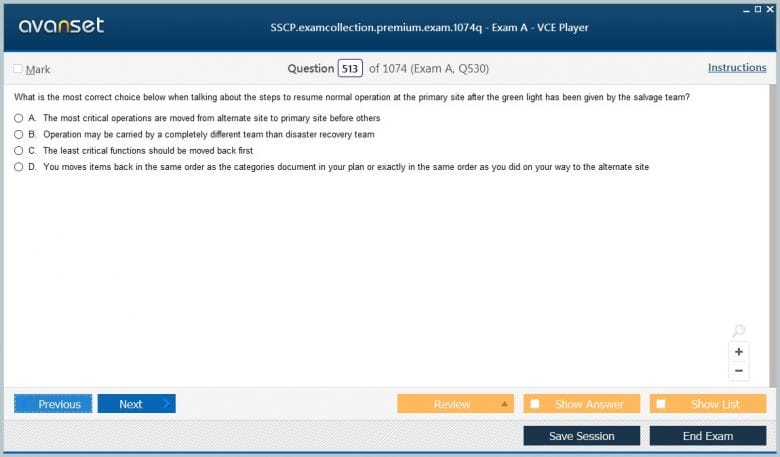
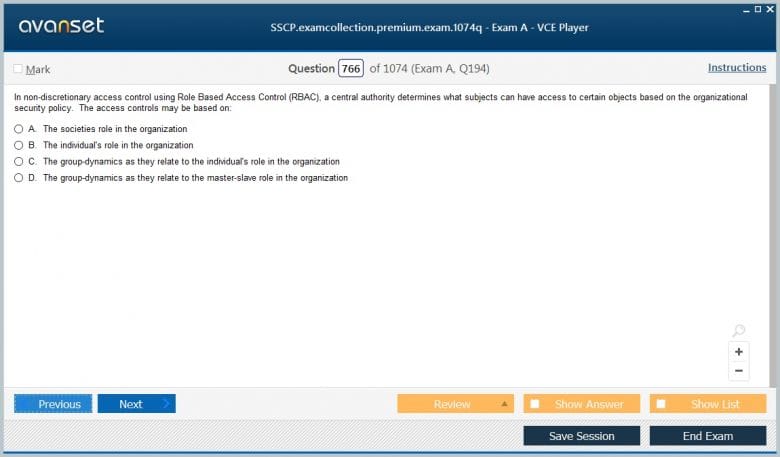
SSCP Product Reviews
Download Free SSCP Practice Test Questions VCE Files
| Exam | Title | Files |
|---|---|---|
Exam SSCP |
Title System Security Certified Practitioner (SSCP) |
Files 10 |
ISC SSCP Certification Exam Dumps & Practice Test Questions
Prepare with top-notch ISC SSCP certification practice test questions and answers, vce exam dumps, study guide, video training course from ExamCollection. All ISC SSCP certification exam dumps & practice test questions and answers are uploaded by users who have passed the exam themselves and formatted them into vce file format.
SSCP: Practical Security Administration Across Modern IT Environments
The Systems Security Certified Practitioner credential is built around operational security: implementing, monitoring, and administering controls that keep information systems dependable. The current SSCP exam uses computerized adaptive testing, lasts two hours, and presents 100 to 125 items across seven domains. Its scope is broad, but its professional perspective is concrete. Candidates are expected to understand how policies and designs become working controls in day-to-day environments.
SSCP belongs to the ISC2 certifications and requires one year of relevant experience in one or more of its domains, with the recognized education pathway able to satisfy that requirement. Candidates who pass without the experience can use the Associate of ISC2 route while completing it. That makes SSCP accessible earlier than CISSP, while still expecting practical security knowledge rather than beginner-level awareness.
The current seven-domain outline is operational by design
The domains are Security Concepts and Practices, Access Controls, Risk Identification Monitoring and Analysis, Incident Response and Recovery, Cryptography, Network and Communications Security, and Systems and Application Security. None exists in isolation. Access decisions affect incident evidence; cryptography depends on key handling; networks influence monitoring; system hardening affects risk; recovery planning depends on asset criticality.
The current SSCP exam outline became effective October 1, 2025. It weights Security Concepts and Practices at 16 percent, Access Controls at 15 percent, Risk Identification, Monitoring and Analysis at 15 percent, Incident Response and Recovery at 14 percent, Cryptography at 9 percent, Network and Communications Security at 16 percent, and Systems and Application Security at 15 percent. The exam is adaptive, lasts two hours, presents 100 to 125 items, and requires a scaled passing score of 700 out of 1000.
The first domain covers confidentiality, integrity, availability, accountability, non-repudiation, least privilege, separation of duties, control types, ethics, governance, and risk. These principles sound familiar, but SSCP tests how they affect implementation.
Least privilege, for example, is not merely a definition. Administrators need processes for provisioning, role assignment, temporary elevation, review, revocation, and logging. Separation of duties needs an actual division of critical actions. Availability needs backup, redundancy, monitoring, capacity, and recovery rather than a slogan in policy.
Access control is a lifecycle
Access Controls covers identity management, authentication, authorization, trust relationships, account administration, and access models. A secure environment needs more than strong passwords. It needs reliable identity proofing, appropriate authenticators, centralized lifecycle processes, privilege governance, timely deprovisioning, and monitoring.
Adaptive access control shows how authorization can become more dynamic, but SSCP candidates should preserve the fundamentals: every access decision should connect a verified identity to an approved level of privilege under defined conditions.
Risk identification turns observations into priorities
Operational teams encounter vulnerabilities, misconfigurations, alerts, outdated software, unsupported assets, and exceptions every day. Risk identification helps decide what matters first. Candidates should understand threats, vulnerabilities, likelihood, impact, risk assessments, scanning, monitoring, baseline deviation, and reporting.
Prioritization should reflect context. A critical vulnerability on an isolated lab system may be less urgent than a moderate weakness on an internet-facing authentication service. Administrators should understand business criticality, exposure, exploitability, compensating controls, and operational constraints.
Incident response and recovery require preparation
Security practitioners often participate directly in incident handling. They need to recognize indicators, preserve evidence, follow escalation paths, support containment, restore systems, and document actions. Preparation matters because access to logs, communication channels, contact lists, tools, and authority cannot be improvised efficiently during a serious event.
A clear incident-response framework matters because operational teams need defined roles, escalation points, evidence-handling expectations, and recovery steps before an incident occurs. SSCP questions may focus more directly on what an administrator should do when a control fails or suspicious activity appears.
Cryptography is about correct use and key handling
The cryptography domain covers concepts such as symmetric and asymmetric encryption, hashing, digital signatures, certificates, public key infrastructure, protocols, and key management. Candidates need enough understanding to select appropriate mechanisms and recognize common implementation errors.
Key management is often more important than algorithm memorization. Keys need secure generation, storage, distribution, rotation, backup, revocation, and destruction. A strong algorithm can still fail if administrators store private keys carelessly or fail to revoke compromised credentials.
Network security depends on architecture and monitoring
Network and Communications Security includes secure protocols, segmentation, wireless, remote access, firewalls, intrusion detection or prevention, network attacks, and communication design. Administrators should understand where controls belong and what each can and cannot prove.
A firewall can restrict traffic but does not replace endpoint hardening. Encryption can protect communication but may reduce visibility for inspection. Segmentation can limit movement but only if routing and access policies are actually enforced. Monitoring helps detect deviation, but alerts still require triage and response.
Systems and applications require secure configuration throughout life
The final domain covers system hardening, patching, mobile systems, virtualization, cloud, applications, databases, malware defenses, secure development, configuration, and change. The operational theme is lifecycle discipline. Secure builds deteriorate if patches are ignored, exceptions accumulate, software is installed outside process, or configuration changes are not monitored.
Baselines create a known state. Vulnerability management identifies weaknesses. Change management reduces unintended impact. Endpoint and application controls limit attack paths. Logging allows teams to detect and reconstruct events. SSCP candidates should understand how these activities reinforce one another.
SSCP differs from CISSP in depth, role, and experience
The distinction between SSCP and CISSP is primarily one of role, breadth, and experience. SSCP is oriented toward practitioners administering and operating security controls, while CISSP expects broader experience and places more emphasis on enterprise security design, governance, and management across eight domains.
That does not make SSCP simplistic. Operational security requires precise knowledge because poor implementation can undermine excellent policy. The certification is most aligned with administrators, analysts, engineers, and security practitioners who work close to systems and controls.
Study by operating the environment, not memorizing it
Hands-on practice can make SSCP topics more durable. Build a lab with identity services, multiple roles, logging, a firewall, a few endpoints, encryption, backups, vulnerability scanning, and an application. Create access policies, generate logs, introduce misconfigurations, practice incident steps, restore data, and document changes.
The goal is not to recreate an enterprise. It is to connect terms to observable behavior. When candidates understand what least privilege, segmentation, certificate validation, patch management, backup verification, or incident containment look like in practice, scenario questions become easier to reason through.
Security programs depend on practitioners who can turn governance into implementation. Policies need accounts, configurations, certificates, logs, backups, network rules, patches, monitoring, and recovery processes behind them. SSCP focuses on that operational layer.
Candidates who prepare as practitioners rather than vocabulary collectors are more likely to succeed. The exam rewards understanding of how controls behave under real conditions and how administrators should respond when risk, incidents, or operational constraints challenge the ideal design.
Vulnerability management is a cycle, not a monthly scan. Operational security teams need an inventory of assets, a way to identify weaknesses, contextual prioritization, remediation ownership, exception handling, verification, and reporting. Scanning is only one step. A finding that remains open for months without a risk decision is not being managed simply because it appears on a dashboard.
SSCP candidates should connect vulnerability severity to exposure and asset value. Internet-facing systems, privileged services, unsupported operating systems, and actively exploited weaknesses may require faster action than lower-risk findings. Compensating controls can reduce exposure, but they should be documented and periodically reassessed rather than used as permanent excuses.
Backups are security controls only when restoration works. Ransomware and destructive incidents have made backup architecture part of security operations. Administrators should understand separation, immutability or offline protection, encryption, retention, access control, monitoring, and restoration testing. A successful backup job is not proof that the organization can recover a complete application with required dependencies inside the business recovery objective.
Recovery exercises should therefore test people and process as well as storage. Teams need to know which systems come first, which credentials are required, where clean recovery environments exist, and how compromised systems will be isolated before restoration.
Cloud operations extend familiar controls into shared environments. SSCP practitioners increasingly administer cloud services, so familiar principles need to be applied to new control planes. Identity permissions, network rules, logging, encryption, secrets, configuration, patch responsibility, and monitoring still matter. The difference is that some infrastructure controls move to the provider while the customer retains configuration and data responsibilities.
Professionals looking for broader entry-level security coverage may compare SSCP with CompTIA Security+, while experienced practitioners seeking a more senior enterprise credential may progress toward CISSP. SSCP sits usefully between those points for people whose daily work involves implementing and operating controls.
Operational security depends on clean configuration management. Many incidents begin with ordinary administrative drift: an unnecessary service is enabled, a firewall rule remains after a project ends, a privileged group grows without review, or a system deviates from its hardened baseline. Configuration management gives security teams a known state against which change and deviation can be evaluated.
SSCP candidates should understand the relationship between approved baselines, change control, inventories, automated configuration checking, patching, and exception management. An exception may be legitimate, but it needs ownership, justification, compensating controls where necessary, and a review date. Permanent undocumented exceptions turn controlled environments into guesswork.
Security operations are also people operations. Technical controls depend on administrators following procedures, analysts escalating correctly, users recognizing suspicious activity, and managers supporting remediation. Awareness and training therefore complement hardening and monitoring. The purpose is not simply annual completion; it is reducing behavior that creates exposure and ensuring people know what to do when something unusual occurs.
That human dimension is one reason SSCP remains practical. The practitioner implementing controls has to work within real maintenance windows, business dependencies, legacy systems, and staffing constraints. Security judgment means protecting the environment without pretending operations have unlimited time or resources.
ExamCollection provides the complete prep materials in vce files format which include ISC SSCP certification exam dumps, practice test questions and answers, video training course and study guide which help the exam candidates to pass the exams quickly. Fast updates to ISC SSCP certification exam dumps, practice test questions and accurate answers vce verified by industry experts are taken from the latest pool of questions.


ISC SSCP Video Courses
Top ISC Certifications
Top ISC Certification Exams
Site Search: