



Premium File
376 Q&A
$76.99$69.99
Google Professional Cloud Security Engineer Exam Questions & Answers, Accurate & Verified By IT Experts
Instant Download, Free Fast Updates, 99.6% Pass Rate

Professional Cloud Security Engineer Premium File: 376 Questions & Answers
Last Update: Oct 26, 2026
Professional Cloud Security Engineer Training Course: 89 Video Lectures
Professional Cloud Security Engineer PDF Study Guide: 335 Pages
$79.99
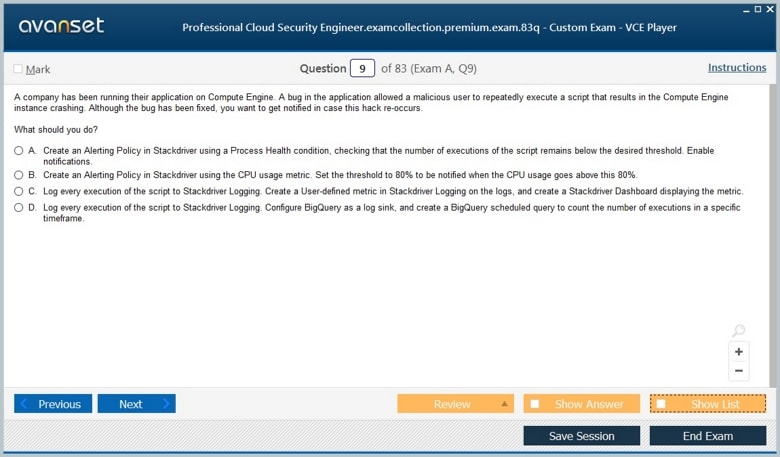
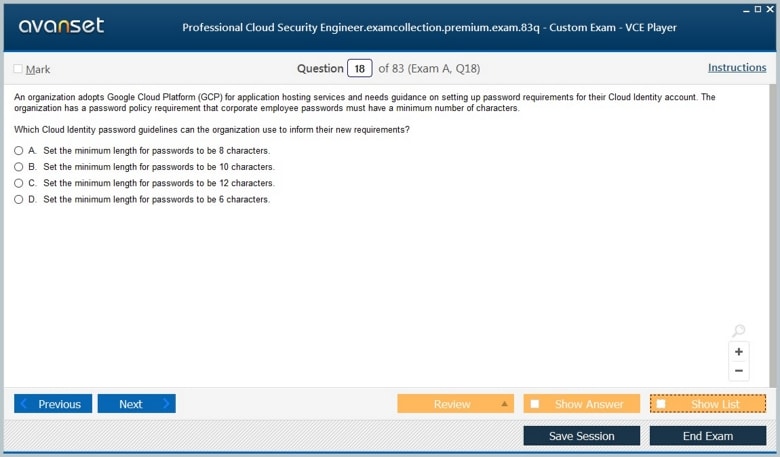
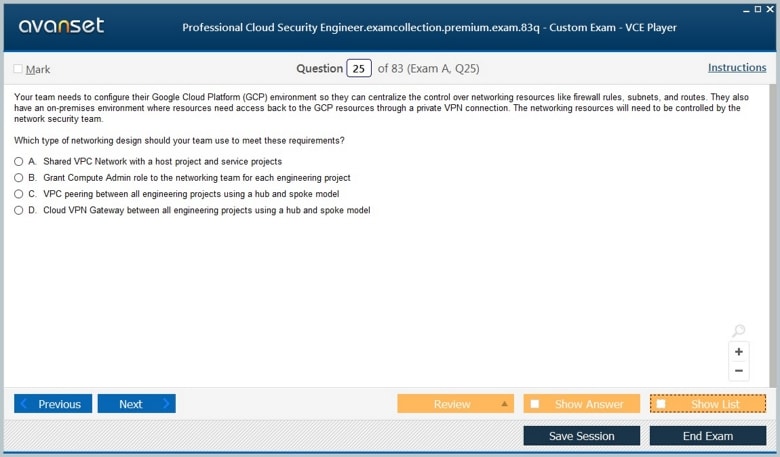
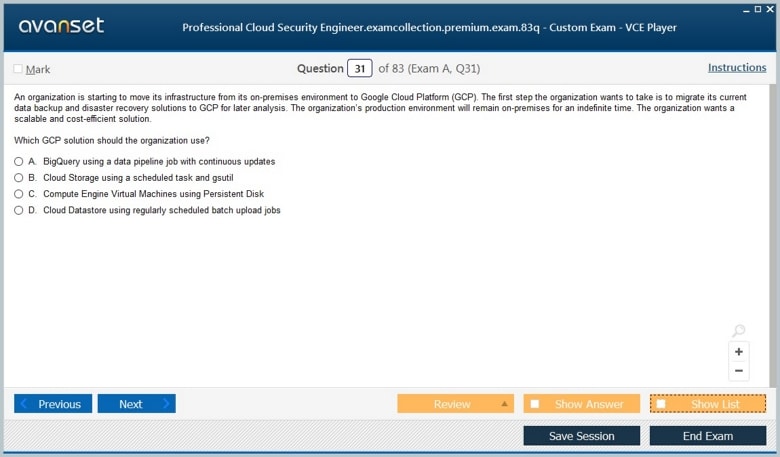
Google Professional Cloud Security Engineer Exam Screenshots
Google Professional Cloud Security Engineer Practice Test Questions in VCE Format
| File | Votes | Size | Date |
|---|---|---|---|
File Google.realtests.Professional Cloud Security Engineer.v2026-08-28.by.louis.74q.vce |
Votes 1 |
Size 1.82 MB |
Date Aug 28, 2026 |
File Google.pass4sures.Professional Cloud Security Engineer.v2021-04-27.by.hamza.52q.vce |
Votes 1 |
Size 102.47 KB |
Date Apr 28, 2021 |
File Google.test-inside.Professional Cloud Security Engineer.v2020-06-21.by.martin.48q.vce |
Votes 2 |
Size 91.79 KB |
Date Jun 21, 2020 |
File Google.practiceexam.Professional Cloud Security Engineer.v2020-02-11.by.sophie.45q.vce |
Votes 6 |
Size 85.91 KB |
Date Feb 11, 2020 |
File Google.Testking.Professional Cloud Security Engineer.v2019-12-11.by.Derek.23q.vce |
Votes 3 |
Size 48.37 KB |
Date Dec 10, 2019 |
Google Professional Cloud Security Engineer Practice Test Questions, Exam Dumps
Google Professional Cloud Security Engineer (Professional Cloud Security Engineer) exam dumps vce, practice test questions, study guide & video training course to study and pass quickly and easily. Google Professional Cloud Security Engineer Professional Cloud Security Engineer exam dumps & practice test questions and answers. You need avanset vce exam simulator in order to study the Google Professional Cloud Security Engineer certification exam dumps & Google Professional Cloud Security Engineer practice test questions in vce format.
Professional Cloud Security Engineer is a current Google Cloud professional certification for practitioners who design and implement secure workloads and infrastructure. Google’s present exam scope includes access control, secure communications and boundary protection, data protection, security operations, compliance, security automation, software-supply-chain controls, and protection of AI workloads. The exam is two hours, costs $200 before applicable tax, uses 50–60 multiple-choice and multiple-select questions, has no formal prerequisite, and recommends three or more years of industry experience including more than one year designing and managing Google Cloud solutions.
The credential tests security as an architecture and operations discipline rather than a collection of isolated controls. The Professional Cloud Security Engineer material should be studied by asking how identity, organization policy, networking, encryption, logging, detection, automation, and regulatory requirements interact. A secure design must still let legitimate teams build and operate services; controls that are impossible to use safely will eventually be bypassed.
Cloud environments contain human administrators, developers, service accounts, workloads, automation systems, and external identities. Each should receive the minimum access necessary for the job and should authenticate with mechanisms appropriate to the risk. Long-lived service-account keys create avoidable exposure; workload identity, federation, short-lived credentials, and centralized group-based administration reduce the need to distribute persistent secrets.
The Google Cloud IAM model is central to the exam because resource hierarchy, inherited policy, predefined and custom roles, service accounts, and conditional access determine who can change or consume cloud resources. Candidates should practice reading an effective-permissions problem from organization to folder to project to resource rather than assuming the policy visible on one page tells the whole story.
Privileged access should be both limited and observable. Administrative roles can be separated by function, elevated only when needed, and reviewed for dormant grants. Human access to production should not rely on shared accounts. When emergency access is necessary, the process should create strong audit evidence and trigger review so exceptional privileges do not quietly become routine.
Organizations should separate workloads and administrative domains so that policy can be applied predictably. Folders can represent business units, environments, or regulatory boundaries, while projects provide billing, quota, IAM, and resource isolation. Organization Policy can restrict risky configuration patterns at scale, such as external IP use or permitted locations, but policies must be tested because a control that blocks an essential deployment workflow can create shadow processes and emergency exceptions.
Security engineers should also design exception handling. A policy exception needs an owner, business reason, expiration or review date, and compensating controls. Otherwise temporary exceptions become permanent architecture. The exam frequently rewards solutions that enforce standards centrally while preserving the ability to delegate ordinary application administration to teams with clear boundaries.
Google Cloud encrypts data by default, but organizations may require customer-managed keys, separation of duties, or tighter control over key location and rotation. The Google Cloud key-management lifecycle helps candidates distinguish key rings, keys, versions, rotation, IAM, destruction schedules, and the operational consequences of making a key unavailable. Encryption architecture should match the sensitivity and recovery requirements of the data rather than applying maximum complexity everywhere.
Secrets need separate treatment from bulk data encryption. The Secret Manager model supports controlled retrieval and rotation of application secrets. Security engineers should also consider data discovery, retention, deletion, backup, regional placement, and egress. A database can be strongly encrypted while still violating policy if sensitive information is copied into logs, exported to an unmanaged bucket, or retained beyond an approved period.
Private addressing, firewall policy, secure ingress, managed egress, service perimeters, proxy controls, and authenticated access can reduce attack surface. The network design should make trusted service-to-service communication easy to understand and make unnecessary public exposure difficult. Broad source ranges and default-open patterns may accelerate early development but create expensive cleanup once many workloads depend on them.
The Professional Cloud Network Engineer perspective is relevant because routing and security are tightly coupled. A security engineer should understand how traffic actually flows through Shared VPC, hybrid links, load balancers, NAT, and managed services before choosing a control. A rule that looks restrictive on paper may be irrelevant if the service is reachable through another path.
Private service access and service-to-service authentication should be designed together. A private IP address reduces exposure but does not prove that a caller is authorized. Conversely, strong identity does not eliminate the need to restrict unnecessary network paths. Layered design assumes one control can fail and uses independent mechanisms to reduce the resulting blast radius.
Modern cloud attacks can enter through source repositories, compromised dependencies, malicious build steps, stolen developer credentials, or untrusted images. Security engineers should design controls around code review, build identity, artifact integrity, vulnerability scanning, provenance, deployment authorization, and least-privilege CI/CD service accounts. The objective is to answer who built an artifact, from which source, using which process, and whether it passed required checks before deployment.
Automated controls are more reliable than policy documents that depend on every developer remembering a rule. However, automation itself becomes privileged infrastructure and should be protected accordingly. Build systems should not have broad organization-wide permissions simply because they need to deploy one service. Segmented service accounts and environment-specific release permissions reduce the impact of a compromised pipeline.
Prevention is never complete, so organizations need evidence that reveals suspicious activity. Audit logs, network telemetry, workload logs, identity events, posture findings, and threat intelligence should feed investigation and response workflows. The security engineer should know which events are available by default, which require additional configuration, what retention is necessary, and how logging costs can be controlled without discarding critical evidence.
The current Professional Security Operations Engineer credential goes deeper into hunting, detection engineering, log ingestion, case management, and response automation. For Cloud Security Engineer preparation, the important relationship is architectural: controls should generate useful telemetry, detections should map to meaningful risk, and incident responders should have enough context to contain a threat without taking the entire environment offline.
Logging strategy should also account for attacker behavior. High-value administrative changes, identity events, key use, network-policy modifications, and access to sensitive data deserve durable evidence. Security teams should protect log sinks and storage from the same administrators whose activity they may need to investigate, using separation of duties where the risk justifies it.
Compliance requirements may affect identity review, data location, encryption, logging, retention, change approval, vulnerability management, and separation of duties. The strongest approach maps each requirement to a control owner and evidence source rather than treating an audit as an annual scramble. Policy-as-code and continuous posture assessment can reveal drift earlier, but automated findings still need prioritization because not every deviation represents equal business risk.
Security architecture also needs documented exceptions and compensating controls. A regulated workload may have stricter requirements than a public marketing site, and the organization should be able to explain that difference. Candidates should practice choosing controls proportionate to data sensitivity, threat model, and regulatory obligations while avoiding unnecessary complexity that adds operational failure modes.
Vulnerability management is another lifecycle responsibility. Findings from images, hosts, libraries, or posture scans need ownership, severity interpretation, remediation windows, and exception handling. Simply enabling a scanner does not reduce risk if high-impact findings remain unassigned or if teams cannot distinguish exploitable exposure from a low-priority package issue.
Business continuity should be considered in security controls. Key rotation, access revocation, organization policy, and incident containment can all disrupt production when executed without dependency awareness. Security engineers should design controls so emergency actions are effective but reversible where possible, and so critical recovery paths do not depend on the same identity or system that may be compromised.
A useful lab begins with a deliberately over-permissive environment. Tighten IAM, remove persistent credentials, place secrets in managed storage, restrict network exposure, apply organization policy, enable appropriate audit logs, and create alerts for suspicious administrative behavior. Then attempt common misuse patterns and confirm whether the control prevents, detects, or merely records them. This turns product knowledge into a defensive model.
The Professional Cloud Security Engineer scope is broad because cloud security is a system property. Identity, networking, data protection, software delivery, monitoring, automation, and compliance influence one another. Strong candidates can explain not only which control to enable, but which threat or governance requirement it addresses, what evidence it produces, and how the organization will operate it over time.
AI workloads create additional security questions. Model endpoints may expose costly resources, prompts can carry confidential data, retrieved context can cross authorization boundaries, and generated output can influence downstream actions. Security engineers should apply identity, data classification, monitoring, and abuse controls to AI systems rather than treating them as a separate experimental zone outside ordinary governance.
Security design reviews should include abuse cases, not only intended use. Ask what happens if a developer credential is stolen, a workload identity is overprivileged, a storage bucket is shared broadly, an attacker controls a build dependency, or an administrator disables logging. Walking through these paths reveals where preventive controls, independent telemetry, and recovery procedures are actually needed and prevents security architecture from becoming a list of disconnected best practices.
Go to testing centre with ease on our mind when you use Google Professional Cloud Security Engineer vce exam dumps, practice test questions and answers. Google Professional Cloud Security Engineer Professional Cloud Security Engineer certification practice test questions and answers, study guide, exam dumps and video training course in vce format to help you study with ease. Prepare with confidence and study using Google Professional Cloud Security Engineer exam dumps & practice test questions and answers vce from ExamCollection.
Purchase Individually


Google Professional Cloud Security Engineer Video Course

Top Google Certifications










Top Google Certification Exams
Site Search:

SPECIAL OFFER: GET 10% OFF

Pass your Exam with ExamCollection's PREMIUM files!
SPECIAL OFFER: GET 10% OFF
Use Discount Code:
MIN10OFF
A confirmation link was sent to your e-mail.
Please check your mailbox for a message from support@examcollection.com and follow the directions.

Download Free Demo of VCE Exam Simulator
Experience Avanset VCE Exam Simulator for yourself.
Simply submit your e-mail address below to get started with our interactive software demo of your free trial.
@Goodhope_J. one thing you might have already known about this exam is that it’s very comprehensive. So, ensure you use as may materials as you can… from my experience, first of all get the official study guide from a reliable source such as Amazon,….then watch videos on YouTube, after that go ahead to acquire valid google professional cloud engineer braindumps available here. They are great to use as most questions I met at the exam were familiar to me.)))
Hey good people, I need your advice. I just failed my exam and I hope to retake soon….could you please share your prep tips with me if you previously passed this exam...should I use these practice tests for the google professional cloud security engineer exam???
guyz use these practice test questions and answers for google professional cloud security engineer exam and trust me, you will pass your assessment in your first try. I just did it…guyz
@almiron99, I’m one of the latest candidates to pass this google exam….what can I say...use these exam dumps for professional cloud engineer test and you become certified soon. I liked this material bcoz it is used with vce player imitates the actual exam testing environment which greatly boosted my skills. Still, be well-prepared for the test. Don’t rely on dumps only. Wish you luck!
@almiron99, yes! Passed my exam yesterday thanks to these google professional cloud security engineer practice tests….thank you a lot examcollection, great job
has anybody used practice exams and passed this Google exam?
@nick2020…. I was skeptical about these files to be honest. But I decided to try them anyway and later realized that they are just okay, even better than most study materials you will find out elsewhere for this exam. these google professional cloud security engineer vce files are what you need to pass the test
hello guys….are these dumps for google professional cloud security engineer exam worth using? I’m preparing for the assessment and need the most effective prep material….please, assist….