
Pass Your Amazon AWS Certified Machine Learning - Specialty Certification Easy!
Amazon AWS Certified Machine Learning - Specialty Certification Exams Questions & Answers, Accurate & Verified By IT Experts
Instant Download, Free Fast Updates, 99.6% Pass Rate.
Amazon AWS Certified Machine Learning - Specialty Certification Exams Screenshots
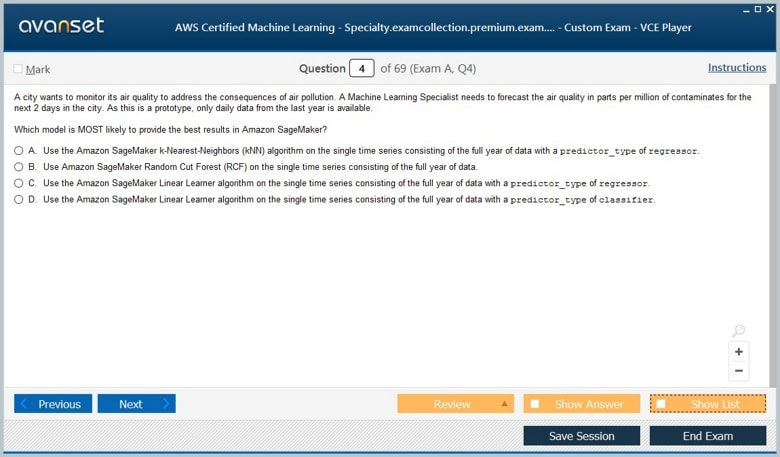
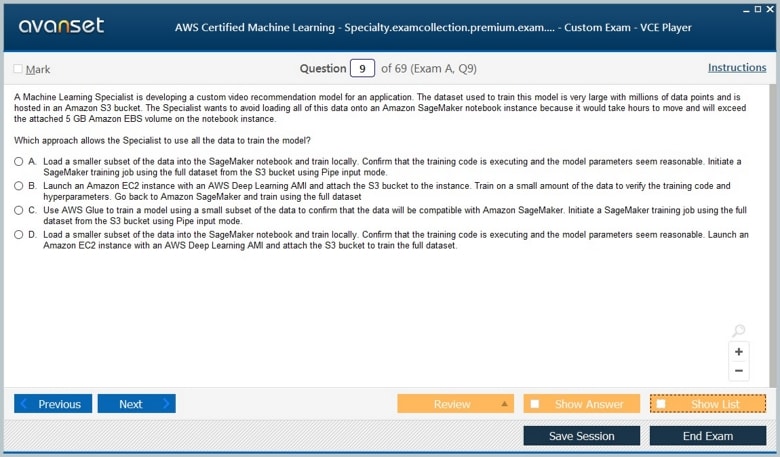
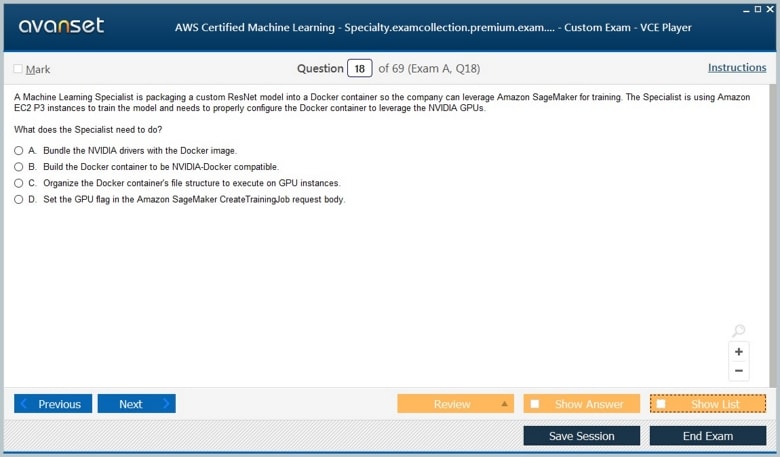
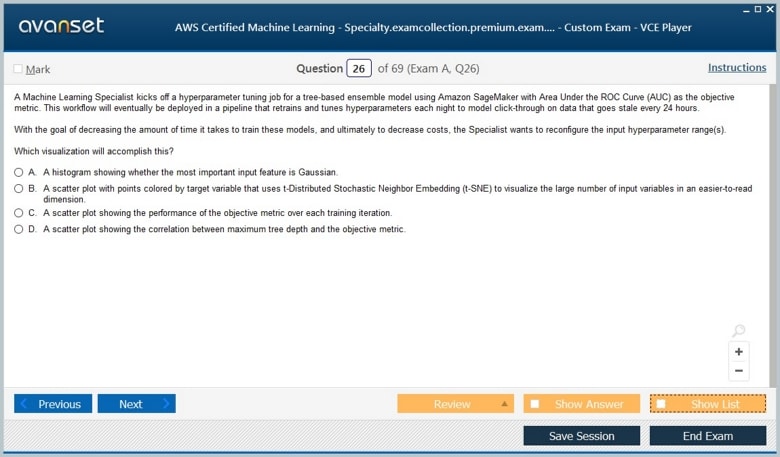
AWS Certified Machine Learning - Specialty Product Reviews
Download Free AWS Certified Machine Learning - Specialty Practice Test Questions VCE Files
| Exam | Title | Files |
|---|---|---|
Exam AWS Certified Machine Learning - Specialty |
Title AWS Certified Machine Learning - Specialty (MLS-C01) |
Files 10 |
Amazon AWS Certified Machine Learning - Specialty Certification Exam Dumps & Practice Test Questions
Prepare with top-notch Amazon AWS Certified Machine Learning - Specialty certification practice test questions and answers, vce exam dumps, study guide, video training course from ExamCollection. All Amazon AWS Certified Machine Learning - Specialty certification exam dumps & practice test questions and answers are uploaded by users who have passed the exam themselves and formatted them into vce file format.
AWS Machine Learning Specialty: What the Retired Credential Still Represents
AWS Certified Machine Learning - Specialty was one of AWS's deepest role-spanning machine-learning credentials, covering the path from data engineering and exploratory analysis through model development and production operations. The certification is now retired. AWS set March 31, 2026 as the final day to take the MLS-C01 exam, so new candidates can no longer earn it. People who passed before retirement keep an active certification for three years from the date they earned it.
That status distinction matters. A page about the credential should preserve its technical and historical value without implying that the exam is still schedulable. The retired AWS Machine Learning - Specialty exam remains useful as a reference for the capabilities AWS once grouped into a single Specialty-level assessment, while current candidates should look at newer role-based AI and ML options among AWS certifications.
What MLS-C01 validated
The MLS-C01 blueprint was organized into four domains: Data Engineering, Exploratory Data Analysis, Modeling, and Machine Learning Implementation and Operations. Their final published weights were 20%, 24%, 36%, and 20% respectively. The largest domain was modeling, but the exam deliberately gave almost two-thirds of its weight to work outside model training. That made the credential valuable as a test of end-to-end ML judgment rather than algorithm memorization.
The target candidate worked in AI/ML development or data science and needed to design, build, train, tune, deploy, and maintain machine-learning solutions on AWS. This required understanding data pipelines, feature preparation, algorithm selection, hyperparameter tuning, evaluation metrics, deployment choices, monitoring, security, and cost. A model that scored well in a notebook but could not be reproduced or operated reliably was not the goal.
The old exam structure also reflected an earlier stage of the AWS AI portfolio. Before separate credentials for machine-learning engineering and generative-AI development, MLS-C01 covered a broad combination of data science and production skills. Its retirement does not make those skills obsolete; it shows that AWS has redistributed them across newer certifications and updated role definitions.
Data engineering was always part of machine learning
Machine-learning projects often fail before the algorithm becomes the hardest problem. Data has to be collected, transformed, labeled where necessary, validated, and made available reproducibly. MLS-C01 expected candidates to understand ingestion patterns, storage, ETL, streaming, and how data volume and format affect the pipeline.
Amazon SageMaker Data Wrangler represented one approach to data preparation, and the concepts in SageMaker Data Wrangler remain relevant for understanding how data quality, transformation, and feature preparation feed the modeling process. The specific interface may evolve, but the underlying questions do not: is the data representative, clean, correctly joined, free of leakage, and prepared in a way that can be reproduced later?
Feature engineering also connects experimentation with production. A training pipeline may create sophisticated derived features, but those same transformations need to be available consistently when the model serves predictions. SageMaker Feature Store illustrates the operational problem: training and inference should not silently use different definitions of the same feature.
Exploratory analysis shaped the modeling decision
The exploratory-data-analysis domain tested whether candidates could understand the structure and quality of a dataset before choosing a model. That included identifying missing data, outliers, imbalance, correlation, leakage, and transformations needed to make the data suitable for training. Good ML work begins by understanding what the data can actually support.
Candidates also had to choose appropriate evaluation metrics. Accuracy can be misleading on imbalanced classification problems. Precision and recall expose different costs. ROC-AUC, F1, mean absolute error, root mean squared error, and other metrics fit different objectives. The best metric is the one aligned to the business consequence of errors rather than the one that produces the most flattering score.
This remains one of the strongest lessons from MLS-C01. Machine learning is not a sequence where a team selects a powerful model first and discovers the objective later. The business problem, data, error costs, and evaluation strategy should shape the modeling approach from the beginning.
Modeling was about selection, training, tuning, and evaluation
The Modeling domain covered algorithms, hyperparameters, optimization, model evaluation, and the relationship between data characteristics and model choice. Candidates needed enough machine-learning theory to recognize overfitting, underfitting, bias and variance, class imbalance, regularization, and validation strategies. They also needed to understand how SageMaker supported managed training and tuning.
Amazon SageMaker remains central to AWS machine-learning workflows because it brings together capabilities for data, training, deployment, and operations. The platform has evolved, but MLS-C01's core reasoning still applies: choose an algorithm that fits the problem, tune it against a meaningful metric, separate training from validation correctly, and do not confuse better training performance with better generalization.
Distributed training and specialized compute introduced additional tradeoffs. Larger instances or more GPUs can shorten training time but increase cost and may not improve the final model. The distributed training pattern is useful when workloads genuinely need scale, but efficient machine learning still begins with a suitable dataset and model design.
Deployment and MLOps made the credential production-oriented
MLS-C01 did not stop at model artifacts. Candidates needed to choose deployment patterns, endpoints, scaling behavior, monitoring, and retraining approaches. Batch inference, real-time endpoints, asynchronous processing, and serverless machine-learning deployment patterns serve different latency and volume requirements. The right deployment is the one that matches how predictions are consumed.
Production models also decay. Input distributions change, business conditions change, and labels may arrive later. Teams need to monitor model quality, data drift, infrastructure behavior, and endpoint performance. A model that was valid six months ago cannot be assumed to remain valid indefinitely simply because the endpoint is healthy.
Security is part of MLOps as well. Training data, model artifacts, notebooks, pipelines, endpoints, and IAM roles can all expose sensitive assets. Securing machine-learning pipelines remains essential because the attack surface spans both data and infrastructure. Encryption and private networking help, but so do least privilege, artifact integrity, logging, and controlled deployment processes.
Why the Specialty exam demanded cross-domain judgment
One reason MLS-C01 remained challenging is that its questions often crossed the boundaries between the four published domains. A data problem could become a modeling problem if leakage inflated validation results. A model problem could become an operations problem if the selected algorithm required an inference pattern that was too expensive or slow. A deployment problem could become a security problem if an endpoint or notebook role had broader access than the workload required. Candidates therefore needed to recognize the system consequence of a decision, not only the local technical fact.
That cross-domain reasoning is still worth practicing. Consider a fraud model trained on historical transactions. The pipeline has to ingest and label the data correctly, avoid using future information during training, choose a metric that reflects the cost of missed fraud versus false positives, deploy the model at the required latency, monitor for changing fraud patterns, and protect sensitive financial records. Each step can be individually correct while the end-to-end system is still wrong. The Specialty blueprint rewarded engineers and data scientists who could see those interactions.
It also rewarded cost awareness. Training on large GPU instances, running always-on endpoints, processing unnecessary features, or repeatedly scanning raw datasets can make a technically successful project financially impractical. The mature question was not simply “can AWS run this model?” but “can the organization operate this model reliably, securely, and economically over time?” That remains one of the most useful lessons to carry from the retired certification into current ML engineering work.
What current candidates should pursue instead
AWS has not simply renamed Machine Learning - Specialty. The modern certification portfolio separates roles more explicitly. AWS Certified Machine Learning Engineer - Associate focuses on building, operationalizing, deploying, and maintaining machine-learning solutions and pipelines. It is a current role-based option for professionals whose work is centered on ML engineering and MLOps. Professionals whose work is concentrated on ingestion, transformation, data quality, and governance can instead align with AWS Certified Data Engineer - Associate.
Generative-AI application developers have a different path through AWS Certified Generative AI Developer - Professional, which emphasizes foundation-model integration, retrieval-augmented generation, agents, safety, governance, evaluation, and production GenAI operations. Foundational learners can begin with AWS Certified AI Practitioner. These credentials overlap with parts of the old Specialty blueprint, but none should be described as a one-for-one replacement.
Professionals who already hold Machine Learning - Specialty should interpret it in the context of when it was earned. The credential remains active for the standard three-year period, while the skills behind it can be updated through newer AWS services, GenAI patterns, and role-based certifications. The historical badge and the current skill set are related but not identical.
How to use MLS-C01 material after retirement
The old blueprint is still a strong learning map for end-to-end machine learning. Data engineering, exploratory analysis, model selection, tuning, deployment, monitoring, and security remain core disciplines. A candidate studying for a newer certification can use the MLS-C01 domains to identify gaps that role-specific material may assume rather than teach from first principles.
The broader landscape of AWS machine-learning credentials should now be read with current program changes in mind, but its central lesson still holds: practical experience matters. Build pipelines, train models, compare metrics, deploy endpoints, monitor data, automate retraining, and investigate failures. Those activities make the concepts durable even when exam names change.
For historical study, the original exam was a 180-minute, 65-question Specialty assessment with a minimum passing scaled score of 750. Those exam mechanics are now archival information, not scheduling guidance. The more important legacy of MLS-C01 is the end-to-end view it enforced. Machine learning succeeds when data engineering, statistics, modeling, cloud architecture, security, and operations work together. That remains true after the certification's retirement.
ExamCollection provides the complete prep materials in vce files format which include Amazon AWS Certified Machine Learning - Specialty certification exam dumps, practice test questions and answers, video training course and study guide which help the exam candidates to pass the exams quickly. Fast updates to Amazon AWS Certified Machine Learning - Specialty certification exam dumps, practice test questions and accurate answers vce verified by industry experts are taken from the latest pool of questions.


Amazon AWS Certified Machine Learning - Specialty Video Courses

Top Amazon Certifications








Top Amazon Certification Exams
- AWS Certified Generative AI Developer - Professional AIP-C01
- AWS Certified Solutions Architect - Associate SAA-C03
- AWS Certified Solutions Architect - Professional SAP-C02
- AWS Certified AI Practitioner AIF-C01
- AWS Certified Security - Specialty SCS-C03
- AWS Certified Cloud Practitioner CLF-C02
- AWS Certified DevOps Engineer - Professional DOP-C02
- AWS Certified Advanced Networking - Specialty ANS-C01
- AWS Certified Machine Learning Engineer - Associate MLA-C01
- AWS Certified CloudOps Engineer - Associate SOA-C03
- AWS Certified Data Engineer - Associate DEA-C01
- AWS Certified Developer - Associate DVA-C02
- AWS Certified Security - Specialty SCS-C02
Site Search:



