Pass Your Microsoft Certified: Azure AI Fundamentals Certification Easy!
Microsoft Certified: Azure AI Fundamentals Certification Exams Questions & Answers, Accurate & Verified By IT Experts
Instant Download, Free Fast Updates, 99.6% Pass Rate.
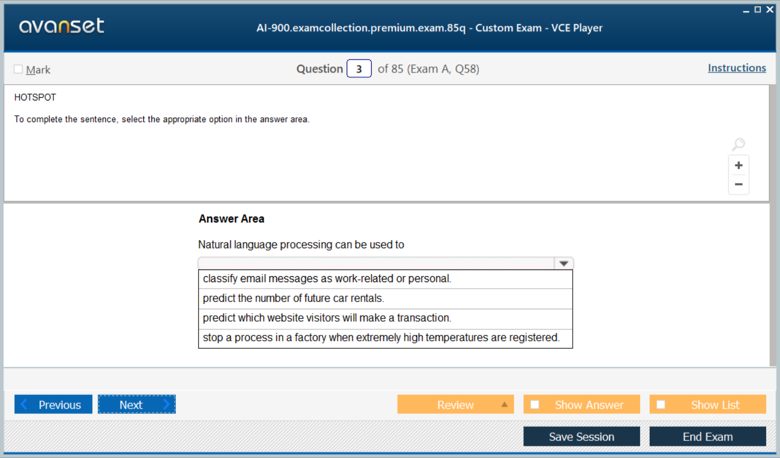
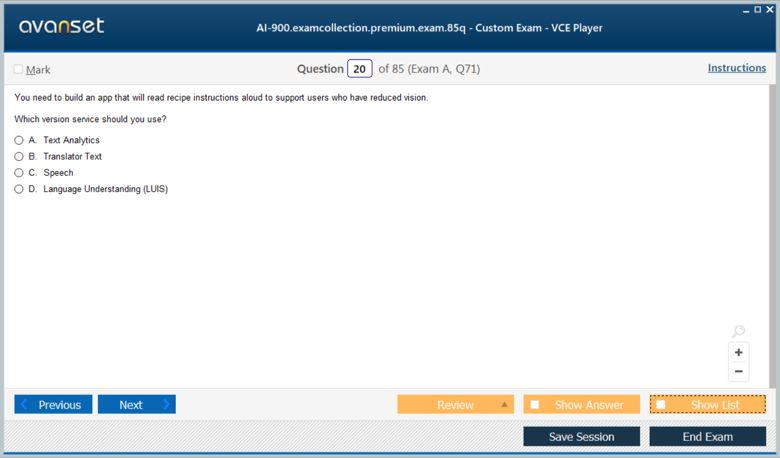
Microsoft Certified: Azure AI Fundamentals Certification Exams Screenshots
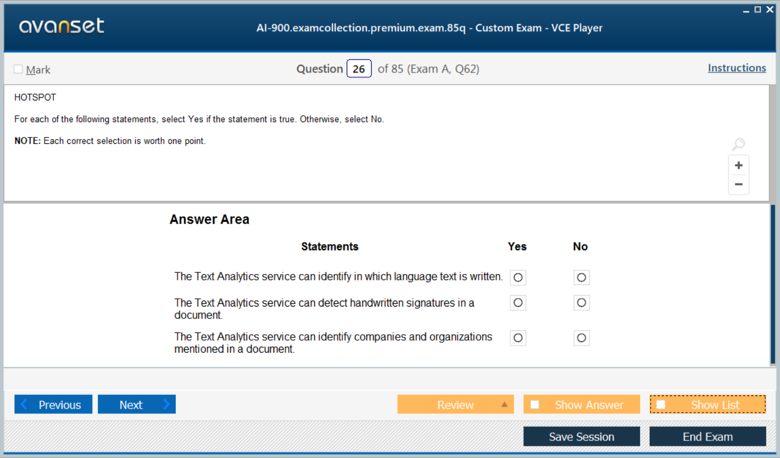
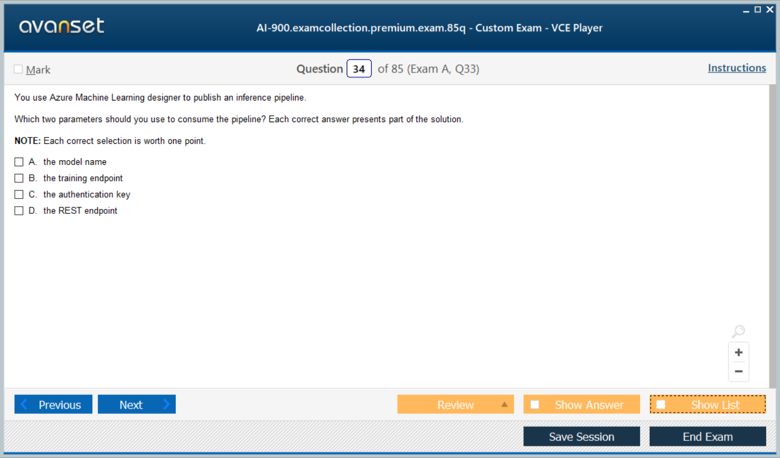
Microsoft Certified: Azure AI Fundamentals Product Reviews
Download Free Microsoft Certified: Azure AI Fundamentals Practice Test Questions VCE Files
| Exam | Title | Files |
|---|---|---|
Exam AI-900 |
Title Microsoft Azure AI Fundamentals |
Files 7 |
Exam AI-901 |
Title Microsoft Azure AI Fundamentals |
Files 1 |
Microsoft Certified: Azure AI Fundamentals Certification Exam Dumps & Practice Test Questions
Prepare with top-notch Microsoft Certified: Azure AI Fundamentals certification practice test questions and answers, vce exam dumps, study guide, video training course from ExamCollection. All Microsoft Certified: Azure AI Fundamentals certification exam dumps & practice test questions and answers are uploaded by users who have passed the exam themselves and formatted them into vce file format.
Azure AI Fundamentals Now Runs on AI-901
Microsoft Certified: Azure AI Fundamentals remains a current certification, but the exam route changed in 2026. The former AI-900 exam retired on June 30, 2026. Candidates starting now should prepare for AI-901, which is the active exam required for the same Azure AI Fundamentals credential. That distinction matters because older study material can still explain useful concepts while describing an exam blueprint that no longer applies.
The current certification is an entry point into Microsoft certifications for people entering AI solution development. Microsoft now expects more than recognition of AI vocabulary. AI-901 combines conceptual understanding with foundational technical awareness: candidates should be comfortable with basic Python syntax, Azure resources, and the idea of working with APIs, SDKs, and command-line tools even though this is still a fundamentals-level credential.
The practical implication is that Azure AI Fundamentals has become a more implementation-aware starting point. It still asks whether a candidate understands machine learning, computer vision, language, generative AI, and responsible AI, but it also places substantial weight on implementing AI solutions with Microsoft Foundry. A useful study plan therefore connects concepts to small hands-on exercises instead of treating the certification as a terminology-only test.
The certification survived even though AI-900 did not
Exam retirements can be confusing because an exam code and a certification name are not always retired together. In this case, AI-900 ended while Microsoft Certified: Azure AI Fundamentals continued under AI-901. That means a page describing the certification can still be current even when an older AI-900 reference on the same subject is historical. Candidates should check the exam code before assuming that an older course, practice set, or study note still maps to the live assessment.
Older AI-900 resources remain useful when they explain durable ideas such as supervised versus unsupervised learning, classification and regression, vision workloads, natural-language processing, generative AI, and responsible AI principles. They can help build context, but their exam-specific percentages and service emphasis should not be treated as current. The safest approach is to use legacy material for concepts and the AI-901 skills outline for final coverage decisions.
AI-901 puts Microsoft Foundry at the center
AI-901 is divided into two broad areas: identifying AI concepts and capabilities, and implementing AI solutions by using Microsoft Foundry. The second area carries the larger share of the blueprint. That changes how a candidate should think about preparation. Knowing what a model, prompt, vector search process, or agent can do is important, but the exam also expects an understanding of how those capabilities appear inside Microsoft’s current AI development environment.
Foundry-oriented preparation should include the basic flow from choosing a model or service through creating a project, connecting resources, testing behavior, evaluating outputs, and understanding how an application consumes the result. The purpose is not to turn a beginner into a production architect. It is to make sure the candidate can recognize how Azure AI concepts become working solution components rather than remaining abstract definitions.
For the current blueprint, the weighting also suggests where time should go. Identifying concepts and capabilities represents roughly two-fifths of the exam, while implementation with Microsoft Foundry represents the larger share. A learner who spends nearly all preparation time on definitions risks missing the practical emphasis. A stronger plan alternates concept review with short Foundry exercises, so every important term is associated with a screen, resource, request, configuration, or output that makes the concept tangible.
Responsible AI is a design concern, not a memorized slogan
Microsoft continues to treat responsible AI as foundational. Fairness, reliability and safety, privacy and security, inclusiveness, transparency, and accountability are useful only when a learner can connect them to design choices. A model that performs well overall can still disadvantage a subgroup; a fluent generative response can still be ungrounded; a useful agent can still have excessive permissions. Those scenarios make the principles concrete.
Candidates should practice identifying the control that fits the risk. Sensitive data may call for access restrictions and privacy safeguards. High-impact automation may require human review and clear accountability. Generative applications need evaluation and safety controls rather than blind trust in model output. Thinking in this problem-solution pattern prepares learners better than memorizing a list of principles.
Machine learning fundamentals still provide the conceptual backbone
Even with the stronger Foundry emphasis, Azure AI Fundamentals still depends on basic machine learning literacy. Candidates should recognize common workload types, understand why training and inference are different activities, and know what features, labels, models, and evaluation metrics represent. They should be able to distinguish a regression problem from classification or clustering by reading the business problem rather than by searching for a keyword.
Hands-on exposure to Azure Machine Learning workflows can make those relationships easier to remember because a learner sees how data, compute, models, endpoints, and evaluation fit together. The exam remains introductory, so deep algorithm derivations are unnecessary. What matters is being able to reason about which type of AI capability fits a scenario and what evidence would show whether the solution works.
Generative AI requires grounding, evaluation, and control
Generative AI is no longer a small add-on to a fundamentals curriculum. Candidates should understand what large language models do, why prompts influence behavior, and how retrieval or grounding can improve responses with organization-specific information. They should also recognize that generative output is probabilistic and can be plausible without being correct, which is why evaluation and safety practices matter.
An introductory treatment of AI agents and autonomous behavior is useful because agents extend a model beyond text generation into planning, tool use, memory, and action. At fundamentals level, the important question is not how to build a complex multi-agent platform. It is why an agent needs clear instructions, constrained permissions, reliable tools, observable behavior, and boundaries around actions that carry business or security risk.
Vision, language, and information extraction remain practical workloads
Computer vision and natural-language processing remain core parts of the Azure AI landscape. A candidate should be able to recognize image analysis, optical character recognition, speech, text classification, entity extraction, translation, and conversational use cases. The best way to study these areas is to start from the business input and desired output, then identify the service capability that closes that gap.
Information extraction also bridges traditional AI services and modern generative applications. A solution might first extract structured fields from documents, then use a generative model to summarize or reason over the result. This layered view helps explain why older service categories still matter even as Microsoft emphasizes Foundry and agents. New tooling changes the orchestration, but reliable input processing remains essential.
Python and APIs change what fundamentals means
Microsoft’s current candidate profile explicitly expects familiarity with Python syntax and programming techniques, along with REST APIs, SDKs, and CLIs. That does not make AI-901 a software-engineering exam, but it does mean a learner should understand how code reaches a cloud service. Reading a short snippet that creates a client, authenticates, sends a request, and handles a response should not feel completely foreign.
A practical study routine can stay lightweight: create a resource, inspect an endpoint, make a simple SDK or REST call, and observe the response structure. The value is conceptual. Once a learner understands that applications authenticate to resources, submit inputs, receive outputs, and must handle errors and limits, many service-specific questions become easier to reason through.
AI-901 is a foundation, not an associate-level substitute
Azure AI Fundamentals is useful for people beginning an AI path, but it does not replace a role-based certification that expects implementation depth. Someone who wants to build production AI applications can progress toward Azure AI Apps and Agents Developer Associate and the AI-103 exam, where generative applications, agents, retrieval, vision, language, and information extraction are assessed at a much more applied level.
That progression works best when the learner treats AI-901 as vocabulary plus first principles, not as a final professional destination. The fundamentals credential can establish a common mental model across developers, analysts, architects, product owners, and technical managers. Deeper credentials then add the role-specific design, coding, deployment, security, evaluation, and operational skills needed for production work.
A current study plan should start from the live blueprint
Because the exam code changed recently, candidates should make the AI-901 skills outline the source of truth for coverage. Build a checklist from the live domains, map each objective to a short note or hands-on task, and mark older AI-900 material as historical before using it. This prevents a familiar legacy course from silently becoming the study plan simply because it has more content.
Preparation should finish with scenario practice that mixes concepts instead of isolating them. A realistic question may combine a workload type, an Azure capability, a responsible AI concern, and an implementation choice. If the learner can explain why one approach fits and why another does not, the knowledge is becoming usable. That is the right level of confidence to bring into a modern fundamentals exam.
A final review should also separate facts that are stable from details that change quickly. The purpose of machine learning, computer vision, language processing, and responsible AI is durable; product names, menus, service packaging, and exam objectives can move. Revisiting the current Microsoft skills outline shortly before the exam protects against studying a superseded emphasis and teaches a useful professional habit: cloud practitioners must validate documentation against the version that is actually live.
ExamCollection provides the complete prep materials in vce files format which include Microsoft Certified: Azure AI Fundamentals certification exam dumps, practice test questions and answers, video training course and study guide which help the exam candidates to pass the exams quickly. Fast updates to Microsoft Certified: Azure AI Fundamentals certification exam dumps, practice test questions and accurate answers vce verified by industry experts are taken from the latest pool of questions.

Microsoft Microsoft Certified: Azure AI Fundamentals Video Courses

Top Microsoft Certifications










Top Microsoft Certification Exams
- AZ-104
- AI-103
- AB-100
- SC-500
- AI-901
- DP-700
- SC-300
- AZ-305
- AB-900
- GH-300
- AB-620
- MD-102
- PL-300
- SC-401
- AZ-900
- SC-200
- DP-600
- MS-102
- SC-100
- DP-800
- AB-730
- AB-731
- AZ-700
- AI-200
- AB-410
- AZ-801
- AZ-400
- DP-750
- SC-900
- PL-400
- AZ-140
- MS-700
- AZ-500
- AI-300
- DP-300
- PL-900
- AZ-800
- MB-310
- GH-600
- MB-800
- DP-900
- PL-200
- MB-330
- AZ-802
- MB-230
- MB-820
- AI-900
- MS-721
- AI-500
- GH-900
- AB-650
- GH-200
- AZ-204
- GH-100
- AB-250
- MB-500
- AI-102
- DP-420
- AZ-120
- MB-280
- GH-500
- MB-910
- SC-400
- PL-600
- MS-900
- MB-700
- AB-210
Site Search: