
Pass Your Microsoft Certified: Azure Data Scientist Associate Certification Easy!
Microsoft Certified: Azure Data Scientist Associate Certification Exams Questions & Answers, Accurate & Verified By IT Experts
Instant Download, Free Fast Updates, 99.6% Pass Rate.

Designing and Implementing a Data Science Solution on Azure
Includes 432 Questions & Answers
$69.99
Microsoft Certified: Azure Data Scientist Associate Certification Exams Screenshots
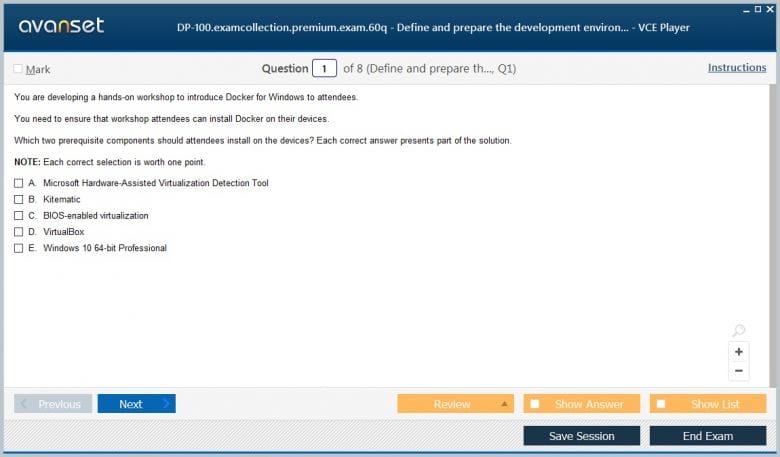
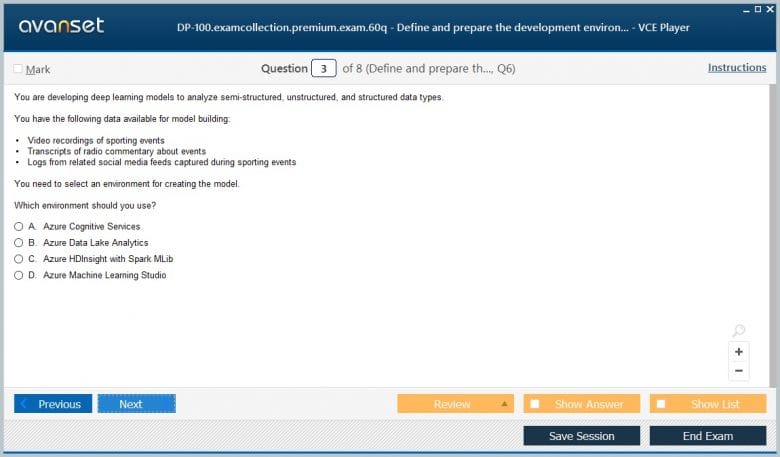
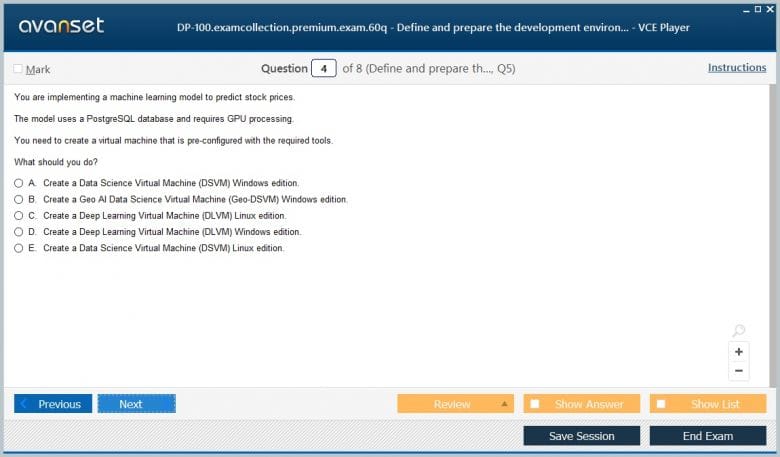
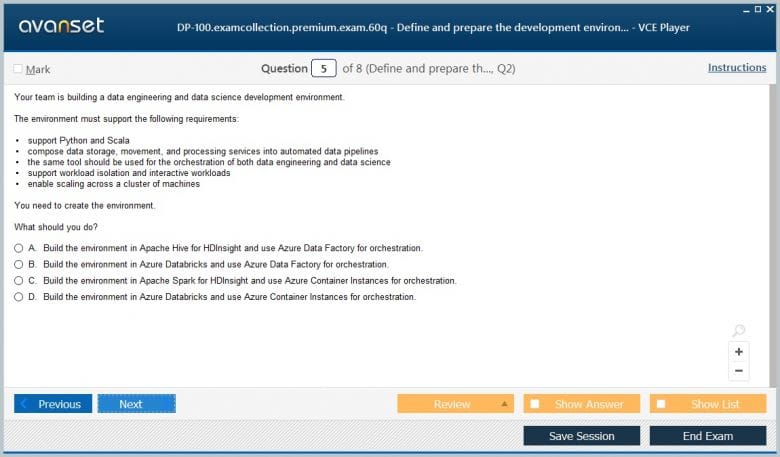
Microsoft Certified: Azure Data Scientist Associate Product Reviews
Download Free Microsoft Certified: Azure Data Scientist Associate Practice Test Questions VCE Files
| Exam | Title | Files |
|---|---|---|
Exam DP-100 |
Title Designing and Implementing a Data Science Solution on Azure |
Files 10 |
Microsoft Certified: Azure Data Scientist Associate Certification Exam Dumps & Practice Test Questions
Prepare with top-notch Microsoft Certified: Azure Data Scientist Associate certification practice test questions and answers, vce exam dumps, study guide, video training course from ExamCollection. All Microsoft Certified: Azure Data Scientist Associate certification exam dumps & practice test questions and answers are uploaded by users who have passed the exam themselves and formatted them into vce file format.
Azure Data Scientist Associate After DP-100
Microsoft Certified: Azure Data Scientist Associate is a retired credential. The DP-100 exam and the certification retired on June 1, 2026, so a current learner should not build a certification plan around DP-100. Microsoft replaced that route with Machine Learning Operations Engineer Associate, earned through AI-300, which shifts the emphasis from a data-science-only workflow toward operationalizing both machine learning and generative AI systems.
The change is substantial enough that AI-300 should not be treated as a renamed DP-100. DP-100 focused on designing and implementing data science solutions with Azure Machine Learning. AI-300 expects infrastructure, lifecycle automation, model deployment, monitoring, GenAIOps, generative AI evaluation, retrieval performance, and production engineering practices. Data-science knowledge still matters, but the certification now validates a wider operating discipline.
For people who already studied DP-100, the best transition is not to discard everything. Experiment tracking, model training, compute, data assets, endpoints, responsible AI, and performance evaluation all remain useful. The work is to identify which foundations transfer, then add the infrastructure-as-code, source-control, automation, observability, and generative AI operations that define the current role.
DP-100 belongs to the previous Azure data science pathway
DP-100 was designed for data scientists who used Azure Machine Learning to prepare data, train models, manage experiments, deploy endpoints, and evaluate results. That historical scope still reflects real data-science responsibilities, especially for teams with established Azure Machine Learning projects. The retirement changes the credential path, not the fact that model development and experimentation remain important professional skills.
Older material such as DP-100 data science preparation can therefore be useful when it explains Azure Machine Learning concepts that still exist. It should be labeled as legacy exam content, particularly when it describes old objective weightings, interface steps, or certification requirements. The current AI-300 blueprint must decide what deserves exam preparation time.
AI-300 turns model development into an operational lifecycle
The new credential focuses on AI operations: MLOps for traditional machine learning and GenAIOps for generative AI applications and agents. That means the candidate is expected to think beyond building a model that performs well in a notebook. A production model needs versioning, repeatable infrastructure, controlled deployment, telemetry, rollback, retraining logic, security, and collaboration with development and operations teams.
This lifecycle perspective changes the questions a learner asks. Instead of only asking which algorithm performs best, the engineer also asks how the model will be packaged, which environment is reproducible, how secrets are managed, how releases are promoted, what metrics trigger investigation, and how a failed deployment is reversed. These are the concerns that turn experimentation into a maintained service.
The weighting reinforces that balance. Machine learning model lifecycle and operations is the largest single domain, while MLOps infrastructure and GenAIOps infrastructure each occupy substantial portions of the assessment. Generative AI quality, observability, and optimization make up the remaining domains. A candidate who studies only traditional Azure Machine Learning can therefore miss a large part of the current role, while someone who studies only prompt engineering misses the production machine learning foundation.
MLOps infrastructure is now an explicit skill domain
AI-300 includes designing and implementing MLOps infrastructure. Candidates work with Azure Machine Learning workspaces, data and environment assets, compute targets, registries, identity and access, network restrictions, and infrastructure as code. Bicep and Azure CLI appear because production teams need environments that can be recreated consistently instead of depending on a sequence of manual portal clicks.
Git and GitHub Actions are equally important because the operating model is collaborative. Source control records changes, pull requests create a review boundary, and workflows can automate validation or deployment. A candidate who comes from a pure notebook background should spend time learning how code, configuration, model assets, and infrastructure definitions move together through an engineering lifecycle.
Model lifecycle work still depends on strong data science fundamentals
Operational discipline does not replace data-science judgment. AI-300 still expects candidates to understand experiment tracking, training jobs, hyperparameter tuning, automated machine learning, distributed training, MLflow model registration, and model evaluation. If the underlying experiment is poorly designed, automating it simply produces bad models more efficiently.
Working through data concepts in Azure Machine Learning can reinforce the relationship among data assets, compute, experiments, and model artifacts. A useful lab follows one model from data registration through training and evaluation to a registered version. The learner should be able to explain what changed at each stage and which artifact would need to be reproduced during an incident.
Production deployment requires safe change, not a one-time endpoint
AI-300 expects knowledge of real-time and batch deployments, endpoint testing, troubleshooting, progressive rollout, and safe rollback. Those topics matter because model releases can fail in ways that ordinary unit tests do not reveal. A new version may increase latency, behave differently on a subgroup, consume more resources, or degrade after its input distribution changes.
A strong preparation project should deploy at least two model versions and deliberately test a controlled promotion. Observe endpoint metrics, route limited traffic where possible, define what would trigger rollback, and document how the previous version would be restored. That exercise turns terms such as versioning and safe deployment into operational judgment.
GenAIOps adds evaluation and observability for nondeterministic systems
Generative AI applications and agents create a different quality problem from a conventional predictive model. Output quality can vary with prompts and context, and a response can be fluent while still being ungrounded or unsafe. AI-300 therefore includes evaluation for groundedness, relevance, coherence, fluency, risk and safety, along with monitoring of latency, throughput, cost, logs, and traces.
Candidates should practice building a small evaluation set and recording why each example exists. A useful evaluation suite covers normal cases, ambiguous cases, missing context, harmful requests, and domain-specific edge conditions. The goal is to move from subjective impressions such as 'the answer looks good' toward repeatable evidence that can be tracked across prompt, model, or retrieval changes.
Observability should also connect technical signals to user impact. A latency increase may be tolerable in an asynchronous workflow but unacceptable in an interactive assistant. Token cost may matter more in a high-volume application than in an internal prototype. Safety failures may demand immediate blocking even when overall quality metrics look strong. The operational skill is deciding which signals matter, what thresholds deserve action, and how engineers will investigate when behavior moves outside the expected range.
RAG performance is an operations problem as well as an application problem
Retrieval-augmented generation links model behavior to the quality of the retrieval layer. Chunk size, embedding choice, search strategy, similarity thresholds, freshness, and access controls all influence the context that reaches the model. AI-300 expects candidates to optimize retrieval performance and evaluate the resulting system rather than assuming that adding a vector store automatically improves accuracy.
This area rewards systematic experimentation. Change one retrieval parameter, measure relevance, compare output quality, and track the effect on latency or cost. Hybrid search may outperform a single retrieval method for some workloads; domain-specific embeddings may help another. Operations engineers need enough understanding to identify whether a problem comes from retrieval, prompting, the model, or the surrounding application.
The replacement broadens collaboration across AI teams
The former Azure Data Scientist Associate naturally centered the data scientist. Machine Learning Operations Engineer Associate is more explicitly cross-functional. The role works with data scientists, DevOps teams, application engineers, security teams, and stakeholders to make AI systems repeatable and supportable. That changes both the technical toolkit and the communication burden.
A good MLOps or GenAIOps engineer must understand what the model owner needs without treating every request as an ad hoc deployment. Standards for environments, registries, monitoring, access, testing, and release approvals make it possible to support many models consistently. Certification preparation should therefore include architectural reasoning and operational trade-offs, not only command syntax.
Build the transition plan around AI-300, not around missing DP-100 topics
Start with the AI-300 domains and map prior DP-100 knowledge onto them. Keep the Azure Machine Learning material that supports current training, tracking, model registration, deployment, and responsible evaluation. Add GitHub Actions, Bicep or CLI-based provisioning, network and identity controls, model monitoring, GenAIOps infrastructure, generative AI evaluation, retrieval optimization, and fine-tuning operations where the old path did not go deeply enough.
Using scalable Azure Machine Learning practices as technical context can help, but the final checklist should stay tied to the current certification. The retirement happened in June 2026, so there is little reason for a new candidate to study DP-100 as if it were still schedulable. Preserve the useful science; move the credential plan to the operational role Microsoft now validates.
A final readiness test is whether you can describe the life of an AI system from source control to production monitoring. Explain how infrastructure is provisioned, how experiments are tracked, how a model or prompt is versioned, how evaluation gates a release, how the deployment is observed, and what happens when performance or quality degrades. If any stage is vague, that gap is more useful to study than another pass through retired DP-100 trivia.
ExamCollection provides the complete prep materials in vce files format which include Microsoft Certified: Azure Data Scientist Associate certification exam dumps, practice test questions and answers, video training course and study guide which help the exam candidates to pass the exams quickly. Fast updates to Microsoft Certified: Azure Data Scientist Associate certification exam dumps, practice test questions and accurate answers vce verified by industry experts are taken from the latest pool of questions.

Microsoft Microsoft Certified: Azure Data Scientist Associate Video Courses

Top Microsoft Certifications


















Top Microsoft Certification Exams
- AZ-104
- AI-103
- AB-100
- SC-500
- AI-901
- DP-700
- SC-300
- AZ-305
- AB-900
- GH-300
- AB-620
- MD-102
- PL-300
- AZ-900
- SC-401
- SC-200
- DP-600
- MS-102
- SC-100
- DP-800
- AB-730
- AB-731
- AZ-700
- AI-200
- AB-410
- AZ-801
- AZ-400
- DP-750
- PL-400
- SC-900
- AZ-140
- MS-700
- AZ-500
- DP-300
- AI-300
- PL-900
- MB-310
- GH-600
- MB-800
- AZ-800
- DP-900
- AZ-802
- PL-200
- MB-330
- MB-230
- MB-820
- AI-900
- AI-500
- GH-900
- MS-721
- GH-200
- AB-650
- AB-250
- AZ-204
- GH-100
- MB-500
- DP-420
- AI-102
- AZ-120
- MB-280
- MB-910
- SC-400
- GH-500
- MS-900
- PL-600
- AB-210
- MB-700
Site Search:




I want do this course