


Premium File
332 Q&A
$76.99$69.99
Microsoft Dynamics 365 MB-700 Exam Questions & Answers, Accurate & Verified By IT Experts
Instant Download, Free Fast Updates, 99.6% Pass Rate

MB-700 Premium File: 332 Questions & Answers
Last Update: Sep 27, 2026
MB-700 PDF Study Guide: 749 Pages
$74.99
Microsoft Dynamics 365 MB-700 Exam Screenshots
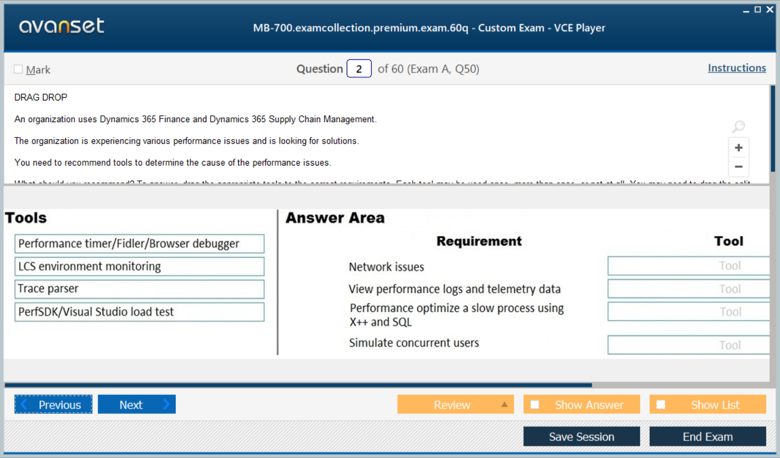
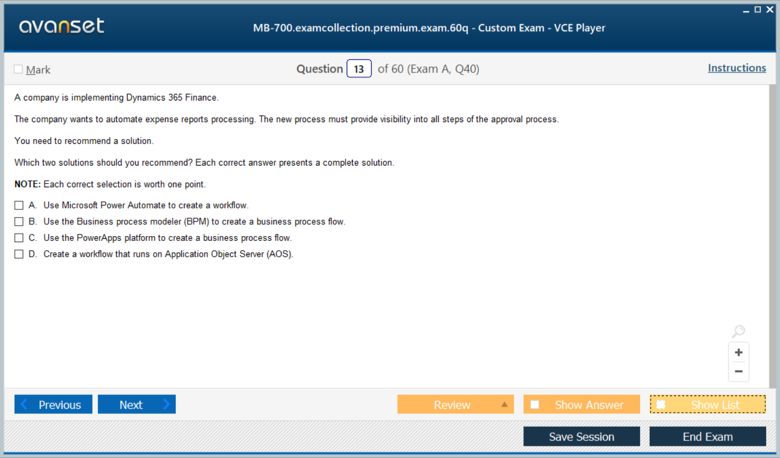
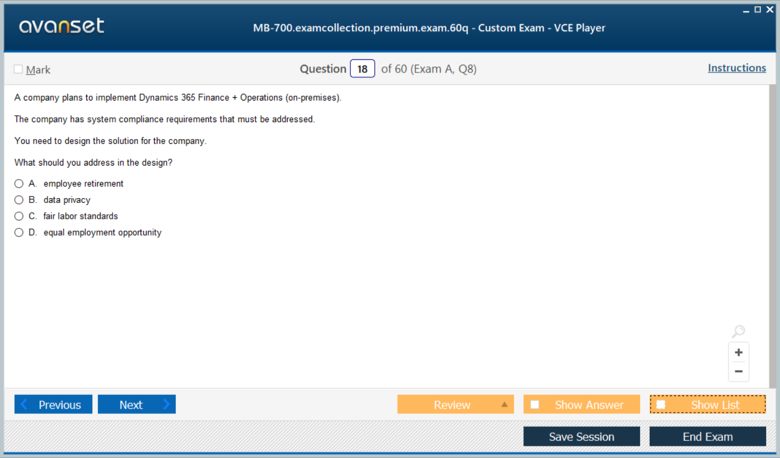
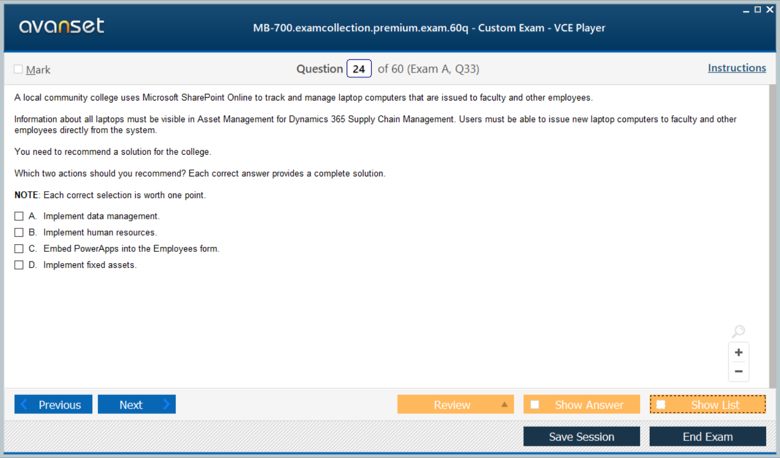
Microsoft Dynamics 365 MB-700 Practice Test Questions in VCE Format
| File | Votes | Size | Date |
|---|---|---|---|
File Microsoft.pass4sures.MB-700.v2026-07-17.by.zala.58q.vce |
Votes 1 |
Size 906.33 KB |
Date Jul 17, 2026 |
File Microsoft.questionspaper.MB-700.v2021-10-21.by.miles.42q.vce |
Votes 1 |
Size 953.95 KB |
Date Oct 21, 2021 |
File Microsoft.certkey.MB-700.v2021-04-27.by.marc.28q.vce |
Votes 1 |
Size 178.24 KB |
Date Apr 28, 2021 |
File Microsoft.train4sure.MB-700.v2020-04-22.by.ida.15q.vce |
Votes 2 |
Size 27.54 KB |
Date Apr 22, 2020 |
File Microsoft.test4prep.MB-700.v2020-02-13.by.frankie.20q.vce |
Votes 3 |
Size 577.03 KB |
Date Feb 13, 2020 |
Microsoft Dynamics 365 MB-700 Practice Test Questions, Exam Dumps
Microsoft MB-700 (Microsoft Dynamics 365: Finance and Operations Apps Solution Architect) exam dumps vce, practice test questions, study guide & video training course to study and pass quickly and easily. Microsoft MB-700 Microsoft Dynamics 365: Finance and Operations Apps Solution Architect exam dumps & practice test questions and answers. You need avanset vce exam simulator in order to study the Microsoft Dynamics 365 MB-700 certification exam dumps & Microsoft Dynamics 365 MB-700 practice test questions in vce format.
MB-700, Microsoft Dynamics 365 Finance and Operations Apps Solution Architect, retired on June 30, 2026. The final exam blueprint covered solution architecture, solution strategy, implementation management, and testing. It expected experienced Dynamics 365 professionals to turn business requirements into secure, scalable, maintainable designs across Finance, Supply Chain Management, Commerce, Power Platform, integrations, data, security, environments, and organizational processes. The MB-700 exam is no longer available, but the architecture discipline it represented remains highly relevant.
A solution architect does not simply choose product features. The role has to identify constraints, document a blueprint, decide how systems divide responsibility, plan migration and integration, define environment and application-lifecycle strategy, address security and compliance, control performance risks, and coordinate implementation teams. The final 2025 blueprint also acknowledged Copilot and AI agents in finance-and-operations scenarios, reflecting how the architecture role had expanded before the certification was retired.
The historical Finance and Operations Apps Solution Architect path is best used now as a framework for design reviews and implementation leadership, not as a current exam plan.
The final MB-700 blueprint emphasized gathering requirements, identifying operational and organizational challenges, documenting the solution blueprint, and mapping business processes. Architects should ask what the organization is trying to achieve, which processes are mandatory, where existing systems constrain change, and which nonfunctional requirements matter most. Build a blueprint for a fictional global organization with several legal entities, warehouses, currencies, integrations, and regulatory needs. Document assumptions and unresolved decisions rather than hiding them. The quality of an architecture depends on making tradeoffs visible. A requirement such as near-real-time inventory across regions may affect integration, data ownership, performance, and cost at the same time. MB-700 rewarded candidates who could see those interactions before implementation locked them in.
A major architecture responsibility is deciding whether a requirement should be met by configuration, extension, Power Platform, an external service, or a process change. Begin with standard Dynamics capabilities and identify true gaps. For each gap, estimate lifecycle impact, security, supportability, upgrade behavior, and testing cost. This creates a disciplined customization strategy. It also defines the boundary between functional roles such as MB-310 Finance or MB-330 Supply Chain Management and the MB-500 developer role. The architect must know when standard configuration is sufficient and when technical extension is justified, because unnecessary customization becomes long-term operational debt.
Integration strategy is about ownership, latency, and failure behavior. Finance-and-operations solutions rarely operate alone. They connect to Dataverse, Power Platform, ecommerce, banking, tax, data platforms, identity systems, suppliers, customers, and custom services. Architects should classify each integration by system of record, data direction, volume, latency, transactional consistency, security, retry behavior, and monitoring. Draw the integration map and identify where synchronous dependencies could create fragility. Then simulate a downstream outage and decide what should queue, fail, retry, or alert. A strong architecture prevents an external interruption from silently corrupting core business processes. The final MB-700 objectives treated integration as a strategy topic because the right pattern depends on business consequences, not only available APIs.
A new implementation must decide how historical data is cleansed and migrated, which master data is authoritative, how reference data is governed, what operational information stays in the application, and how analytics consume it. Build a migration plan with several mock legacy sources and define sequencing, validation, reconciliation, and cutover criteria. Separate data that is required for ongoing transactions from data that can remain in an archive or analytical platform. Add retention and privacy requirements. This exercise makes clear why migration is not merely an import project. The data model is part of the architecture, and poor migration decisions can compromise reporting, performance, user trust, and compliance long after go-live.
Architects need a security model that covers roles and duties inside the applications, Microsoft Entra identities, privileged access, segregation of duties, data restrictions, integration identities, auditing, and environment access. Define several user personas and identify the minimum access required for each. Add an integration account and a support administrator, then review how their permissions differ from business users. Consider sensitive financial, personal, or commercial data and determine whether record or field-level controls are necessary. Security design should also account for operational support: a production incident may require elevated access, but that access should be controlled and auditable. The exam treated security as architecture because inconsistent authorization cannot be repaired reliably by adding ad hoc restrictions later.
A solution architecture should define development, test, user-acceptance, training, and production environments; data-refresh rules; deployment gates; branching and source-control practices; regression testing; and responsibility for releases. Model one feature from design through production and list every environment transition and approval. Then introduce an urgent production defect and decide how the hotfix should move without bypassing governance. These scenarios reveal whether the lifecycle can handle both planned releases and exceptional change. Solution architects do not need to perform every developer task, but they must understand the delivery system well enough to prevent environment drift and untested changes from becoming normal practice.
Testing strategy must prove business processes, integrations, and nonfunctional requirements. The final blueprint gave a substantial share to testing because go-live confidence depends on more than unit tests. Define functional, integration, regression, performance, security, migration, and user-acceptance testing for a cross-module process such as order-to-cash or procure-to-pay. Create acceptance criteria before execution, identify representative data, and decide what evidence is required for signoff. Include failure scenarios, not just the happy path. A system that processes a normal order may still fail under peak load, a permission boundary, or an integration outage. Architects should also plan regression coverage for future releases. The key is traceability: every critical requirement should map to a design decision and to evidence showing that the implemented solution satisfies it.
Microsoft retired the MB-700 certification and exam on June 30, 2026 as part of wider credential changes. That means candidates should not build a current certification plan around MB-700, and older pages that imply an active expert path need historical context. The architectural responsibilities remain, however, because complex Dynamics 365 implementations still require someone to coordinate processes, data, integration, security, lifecycle, performance, testing, and stakeholder decisions. The old MB-700 solution-architect material is most useful as a design-review checklist and a source of scenario practice rather than as an exam-registration guide.
MB-700 is retired, but the role it described remains essential on large Dynamics programs. Use the blueprint to practice making cross-system tradeoffs, documenting decisions, and proving that the resulting solution is secure, supportable, and testable. Use Microsoft’s current credential catalog—not the old exam code—for present-day certification choices.
A useful MB-700 exercise is an architecture decision record for a difficult requirement. Suppose a global company wants near-real-time order visibility across Dynamics 365, a customer portal, and a data platform while preserving regional data controls. Document at least three designs, list tradeoffs in latency, ownership, failure isolation, security, cost, and supportability, then select one and record why. This practice builds the judgment the expert exam tried to validate. Architects rarely choose between a correct answer and an obviously wrong one; they choose among workable options with different consequences.
Next, run a pre-go-live review using the old blueprint as a checklist. Confirm that business processes have owners, integrations have monitoring and retry behavior, migration has reconciliation criteria, security has been tested with real roles, environments have controlled deployment paths, performance assumptions have been measured, and critical processes have evidence from end-to-end testing. Add a support model for the first weeks after launch. This demonstrates why solution architecture continues after the diagrams are drawn. A design is only successful when the implementation can be operated and changed safely.
The companion MB-700 solution-architect discussion can help revisit the retired scope, but current professionals should use it as architecture practice rather than a certification schedule. Microsoft’s credential portfolio has changed, while the need to coordinate Finance, Supply Chain, developers, Power Platform, data, security, integration, and testing remains. That is the lasting value of the MB-700 body of knowledge.
Architecture practice should also include governance after go-live. Define who owns process changes, who approves extensions, how integration contracts are versioned, how environment capacity is reviewed, how security changes are audited, and how new Microsoft features are evaluated before adoption. Without this operating model, even a sound launch architecture can degrade through uncontrolled local decisions. The MB-700 blueprint implicitly rewarded architects who treated the solution as a living system with ongoing change, not a one-time implementation artifact.
When reviewing an old MB-700 scenario, separate the enduring architecture question from the retired credential wording. Requirements around integration, data ownership, segregation of duties, environment strategy, testing, and support remain relevant even when product features or certification names change. Reframing the question this way preserves the useful design reasoning while preventing an archived exam objective from being mistaken for a current Microsoft certification requirement.
The most useful final habit is to make every major decision traceable. Record the requirement, alternatives considered, chosen design, risks, assumptions, owner, and validation evidence. That discipline makes architecture easier to govern after go-live and preserves the reasoning behind decisions when teams, products, and organizational priorities change.
It also makes future reviews faster because assumptions are visible instead of buried in memory or meeting history.
Go to testing centre with ease on our mind when you use Microsoft Dynamics 365 MB-700 vce exam dumps, practice test questions and answers. Microsoft MB-700 Microsoft Dynamics 365: Finance and Operations Apps Solution Architect certification practice test questions and answers, study guide, exam dumps and video training course in vce format to help you study with ease. Prepare with confidence and study using Microsoft Dynamics 365 MB-700 exam dumps & practice test questions and answers vce from ExamCollection.
Purchase Individually

Top Microsoft Certifications























































Top Microsoft Certification Exams
Site Search:

SPECIAL OFFER: GET 10% OFF

Pass your Exam with ExamCollection's PREMIUM files!
SPECIAL OFFER: GET 10% OFF
Use Discount Code:
MIN10OFF
A confirmation link was sent to your e-mail.
Please check your mailbox for a message from support@examcollection.com and follow the directions.

Download Free Demo of VCE Exam Simulator
Experience Avanset VCE Exam Simulator for yourself.
Simply submit your e-mail address below to get started with our interactive software demo of your free trial.