
Pass Your Microsoft Certified: Azure Developer Associate Certification Easy!
Microsoft Certified: Azure Developer Associate Certification Exams Questions & Answers, Accurate & Verified By IT Experts
Instant Download, Free Fast Updates, 99.6% Pass Rate.

$69.99
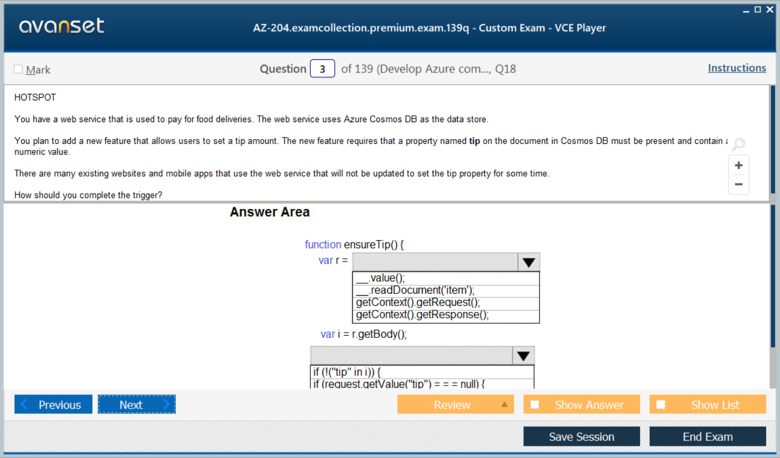
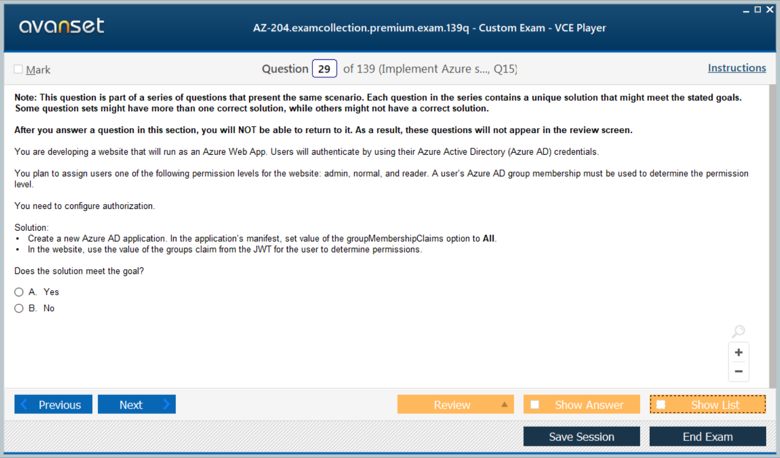
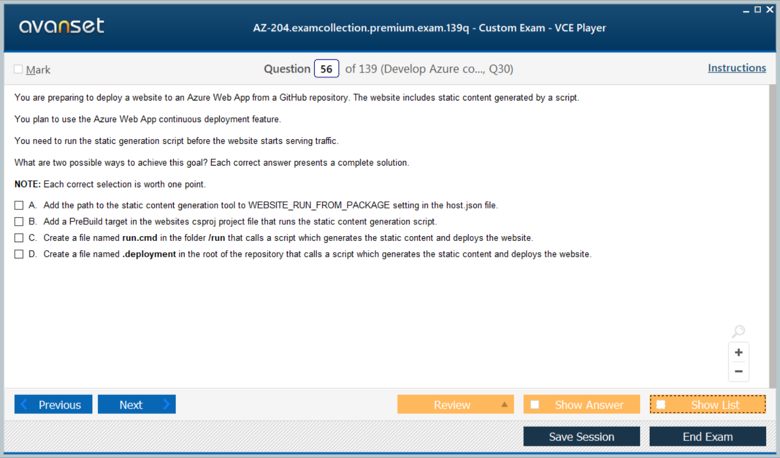
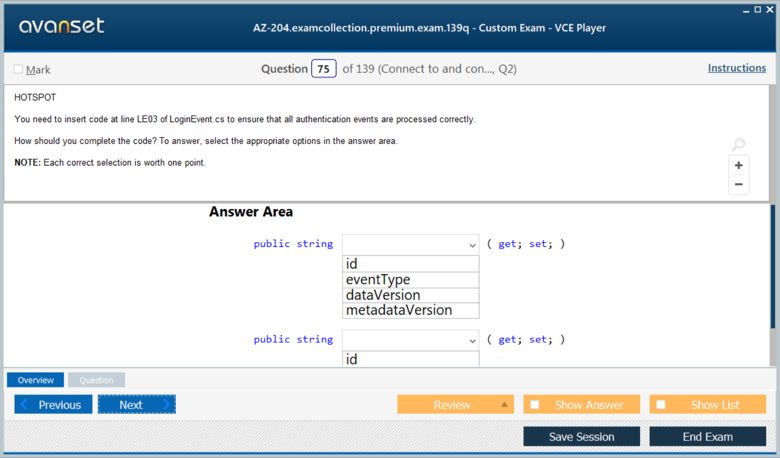
Microsoft Certified: Azure Developer Associate Certification Exams Screenshots
Microsoft Certified: Azure Developer Associate Product Reviews
Download Free Microsoft Certified: Azure Developer Associate Practice Test Questions VCE Files
| Exam | Title | Files |
|---|---|---|
Exam AZ-204 |
Title Developing Solutions for Microsoft Azure |
Files 11 |
Microsoft Certified: Azure Developer Associate Certification Exam Dumps & Practice Test Questions
Prepare with top-notch Microsoft Certified: Azure Developer Associate certification practice test questions and answers, vce exam dumps, study guide, video training course from ExamCollection. All Microsoft Certified: Azure Developer Associate certification exam dumps & practice test questions and answers are uploaded by users who have passed the exam themselves and formatted them into vce file format.
Azure Developer Associate After AZ-204
Microsoft Certified: Azure Developer Associate is now a retired certification. The AZ-204 exam retired on July 31, 2026, and Microsoft replaced the route with Azure AI Cloud Developer Associate, available through AI-200 from July 9, 2026. Current candidates should therefore treat AZ-204 as historical certification material rather than as an exam they can still schedule.
The transition does not make traditional Azure application-development skills obsolete. Azure App Service, Functions, containers, storage, identity, messaging, eventing, monitoring, and secure service integration still matter. What changed is the center of the role. The current developer credential explicitly combines those cloud-development foundations with AI solutions, vector databases, Python, containerized applications, and the full application lifecycle inside the modern Microsoft certifications.
Developers who already prepared for AZ-204 are in a good position if they separate transferable engineering skills from retired exam details. The best transition plan preserves durable Azure development knowledge, then adds the AI-200 emphasis on containerized back ends, AI-aware data services, service integration, security, monitoring, troubleshooting, and production AI application patterns.
AZ-204 is retired, so old preparation needs a status label
AZ-204 covered a broad developer role: compute solutions, storage, authentication and authorization, security, monitoring, and connections to Azure and third-party services. Those topics produced a strong cloud-application foundation, but the certification path itself ended in July 2026. An article, course, or question bank written for AZ-204 should no longer be presented as current scheduling guidance.
Legacy material such as AZ-204 application-development preparation can still help with App Service, Functions, storage, messaging, identity, and telemetry concepts. Candidates should use it deliberately as background and ignore exam-specific weightings or instructions that assume AZ-204 remains live. The AI-200 skills outline now defines the credential target.
AI-200 keeps cloud development but makes AI part of the application
Azure AI Cloud Developer Associate validates the ability to contribute across requirements, design, development, deployment, security, monitoring, and troubleshooting, with an emphasis on back-end services. Microsoft expects familiarity with Azure SDKs, data services, messaging and eventing, monitoring, vector databases, Python, and containerized applications. That profile is recognizably a developer role, but one shaped around AI-enabled systems.
The current blueprint is divided across containerized solutions, AI solutions using Azure data-management services, consuming Azure services, and securing, monitoring, and troubleshooting applications. Rather than treating AI as an isolated API call, the role assumes it participates in a larger distributed system with data, identity, networking, messaging, deployment, and operational requirements.
The change also reflects how application architecture has evolved. A cloud developer increasingly connects managed AI services to ordinary application components rather than building a separate 'AI system' beside the product. A request may pass through an API, retrieve user-authorized data, perform vector search, call a model, publish an event, and write an auditable result. The current certification makes that integration work part of the developer identity.
Containerized back ends are a major part of the current role
Container skills matter because modern AI workloads often need portable back-end services that can scale independently of the user interface. Candidates should understand the purpose of container images, registries, environment configuration, secrets, networking, scaling, and deployment targets. The exam is not a Kubernetes-specialist assessment, but developers should know why containers change how an application is packaged and operated.
A useful lab packages a small Python service, stores the image in a registry, deploys it to an Azure container platform, injects configuration securely, and observes the running application. The developer should be able to explain what belongs in the image, what belongs in environment configuration, how identity is supplied, and how a new version is rolled out without hard-coding secrets.
App Service and Functions remain valuable Azure development patterns
Azure App Service remains relevant for managed web applications and APIs where teams want the platform to handle much of the underlying infrastructure. Serverless functions are useful when code should run in response to events or short-lived requests. These patterns survived the certification transition because they solve enduring hosting and integration problems.
Comparing Azure Functions, Logic Apps, and Event Grid helps developers see where compute, workflow orchestration, and event routing differ. The important skill is not remembering which product icon belongs to which feature. It is recognizing whether a requirement calls for application hosting, event-driven code, a managed business workflow, or event distribution across loosely coupled components.
Messaging and eventing protect services from tight coupling
Distributed applications need ways to communicate without every component depending on another component being immediately available. Azure Service Bus messaging supports durable queue and publish-subscribe patterns, while eventing services address different types of notifications and streams. Developers should understand when the business requires guaranteed work processing, asynchronous decoupling, fan-out, ordering, or high-throughput event ingestion.
This matters even more in AI applications. A model call may be expensive or slow, document processing may run asynchronously, and downstream systems may need to react to generated results. Messaging lets developers isolate failures, smooth load spikes, and retry work without forcing every service into a synchronous request chain. Those are architecture choices, not merely API syntax.
Data services now include vector and AI-oriented access patterns
Azure developers still need to work with object, relational, and NoSQL data, and Azure Cosmos DB remains a useful example of an application-oriented distributed data service. AI-200 extends the data conversation to vector databases and retrieval patterns because AI applications often need semantic access to domain knowledge in addition to conventional transactional storage.
Candidates should be able to reason about why an application separates operational records from embeddings or retrieved knowledge, how identity protects data access, and how data freshness affects model behavior. The developer does not need to become a database administrator, but must understand enough about the data layer to build reliable APIs and AI features on top of it.
Security should be designed into every service call
The current developer role expects applications to authenticate to Azure resources securely, use managed identities where appropriate, protect secrets, control authorization, and avoid embedding credentials in code. Network restrictions, API permissions, service identities, and least privilege become more important as an AI application connects to data, models, messaging systems, storage, and other tools.
Developers should practice tracing an identity through a request. Which principal is running the application? What resource is it trying to reach? Which permission grants the action? Where would a failure appear? This method is more useful than memorizing a list of authentication options because it helps diagnose both security weaknesses and real connectivity problems.
Authorization becomes especially important when an AI feature can act on behalf of a user or service. The application may have permission to retrieve documents, call a business API, or publish a message that triggers another workflow. Each capability should be scoped to the minimum required action, and logs should make the resulting behavior attributable. Agentic or automated functionality increases the cost of getting this boundary wrong.
Monitoring needs to explain behavior across a distributed system
A production application needs telemetry for requests, dependencies, exceptions, latency, resource consumption, and business-critical operations. AI systems add model latency, token or inference cost, retrieval quality, and other specialized signals. AI-200 therefore expects developers to secure, monitor, and troubleshoot solutions rather than stop once deployment succeeds.
A good exercise sends a request through several components and then follows the trace. Observe which dependency took longest, where an exception was recorded, and how logs correlate across services. If a message is delayed, a model endpoint is unavailable, or a data call is denied, the developer should have enough evidence to locate the fault instead of guessing.
Troubleshooting should include dependency failures as well as code defects. An application can be healthy while a storage account, message broker, identity permission, DNS path, model endpoint, or quota causes the user-visible failure. Learning to separate local application errors from service and configuration problems is one of the strongest transferable skills from AZ-204 into the new AI-200 role.
Move forward by mapping AZ-204 knowledge onto AI-200
Start by listing the AZ-204 topics you already know: hosting, functions, storage, identity, messaging, APIs, monitoring, containers, and deployment. Map those to the live AI-200 domains, then identify the additions—Python-centered development, AI-aware data access, vector databases, AI service integration, and the operational needs of AI-enabled back ends. This converts prior study into a head start without pretending the exams are identical.
Finish with one application that combines the pieces: a containerized API, secure access to data, an AI or retrieval capability, asynchronous messaging where appropriate, and end-to-end monitoring. Build, deploy, observe, break, and repair it. That project reflects the current developer role far better than repeatedly reviewing retired AZ-204 objective lists, while preserving the Azure engineering foundation that made the former certification useful.
Because the replacement became available before AZ-204 formally retired, some training catalogs may still contain both codes. The date matters. By late September 2026 the transition is complete: new candidates should choose AI-200. When an older tutorial teaches a durable Azure service well, keep it; when it discusses certification status, objective weighting, or scheduling for AZ-204, treat that portion as historical.
ExamCollection provides the complete prep materials in vce files format which include Microsoft Certified: Azure Developer Associate certification exam dumps, practice test questions and answers, video training course and study guide which help the exam candidates to pass the exams quickly. Fast updates to Microsoft Certified: Azure Developer Associate certification exam dumps, practice test questions and accurate answers vce verified by industry experts are taken from the latest pool of questions.


Microsoft Microsoft Certified: Azure Developer Associate Video Courses

Top Microsoft Certifications
























Top Microsoft Certification Exams
- AZ-104
- AI-103
- AB-100
- AI-901
- SC-500
- DP-700
- SC-300
- AZ-305
- GH-300
- MD-102
- AB-620
- AB-900
- PL-300
- SC-401
- SC-200
- AZ-900
- DP-600
- MS-102
- SC-100
- AI-200
- AB-731
- DP-800
- AB-730
- AZ-700
- AB-410
- AZ-400
- SC-900
- DP-750
- AZ-801
- PL-400
- AZ-140
- DP-300
- MS-700
- AI-300
- PL-900
- AZ-500
- AZ-802
- MB-800
- DP-900
- MB-310
- MB-330
- GH-600
- AZ-800
- PL-200
- MB-820
- AB-650
- AI-500
- MB-230
- AI-900
- GH-900
- GH-200
- AB-250
- MS-721
- MB-500
- GH-100
- AB-210
- AZ-120
- SC-400
- DP-420
- AI-102
- GH-500
- MS-900
- AZ-204
- PL-600
- MB-280
- MB-700
Site Search:



