



Premium File
343 Q&A
$76.99$69.99
Microsoft Dynamics 365 MB-240 Exam Questions & Answers, Accurate & Verified By IT Experts
Instant Download, Free Fast Updates, 99.6% Pass Rate

MB-240 Premium File: 343 Questions & Answers
Last Update: Oct 03, 2026
MB-240 Training Course: 8 Video Lectures
$74.99
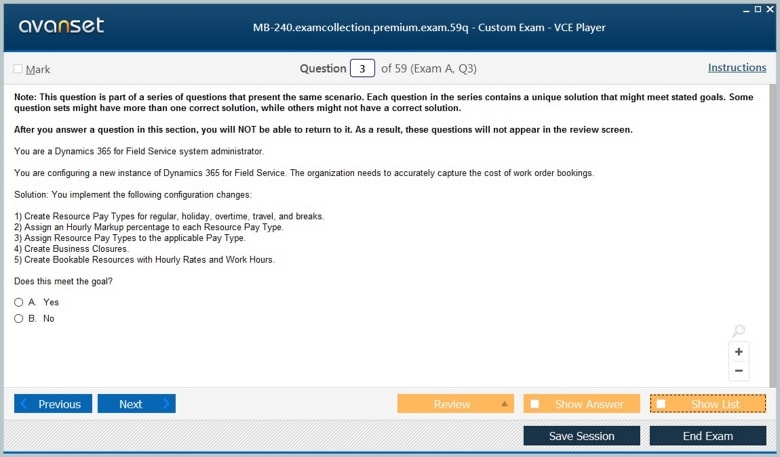
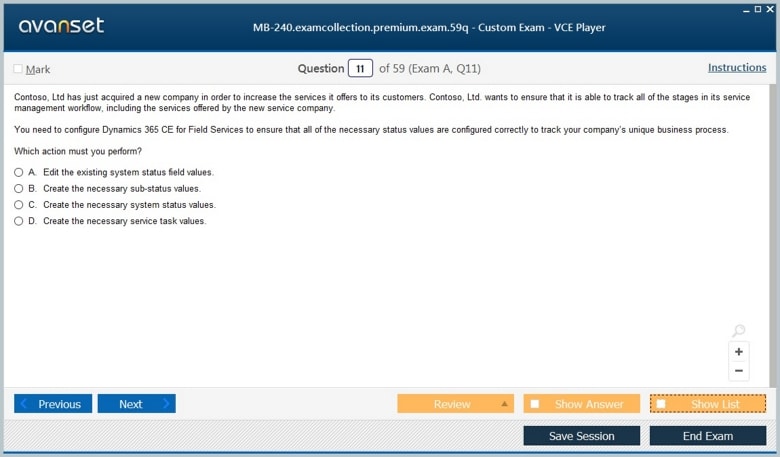
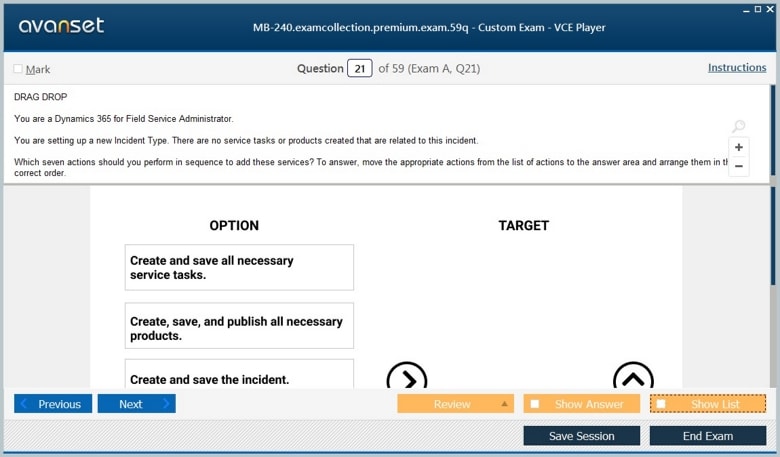
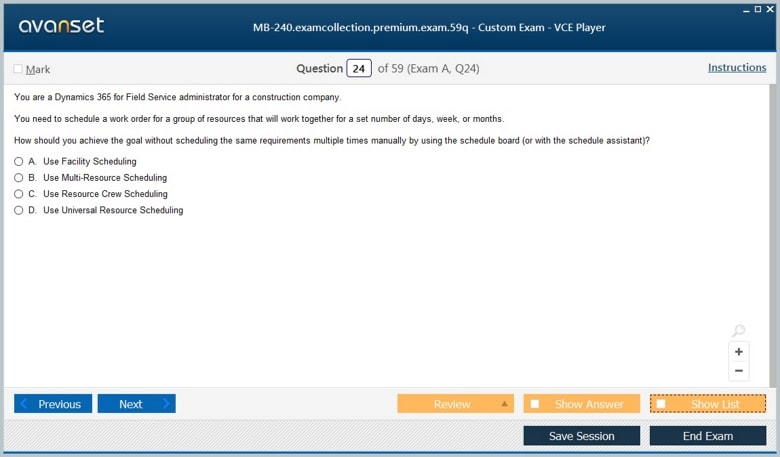
Microsoft Dynamics 365 MB-240 Exam Screenshots
Microsoft Dynamics 365 MB-240 Practice Test Questions in VCE Format
| File | Votes | Size | Date |
|---|---|---|---|
File Microsoft.test-inside.MB-240.v2026-09-05.by.jacob.34q.vce |
Votes 1 |
Size 399.23 KB |
Date Sep 05, 2026 |
File Microsoft.test4prep.MB-240.v2021-05-04.by.lewis.30q.vce |
Votes 1 |
Size 65.91 KB |
Date May 04, 2021 |
File Microsoft.Testking.MB-240.v2019-05-17.by.Perry.24q.vce |
Votes 2 |
Size 83.47 KB |
Date May 19, 2019 |
Microsoft Dynamics 365 MB-240 Practice Test Questions, Exam Dumps
Microsoft MB-240 (Microsoft Dynamics 365 for Field Service) exam dumps vce, practice test questions, study guide & video training course to study and pass quickly and easily. Microsoft MB-240 Microsoft Dynamics 365 for Field Service exam dumps & practice test questions and answers. You need avanset vce exam simulator in order to study the Microsoft Dynamics 365 MB-240 certification exam dumps & Microsoft Dynamics 365 MB-240 practice test questions in vce format.
MB-240, Microsoft Dynamics 365 Field Service Functional Consultant, retired on June 30, 2026. Microsoft still preserves the study guide for reference, but the MB-240 exam can no longer be taken. Its final blueprint remains useful because it captured the end-to-end operating model of a field-service organization: configure the application, manage work orders and assets, schedule resources, support technicians on mobile devices, manage inventory and purchasing, and extend the solution with Power Platform.
Microsoft did not position a single one-for-one exam as a direct replacement for MB-240. The company’s 2026 credential changes instead added newer AI-oriented service credentials while the underlying Dynamics 365 Field Service product continues to exist. That distinction matters. A retired certification path does not mean the workload disappeared; it means candidates should not use an old exam code to make current certification decisions.
The historical Field Service Functional Consultant material is best used as a structured implementation syllabus. It teaches how demand, resources, scheduling, customer assets, mobile execution, inventory, and service history fit together in a working operation.
The application depends on foundational records such as territories, organizational units, characteristics, proficiency models, resource roles, and categories. These are easy to treat as setup screens, but they encode the organization’s real operating structure. A territory affects dispatch decisions. A characteristic can determine whether a technician is qualified for a job. An organizational unit can shape reporting and resource availability. Practice by modeling a small service organization with two regions, several technicians, different skills, and a mix of work types. Then create service demand that intentionally crosses those boundaries. The exercise reveals whether the configuration matches the business reality. The MB-240 Field Service material becomes much more useful when every configuration record can be tied to a scheduling or execution consequence rather than memorized independently.
Work orders bring together the customer, service location, incident type, tasks, products, services, bookings, and asset context required for a technician to do the job. A good lab follows a work order from creation through scheduling, travel, work, completion, review, and follow-up. Use incident types to standardize common jobs, then deliberately create an exception that requires additional products or tasks. This teaches the difference between a reusable template and the actual service transaction. It also shows why status transitions matter: changing a booking or work-order state can drive timestamps, inventory usage, invoicing logic, or automation. The exam’s work-order objectives rewarded candidates who could reason about this lifecycle and diagnose why a record was incomplete, unschedulable, or producing the wrong downstream effect.
Customer assets turn one visit into a service history. Field service becomes more valuable when the organization understands what it is servicing, not only who requested help. Customer assets create that longitudinal context. Candidates should practice creating asset hierarchies, associating work history, connecting products or equipment to locations, and using the record to inform future maintenance. Consider a customer with several similar machines at one site. If the asset relationship is wrong, a technician may arrive with the wrong history or parts assumptions even though the work order itself looks valid. Preventive maintenance scenarios make the value even clearer: recurring agreements and service patterns can be generated from asset needs rather than from ad hoc incidents. Treat asset data as operational master data that deserves consistent naming, ownership, and lifecycle rules.
The schedule board and Universal Resource Scheduling capabilities bring together location, skills, availability, duration, priority, territory, travel, and capacity. A candidate should be able to explain why one technician is a better fit than another and how the system reaches that conclusion. Build a scenario with more demand than capacity, add a high-priority job, and change one technician’s skills or working hours. Then observe how recommendations and the schedule board respond. Manual dispatch also matters because real operations include exceptions that algorithms cannot fully predict. The skill is knowing which constraints are hard requirements and which are preferences. That same systems thinking connects Field Service to current Dynamics 365 Customer Service operations when a customer issue starts in a service center and ultimately requires an on-site visit.
MB-240 devoted explicit attention to the Field Service mobile app because frontline work occurs away from the desktop. Technicians need the right records, forms, tasks, asset details, directions, notes, photos, and status controls at the moment of service. Configure a mobile experience, then test it from the technician’s perspective. Which fields are essential before travel? What information should be easy to update during the visit? What happens when connectivity is poor? A form designed for a dispatcher may be unusable on a phone. Mobile configuration therefore tests whether the data model and process design are genuinely practical. A useful preparation habit is to complete a full job using only the mobile interface and note every place where the process forces unnecessary navigation or assumes information that a technician would not actually have.
A repair can fail even when the right technician arrives if the required part is unavailable. MB-240 included built-in inventory and purchasing because stock movement is part of field execution. Practice with warehouses, technician truck stock, products used on work orders, transfers, returns, purchase needs, and consumption. Track one spare part from central inventory to a technician and then to a completed work order. Verify how quantities and cost-related information change. Next simulate a return or an incorrect part. These scenarios make inventory transactions meaningful and help candidates recognize why operational data must remain synchronized. Field service is not simply scheduling people; it coordinates people, assets, time, and materials. That broader view is one reason the retired exam still provides useful implementation structure even though the credential itself has ended.
The final MB-240 blueprint included Power Platform because organizations often need automation or user experiences beyond standard Field Service configuration. Use Power Platform capabilities where they have a clear operational purpose: a cloud flow can notify a manager when a critical booking is delayed, a custom Dataverse table can capture specialized inspection data, or an app extension can support a unique frontline step. The discipline is to separate configuration from customization. If an out-of-box feature meets the requirement, unnecessary extensions increase maintenance cost. If the requirement is genuinely unique, Power Platform can provide a cleaner answer than forcing an unrelated Field Service feature to behave differently. Candidates who practiced that decision process were better prepared for scenario questions than those who merely memorized component names.
Since June 30, 2026, MB-240 preparation should not be framed as scheduling advice. Use the blueprint to understand product architecture, evaluate an existing Field Service deployment, or transfer skills into newer service and AI roles. A sensible lab still includes environment configuration, work orders, assets, scheduling, mobile work, inventory, and a small Power Platform extension, but the objective is competence rather than an obsolete exam appointment. Also distinguish Field Service from adjacent workloads: MB-230 Customer Service focuses on cases, routing, knowledge, and agent experience, while Field Service focuses on dispatching and executing work at customer locations. The two can integrate, but they are not interchangeable.
MB-240 is now best viewed as a historical but technically coherent Field Service implementation syllabus. Keep the operational lessons, discard outdated certification assumptions, and use Microsoft’s current credential catalog when deciding what exam—if any—should follow those skills in 2026.
To use MB-240 material productively today, build a complete service day rather than isolated feature demonstrations. Begin with several work orders that compete for the same technicians and parts. Include one planned maintenance job, one emergency repair, and one task requiring a rare skill. Dispatch them, complete the mobile steps, consume inventory, record asset history, and review what happened to the schedule as reality changed. This exercise joins the exam domains naturally and reveals the central design challenge of field service: limited people, time, and materials have to be matched to unpredictable customer demand.
Then add a service-center handoff. A case created in Customer Service should produce or relate to field work only when on-site action is genuinely required. Decide which information must travel with the handoff and which remains owned by the service desk. That is where the relationship with the Dynamics 365 Customer Service domain becomes useful. The goal is not to duplicate records between applications; it is to preserve enough context that the technician and the support representative understand the same customer problem from different operational perspectives.
Archived exam questions should also be filtered for product-age risk. Core concepts such as work orders, assets, resource scheduling, mobile execution, and inventory remain durable, while menu paths, labels, licensing assumptions, and AI features can change. Compare any old question with current Microsoft product documentation before using it as a configuration recipe. A second MB-240 Field Service preparation can help organize the older scope, but current product behavior should always take precedence over certification-era screenshots or memorized navigation.
One more useful validation step is to compare the planned service process with the data created after execution. Review booking timestamps, work-order status history, products consumed, asset updates, notes, and any follow-up case or invoice-related information. Ask whether a supervisor could reconstruct what happened without interviewing the technician. That standard—an auditable service history—helps explain why mobile completion, asset data, inventory, and status configuration deserve careful design. It also gives older MB-240 scenarios a practical modern use: they can expose whether a Field Service implementation produces trustworthy operational evidence rather than simply moving bookings across a schedule board.
Go to testing centre with ease on our mind when you use Microsoft Dynamics 365 MB-240 vce exam dumps, practice test questions and answers. Microsoft MB-240 Microsoft Dynamics 365 for Field Service certification practice test questions and answers, study guide, exam dumps and video training course in vce format to help you study with ease. Prepare with confidence and study using Microsoft Dynamics 365 MB-240 exam dumps & practice test questions and answers vce from ExamCollection.
Purchase Individually

Microsoft MB-240 Video Course

Top Microsoft Certifications























































Top Microsoft Certification Exams
Site Search:

SPECIAL OFFER: GET 10% OFF

Pass your Exam with ExamCollection's PREMIUM files!
SPECIAL OFFER: GET 10% OFF
Use Discount Code:
MIN10OFF
A confirmation link was sent to your e-mail.
Please check your mailbox for a message from support@examcollection.com and follow the directions.

Download Free Demo of VCE Exam Simulator
Experience Avanset VCE Exam Simulator for yourself.
Simply submit your e-mail address below to get started with our interactive software demo of your free trial.