

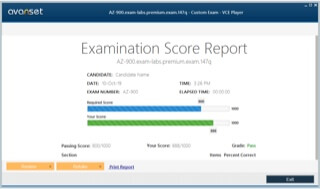

Premium File
131 Q&A
$76.99$69.99
Microsoft MB-820 Exam Questions & Answers, Accurate & Verified By IT Experts
Instant Download, Free Fast Updates, 99.6% Pass Rate

MB-820 Premium File: 131 Questions & Answers
Last Update: Aug 22, 2026
MB-820 PDF Study Guide: 948 Pages
$74.99
Microsoft MB-820 Practice Test Questions in VCE Format
| File | Votes | Size | Date |
|---|---|---|---|
File Microsoft.pass4sure.MB-820.v2026-08-21.by.tyler.7q.vce |
Votes 1 |
Size 542.18 KB |
Date Aug 21, 2026 |
Microsoft MB-820 Practice Test Questions, Exam Dumps
Microsoft MB-820 (Microsoft Dynamics 365 Business Central Developer) exam dumps vce, practice test questions, study guide & video training course to study and pass quickly and easily. Microsoft MB-820 Microsoft Dynamics 365 Business Central Developer exam dumps & practice test questions and answers. You need avanset vce exam simulator in order to study the Microsoft MB-820 certification exam dumps & Microsoft MB-820 practice test questions in vce format.
MB-820 is the current Microsoft exam for Dynamics 365 Business Central developers. Microsoft’s published study guide describes a developer who designs, builds, tests, deploys, troubleshoots, and maintains extensions, integrates Business Central with other applications, keeps data usable through upgrades, and improves performance when code or design choices create bottlenecks. The MB-820 exam is therefore about disciplined extension engineering rather than memorizing AL syntax.
Business Central is intentionally extensible. Good solutions add behavior without rewriting the base application, respect events and public interfaces, secure data appropriately, and remain supportable when Microsoft ships a new version. Candidates need to understand AL objects, Visual Studio Code tooling, extension packaging, APIs, testing, debugging, telemetry, permissions, and the data model well enough to make those tradeoffs consciously.
MB-820 complements the functional work covered by MB-800. The functional consultant defines how Business Central should serve the business; the developer decides when configuration is insufficient and implements the smallest reliable extension or integration needed to close the gap.
The most important design habit is to avoid treating Business Central as code that should be directly modified. Modern development uses extensions, events, interfaces, and supported customization points so that Microsoft updates do not overwrite customer work. Candidates should know when to create a table extension, page extension, report extension, codeunit, enum, or entirely new object, and how that choice affects maintainability.
Take a simple requirement such as adding an approval attribute to sales documents. Implement it first as a field and page extension, then consider the business logic that validates or reacts to the value. Decide whether an event subscriber, procedure, interface, or separate codeunit is the cleanest home. The exercise trains architecture judgment: the shortest code is not always the most maintainable code, and the exam can test that difference through scenario constraints.
AL syntax is only one layer. Developers need to understand record variables, keys, filters, FlowFields, temporary records, transactions, page and table triggers, events, error handling, labels, permissions, and object dependencies. A piece of code may compile and still be wrong because it runs in the wrong trigger, reads too much data, changes records unexpectedly, or assumes permissions the user does not have.
Build small extensions that deliberately use different data-access patterns. Measure the effect of filtering before reading, using appropriate keys, and avoiding repeated database calls inside loops. Then trigger the same logic from a page, job queue, or API path and observe which assumptions break. Those experiments develop the practical intuition Microsoft expects from a developer who is responsible for both correctness and performance.
The MB-820 study guide highlights APIs as a major development area. A reliable integration exposes a deliberate contract: stable fields, clear identifiers, predictable validation, versioning, security, and error behavior. Candidates should understand API pages, OData and REST concepts, web service authentication, JSON handling, and how Business Central interacts with Power Platform or external systems.
Design an integration for a small external order system. Decide which fields are writable, which values Business Central derives, how duplicate requests are detected, and how errors are returned. Test create, update, and retry behavior. This is more useful than memorizing endpoint shapes because it teaches idempotency and ownership. The broader Power Platform Developer track is a useful adjacent reference when integrations involve Dataverse, connectors, or custom components, but MB-820 remains anchored in Business Central’s application model.
Business Central changes continuously, so an extension must survive not only deployment but also future upgrades. Candidates should understand schema synchronization, obsolete objects or fields, data migration patterns, dependency versions, app manifests, and upgrade codeunits. Removing a field from code does not magically erase the business meaning or historical data attached to it.
Practice a versioned extension. Version 1 stores a value one way; version 2 changes the structure. Write the upgrade logic, test it with existing records, and confirm that the result remains usable after deployment. Then introduce a dependency on another extension and test version compatibility. This kind of controlled change is central to professional Business Central development because production systems cannot be rebuilt from scratch every time requirements evolve.
Automated tests are valuable when they express the rule the extension is supposed to enforce. MB-820 candidates should practice test codeunits, test libraries, isolation, assertions, handler functions, and repeatable setup. A test that merely executes a procedure without verifying the resulting record or posting outcome provides little protection.
Choose a business rule such as blocking a shipment when a custom compliance value is missing. Create tests for the allowed case, blocked case, boundary values, and a user with different permissions. If the extension affects posting, validate the resulting ledger entries. This teaches candidates to think from observable behavior backward into code. It also makes debugging easier because failures identify which rule broke rather than only reporting that a procedure returned an error.
When an extension fails, the developer’s job is to isolate the cause quickly. Visual Studio Code debugging, breakpoints, call stacks, snapshots, error messages, and telemetry each provide a different view. Candidates should know how to reproduce a problem with controlled data, identify whether the issue belongs to custom code or standard behavior, and avoid changing multiple variables at once.
Create an intentional performance problem, such as repeated queries over a large set, and use available diagnostics to find it. Then improve the design and compare the result. Do the same with an intermittent integration failure and capture enough context to distinguish authentication, validation, and network problems. This operational discipline is more durable than remembering a troubleshooting command because it gives every incident a repeatable investigation method.
Security belongs in object and integration design. Permissions should be designed with the extension, not appended after users receive authorization errors. Business Central developers need to understand permission sets, entitlements, indirect access patterns, sensitive data exposure, and the authentication model used by integrations. An API that returns more fields than an external system needs increases risk even if every call is technically authorized.
Build two roles for a sample extension: one that can maintain configuration and another that can use the resulting process without changing setup. Test both through the UI and API. Review whether error messages reveal sensitive information and whether background jobs run with the permissions you expect. This complements the security awareness found across PL-400 development work while keeping the design specific to Business Central.
The best capstone is a small extension that solves a real business problem from end to end. Define the requirement, model the data, create the UI, implement business rules, expose or consume an API, add automated tests, package the extension, deploy it to a sandbox, and record how you would upgrade it. Include telemetry or diagnostic checkpoints so that support is possible after go-live.
Then review the solution from the perspective of the Business Central functional consultant. Which requirement could have been solved by standard configuration instead? Which customization creates future maintenance cost? That review is valuable because strong MB-820 developers do not measure success by how much code they wrote; they measure it by how reliably the business requirement is met.
Performance deserves its own repeated practice because Business Central extensions can degrade gradually as data grows. A routine that appears harmless with a few hundred records may become expensive with millions. Build a sample process that aggregates or updates records, measure it with a small dataset, then increase the volume and inspect how filters, keys, FlowFields, temporary tables, and repeated lookups change execution behavior. The lesson is not to memorize one optimization trick. It is to develop the instinct to ask how many database operations a design performs, where the work runs, and whether the same business result can be achieved with a more selective access pattern.
Integration labs should also include failure and replay. Have an external request time out after Business Central has already committed a change, then decide how the caller can determine whether it is safe to retry. Introduce an invalid reference value and verify that the API returns an error that another developer could act on. These scenarios turn API design into reliability engineering. They also highlight why a developer should define ownership clearly: Business Central should not silently accept an external system's data when that data violates the application's business rules merely because the transport layer succeeded.
Finally, practice reading standard application code and event patterns before creating new abstractions. Many extension problems have already been solved in a supported way by the base application. Understanding naming conventions, posting codeunits, integration events, and common library patterns helps a developer fit new behavior into the product instead of building a parallel framework. That discipline reduces code volume, improves upgrade compatibility, and makes a solution easier for another Business Central developer to support later.
A small code-review routine is also worth practicing. Take an extension you wrote a week earlier and review it for naming, error messages, permissions, data-access patterns, event usage, test coverage, and upgrade implications. Ask whether another developer can infer the business intent without reconstructing it from UI behavior. This review mindset catches many problems before deployment and reinforces the exam’s broader theme: professional Business Central development is not simply making AL compile, but producing an extension whose behavior, dependencies, and maintenance path are clear.
MB-820 preparation is strongest when AL, APIs, testing, security, deployment, and upgrade behavior are practiced as one engineering system. Build extensions that can be understood by another developer, upgraded without drama, and supported with evidence when something fails. Those qualities map directly to the current Business Central developer role.
Go to testing centre with ease on our mind when you use Microsoft MB-820 vce exam dumps, practice test questions and answers. Microsoft MB-820 Microsoft Dynamics 365 Business Central Developer certification practice test questions and answers, study guide, exam dumps and video training course in vce format to help you study with ease. Prepare with confidence and study using Microsoft MB-820 exam dumps & practice test questions and answers vce from ExamCollection.
Purchase Individually

Top Microsoft Certifications

























































Top Microsoft Certification Exams
Site Search:

SPECIAL OFFER: GET 10% OFF

Pass your Exam with ExamCollection's PREMIUM files!
SPECIAL OFFER: GET 10% OFF
Use Discount Code:
MIN10OFF
A confirmation link was sent to your e-mail.
Please check your mailbox for a message from support@examcollection.com and follow the directions.

Download Free Demo of VCE Exam Simulator
Experience Avanset VCE Exam Simulator for yourself.
Simply submit your e-mail address below to get started with our interactive software demo of your free trial.