



Premium File
80 Q&A
$76.99$69.99
Microsoft Dynamics 365 MB-900 Exam Questions & Answers, Accurate & Verified By IT Experts
Instant Download, Free Fast Updates, 99.6% Pass Rate
80 Questions & Answers
Last Update: Oct 03, 2026
$69.99
Microsoft Dynamics 365 MB-900 Exam Screenshots
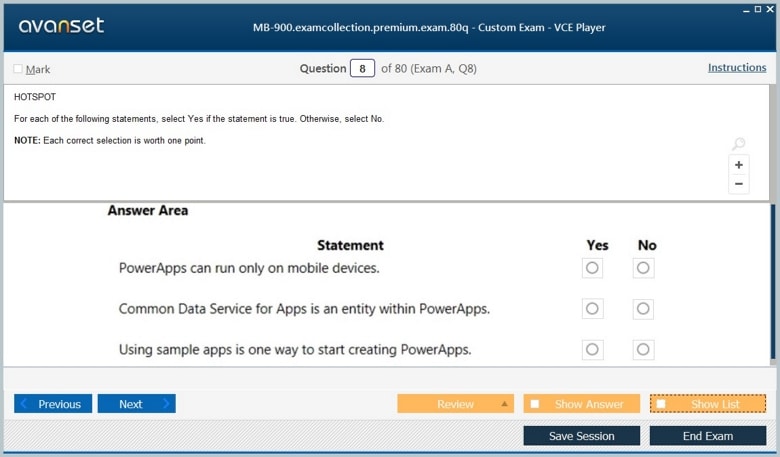
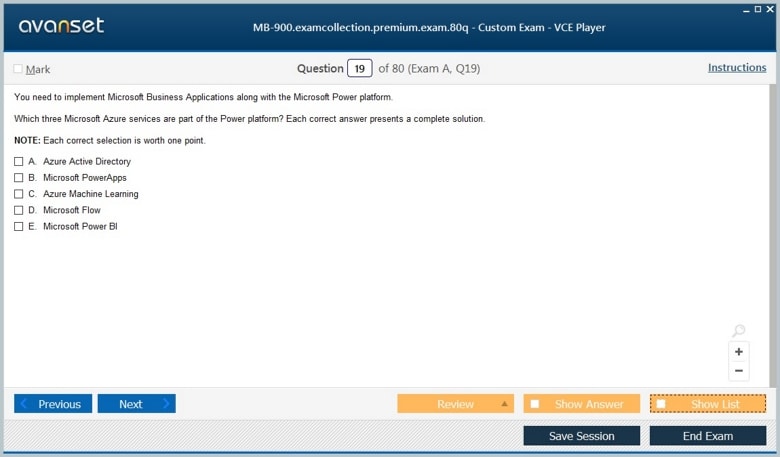
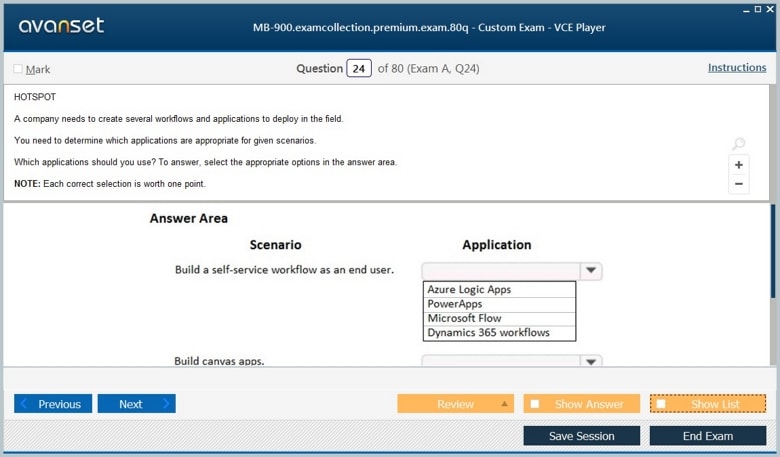
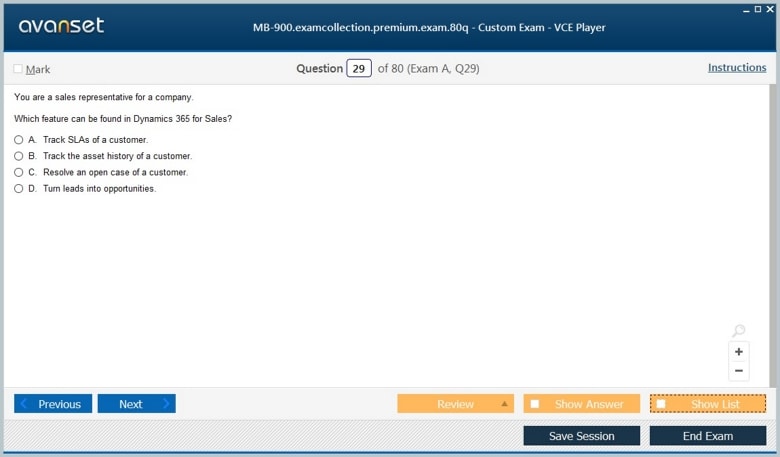
Microsoft Dynamics 365 MB-900 Practice Test Questions in VCE Format
| File | Votes | Size | Date |
|---|---|---|---|
File Microsoft.pass4sureexam.MB-900.v2026-08-16.by.ninja.48q.vce |
Votes 1 |
Size 317.63 KB |
Date Aug 16, 2026 |
File Microsoft.actualtests.MB-900.v2020-02-27.by.arlo.48q.vce |
Votes 2 |
Size 346.6 KB |
Date Feb 27, 2020 |
File Microsoft.Braindumps.MB-900.v2019-10-04.by.Kody.42q.vce |
Votes 3 |
Size 168.45 KB |
Date Oct 09, 2019 |
File Microsoft.Prep4sure.MB-900.v2019-07-30.by.Alexander.29q.vce |
Votes 5 |
Size 142.31 KB |
Date Jul 31, 2019 |
File Microsoft.Test-king.MB-900.v2019-06-18.by.Gary.17q.vce |
Votes 5 |
Size 116.35 KB |
Date Jun 23, 2019 |
Microsoft Dynamics 365 MB-900 Practice Test Questions, Exam Dumps
Microsoft MB-900 (Microsoft Dynamics 365 Fundamentals) exam dumps vce, practice test questions, study guide & video training course to study and pass quickly and easily. Microsoft MB-900 Microsoft Dynamics 365 Fundamentals exam dumps & practice test questions and answers. You need avanset vce exam simulator in order to study the Microsoft Dynamics 365 MB-900 certification exam dumps & Microsoft Dynamics 365 MB-900 practice test questions in vce format.
MB-900 is a historical Microsoft Dynamics 365 Fundamentals exam. Microsoft launched it in 2019 and soon reworked the fundamentals program, announcing MB-901 as a substantially refreshed version after removing Power Platform content into its own fundamentals track. Later, Dynamics fundamentals split again into the CRM-focused MB-910 and ERP-focused MB-920 exams, both of which are now retired. The MB-900 exam therefore belongs to an earlier stage of Microsoft’s certification architecture and should not be presented as a current registration target.
Its subject matter is still useful for understanding what Microsoft wanted beginners to grasp about Dynamics 365 as a family of business applications: why organizations use customer-engagement and operations systems, how cloud services integrate, how common data and analytics support processes, and where Power Platform fit in the original picture. That historical framing matters because product names and certification boundaries have changed while the underlying business problems have not.
For readers encountering old study plans, the Dynamics 365 Fundamentals lineage provides context, but current learners should choose modern role-based credentials rather than trying to schedule MB-900.
MB-900 was not designed to prove that a candidate could implement a production Dynamics environment. Its purpose was to test recognition of the major applications, the problems they solved, and the value of connecting customer, financial, operational, and analytical data. That makes the exam a useful historical introduction to Microsoft’s business-applications strategy.
Study the older domains by translating product names into business outcomes. Sales systems manage leads, opportunities, activities, and customer history. Customer service systems organize cases, knowledge, queues, and service performance. Finance and operations systems coordinate accounting, procurement, inventory, manufacturing, and fulfillment. When the product lineup changes, those process categories remain understandable. This is why a historical fundamentals article should teach relationships rather than preserve an obsolete list of interface labels.
One major evolution after MB-900 was separating customer-engagement concepts into dedicated coverage. The retired MB-910 exam focused on Dynamics 365 applications used for CRM-style work such as sales, customer service, marketing, and related customer experiences. That split made the learning path clearer because candidates could study front-office business processes without also carrying the full ERP workload.
For historical MB-900 readers, this branch explains why older notes may group many products under a single fundamentals heading. Modern Dynamics solutions still connect customer records, activities, service interactions, automation, and analytics, but the credentials validating those roles have changed. Current certification planning should start with the job being performed rather than assuming that a retired fundamentals code still maps neatly to a live exam.
Finance and operations became a separate fundamentals branch as well. The other major branch was the retired MB-920 exam, which organized ERP-style concepts around finance and operations applications. That included financial management, supply chain, commerce, human-resource scenarios, and project operations at a high level. Again, the purpose was recognition of business capability rather than implementation depth.
A useful way to revisit MB-900 is to classify every old objective as customer engagement, enterprise operations, common platform, or cross-cloud integration. Doing so makes the later split into MB-910 and MB-920 intuitive and prevents learners from assuming that all Dynamics 365 products share the same data or process model. It also highlights why today’s role-based exams such as MB-310 or MB-330 demand much deeper configuration knowledge than the original fundamentals exam ever did.
Microsoft explicitly removed Power Platform content from the MB-900 redesign and created dedicated fundamentals coverage. That transition is important because Power Apps, Power Automate, Dataverse, Power BI, and AI capabilities became broad enough to support many workloads beyond Dynamics 365. The current PL-900 path is therefore a better place to study platform concepts than treating them as a small appendix to a retired Dynamics exam.
Historically, however, MB-900’s inclusion of Power Platform made sense: Dynamics applications often depend on the same data, automation, analytics, and low-code services. Readers should preserve that architectural relationship while updating the certification map. Product boundaries may change, but the skill of deciding whether a requirement belongs in a Dynamics app, a Power Platform component, or an integration remains useful.
Fundamentals candidates were expected to understand that business applications become more valuable when they share customer, product, financial, or operational context instead of operating as isolated systems. In modern terminology, Dataverse and standardized integration patterns help many customer-engagement scenarios, while finance and operations workloads have their own application structures and integration mechanisms.
A practical historical exercise is to take a simple business event—a customer places an order—and map which systems might touch it. Sales may capture the opportunity, finance may recognize revenue and payment, inventory may fulfill the product, customer service may later handle a case, and analytics may summarize the result. The exercise teaches the cross-functional viewpoint that MB-900 was trying to establish without pretending that every product stores the event identically.
MB-900 included broad recognition of cloud benefits, security and privacy considerations, reporting, analytics, and emerging intelligent capabilities. Those subjects should be read at the right level. A fundamentals learner needed to understand why cloud delivery enables frequent updates and integration, why identity and permissions matter, and how analytics can turn operational data into decisions. The exam did not make the candidate an Azure architect, security engineer, or data scientist.
That distinction remains helpful when evaluating old practice material. Questions that dive deeply into infrastructure minutiae may not reflect the original intent. Strong fundamentals study explains what a capability enables and which business problem it addresses. More specialized skills belong in role exams across the wider Microsoft certification catalog.
Certification transitions are rarely perfect one-for-one replacements. MB-900 was redesigned into MB-901, and the fundamentals family later evolved again, but a modern learner should not infer that a single current exam carries exactly the same scope. The Dynamics portfolio has increasingly emphasized role credentials tied to concrete implementation responsibilities.
For someone with a sales or service role, the relevant path may now be a current customer-experience or customer-service credential. Finance and supply-chain professionals may move toward MB-310 or MB-330. Developers may work across Power Platform or finance-and-operations development. The correct transition depends on work, not on matching the first letters of an old exam code.
The best use of MB-900 material today is diagnostic. Read a domain, ask whether you understand the business purpose behind it, and then follow that topic into current documentation or a live role-based exam where appropriate. If customer-service concepts are unfamiliar, explore the current Dynamics customer-service role. If automation and low-code topics stand out, move toward Power Platform. If finance or supply chain is the real interest, study those workloads directly.
This turns an obsolete exam code into a useful orientation map. It also prevents a common problem with legacy certification content: treating historical objectives as though they still define Microsoft’s current credential structure. The concepts can remain valuable even when the registration path has disappeared.
One reason legacy fundamentals material can be confusing is that brand names changed faster than the underlying processes. A learner may see Common Data Service where current material says Dataverse, Microsoft Flow where current material says Power Automate, or older Dynamics application names that have since been reorganized. Do not flatten those differences as though the names are interchangeable across time. Instead, record the historical term, identify the modern concept it most closely corresponds to, and note where capabilities or boundaries changed. That approach preserves accuracy while still allowing older material to teach the architecture that existed when MB-900 was active.
The exam is also a useful reminder that fundamentals credentials are about choosing the right service before learning to configure it. Given a business problem, ask first whether it is primarily customer engagement, finance, supply chain, analytics, automation, or another domain. Then identify which current product or role owns that problem. This decision-first method prevents learners from collecting disconnected product facts and mirrors how technology decisions are made in real organizations: start with the process and outcome, then select the platform capability that fits.
For archival study, keep a small timeline beside the notes. Place MB-900 in 2019, mark Microsoft’s MB-901 redesign announcement, then note the later MB-910 and MB-920 fundamentals split and their eventual retirement. The timeline prevents a common error in certification content: treating material from different generations as if it described one simultaneous program. Historical accuracy is part of useful exam content, especially on pages that may continue to attract search traffic years after the credential disappeared.
When reviewing old fundamentals questions, pay attention to the level of abstraction. If an item asks for a deep configuration sequence, it may belong to a specialist role rather than the original MB-900 intent. Reframe the topic around recognition of capability, business value, and high-level integration. That keeps historical study aligned with what a fundamentals credential was supposed to validate and prevents modern learners from spending disproportionate time on technical details that were never the core purpose of the exam.
MB-900 should be preserved as a historical Dynamics 365 fundamentals milestone. Its value now is conceptual: it shows how Microsoft grouped business applications, data, automation, analytics, and cloud value before the certification program became more specialized. Use that understanding to choose a current role path rather than trying to revive the retired exam itself.
Go to testing centre with ease on our mind when you use Microsoft Dynamics 365 MB-900 vce exam dumps, practice test questions and answers. Microsoft MB-900 Microsoft Dynamics 365 Fundamentals certification practice test questions and answers, study guide, exam dumps and video training course in vce format to help you study with ease. Prepare with confidence and study using Microsoft Dynamics 365 MB-900 exam dumps & practice test questions and answers vce from ExamCollection.
Purchase Individually
Top Microsoft Certifications


































Top Microsoft Certification Exams
Site Search:

SPECIAL OFFER: GET 10% OFF

Pass your Exam with ExamCollection's PREMIUM files!
SPECIAL OFFER: GET 10% OFF
Use Discount Code:
MIN10OFF
A confirmation link was sent to your e-mail.
Please check your mailbox for a message from support@examcollection.com and follow the directions.

Download Free Demo of VCE Exam Simulator
Experience Avanset VCE Exam Simulator for yourself.
Simply submit your e-mail address below to get started with our interactive software demo of your free trial.
The team of ExamCollection, I want to thank you all for these files, because they helped me a lot during my preparation. They helped me to gain confidence in my knowledge and skills and pass the test. Thank you very much for the support you gave me during my struggles!
To be honest, the free VCE files are not so bad as I expected. My friend said that they are almost the same as the premium file. The premium option just covers more questions and answers. I used the free ones after I learned the topics to check my skills, and the results were high. It helped me to become sure that I pass the test with flying colors. And that exactly what happened.
I found this site when I was searching for the best prep materials for the MB-900 test. I used the premium file and read some books before that, and I passed. It was very convenient to use these practice questions in a form of a test with the help of a VCE emulator. Thank you for these useful products!