Premium File
90 Q&A
$76.99$69.99
Microsoft MCP MB2-712 Exam Questions & Answers, Accurate & Verified By IT Experts
Instant Download, Free Fast Updates, 99.6% Pass Rate

MB2-712 Premium File: 90 Questions & Answers
Last Update: Oct 12, 2026
MB2-712 Training Course: 44 Video Lectures
$74.99
Microsoft MCP MB2-712 Exam Screenshots
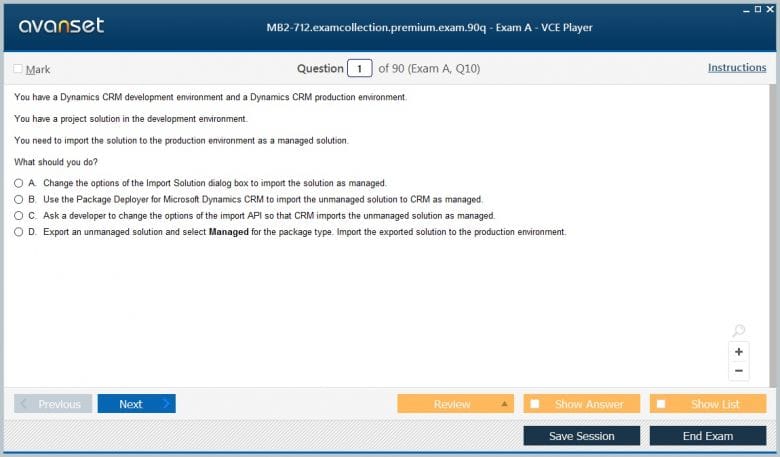
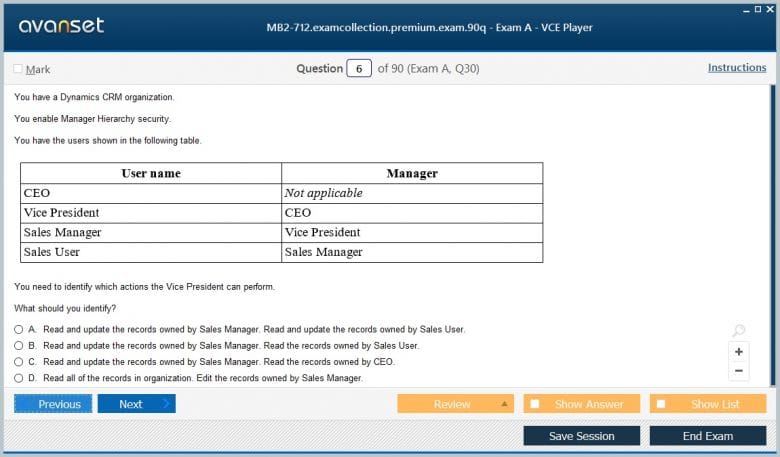
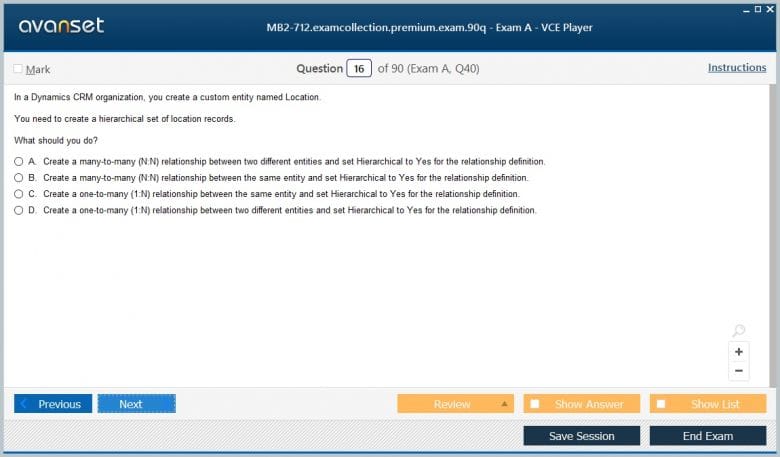
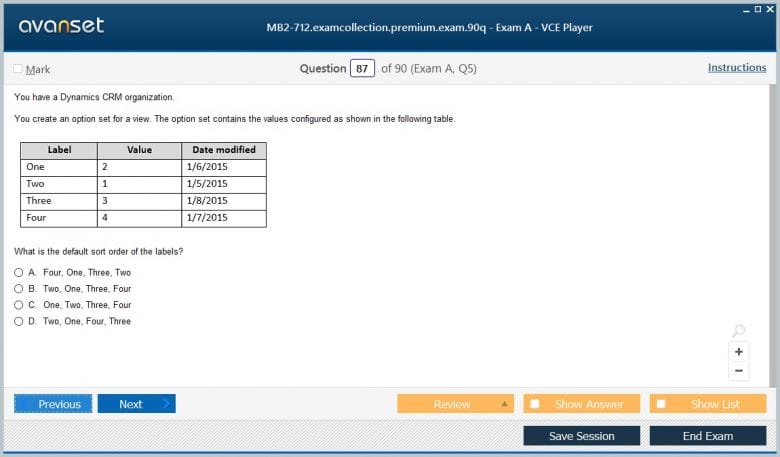
Microsoft MCP MB2-712 Practice Test Questions in VCE Format
| File | Votes | Size | Date |
|---|---|---|---|
File Microsoft.Prepaway.MB2-712.v2026-09-11.by.George.45q.vce |
Votes 3 |
Size 100.77 KB |
Date Sep 14, 2026 |
File Microsoft.Pass4sures.MB2-712.v2016-12-01.by.Lara.10q.vce |
Votes 3 |
Size 184.93 KB |
Date Dec 01, 2016 |
Microsoft MCP MB2-712 Practice Test Questions, Exam Dumps
Microsoft MB2-712 (Microsoft Dynamics CRM 2016 Customization and Configuration) exam dumps vce, practice test questions, study guide & video training course to study and pass quickly and easily. Microsoft MB2-712 Microsoft Dynamics CRM 2016 Customization and Configuration exam dumps & practice test questions and answers. You need avanset vce exam simulator in order to study the Microsoft MCP MB2-712 certification exam dumps & Microsoft MCP MB2-712 practice test questions in vce format.
MB2-712, Microsoft Dynamics CRM 2016 Customization and Configuration, retired on December 31, 2019. The MB2-712 exam belongs to an older Dynamics CRM generation, but many of the design questions it raised are still familiar in today’s Dataverse and model-driven application work: how to model business data, shape forms and views, control access, automate processes, package changes, and avoid customizations that become difficult to maintain.
The important caution is historical accuracy. Entity, field, workflow, security, and solution terminology from CRM 2016 does not map perfectly to current product names or capabilities. A reader should learn the architectural idea and then verify the modern implementation against current Power Platform and Dynamics documentation.
MB2-712 also paired naturally with infrastructure exams such as MB2-708. One validated platform installation knowledge; the other validated application customization. Cloud delivery has shifted that boundary, but separating infrastructure, configuration, low-code extension, and custom development remains valuable.
CRM customization started with entities, fields, relationships, option sets, ownership, and record behavior. A good model reflected business concepts without duplicating data unnecessarily. Poor modeling could create awkward forms, difficult reporting, inconsistent security, and integrations that were hard to maintain.
Recreate the reasoning with a modern example: a service company needs to track customer equipment, warranties, and inspections. Decide which concepts deserve separate tables, which values are attributes, and which relationships are one-to-many or many-to-many. Then ask how the model will be searched, secured, reported, and integrated. This is the durable lesson behind the older entity-customization objectives.
CRM 2016 gave customizers substantial control over forms, sections, tabs, subgrids, quick views, business rules, and system views. The temptation was to surface every available field. Strong design instead considers the user’s task: what information is required to make the next decision, what should be editable, and what can be hidden until needed.
Create two forms for different roles using the same underlying record. A service agent may need recent cases and entitlement data; a manager may care more about account health and escalations. Compare the layouts and security assumptions. This teaches that customization is user-experience design grounded in process, not just moving controls around a screen.
Security is part of the data model, not an afterthought. Business units, security roles, privileges, ownership, teams, hierarchy behavior, field security, and sharing were central to Dynamics CRM administration. Candidates needed to understand how these mechanisms combined, because a single record-access problem might involve several layers.
Build a matrix of roles and data responsibilities before creating permissions. Who can create, read, update, delete, assign, or share each record type, and at what organizational scope? Then test with real users rather than assuming the role definition is correct. The modern platform has evolved, but least privilege and explicit ownership remain fundamental. Over-permissioning a CRM to avoid support tickets creates long-term governance and privacy problems.
CRM 2016 offered workflows, business process flows, business rules, calculated or rollup behavior, and other mechanisms for automating or guiding work. The difficult question was not whether automation was possible; it was which mechanism best fit the requirement. Synchronous logic could give immediate feedback but affect performance. Background processes could scale differently but introduced delay. Client-side behavior could improve usability but might not protect data coming through other channels.
Modern Power Platform offers a richer automation toolkit, including Power Automate and custom development. The same decision principle applies: select the simplest supported mechanism that enforces the rule in every channel where it must hold. The current PL-400 path is a more appropriate place to study today’s developer extension choices.
Solutions were the packaging mechanism for moving customizations between environments. Managed versus unmanaged behavior, component dependencies, publishers, versioning, and import order could determine whether a release was clean or painful. A customizer needed to understand that an environment is not a collection of unrelated changes; components depend on one another.
Practice with a small solution containing a table, form, view, process, and security component. Move it from development to test, inspect dependencies, then make a second version. Record what happens when a component is removed or changed. This release discipline remains highly relevant in modern application lifecycle management even though tooling has improved substantially since CRM 2016.
A common implementation mistake is reaching for code before standard configuration has been exhausted. MB2-712 sat in a customization space where forms, rules, relationships, workflows, and solutions could solve many requirements without a custom plugin. Modern low-code tools make that choice even more important because there are now more supported configuration options.
For each requirement, classify the solution as standard feature, configuration, low-code automation, client extension, server-side custom logic, or external integration. Document why the chosen layer is necessary. This produces maintainable systems and clearer ownership. It also helps learners distinguish functional customization from developer work without pretending the boundary is always rigid.
Many readers will notice familiar ideas under newer names: entities became tables, fields became columns, option sets became choices, and the surrounding platform expanded. That continuity is useful, but it can also cause overconfidence. Security models, automation capabilities, user interfaces, solution behavior, APIs, and licensing have all evolved.
Treat a legacy objective as a concept prompt, then verify the modern equivalent. If an old guide discusses a workflow, ask what current mechanism would implement the same requirement and what tradeoffs have changed. If it discusses entity ownership, check how current Dataverse security applies. This approach preserves understanding without silently turning 2016 documentation into 2026 instructions.
MB2-712 retired with the older Dynamics certification structure. There is no honest one-to-one successor that preserves its exact scope. A current customer-service functional consultant may need MB-230; a platform developer may need PL-400; other specialists follow their own workload credentials. The right path depends on whether the person configures business processes, builds platform extensions, or owns a particular Dynamics application.
That is the appropriate way to use MB2-712 today. Keep its lessons about data modeling, security, automation, UX, and solution packaging, but choose current training based on responsibilities rather than chasing a historical exam lineage.
Data quality should be treated as a customization outcome, not just a user-training issue. Required fields, duplicate detection, validation rules, constrained choices, process stages, and automation can all reduce inconsistent records. Build a scenario in which several users create the same kind of customer record through different paths and decide which controls belong in the platform versus in written procedures. The strongest design prevents obviously invalid states while still allowing legitimate exceptions to be handled deliberately rather than forcing users to invent workarounds.
Reporting is another reason to keep customization disciplined. A field or relationship that seems harmless during form design may later become central to segmentation, dashboards, integration, or compliance reporting. Before creating a new element, ask how its values will be populated, whether they are consistent enough to aggregate, and who owns corrections. This connects interface customization to information architecture and helps explain why mature CRM implementations resist uncontrolled creation of near-duplicate fields for every team request.
Application lifecycle thinking also means separating development, test, and production responsibilities. Changes should be built and reviewed away from production, moved through controlled packages, and validated against representative data. Even in the CRM 2016 era, that discipline reduced deployment risk; in current Power Platform work it is even more important because solutions can contain many interdependent components. A customizer who understands release boundaries is far less likely to solve one request by creating long-term environment drift.
For present-day study, keep a translation table rather than rewriting the old exam in modern terminology. Note the legacy CRM 2016 term, its broad modern counterpart, and any important difference. This prevents accidental claims that a current Dataverse feature behaved the same way in CRM 2016. It also makes the historical page more educational: readers can see how Microsoft’s application platform evolved instead of receiving an anachronistic blend of two generations.
Customization also affects supportability. A help-desk analyst needs to know whether unexpected behavior comes from standard CRM, a business rule, a workflow, a form script, a plugin, or an integration. Good implementations make that provenance discoverable through naming, documentation, and controlled ownership. In a practice environment, choose one field and trace every automation that can change it. If that is difficult, the design is already too opaque. This diagnostic perspective is a useful modern lesson from an older customization exam.
User adoption provides another test of customization quality. If a form requires excessive scrolling, a process asks for data nobody understands, or automation creates unexpected changes, users will work around the system and data quality will deteriorate. After building a customization, observe a realistic user completing the task and record where the design creates friction. This is a practical way to connect technical configuration with the business outcome the customization was meant to improve.
That supportability test is a useful final filter for every customization: if its behavior cannot be explained clearly to users, administrators, and the next maintainer, simplify the design before adding more features.
MB2-712 remains valuable as a snapshot of disciplined CRM customization. The names and tools have changed, but good design still means modeling data carefully, giving users only the access they need, choosing maintainable automation, packaging changes predictably, and knowing when custom code is justified.
Go to testing centre with ease on our mind when you use Microsoft MCP MB2-712 vce exam dumps, practice test questions and answers. Microsoft MB2-712 Microsoft Dynamics CRM 2016 Customization and Configuration certification practice test questions and answers, study guide, exam dumps and video training course in vce format to help you study with ease. Prepare with confidence and study using Microsoft MCP MB2-712 exam dumps & practice test questions and answers vce from ExamCollection.
Purchase Individually

Microsoft MB2-712 Video Course
Top Microsoft Certifications

































Top Microsoft Certification Exams
Site Search:

SPECIAL OFFER: GET 10% OFF

Pass your Exam with ExamCollection's PREMIUM files!
SPECIAL OFFER: GET 10% OFF
Use Discount Code:
MIN10OFF
A confirmation link was sent to your e-mail.
Please check your mailbox for a message from support@examcollection.com and follow the directions.

Download Free Demo of VCE Exam Simulator
Experience Avanset VCE Exam Simulator for yourself.
Simply submit your e-mail address below to get started with our interactive software demo of your free trial.