



Premium File
146 Q&A
$76.99$69.99
Microsoft MTA 98-375 Exam Questions & Answers, Accurate & Verified By IT Experts
Instant Download, Free Fast Updates, 99.6% Pass Rate
146 Questions & Answers
Last Update: Oct 12, 2026
$69.99
Microsoft MTA 98-375 Exam Screenshots
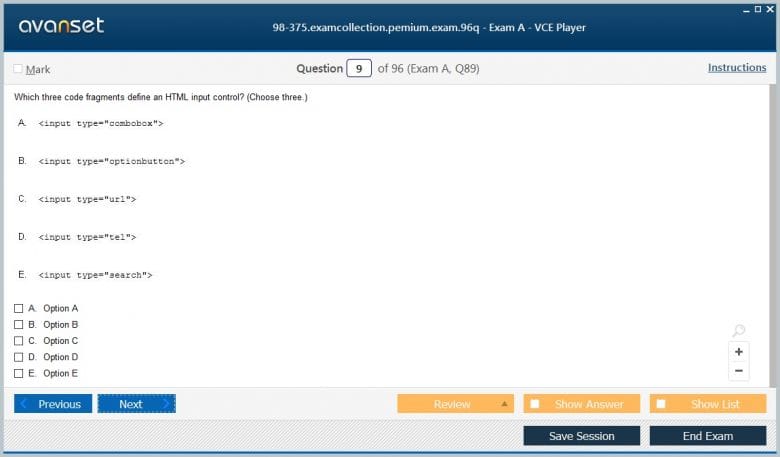
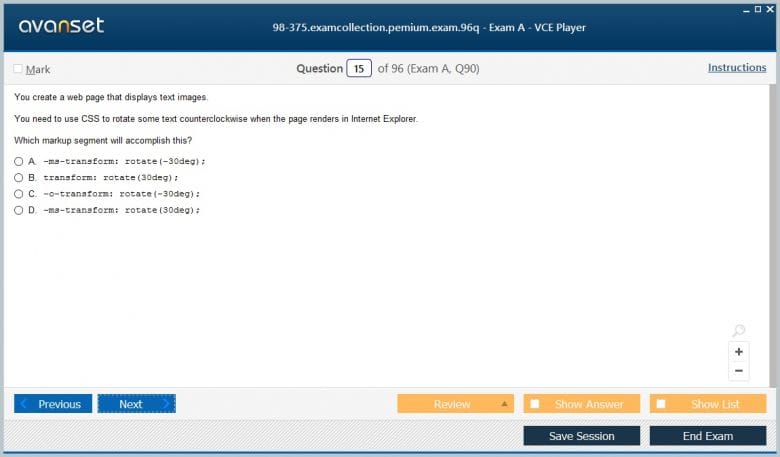
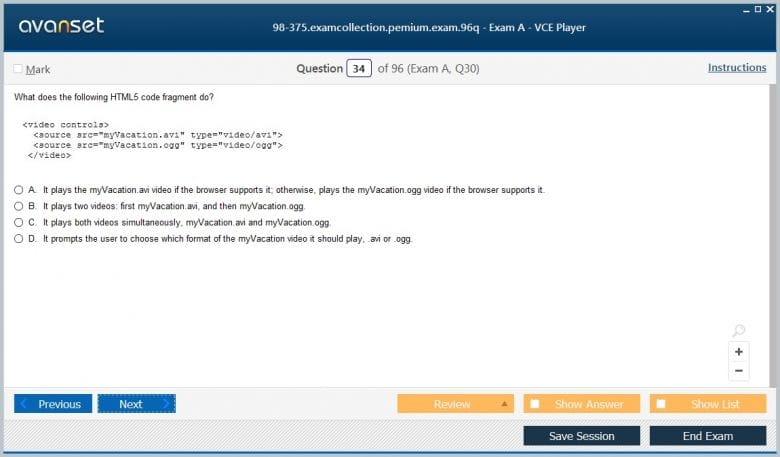
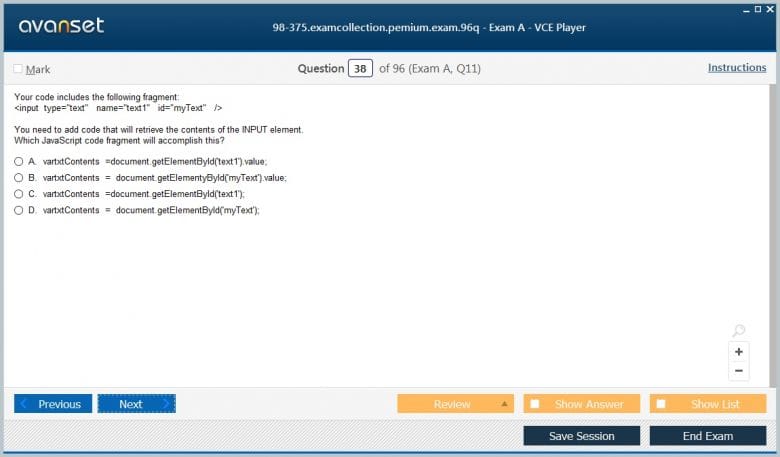
Microsoft MTA 98-375 Practice Test Questions in VCE Format
| File | Votes | Size | Date |
|---|---|---|---|
File Microsoft.passguide.98-375.v2026-09-22.by.lexi.84q.vce |
Votes 1 |
Size 564.21 KB |
Date Sep 22, 2026 |
File Microsoft.passit4sure.98-375.v2021-10-22.by.theo.76q.vce |
Votes 1 |
Size 622.28 KB |
Date Oct 22, 2021 |
File Microsoft.real-exams.98-375.v2021-09-23.by.oscar.62q.vce |
Votes 1 |
Size 568.95 KB |
Date Sep 23, 2021 |
File Microsoft.Testking.98-375.v2013-07-22.by.Vindicator930.35q.vce |
Votes 4 |
Size 24.42 KB |
Date Jul 23, 2013 |
Microsoft MTA 98-375 Practice Test Questions, Exam Dumps
Microsoft 98-375 (HTML5 App Development Fundamentals) exam dumps vce, practice test questions, study guide & video training course to study and pass quickly and easily. Microsoft 98-375 HTML5 App Development Fundamentals exam dumps & practice test questions and answers. You need avanset vce exam simulator in order to study the Microsoft MTA 98-375 certification exam dumps & Microsoft MTA 98-375 practice test questions in vce format.
Exam 98-375, HTML5 Application Development Fundamentals, was a Microsoft Technology Associate exam aimed at learners building browser-based applications with HTML5, CSS, and JavaScript. Its published skills were organized around the application lifecycle, the user interface, CSS formatting, and JavaScript coding. That mix made it more than a markup test: candidates had to see a web page as a small application with structure, presentation, behavior, resources, and events.
The 98-375 HTML5 Application Development Fundamentals exam retired with the MTA program on June 30, 2022. Browsers, JavaScript tooling, accessibility expectations, security guidance, and application architectures have evolved since the blueprint was written. The exam should therefore be treated as a historical foundation, not a current Microsoft web-development credential.
The durable learning goal is still strong. Every modern web framework ultimately produces or manipulates HTML, CSS, and JavaScript in a browser. A developer who understands document structure, the cascade, layout, events, the DOM, data handling, and debugging can reason about higher-level frameworks much more effectively than someone who only knows framework-specific commands.
The old objective domain included planning, packaging, deployment, and application state. Those topics matter because code does not exist in isolation. A page must load resources, survive errors, preserve or retrieve state appropriately, and be delivered in a form the browser can interpret. Even a small front-end project benefits from thinking about startup, user interaction, data changes, failure, and shutdown or navigation.
Practice by drawing the lifecycle of a simple task application. Identify what happens on initial load, where data comes from, how a new item is validated, what changes in the DOM, what state should persist, and what the user sees if storage or network access fails. This turns individual language features into a working application model.
Add a versioning and deployment step to the task application. Make a small change to the data format or interface and decide whether old stored state still works. Then define what should happen if the new version fails after deployment. Even a small browser application benefits from migration thinking because users can keep cached resources and persistent data across releases.
HTML5 introduced and popularized semantic elements that communicate purpose rather than only appearance. Headings, navigation, main content, sections, forms, labels, media, and other elements provide a document structure that browsers, assistive technologies, search engines, and developers can interpret. Using the correct element is often a better first decision than solving every visual problem with generic containers.
Build a page without styling first. Make the heading hierarchy logical, connect labels to form controls, use links for navigation and buttons for actions, and add appropriate semantic landmarks. Then inspect the document outline and keyboard behavior. This sequence makes structure visible before CSS can hide weaknesses in the markup.
Accessibility tools provide another way to inspect semantics. Use the browser accessibility tree or a screen reader to verify landmarks, names, roles, and form relationships. If the interface depends on visual position alone, the semantic model will expose that weakness. This makes HTML correctness observable rather than a matter of style preference.
The CSS portion of 98-375 included selectors, properties, positioning, visibility, sizing, and layout behavior. Memorizing individual properties is not enough because multiple rules can apply to the same element. Specificity, source order, inheritance, the box model, positioning context, and normal document flow explain why a style appears or fails to appear.
Create a deliberately broken layout and debug it from the browser tools. Inspect which rule wins, where dimensions come from, what margin and padding contribute, and how positioned or floating elements affect surrounding content. A developer who can explain the computed result is much more capable than one who repeatedly adds stronger selectors until the page looks right.
A good debugging drill is to prohibit adding new CSS until the cause of a defect is identified. Inspect the matched rules, computed value, containing block, and box dimensions first. Only then change the smallest rule necessary. This prevents the common cascade problem where repeated overrides accumulate until no one knows which declaration is responsible for the final appearance.
JavaScript in the old blueprint covered variables, functions, decisions, loops, events, and interaction with page elements. Those fundamentals are still the language underneath modern front-end ecosystems. Frameworks may change the programming model, but values, control flow, functions, state, asynchronous work, and events remain central.
The related 98-382 JavaScript fundamentals exam focused even more directly on introductory programming with the language. For 98-375 study, use JavaScript to solve page behavior: validate input, respond to an event, update content, calculate a value, or alter a class. Avoid writing code only to demonstrate syntax; give every function a visible purpose in the application.
Add asynchronous behavior to the practice project even if the legacy objectives treated it lightly. Simulate a request that completes after a delay, disable duplicate submissions while it runs, show a meaningful loading state, and handle failure. Modern interfaces spend a great deal of time waiting for services, so understanding state transitions around asynchronous work is an important bridge beyond the old syllabus.
Once the browser parses HTML, scripts interact with a document object model rather than with raw text. Selecting elements, reading properties, changing attributes, creating nodes, and responding to events all depend on understanding that model. Many front-end bugs are really misunderstandings about when an element exists or which element a selector actually returns.
Build a small interface that adds, edits, filters, and removes items without reloading the page. Use browser developer tools to watch the DOM change after each action. This is also a good place to explore why JavaScript behavior in web applications matters to security: client-side code controls real application interactions and can expose assumptions that attackers probe.
The web is used on different screen sizes, input methods, network conditions, and assistive technologies. An interface that passes a syntax exercise can still be unusable. Responsive layouts, readable contrast, keyboard navigation, meaningful labels, sensible focus order, and clear error messages are part of building a reliable user interface rather than optional polish.
Take one form and test it with a narrow viewport and keyboard-only navigation. Increase text size, trigger validation errors, and verify that the structure still makes sense. These checks were not the center of the old MTA exam, but they are essential modern extensions of its user-interface fundamentals and prevent legacy study from becoming a purely historical exercise.
Use automated checks as a starting signal, not as proof of accessibility. A scanner can identify missing labels or contrast issues, but it cannot tell whether the workflow is understandable or whether focus moves logically after a dynamic update. Pair automated checks with keyboard use and a short task performed through assistive technology.
A present-day front-end project may use modules, package managers, bundlers, TypeScript, testing frameworks, API clients, component systems, and cloud deployment. None of those changes the fact that browsers ultimately enforce web-platform behavior. Learners who begin with 98-375 should recognize where its fundamentals stop and modern engineering begins.
For a current Microsoft-oriented developer path, AZ-204 covers developing solutions for Azure and is far broader than browser fundamentals. It is not a successor exam in the historical sense, but it represents the kind of role-based credential Microsoft now emphasizes. The broader Microsoft certifications shows that shift from introductory technology exams to job-oriented cloud and solution skills.
Source control should be part of the bridge to modern practice. Commit a working version, make one focused change, review the diff, and revert it. This teaches learners to separate code history from the deployed page and creates a safe environment for experimentation. Version control is now so central to development that a web foundation is incomplete without it.
Build a small application such as an expense tracker, inventory list, or event planner. Use semantic HTML for structure, CSS for a responsive layout, JavaScript for validation and interaction, and browser storage or a mock API for data. Add empty states, error states, and keyboard-friendly behavior. Then deliberately introduce a broken selector, event handler, and layout rule and diagnose each with developer tools.
That project captures the strongest part of the 98-375 blueprint: the technologies are meant to work together. A learner who can explain why the page is structured a certain way, how the cascade produces its layout, how events change state, and how to trace a defect has gained something much more useful than familiarity with a retired exam code.
98-375 is retired, but HTML, CSS, JavaScript, and browser debugging remain foundational. Use the legacy blueprint to establish those mechanics, then extend the work with modern standards, accessibility, security, testing, and current development tooling.
Review the finished project with a performance mindset as well. Remove an oversized image, avoid unnecessary DOM work, and verify that resources are loaded only when needed. Then test on a slower connection profile. Performance is part of user experience, and it reinforces the lifecycle idea that an application must not only be correct but must reach the user in a usable state.
Add a security pass to the capstone. Treat all user-controlled text as untrusted, avoid inserting raw content into the page in unsafe ways, and review any external resource or API boundary. Basic front-end security habits reinforce the lesson that application behavior and data handling matter just as much as visual correctness.
Go to testing centre with ease on our mind when you use Microsoft MTA 98-375 vce exam dumps, practice test questions and answers. Microsoft 98-375 HTML5 App Development Fundamentals certification practice test questions and answers, study guide, exam dumps and video training course in vce format to help you study with ease. Prepare with confidence and study using Microsoft MTA 98-375 exam dumps & practice test questions and answers vce from ExamCollection.
Purchase Individually
Top Microsoft Certifications



























































Top Microsoft Certification Exams
Site Search:

SPECIAL OFFER: GET 10% OFF

Pass your Exam with ExamCollection's PREMIUM files!
SPECIAL OFFER: GET 10% OFF
Use Discount Code:
MIN10OFF
A confirmation link was sent to your e-mail.
Please check your mailbox for a message from support@examcollection.com and follow the directions.

Download Free Demo of VCE Exam Simulator
Experience Avanset VCE Exam Simulator for yourself.
Simply submit your e-mail address below to get started with our interactive software demo of your free trial.