



Premium File
66 Q&A
$76.99$69.99
Microsoft Mobility 98-368 Exam Questions & Answers, Accurate & Verified By IT Experts
Instant Download, Free Fast Updates, 99.6% Pass Rate
66 Questions & Answers
Last Update: Oct 12, 2026
$69.99
Microsoft Mobility 98-368 Exam Screenshots
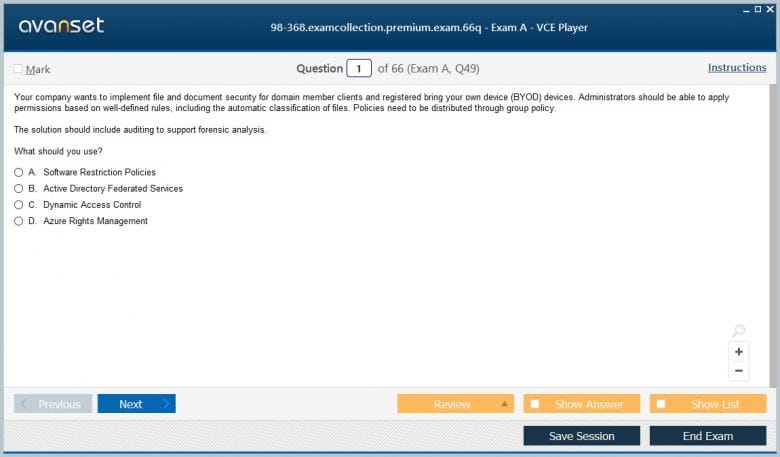
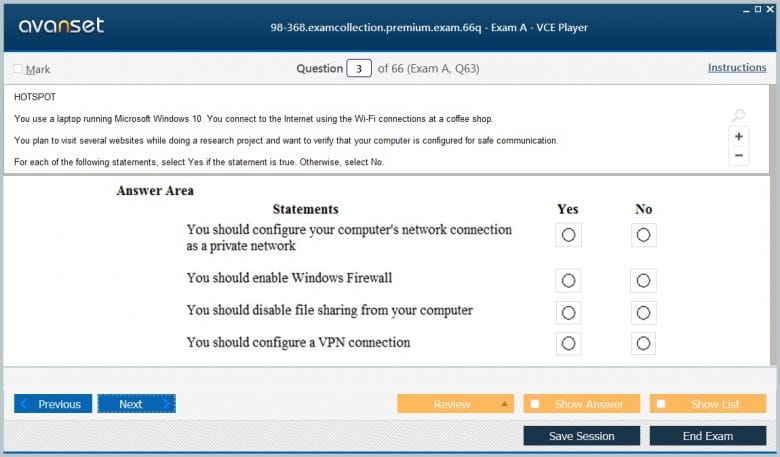
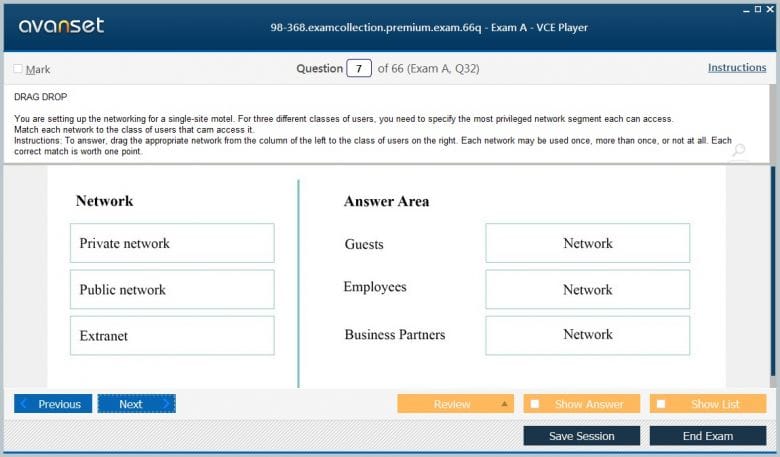
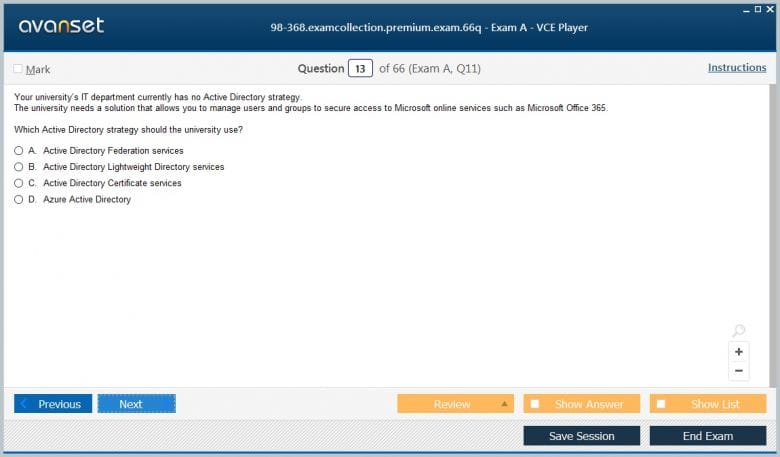
Microsoft Mobility 98-368 Practice Test Questions in VCE Format
| File | Votes | Size | Date |
|---|---|---|---|
File Microsoft.examquestions.98-368.v2026-10-04.by.grayson.37q.vce |
Votes 1 |
Size 353.16 KB |
Date Oct 04, 2026 |
File Microsoft.Prep4sure.98-368.v2019-06-04.by.Bobby.36q.vce |
Votes 4 |
Size 383.58 KB |
Date Jun 05, 2019 |
Microsoft Mobility 98-368 Practice Test Questions, Exam Dumps
Microsoft 98-368 (Mobility and Devices Fundamentals) exam dumps vce, practice test questions, study guide & video training course to study and pass quickly and easily. Microsoft 98-368 Mobility and Devices Fundamentals exam dumps & practice test questions and answers. You need avanset vce exam simulator in order to study the Microsoft Mobility 98-368 certification exam dumps & Microsoft Mobility 98-368 practice test questions in vce format.
Exam 98-368 was part of the Microsoft Technology Associate program and covered mobility and device fundamentals in the context of the Windows ecosystem of its time. The blueprint brought together device configuration, cloud services, enterprise mobility, access to resources, and device security. Its central idea was that an endpoint is not useful merely because it boots; it must be configured, connected, governed, and protected as part of an organization.
The 98-368 Mobility and Device Fundamentals exam retired with MTA on June 30, 2022. Older references sometimes use “Mobility and Devices Fundamentals,” while Microsoft’s retirement material lists “Mobility and Device Fundamentals.” Either way, candidates should treat the code as historical. The management products and Windows versions surrounding it have changed substantially since the exam was active.
The enduring value is architectural. Modern endpoint management still asks who owns a device, how it is enrolled, which settings are enforced, how applications are delivered, what happens when a device is lost, and which conditions must be satisfied before access is granted. Those questions provide a bridge from the retired exam to today’s cloud-managed endpoint model.
A workstation can be correctly configured on Monday and drift by Friday. Users install software, policies change, operating systems update, certificates expire, and security requirements evolve. The old fundamentals material introduced the idea that device settings need to be standardized and controlled rather than left entirely to local preference.
Build a simple configuration baseline for a test machine: required updates, screen-lock behavior, local administrator restrictions, encryption, approved applications, browser settings, and firewall state. Then intentionally change several items and record how you would detect and remediate the drift. That exercise expresses the same governance problem that modern endpoint platforms solve at much larger scale.
Configuration also needs a precedence model. Local settings, organization policy, application requirements, and user preferences can conflict. Create a scenario in which a user changes a setting that policy later restores, and document which source should win. This helps learners understand why “the user changed it back” is not a complete diagnosis in a centrally managed environment.
Enterprise mobility depends on knowing which device belongs to which user and what management authority the organization has over it. Corporate-owned and personally owned devices may require different controls. Enrollment establishes the management relationship that allows policies, applications, inventory, and compliance signals to be applied consistently.
In a practice scenario, compare a company laptop with an employee-owned mobile device. Decide what information the organization legitimately needs, which settings it should control, and how corporate data can be removed without unnecessarily affecting personal information. This is where endpoint management becomes a policy problem as well as a technical one.
Lifecycle planning should include unenrollment and ownership transfer. A corporate device being reassigned to another employee requires a different process from a personal phone leaving the organization. Define what data is retained, what keys or credentials are revoked, and how the next owner receives a clean state. These exit conditions are as important as initial enrollment because unmanaged remnants can expose corporate information.
Device management includes getting the right software onto the right endpoint, keeping it current, and removing it when it is no longer authorized. The old mobility exam touched application delivery in an era when traditional desktop deployment and early cloud management overlapped. Modern environments add app stores, mobile application management, SaaS access, and more sophisticated deployment rings.
Practice by classifying applications as required, optional, prohibited, or role-specific. Define how each would be installed, updated, and removed. Then consider failure cases: a deployment that breaks a dependency, an application that requires elevated permissions, or a user who leaves the department. Good endpoint practice treats application delivery as a managed lifecycle, not simply a download event.
Add deployment rings to the application exercise. Release an update first to a small test group, then a broader group, and finally the remaining users after validation. Decide what evidence allows promotion and what condition triggers rollback. This introduces modern change-management thinking without pretending that the old MTA exam used today’s exact tooling.
Mobile work made a simple “inside versus outside the network” model increasingly weak. Users wanted access from laptops, phones, home networks, and public connections. The device itself therefore became part of the access decision: is it known, healthy, encrypted, updated, and under management?
That reasoning leads naturally toward today’s conditional-access and zero-trust models. The article on endpoint management in a zero-trust model is useful current context because it shows how device posture now participates in access control. The old exam did not describe the modern stack in its present form, but it helped establish why mobility and security cannot be separated.
98-368 arrived during a transition from primarily on-premises management toward cloud-connected identity, synchronization, storage, and device services. That historical position is useful because it shows why endpoint administrators had to understand both local Windows behavior and centrally delivered services. A mobile workforce cannot depend on every task being performed while connected to an office LAN.
Create a dependency map for a user who signs in to a managed device, receives settings, installs an application, accesses cloud files, and connects to an internal resource. Mark which dependencies require identity, internet connectivity, device compliance, certificates, or VPN-like connectivity. The map makes troubleshooting more disciplined because a failed user experience can originate in several layers.
Offline behavior deserves explicit testing. Disconnect a managed device after it has received policy and cached credentials, then list which capabilities should still work and which require cloud connectivity. Reconnect and observe synchronization. Mobile and remote work are defined partly by intermittent connectivity, so a management design that assumes constant access to every service is incomplete.
Lost hardware, malicious software, weak local accounts, unencrypted storage, and outdated software were already important endpoint risks during the MTA era. Strong management therefore had to include both prevention and response. Encryption limits exposure from lost devices, updates reduce vulnerability, authentication protects access, and remote actions can reduce risk when a device leaves organizational control.
A realistic lab should include a simulated lost-device event. Decide what information must be known before acting, which corporate data should be removed, how credentials or tokens might be revoked, and how the incident should be documented. This kind of scenario is more useful than memorizing a feature name because it forces the learner to connect endpoint state, identity, data protection, and operational procedure.
Certificate and credential renewal should also be considered in long-lived devices. A configuration may work during enrollment and fail months later if a certificate expires, a password changes, or a token cannot refresh. Add one expiry scenario to the lab and document how the user, management service, and support team should detect and recover from it.
Today, MD-102 Endpoint Administrator is a much more current Microsoft exam for professionals managing endpoints. It covers a modern Microsoft 365 environment and should not be described as a one-for-one replacement for 98-368. The responsibilities, services, and expected depth are different, even though themes such as device enrollment, configuration, applications, security, and access remain recognizable.
Learners using the old blueprint should therefore pivot intentionally. Use 98-368 to understand the problem space, then use current material such as the MD-102 endpoint role to learn present-day terminology and responsibilities. The wider Microsoft certifications provides context for adjacent identity, security, and Microsoft 365 paths.
When moving from the legacy syllabus to MD-102, build a terminology translation sheet rather than assuming feature names map directly. List the old problem being solved, the current service or control that addresses it, and any new cloud or identity dependency. This makes the transition conceptual instead of turning it into a product-name memorization exercise.
Endpoint problems are often misdiagnosed because administrators jump directly to the visible symptom. An application may not install because the device is not properly enrolled; access may fail because the device is noncompliant; a policy may appear missing because synchronization has not occurred; a user may blame Wi-Fi for an identity or certificate problem.
Use a structured troubleshooting sequence: confirm the user and device identity, verify enrollment and management status, inspect configuration and compliance, check connectivity, validate the target service, and review logs or management feedback. That discipline outlives every product generation. It is the main transferable skill a modern learner can extract from a retired mobility exam.
98-368 belongs to Microsoft certification history, but the endpoint-management questions it raised remain current. Treat the old objectives as foundations, then move to MD-102 and current Microsoft documentation for today’s tools and policies.
Build a fault tree for one common symptom such as “the user cannot open a corporate application.” Possible causes might include licensing, identity, device compliance, application assignment, installation failure, network access, or service outage. Check inexpensive and high-probability causes first, preserve evidence, and change one variable at a time. That method is more transferable than memorizing a specific troubleshooting wizard.
Finally, document the resolution in operational terms: root cause, affected scope, corrective action, and prevention. If the same symptom could recur across hundreds of endpoints, the long-term fix should normally be policy, deployment, or monitoring rather than a manual repair on one device. That distinction is fundamental to managed computing.
Go to testing centre with ease on our mind when you use Microsoft Mobility 98-368 vce exam dumps, practice test questions and answers. Microsoft 98-368 Mobility and Devices Fundamentals certification practice test questions and answers, study guide, exam dumps and video training course in vce format to help you study with ease. Prepare with confidence and study using Microsoft Mobility 98-368 exam dumps & practice test questions and answers vce from ExamCollection.
Purchase Individually
Top Microsoft Certifications



























































Top Microsoft Certification Exams
Site Search:

SPECIAL OFFER: GET 10% OFF

Pass your Exam with ExamCollection's PREMIUM files!
SPECIAL OFFER: GET 10% OFF
Use Discount Code:
MIN10OFF
A confirmation link was sent to your e-mail.
Please check your mailbox for a message from support@examcollection.com and follow the directions.

Download Free Demo of VCE Exam Simulator
Experience Avanset VCE Exam Simulator for yourself.
Simply submit your e-mail address below to get started with our interactive software demo of your free trial.
Is premium 66q still valid? Someone passed the exam in the last months?
Is the premium file still up-to-date with 66 questions?