



Premium File
260 Q&A
$76.99$69.99
Microsoft Windows 98-349 Exam Questions & Answers, Accurate & Verified By IT Experts
Instant Download, Free Fast Updates, 99.6% Pass Rate

98-349 Premium File: 260 Questions & Answers
Last Update: Oct 12, 2026
98-349 Training Course: 50 Video Lectures
98-349 PDF Study Guide: 273 Pages
$79.99
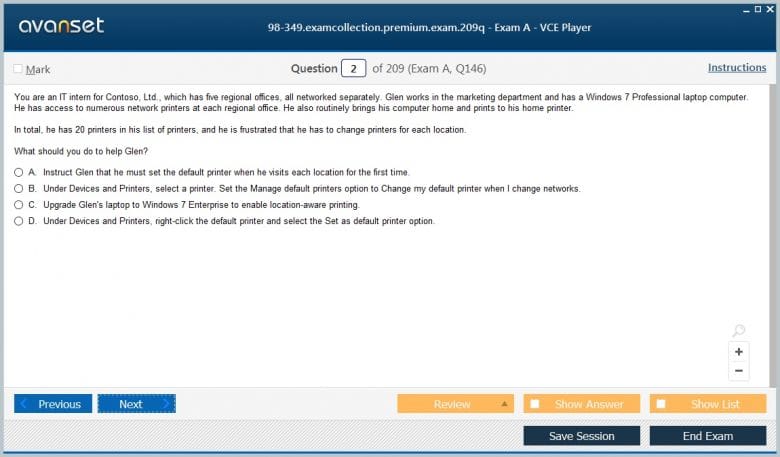
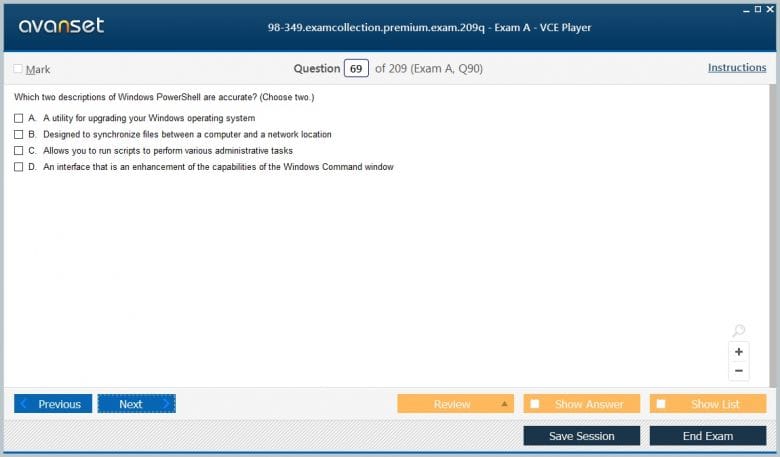
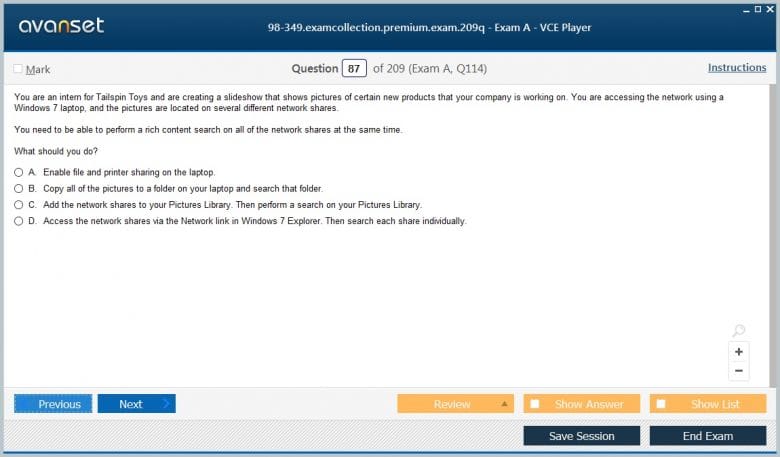
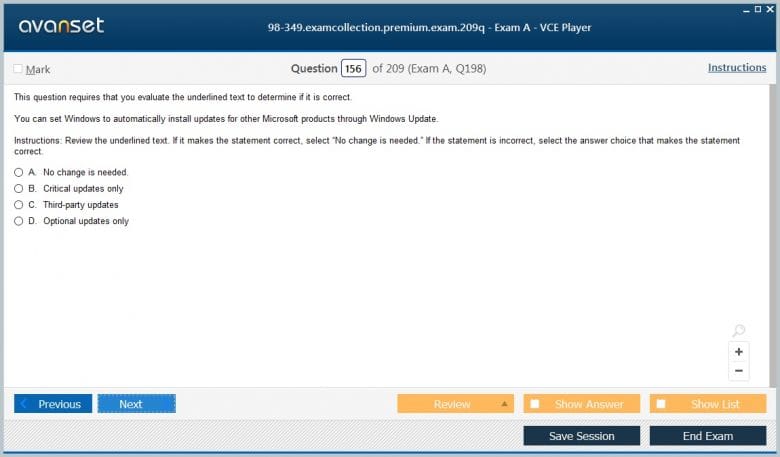
Microsoft Windows 98-349 Exam Screenshots
Microsoft Windows 98-349 Practice Test Questions in VCE Format
| File | Votes | Size | Date |
|---|---|---|---|
File Microsoft.braindumps.98-349.v2026-10-13.by.oliver.132q.vce |
Votes 1 |
Size 646.56 KB |
Date Oct 13, 2026 |
File Microsoft.braindumps.98-349.v2021-04-29.by.brahim.116q.vce |
Votes 1 |
Size 521.55 KB |
Date Apr 28, 2021 |
File Microsoft.Passit4sure.98-349.v2019-03-20.by.William.122q.vce |
Votes 4 |
Size 129.08 KB |
Date Mar 24, 2019 |
File Microsoft.Examsoon.98-349.v2014-08-25.by.LYNN.90q.vce |
Votes 7 |
Size 909.25 KB |
Date Aug 25, 2014 |
File Microsoft.Examsoon.98-349.v2014-06-17.by.Nicole.90q.vce |
Votes 1 |
Size 906.78 KB |
Date Jul 17, 2014 |
File Microsoft.Pass4Sure.98-349.v2012-09-29.by.Joe.155q.vce |
Votes 15 |
Size 4.87 MB |
Date Oct 02, 2012 |
Microsoft Windows 98-349 Practice Test Questions, Exam Dumps
Microsoft 98-349 (Windows Operating System Fundamentals) exam dumps vce, practice test questions, study guide & video training course to study and pass quickly and easily. Microsoft 98-349 Windows Operating System Fundamentals exam dumps & practice test questions and answers. You need avanset vce exam simulator in order to study the Microsoft Windows 98-349 certification exam dumps & Microsoft Windows 98-349 practice test questions in vce format.
Exam 98-349, Windows Operating System Fundamentals, was part of the Microsoft Technology Associate program. Microsoft’s academic material organized the exam around operating system configurations, installing and upgrading client systems, managing applications, files and folders, devices, and operating system maintenance. It was designed as an entry-level foundation rather than an administrator-level Windows credential.
The 98-349 Windows Operating System Fundamentals exam retired with the MTA program on June 30, 2022. Microsoft explicitly moved learners toward newer Fundamentals and role-based certification families. That makes 98-349 historical, but its core topics remain useful for someone learning how a desktop operating system starts, stores files, manages applications and devices, applies permissions, and recovers from problems.
The exam is most valuable today when treated as a conceptual bridge. Specific Windows 7 or Windows 8-era dialogs have aged, but the questions behind them have not: What is the operating system managing? Which layer owns a setting? What changes require administrative rights? Where does a failure originate? Good foundational study builds those mental models before adding modern cloud and endpoint-management tooling.
A Windows client has an edition, hardware architecture, user accounts, profiles, services, policies, and system settings that together define its behavior. MTA-level study asked learners to understand common configurations rather than memorize deep internals. The important skill is recognizing which settings are per-user, system-wide, hardware-dependent, or controlled by an administrator.
Build a small lab with two local users and compare profile-specific settings with machine-wide configuration. Check system information, architecture, storage, and edition details. Then explain which changes would follow a user to another machine and which would not. This creates a practical model of Windows as a multiuser operating system rather than a personal desktop with a single settings screen.
A foundational learner should also understand the boundary between the operating system and firmware. Boot order, virtualization support, secure boot, and hardware initialization may be configured outside Windows even though they affect whether Windows starts or which features are available. Knowing that boundary prevents the beginner from searching the Control Panel for a setting that belongs in firmware or hardware configuration.
The exam covered installation types, upgrade paths, migration concepts, and compatibility. A clean install, in-place upgrade, and migration solve different problems and carry different risks. Hardware requirements, application compatibility, user data, licensing, and rollback options all need to be considered before changing the operating system.
Practice by writing an upgrade plan for an older PC without actually performing it. Inventory hardware, applications, drivers, user data, encryption, and backup state. Decide what can be preserved and what must be reinstalled. This planning exercise is more educational than clicking through a setup wizard because it exposes the dependencies that determine whether an upgrade succeeds.
Migration planning should include user state separately from applications. Files, browser data, certificates, preferences, and locally stored application data may need different treatment. A successful operating-system installation that loses user data is not a successful upgrade. Building a checklist around identity, data, applications, settings, and recovery makes the process repeatable.
Windows application management involves installation, startup behavior, services, processes, compatibility, and removal. Task Manager and system configuration tools help users distinguish an application that is slow from a service that failed to start or a background process consuming resources.
Run several applications, inspect their processes, and observe CPU, memory, and disk activity. Stop a noncritical process and compare that with stopping a service in a controlled lab. The point is not to break the system; it is to learn the difference between an application window, a process, and a service. That distinction remains fundamental in modern Windows troubleshooting.
Startup troubleshooting is another useful systems exercise. If Windows boots slowly, identify whether the delay occurs before sign-in, during profile loading, or after the desktop appears. Review startup applications and services in a controlled environment and measure before changing anything. This teaches evidence-based troubleshooting and reduces the temptation to disable random components until the symptom disappears.
The MTA objectives included file systems, files and folders, permissions, sharing, encryption, compression, and libraries. These topics teach that access to a file depends on more than knowing its path. Ownership, NTFS permissions, share permissions, encryption state, and the user’s security context all affect what can be done.
Create a test folder with two users and experiment with read, modify, and deny behavior. Compress one file and encrypt another if the lab environment supports it. Document the difference between protecting confidentiality and reducing disk usage. This helps prevent a common beginner error: treating every file-related feature as if it solved the same problem.
Permission testing should distinguish local file access from network sharing. A user may have NTFS permission but lack share permission, or the reverse; effective access depends on both when a resource is reached over the network. Even if the old exam used simpler examples, this distinction is foundational for understanding why “I can open it locally” does not prove another user can access it remotely.
Windows relies on drivers to communicate with hardware, and Device Manager exposes much of that relationship. The exam covered storage devices, printers, and other hardware concepts at a foundational level. A device problem may therefore originate in the physical hardware, driver, configuration, power state, or application using it.
In a virtual machine or spare system, inspect Device Manager and identify driver provider, version, and status for several devices. Compare that information with what appears in system settings. The exercise builds diagnostic discipline: before replacing hardware or reinstalling an application, determine whether Windows recognizes the device and whether the driver stack is healthy.
Operating systems accumulate updates, logs, temporary data, startup entries, and configuration changes. The MTA exam included maintenance tools such as Windows Update, Disk Cleanup, Task Scheduler, system information, restore options, and backup or recovery concepts. Those tools reflect an ongoing lifecycle rather than one-time setup.
Create a maintenance checklist for a lab computer: verify updates, inspect storage, review startup behavior, create a restore point or recovery option where supported, and confirm that important data is backed up separately. Then simulate a non-destructive configuration mistake and recover from it. Maintenance becomes real when the learner can restore service, not just name the utility.
Recovery planning should also distinguish system recovery from data backup. A restore point can reverse certain system changes but is not a substitute for a backup of user documents. A recovery drive can help start or reinstall Windows but does not automatically preserve business data. Learners should match each recovery tool to the failure it is designed to address.
Even an entry-level Windows user benefits from understanding that the graphical interface is not the only way to inspect or control the system. Command Prompt and PowerShell expose files, processes, network information, services, and configuration in forms that can be repeated or documented.
A walkthrough of Windows command-line commands can extend this practice. Use a safe subset to navigate directories, inspect network configuration, list processes, and query system information. The goal is not to memorize dozens of commands. It is to become comfortable verifying what the GUI is showing and to recognize when a scripted approach is more efficient.
Microsoft retired the entire MTA family in 2022 and recommended newer Fundamentals certifications as starting points. Depending on the learner’s direction, useful starting paths include AZ-900 Azure Fundamentals, MS-900 Microsoft 365 Fundamentals, and SC-900 Security, Compliance, and Identity Fundamentals. None is a one-for-one replacement for desktop Windows fundamentals.
The broader Windows certification track and Microsoft certifications can help identify current role-based options. The right modern path depends on whether the learner wants endpoint administration, cloud infrastructure, Microsoft 365, security, or development. The retired MTA exam should be treated as foundational history, not as a current recommendation.
Because modern endpoint management often happens through cloud services, a current learner can extend the old MTA foundation by studying identity, policy, device compliance, and remote management. The Windows client is still an operating system, but organizations increasingly manage it as part of a service ecosystem. Understanding the local fundamentals makes those higher-level controls easier to reason about.
A useful capstone is to build and document a Windows virtual machine from installation through maintenance. Create users, organize storage, install an application, inspect processes and services, configure permissions, connect a device or virtual hardware component, update the system, and test a recovery mechanism. Record what changed at each step and which operations required elevated privileges.
Networking should also be part of a practical Windows foundation even when the exam is not primarily a networking credential. A client needs an IP configuration, DNS resolution, a network profile, and firewall behavior before many applications can communicate reliably. Use safe commands to inspect address, gateway, and name-resolution information, then compare local connectivity with access to a remote service. This encourages layered troubleshooting: first verify the interface, then addressing, then name resolution, then the application, rather than treating every connection failure as “the internet is down.”
98-349 no longer exists as a certification goal, but it still offers a coherent introduction to how a Windows client works. The durable outcome is a troubleshooting mindset: identify the layer, verify the evidence, change one thing at a time, and keep recovery options available. Those habits remain useful long after the specific operating system version and MTA badge have retired.
Go to testing centre with ease on our mind when you use Microsoft Windows 98-349 vce exam dumps, practice test questions and answers. Microsoft 98-349 Windows Operating System Fundamentals certification practice test questions and answers, study guide, exam dumps and video training course in vce format to help you study with ease. Prepare with confidence and study using Microsoft Windows 98-349 exam dumps & practice test questions and answers vce from ExamCollection.
Purchase Individually


Microsoft 98-349 Video Course
Top Microsoft Certifications



























































Top Microsoft Certification Exams
Site Search:

SPECIAL OFFER: GET 10% OFF

Pass your Exam with ExamCollection's PREMIUM files!
SPECIAL OFFER: GET 10% OFF
Use Discount Code:
MIN10OFF
A confirmation link was sent to your e-mail.
Please check your mailbox for a message from support@examcollection.com and follow the directions.

Download Free Demo of VCE Exam Simulator
Experience Avanset VCE Exam Simulator for yourself.
Simply submit your e-mail address below to get started with our interactive software demo of your free trial.
please am preparing for this exam and i dont have a clue what to expect. i need your help guys.am also having difficulties scheduling for the exam. i need to know if i can forfeit it and go straight to mcsa exams as am in a tight schedule for a job. thank.
am brian
hey damwel don’t worry much. before u start looking for the practice test first make sure that you have understood the concept. the practice test are of no use if you don’t understand the concept. master the concept and the rest will follow.
hi people i am preparing for my exams. i have gone through the dumps here but need more. kindly if you materials where i can get exam 98-349 practice test help me out. i one failed on my previous exams and i don’t need a repeat.
this mta 98-349 is an just introducing you to the world of microsoft. it helps one to grasp the foundation of microsoft career. i will be doing a blog on how best this will help you out and what is the next step in building your microsoft career. be on the watch for the blog it may be of help.
such a good site for u to get certification. the mta 98-349 windows operating system fundamentals microsoft official practice test prepares you for exams. actually, its not giving the real exam but you have a know how of what you expect.
i finally did it. 98-349 exam is passed now.
this site here was really helpful. i did not not have time to get an instructor to help me through my course. this is because my job demands quite a lot of my presence. but anytime i get a few minutes i would go through my computer to study. i am confidence on what i have learnt and i am ready to take exam 98-349.
@easther i have 98-349 practice test collection from different books. however, i dint have time to get the answers. i used them for the preview test when i did the course. i don’t know if they would be of help to you if they don’t have the answers.
hey am looking for reading materials that has mta 98-349 practice test. it will be better f it has both questions and answers on each chapter.