



Premium File
168 Q&A
$76.99$69.99
Microsoft MTA 98-367 Exam Questions & Answers, Accurate & Verified By IT Experts
Instant Download, Free Fast Updates, 99.6% Pass Rate

98-367 Premium File: 168 Questions & Answers
Last Update: Oct 12, 2026
98-367 Training Course: 66 Video Lectures
98-367 PDF Study Guide: 210 Pages
$79.99
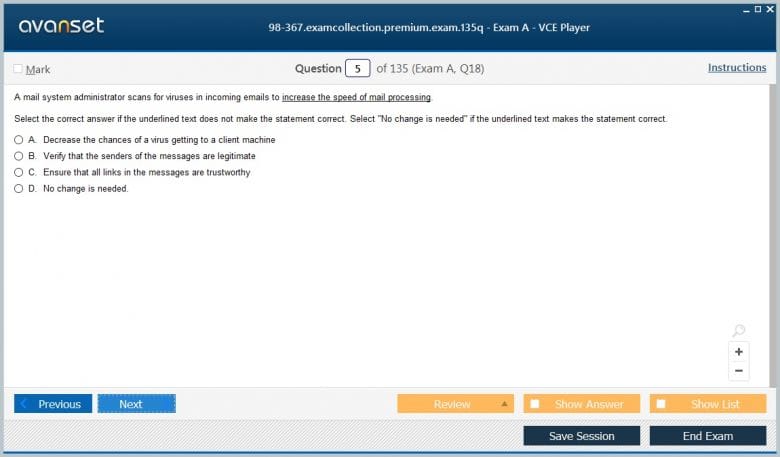
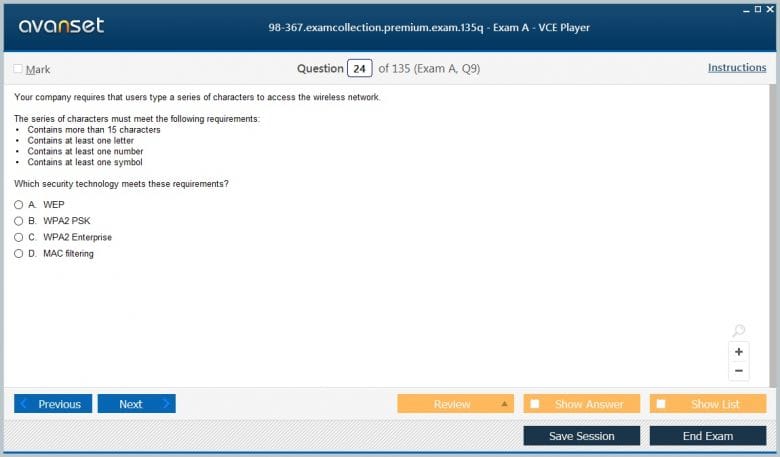
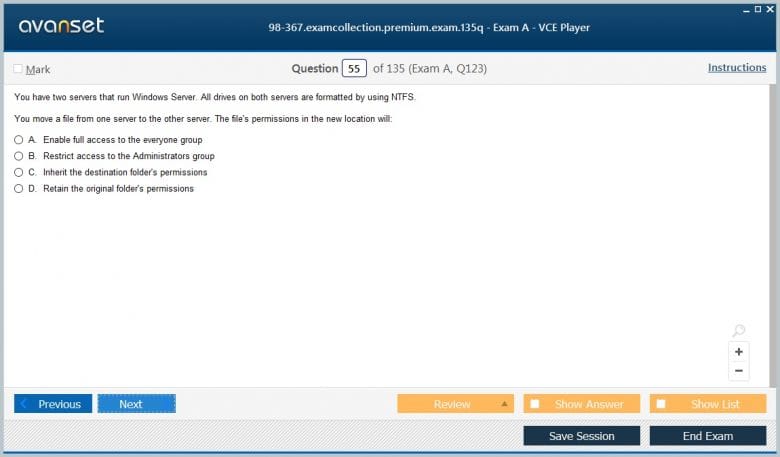
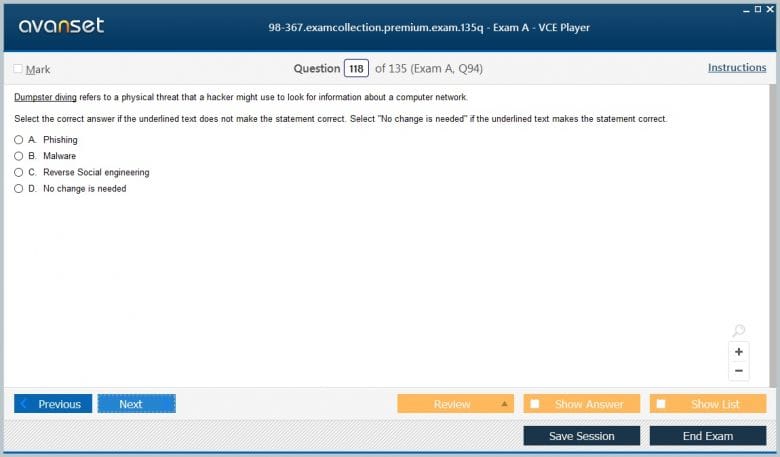
Microsoft MTA 98-367 Exam Screenshots
Microsoft MTA 98-367 Practice Test Questions in VCE Format
| File | Votes | Size | Date |
|---|---|---|---|
File Microsoft.certkey.98-367.v2026-10-05.by.ryan.90q.vce |
Votes 1 |
Size 365.11 KB |
Date Oct 05, 2026 |
File Microsoft.Test-king.98-367.v2019-07-09.by.Lincoln.88q.vce |
Votes 2 |
Size 262.26 KB |
Date Jul 10, 2019 |
File Microsoft.Actualtests.98-367.v2014-07-04.by.DAWN.24q.vce |
Votes 3 |
Size 19.15 KB |
Date Jul 04, 2014 |
File Microsoft.Test-inside.98-367.v2014-02-11.by.Elsy.160q.vce |
Votes 13 |
Size 790.91 KB |
Date Feb 11, 2014 |
File Microsoft.Testking.98-367.v2013-07-22.by.Vindicator930.35q.vce |
Votes 5 |
Size 21.43 KB |
Date Jul 21, 2013 |
File Microsoft.Passguide.98-367.v2012-11-08.by.undergl.161q.vce |
Votes 1 |
Size 238.05 KB |
Date Nov 08, 2012 |
Microsoft MTA 98-367 Practice Test Questions, Exam Dumps
Microsoft 98-367 (Security Fundamentals) exam dumps vce, practice test questions, study guide & video training course to study and pass quickly and easily. Microsoft 98-367 Security Fundamentals exam dumps & practice test questions and answers. You need avanset vce exam simulator in order to study the Microsoft MTA 98-367 certification exam dumps & Microsoft MTA 98-367 practice test questions in vce format.
Microsoft exam 98-367 belonged to the Microsoft Technology Associate generation and focused on security fundamentals rather than on one administrator role or cloud product. Its value was breadth: learners had to connect operating-system security, network security, software protection, identity concepts, permissions, and basic defensive thinking instead of treating security as a single tool.
The 98-367 Security Fundamentals exam retired when Microsoft ended the remaining MTA exams on June 30, 2022. It should therefore be studied as a historical fundamentals blueprint, not as an exam that can still be scheduled. The underlying ideas remain useful because authentication, authorization, least privilege, encryption, malware defense, network segmentation, and security monitoring are still core concepts even though Microsoft’s current credentials organize them differently.
For a modern learner, the best use of 98-367 is to build a coherent security model and then map that model to current Microsoft technologies. That means understanding why a control exists, what threat it addresses, and how multiple controls work together. Memorizing the terminology of an older Windows environment without that reasoning produces knowledge that ages quickly.
Authentication answers who or what is requesting access; authorization answers what that identity may do. The exam’s fundamentals approach made that distinction central because nearly every practical security decision depends on it. Password policies, account lockout, permissions, group membership, and administrative rights all make more sense when they are treated as parts of an identity-and-access system rather than isolated settings.
A useful lab begins with three roles: a normal user, a help-desk operator, and an administrator. Give each role only the permissions required for its work, then test what happens when the boundaries are too broad. Modern Microsoft environments extend this reasoning through Microsoft Entra ID, conditional access, privileged roles, and cloud identity, but the least-privilege principle is the same one that made the old fundamentals exam meaningful.
Account lifecycle is another useful way to make access control concrete. Create a user, grant role-based access, change that user’s department, suspend the account, and finally remove access. At each step, ask which groups, tokens, shared resources, and privileged permissions should change. Security failures often come from stale access rather than from a missing authentication feature, so joiner-mover-leaver discipline belongs in a fundamentals lab.
Host security is not one control. Updates reduce exposure to known vulnerabilities, anti-malware tools look for malicious behavior or signatures, host firewalls constrain traffic, permissions limit damage, and secure configuration removes unnecessary attack surface. The strongest 98-367 preparation connected those layers rather than assuming that installing an antivirus product completed the task.
Practice by hardening a test workstation and documenting the reason for every change. Disable an unnecessary service, apply updates, review local administrator membership, inspect firewall rules, and verify how standard-user permissions affect application behavior. Then imagine one layer failing. If malware executes, what prevents privilege escalation? If credentials are stolen, what limits their usefulness? That threat-path reasoning is far more durable than memorizing a list of controls.
The network portion of the old blueprint introduced firewalls, ports, protocols, wireless protection, network isolation, and common attack patterns. The goal was not deep packet analysis. It was to make learners ask which systems should communicate, which services must be exposed, and how traffic can be constrained or observed when something abnormal happens.
Create a small network diagram with a user subnet, server subnet, management path, and internet edge. Mark permitted flows and justify each one. This reveals why “allow everything internally” is weak design. It also creates a bridge to current zero-trust thinking, where device condition, identity, and resource sensitivity influence access instead of assuming trust solely because a connection originates inside a corporate network.
Do not stop with a network diagram. Add one public service, one management service, and one sensitive internal application, then write the expected source and destination for every allowed connection. Review what should be logged when traffic is blocked and what evidence would distinguish a misconfiguration from an attack. This turns ports and protocols into an operational control model rather than a memorization exercise.
Malware names are less important than understanding what an attacker is trying to achieve. A phishing message may steal credentials; a Trojan may establish persistence; ransomware may encrypt data; a denial-of-service attack may target availability. Each threat matters because it exploits a weakness in people, software, configuration, or architecture and affects confidentiality, integrity, or availability.
For each scenario, name the asset, the weakness, the likely impact, and at least two controls. A credential-phishing scenario might call for user awareness, strong authentication, conditional access, and detection of unusual sign-ins. A vulnerable web service might require patching, least privilege, network filtering, secure coding, and logging. This exercise turns security from vocabulary into causal analysis.
A simple risk register can deepen this exercise. Assign each scenario an asset owner, likely impact, existing controls, and one residual risk that remains after mitigation. The objective is not to calculate a perfect score but to recognize that security decisions are prioritized. A low-probability event affecting a critical system may still deserve stronger controls than a frequent nuisance with little business impact.
98-367 introduced encryption as a way to protect data at rest and in transit, but the important lesson is that encryption is a system rather than a magic checkbox. Algorithms, certificates, keys, trust chains, recovery processes, and access policies all affect whether protection works. A perfectly encrypted file can still be exposed if an authorized account is compromised or keys are handled carelessly.
Compare three cases: a laptop disk, a browser session to a website, and a file exchanged between two people. Identify what is encrypted, where keys live, how identities are validated, and what happens if a key or credential is lost. That analysis prepares learners for modern cloud key management and certificate-based security without pretending that the MTA blueprint itself covered today’s implementation details.
Include backup and recovery in the encryption discussion. Encrypting data without a recoverable key strategy can protect confidentiality while creating an availability problem. Conversely, storing recovery material beside the encrypted data can undermine the protection. A strong learner should be able to explain who can recover data, how that authority is protected, and what audit trail exists when recovery access is used.
Logs, alerts, auditing, and event review were basic ideas in entry-level security then and remain essential now. Controls can fail silently. An account may be abused without being disabled, a firewall may allow a new path, or malware may be blocked repeatedly on one endpoint. Without evidence, administrators cannot tell the difference between a secure configuration and a configuration that merely looks secure.
A good fundamentals exercise is to generate normal and abnormal events in a lab, then trace what is recorded. Sign in successfully, fail several sign-ins, change a permission, trigger a blocked connection, and inspect the resulting evidence. Current credentials such as SC-200 go much deeper into security operations, but the habit of asking “what evidence proves this happened?” starts at the fundamentals level.
Finish the monitoring lab by writing a short incident timeline from the events you generated. Identify the first suspicious signal, the action taken, and the evidence that confirmed or rejected the hypothesis. This is a small version of incident response. It teaches that logs are valuable when they support a decision, not merely because a system produces large volumes of events.
Microsoft moved away from MTA toward fundamentals and role-based certifications. For someone starting with the old 98-367 body of knowledge, SC-900 is a more current entry point for security, compliance, and identity concepts, while SC-300 and SC-100 represent more specialized identity and architecture directions. Those exams should not be described as direct replacements for 98-367; they reflect a different credential model and much newer Microsoft platforms.
This distinction prevents a common legacy-content mistake. The old exam can still teach core vocabulary and reasoning, but current preparation must use current objectives, services, and interfaces. The broader Microsoft certifications shows how far the ecosystem has shifted from generic technology-associate credentials toward product, role, and solution responsibilities.
Instead of taking the old objectives one at a time, design security for a small organization. Define identities, devices, sensitive information, network zones, administrative roles, backup expectations, monitoring, and incident escalation. Then introduce failures: a lost laptop, a phished account, an unpatched server, a malicious attachment, and an employee who changes departments. Decide which preventive, detective, and recovery controls should respond.
The exercise exposes whether the learner understands interactions. Least privilege is not useful if privileged accounts are shared. Encryption is incomplete if recovery keys are unmanaged. A firewall is insufficient if stolen credentials can reach everything. That systems view is the durable lesson of the retired exam and the best reason to keep its fundamentals in a broader security curriculum.
98-367 is no longer a live Microsoft exam, but its strongest concepts remain foundational. Use it to learn the logic of security controls, then move to current Microsoft objectives for the credential you actually intend to earn.
After the design is complete, perform a permissions and dependency review from the perspective of a compromised standard user. Trace which files, applications, network segments, and administrative interfaces become reachable, then identify where another control should stop the attack path. This validates defense in depth more effectively than reviewing controls one by one.
Go to testing centre with ease on our mind when you use Microsoft MTA 98-367 vce exam dumps, practice test questions and answers. Microsoft 98-367 Security Fundamentals certification practice test questions and answers, study guide, exam dumps and video training course in vce format to help you study with ease. Prepare with confidence and study using Microsoft MTA 98-367 exam dumps & practice test questions and answers vce from ExamCollection.
Purchase Individually


Microsoft 98-367 Video Course

Top Microsoft Certifications



























































Top Microsoft Certification Exams
Site Search:

SPECIAL OFFER: GET 10% OFF

Pass your Exam with ExamCollection's PREMIUM files!
SPECIAL OFFER: GET 10% OFF
Use Discount Code:
MIN10OFF
A confirmation link was sent to your e-mail.
Please check your mailbox for a message from support@examcollection.com and follow the directions.

Download Free Demo of VCE Exam Simulator
Experience Avanset VCE Exam Simulator for yourself.
Simply submit your e-mail address below to get started with our interactive software demo of your free trial.
Thank you very much.
i passed the exam 86% today! with the Premium file.
Anyone know where I can find Exam 98-368: Mobility and Devices Fundamentals. Please let me know. Thank you!
mta 98-367 exam questions are helpful. It actually helped me to perform pretty well. Thanks!
@eriksson, you can use the VCE exam simulator to play the VCE files related to 98-367 exam.
The examcollection 98-367 premium file is really helpful…it provided me with several questions related to the security fundamentals exam. Thank you so much.
I passed 98-367 exam with the help of premium files for 98-367 exam . I scored 82 percent.
I performed excellently in 98-367 exam. I encountered five questions which were in 98-367 exam questions.
I’m doing my 98-367 exam in next two weeks. Someone advise me on how to get the updated 98-367 exam dumps.
I did 98-367 exam three days ago and I failed. I think I failed because I lacked the appropriate materials for preparing for the exam. I don’t use 98-367 practice tests at all. I need the valid ones. somebody help me with them please.
who has the latest VCE reader to open 98-367 vce file? assist me pliz?
Wow! the dumps for 98-367 exam are valid. The helped me to perform very well in the exam.
mta security fundamentals practice test is very helpful. Generally, the questions it contains are similar to those in the actual exam. It helped me to score high in 98-367 cert exam.