
Pass Your Cisco CCNP Collaboration Certification Easy!
Cisco CCNP Collaboration Certification Exams Questions & Answers, Accurate & Verified By IT Experts
Instant Download, Free Fast Updates, 99.6% Pass Rate.

Implementing Cisco Advanced Call Control and Mobility Services (CLASSM)
Includes 245 Questions & Answers
Implementing Cisco Collaboration Core Technologies (CLCOR)
Includes 421 Questions & Answers
$209.97
Or Purchase CCNP Collaboration Exams Individually
| 300-810 | Implementing Cisco Collaboration Applications (CLICA) | $69.99 | Add to cart |
| 300-815 | Implementing Cisco Advanced Call Control and Mobility Services (CLASSM) | $69.99 | Add to cart |
| 300-820 | Implementing Cisco Collaboration Cloud and Edge Solutions | $69.99 | Add to cart |
| 300-835 | Automating Cisco Collaboration Solutions (CLAUTO) | $69.99 | Add to cart |
| 350-801 | Implementing Cisco Collaboration Core Technologies (CLCOR) | $69.99 | Add to cart |
Cisco CCNP Collaboration Certification Exams Screenshots
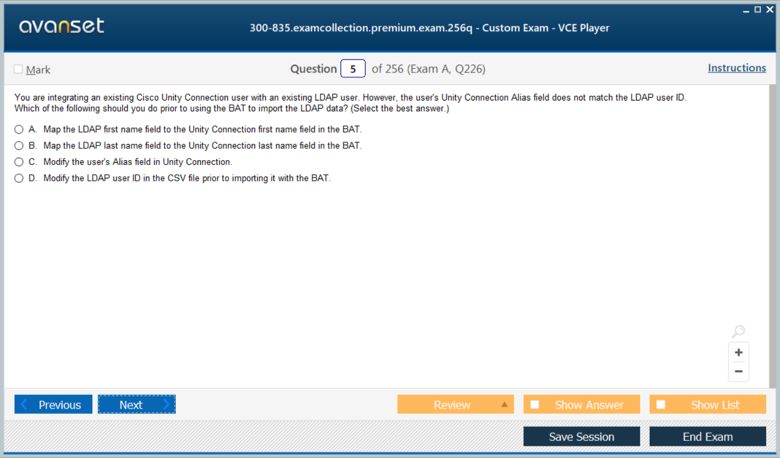
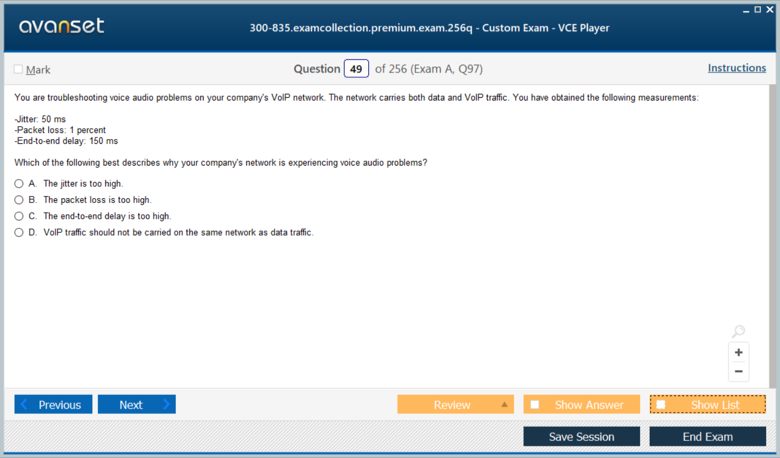
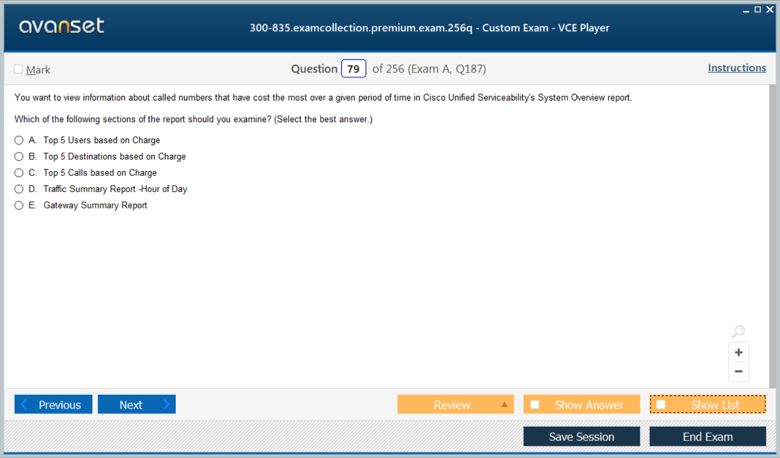
CCNP Collaboration Product Reviews
Download Free CCNP Collaboration Practice Test Questions VCE Files
| Exam | Title | Files |
|---|---|---|
Exam 300-810 |
Title Implementing Cisco Collaboration Applications (CLICA) |
Files 1 |
Exam 300-815 |
Title Implementing Cisco Advanced Call Control and Mobility Services (CLASSM) |
Files 1 |
Exam 300-820 |
Title Implementing Cisco Collaboration Cloud and Edge Solutions |
Files 1 |
Exam 300-835 |
Title Automating Cisco Collaboration Solutions (CLAUTO) |
Files 2 |
Exam 350-801 |
Title Implementing Cisco Collaboration Core Technologies (CLCOR) |
Files 1 |
Cisco CCNP Collaboration Certification Exam Dumps & Practice Test Questions
Prepare with top-notch Cisco CCNP Collaboration certification practice test questions and answers, vce exam dumps, study guide, video training course from ExamCollection. All Cisco CCNP Collaboration certification exam dumps & practice test questions and answers are uploaded by users who have passed the exam themselves and formatted them into vce file format.
CCNP Collaboration: Engineering Modern Voice and Hybrid Communications
CCNP Collaboration sits in a part of networking where a technically correct design can still fail if the human experience is poor. Voice, video, messaging, meetings, contact-center interactions, endpoints, gateways, cloud services, identity, and network quality all have to cooperate in real time. Within the wider Cisco certifications portfolio, that makes the collaboration track unusually interdisciplinary: candidates need networking fundamentals, but they also need to understand signaling, media, call routing, user services, security, and operational behavior.
As of September 2026, the current certification is earned by passing the 350-801 CLCOR core exam and one current concentration exam. Cisco updated CLCOR to v2.0 in February 2026 and also refreshed the concentration structure, so older preparation material needs to be checked carefully against the current blueprint. That version awareness matters because collaboration platforms evolve quickly as on-premises call control, cloud-delivered services, APIs, and hybrid deployment models converge.
The certification is really about end-to-end service behavior
A collaboration engineer does not work with a single protocol or appliance. A simple call may involve endpoint registration, directory lookup, dial-plan decisions, signaling across call-control systems, gateway selection, codec negotiation, media traversal, QoS policy, firewall behavior, and perhaps a connection to a cloud service or the public telephone network. When something breaks, the symptom experienced by the user often appears far away from the actual fault.
That is why CCNP Collaboration is best approached as a service-path certification rather than a product memorization exercise. Candidates should be able to ask what should happen from the instant a user initiates communication until signaling is completed and media flows. The same method applies to meetings and messaging: identify the control plane, identify the media or data path, establish dependencies, and then isolate the first point where observed behavior differs from expected behavior.
This mindset is also what separates professional-level work from basic administration. Creating a user or registering an endpoint is useful, but production collaboration engineering demands that the entire system remain understandable when there are multiple sites, trunks, route patterns, cloud integrations, survivability requirements, and security boundaries.
CLCOR establishes the common collaboration core
The current CLCOR blueprint covers collaboration infrastructure and design, protocols and endpoints, Cisco IOS XE gateway and media resources, call control, quality of service, and collaboration applications. Those topics are broad because the core exam is meant to establish the technical language shared by the concentration paths. Passing CLCOR also earns the Collaboration Core specialist credential and satisfies the core requirement for both CCNP Collaboration and CCIE Collaboration.
Infrastructure and design questions should be interpreted in terms of dependencies and failure domains. A centralized service may be simpler to manage, but branches need a plan for WAN outages. A cloud service reduces some local infrastructure, but it creates new dependencies on Internet access, identity, DNS, certificates, and secure connectivity. High availability is not simply “two servers”; it is the ability for signaling, media, user services, and management functions to continue or recover in a predictable way.
Protocols are equally important. Candidates do not need to treat SIP as a collection of isolated message names. They should understand why endpoints register, how sessions are established and torn down, how addressing is transformed, and how signaling problems differ from media problems. That distinction becomes critical when a call connects but has one-way audio, poor quality, or unexpected codec behavior.
Call control is a routing problem expressed through communications
Dial plans are one of the clearest places where networking-style reasoning carries into collaboration. A dialed string has to match a pattern, be transformed when necessary, select an appropriate route, and reach a destination that understands the resulting number format. The details vary by deployment, but the engineering discipline resembles IP routing: define the intended path, understand the selection logic, and verify where an unexpected decision occurred.
The current 300-815 CLACC concentration focuses on advanced on-premises call control and mobility. That makes it a natural choice for engineers who spend significant time with Cisco Unified Communications Manager, gateways, dial planning, mobility services, survivability, and signaling behavior. The concentration should not be viewed as “more configuration commands.” Its real value is learning to reason about call paths that cross clusters, sites, trunks, and failover conditions.
Advanced call control also exposes why naming and numbering discipline matters. Organizations often inherit years of extensions, E.164 numbers, route patterns, transformations, and exceptions. A professional engineer needs to simplify that complexity where possible and document the remaining rules so operational teams can diagnose problems without guessing.
Hybrid and cloud collaboration changes the boundary of responsibility
Modern collaboration environments are rarely purely on-premises or purely cloud based. Users may meet in a cloud platform while calling through enterprise gateways, or they may use cloud-registered devices that still depend on local network quality and security. Identity, device management, APIs, certificates, and secure edge connectivity become part of the collaboration engineer’s daily scope.
The current 300-820 CLHCT concentration reflects that shift by focusing on collaboration hybrid and cloud technologies. The important conceptual change is that the service boundary moves. Engineers may no longer control every application server, but they still own the user experience and must prove whether a problem originates in the endpoint, LAN, WAN, edge, identity system, configuration, or cloud service.
That operational model rewards evidence. DNS resolution, certificate validity, latency, packet loss, authentication events, API responses, and client logs can all contribute to a diagnosis. A vague report that “Web meetings are bad” must be converted into measurable observations: who is affected, where they are located, which media path is used, whether signaling succeeds, and whether impairment is consistent or intermittent.
Cloud customer experience is a distinct engineering problem
The 300-830 CLCCE concentration focuses on collaboration cloud customer-experience technologies. Contact-center environments add queuing, routing logic, agent states, customer channels, reporting, and business workflows to the communication stack. The technical objective is not merely to connect a call; it is to deliver an interaction to the right resource with the right context while preserving a measurable service experience.
This creates additional failure domains. A caller may reach the platform but be routed incorrectly. An agent may be available but not receive work because of queue configuration. Media can be healthy while CRM integration fails. Reporting can disagree with operational expectations because states or events are interpreted differently. Good troubleshooting therefore begins by defining the exact business workflow, then tracing the technical components that implement each step.
Contact-center engineering also makes observability more important. Queue statistics, agent states, interaction histories, application events, and network telemetry need to be correlated. The strongest engineers learn to move between user symptoms and system evidence instead of treating contact-center behavior as a black box.
QoS is not optional when media is sensitive to delay
Data applications can often tolerate short bursts of congestion because retransmission or buffering hides the problem. Real-time voice and video are less forgiving. Delay, jitter, and packet loss are experienced directly as pauses, clipping, frozen video, or failed conversations. That is why QoS remains a core collaboration skill even in environments with substantial bandwidth.
The central idea is classification and controlled contention. The network must recognize important traffic, mark it consistently, preserve those markings across trust boundaries, and provide predictable treatment when links become congested. Engineers should understand that QoS does not create bandwidth. It decides which traffic suffers first when demand exceeds available capacity.
Troubleshooting therefore requires more than checking that a policy exists. Verify markings at the source, confirm that intermediate devices trust or rewrite them as intended, inspect queue behavior, and measure the actual path. A correct call-control configuration cannot compensate for a WAN queue that routinely drops media packets.
Gateways and edge functions connect different worlds
Collaboration gateways sit at boundaries: IP networks meet service providers, older telephony interfaces, survivable branches, or external communication systems. Translation is often required in numbering, signaling, media, or security policy. These devices can therefore become the place where otherwise healthy systems fail to interoperate.
A reliable troubleshooting sequence separates signaling from media. First confirm that the call reaches the gateway and that signaling proceeds as expected. Then examine codec negotiation, media addresses, NAT or firewall behavior, and RTP flow. One-way audio is especially useful as a teaching symptom because it demonstrates that successful signaling does not prove a healthy bidirectional media path.
Security should be considered at the same boundary. Certificates, encrypted signaling and media, access controls, and properly limited management exposure matter because communications systems often carry sensitive conversations and identity information.
The 2026 concentration changes make old study plans risky
Cisco retired several older Collaboration concentration exams in early 2026 and renamed or replaced others. The former 300-810 CLICA option retired without becoming one of the current concentration choices. For example, the former 300-815 CLACCM path transitioned to the current CLACC designation, while the former 300-820 CLCEI transitioned to CLHCT. The old 300-835 CLAUTO also retired in February 2026. Candidates should therefore avoid building a study plan from a stale diagram or course bundle without checking current Cisco requirements.
This does not mean the underlying skills suddenly stopped mattering. Automation, APIs, cloud edge behavior, and advanced call control remain useful. The change is in how Cisco packages and assesses those skills. A strong learner separates durable technical knowledge from the administrative structure of the certification program.
The same principle applies to ExamCollection’s older discussion of whether CCNP Collaboration: career context can remain useful, but current exam requirements should always be checked against the live Cisco blueprint.
Choose a concentration based on the systems you actually want to operate
The core exam is shared, but the concentration should reflect the work a candidate wants to perform. Engineers responsible for on-premises call control and complex dial plans will get the most direct value from CLACC. Engineers moving toward hybrid services and cloud-managed collaboration will find CLHCT more aligned. Those supporting contact-center and customer-experience platforms should evaluate CLCCE.
There is no advantage in selecting a concentration because someone else calls it easier. A concentration becomes valuable when its lab work overlaps with real systems you can observe, build, and troubleshoot. Professional-level learning compounds when the same concepts appear in both study and production incidents.
That also creates a sensible path toward expert-level work. The article on CCIE Collaboration can help frame that next step, but the technical progression is straightforward: first become comfortable explaining why a collaboration service behaves as it does, then develop the speed and depth to diagnose multi-domain failures under pressure.
Build preparation around traces, labs, and failure scenarios
Configuration practice is necessary, but troubleshooting practice is more revealing. Register endpoints, create a working call route, then break one dependency at a time. Change a dial pattern. Remove a route. Introduce a codec mismatch. Break DNS. Expire a certificate in a lab. Misclassify media traffic. Disable a gateway resource. Cisco lab simulators and emulators can make those failure scenarios repeatable without risking production systems. Observe exactly what users see and what logs or traces reveal.
Packet captures and protocol traces are particularly valuable because they force candidates to connect theory with evidence. A SIP ladder can show whether a call was rejected, redirected, or established. RTP analysis can distinguish signaling success from media impairment. QoS counters can prove whether congestion is actually affecting a queue rather than merely being suspected.
CCNP Collaboration is strongest when it produces that diagnostic discipline. The certification is not just about knowing the components in Cisco’s collaboration portfolio. It is about understanding how those components combine into a real-time service and being able to explain, with evidence, why that service succeeds or fails.
ExamCollection provides the complete prep materials in vce files format which include Cisco CCNP Collaboration certification exam dumps, practice test questions and answers, video training course and study guide which help the exam candidates to pass the exams quickly. Fast updates to Cisco CCNP Collaboration certification exam dumps, practice test questions and accurate answers vce verified by industry experts are taken from the latest pool of questions.


Cisco CCNP Collaboration Video Courses

Top Cisco Certifications





Top Cisco Certification Exams
- 200-301
- 350-401
- 300-410
- 350-701
- 300-415
- 350-601
- 300-420
- 300-715
- 810-110
- 350-801
- 350-101
- 350-501
- 350-201
- 200-901
- 200-201
- 400-007
- 500-220
- 300-710
- 100-150
- 350-901
- 300-620
- 820-605
- 300-730
- 300-640
- 300-110
- 800-150
- 300-510
- 300-815
- 300-435
- 300-745
- 500-442
- 300-515
- 700-805
- 100-140
- 100-160
- 300-610
- 300-440
- 300-425
- 300-720
- 300-220
- 300-215
- 500-560
- 700-246
- 500-443
- 700-750
- 300-430
- 300-445
- 300-725
- 010-151
- 300-830
- 500-470
- 300-820
- 300-615
- 700-242
Site Search:



