
Pass Your Cisco DevNet Professional Certification Easy!
Cisco DevNet Professional Certification Exams Questions & Answers, Accurate & Verified By IT Experts
Instant Download, Free Fast Updates, 99.6% Pass Rate.

$97.98
Or Purchase DevNet Professional Exams Individually
| 300-435 | Automating Cisco Enterprise Solutions (ENAUTO) | $69.99 | Add to cart |
| 300-535 | Automating Cisco Service Provider Solutions (SPAUTO) | $69.99 | Add to cart |
| 300-635 | Automating Cisco Data Center Solutions (DCAUTO) | $69.99 | Add to cart |
| 300-735 | Automating Cisco Security Solutions (SAUTO) | $69.99 | Add to cart |
| 300-835 | Automating Cisco Collaboration Solutions (CLAUTO) | $69.99 | Add to cart |
| 300-910 | Implementing DevOps Solutions and Practices using Cisco Platforms (DEVOPS) | $69.99 | Add to cart |
| 300-920 | Developing Applications for Cisco Webex and Webex Devices (DEVWBX) | $69.99 | Add to cart |
| 350-901 | Designing, Deploying, and Managing Network Automation Systems | $69.99 | Add to cart |
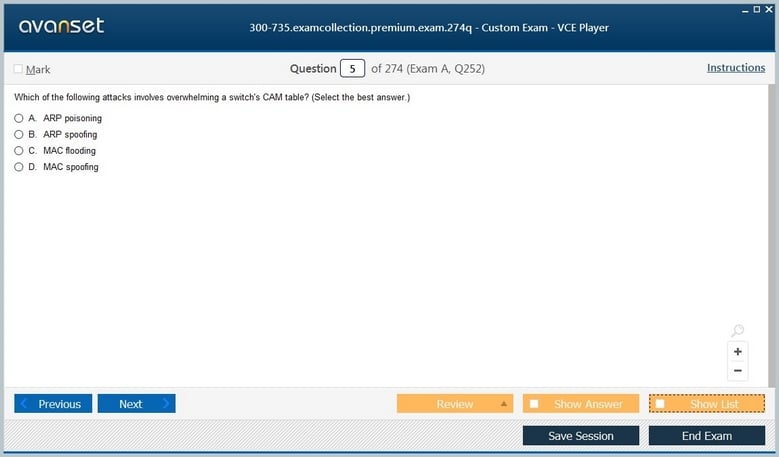
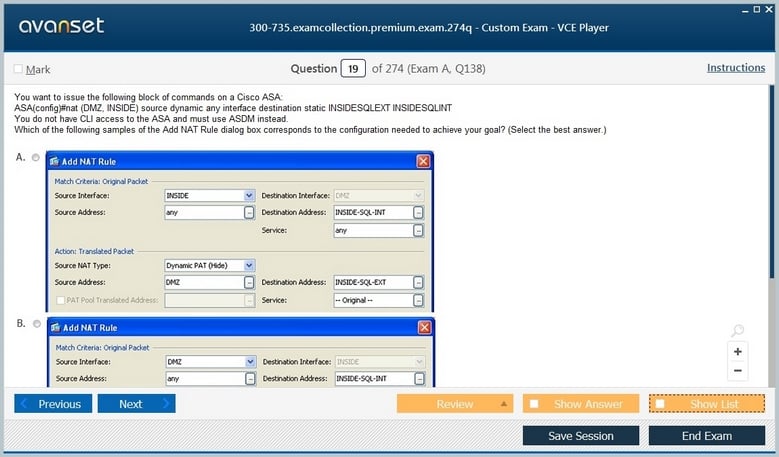
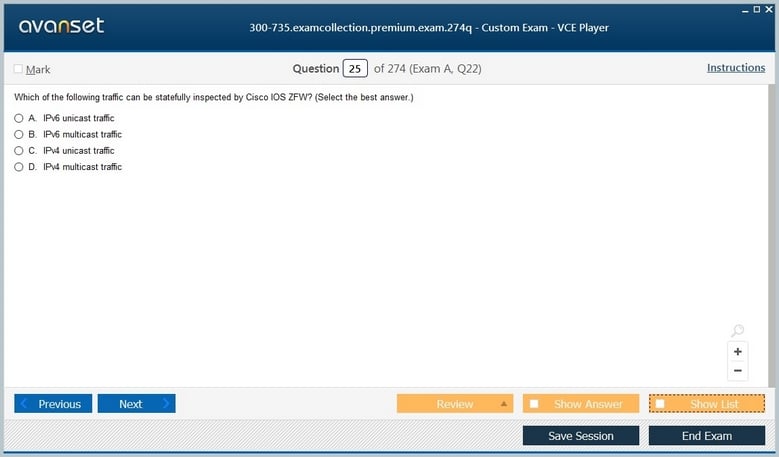
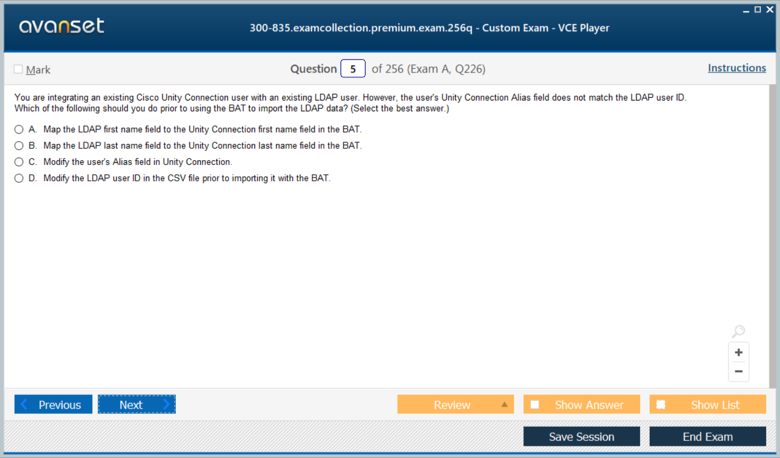
Cisco DevNet Professional Certification Exams Screenshots
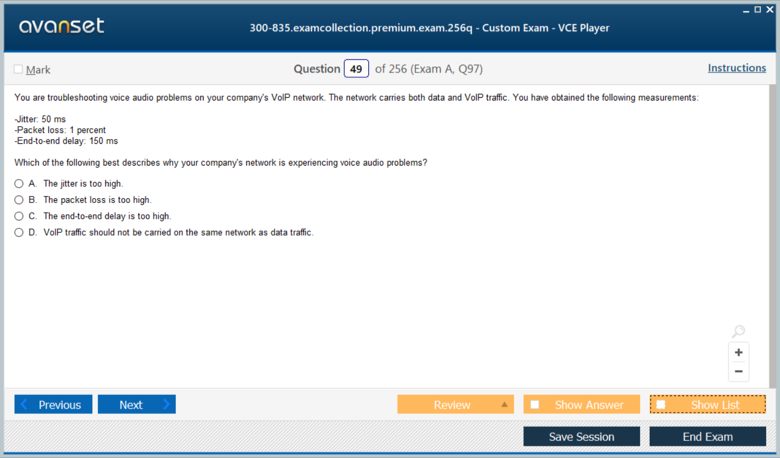
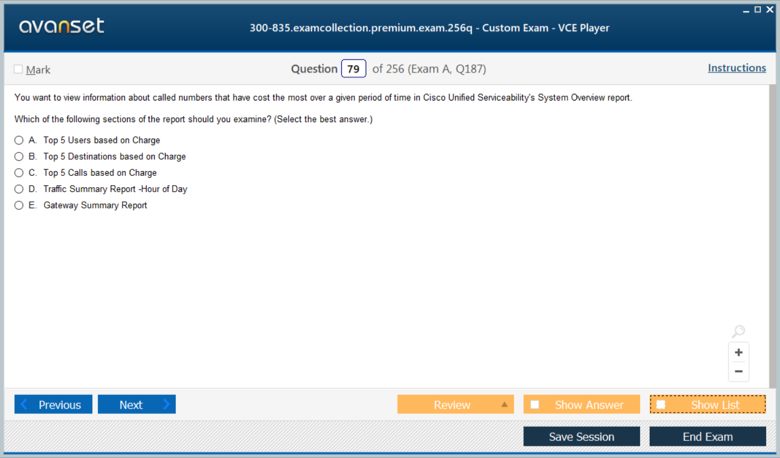
DevNet Professional Product Reviews
Download Free DevNet Professional Practice Test Questions VCE Files
| Exam | Title | Files |
|---|---|---|
Exam 300-435 |
Title Automating Cisco Enterprise Solutions (ENAUTO) |
Files 1 |
Exam 300-535 |
Title Automating Cisco Service Provider Solutions (SPAUTO) |
Files 1 |
Exam 300-635 |
Title Automating Cisco Data Center Solutions (DCAUTO) |
Files 1 |
Exam 300-735 |
Title Automating Cisco Security Solutions (SAUTO) |
Files 2 |
Exam 300-835 |
Title Automating Cisco Collaboration Solutions (CLAUTO) |
Files 2 |
Exam 300-910 |
Title Implementing DevOps Solutions and Practices using Cisco Platforms (DEVOPS) |
Files 1 |
Exam 300-920 |
Title Developing Applications for Cisco Webex and Webex Devices (DEVWBX) |
|
Exam 350-901 |
Title Designing, Deploying, and Managing Network Automation Systems |
Files 1 |
Cisco DevNet Professional Certification Exam Dumps & Practice Test Questions
Prepare with top-notch Cisco DevNet Professional certification practice test questions and answers, vce exam dumps, study guide, video training course from ExamCollection. All Cisco DevNet Professional certification exam dumps & practice test questions and answers are uploaded by users who have passed the exam themselves and formatted them into vce file format.
DevNet Professional: How the Path Became CCNP Automation
DevNet Professional is now a legacy certification name. Cisco replaced the DevNet track on February 3, 2026, and the professional-level successor is CCNP Automation. This transition was more than a cosmetic rename. Cisco redesigned the professional core around modern network-automation engineering, including infrastructure as code, operations, security, and AI-assisted workflows.
The current core remains exam number 350-901, but it is now AUTOCOR v2.0 rather than the older DEVCOR identity. To earn CCNP Automation, candidates pass AUTOCOR plus one current concentration: 300-435 ENAUTO for enterprise automation or 300-635 DCNAUTO for data-center networking automation.
That means historical DevNet Professional study plans cannot simply be reused unchanged. The earlier material still contains valuable software, API, and application-development foundations, but candidates should plan from Cisco’s current automation blueprint and current concentration structure.
The professional role is an automation system engineer, not just a script author
At associate level, a candidate may automate one task with Python and an API. At professional level, the larger question is how automation behaves as a system. Where does code run? How are secrets protected? How is state stored? How are changes tested? What happens when one device fails halfway through a workflow? How are logs collected? Who approves production execution?
These questions move the role toward NetDevOps and site-reliability thinking. The engineer still writes code, but reliability, observability, security, and lifecycle management become just as important as syntax.
Within Cisco certifications, CCNP Automation now stands beside enterprise, data center, security, collaboration, wireless, service-provider, and cybersecurity tracks rather than being presented as a separate developer brand.
AUTOCOR v2.0 broadens the old DEVCOR foundation
The core exam focuses on designing, deploying, and managing network automation systems. Candidates need to understand software development, APIs, data models, infrastructure as code, operations, secure development, telemetry, containers, CI/CD, and the use of AI in automation workflows.
The change reflects how production automation has matured. A few years ago, retrieving interface information through an API was enough to demonstrate programmability. Today, organizations want automation that can be reviewed, tested, deployed repeatedly, observed in production, and integrated with other engineering systems.
The older DevNet Associate path—now CCNA Automation—still represents a useful foundation because professional candidates are expected to be comfortable with HTTP, APIs, Python, structured data, Git, and application basics before tackling system design.
Infrastructure as code is now central rather than peripheral
Professional automation increasingly treats infrastructure state as code. The benefit is not simply faster provisioning. Versioned definitions create a reviewable record of intent. Teams can compare changes, test them in pipelines, reproduce environments, and reduce configuration drift.
Tools such as Terraform are relevant because they introduce concepts of desired state, providers, plans, dependencies, state files, and controlled application. The Terraform Associate path can deepen those concepts, while ExamCollection’s discussion of infrastructure as code shows the same operating model in a cloud environment.
The professional-level question is always risk: what happens if the declared state is incomplete, the state file is wrong, a dependency changes, or an automated plan touches more resources than intended?
CI/CD brings software delivery discipline to network changes
Continuous integration and delivery pipelines can lint code, run unit tests, validate data, build artifacts, execute lab tests, require approvals, and deploy changes. This creates a repeatable path from idea to production rather than relying on one engineer’s workstation.
For network automation, pipelines are particularly valuable because infrastructure changes can affect large failure domains. A pipeline might validate YAML, render configuration, run policy checks, test against a simulated topology, require peer review, and only then execute against a controlled set of devices.
The same principle appears in CI/CD pipelines in cloud development: automation should make quality gates repeatable, not merely accelerate deployment.
APIs need production-grade error handling
At professional level, candidates should move beyond “send request, parse JSON.” APIs can paginate results, throttle clients, return partial data, reject expired tokens, change schemas, expose asynchronous jobs, or succeed technically while producing an undesired operational state.
Robust integrations validate inputs, handle expected status codes, use bounded retries, respect rate limits, protect credentials, and record enough context for troubleshooting. They also avoid silently swallowing errors.
The broader article on the modern API is useful because API design decisions influence how safely automation can consume a service.
Model-driven networking makes state machine-readable
NETCONF, RESTCONF, YANG models, and telemetry interfaces allow automation to work with structured data rather than relying on human-oriented CLI text. This makes validation easier and reduces fragile parsing, but it introduces its own complexity: schemas, namespaces, capabilities, supported paths, candidate versus running state, and platform differences.
Professional engineers need to know how to discover what a system supports and how to fail safely when a model or feature is unavailable. A workflow that assumes every platform implements the same YANG paths will eventually break in a mixed environment.
Abstraction is useful only when the automation still understands the capabilities and limits of the systems underneath it.
As automation grows from scripts into services, containerization becomes useful for packaging runtimes, libraries, and dependencies consistently. The main benefit is reproducibility. A workflow can run the same application image in a test environment and in production with different configuration and secrets.
Engineers should understand images, containers, registries, environment variables, networking, persistent state, and logging. The goal is not to become a Kubernetes administrator as part of CCNP Automation, but to understand how software is deployed and operated.
The approved discussion of Docker image deployment illustrates why packaging and runtime configuration become part of the automation system.
Observability determines whether automation can be trusted
An automated change system must explain what it did. Logs should identify the target, requested action, result, and meaningful error context. Metrics can track execution duration, failure rate, queued work, device reachability, or change volume. Traces may help when a workflow spans several services.
Observability also applies to the infrastructure being changed. Model-driven telemetry can verify state continuously rather than waiting for a user to report a problem. The professional engineer can then create closed-loop workflows where evidence triggers investigation or remediation.
Care is essential. Automatic remediation without guardrails can turn a small detection error into a large outage. Human approval, blast-radius limits, and rollback paths are often appropriate.
AI can assist automation without replacing deterministic controls
Cisco’s current AUTOCOR material explicitly incorporates AI-assisted automation. Large language models can help summarize telemetry, generate candidate code, explain configuration, or interact with tool interfaces. They can also hallucinate commands, misunderstand context, and produce plausible but unsafe changes.
A professional workflow therefore separates probabilistic assistance from deterministic enforcement. An AI system might propose a remediation, but policy checks, tests, approval, and exact API calls should control what actually reaches production.
The useful skill is not simply “using AI.” It is designing boundaries so that AI adds speed and context without bypassing engineering controls.
ENAUTO connects automation to enterprise networking
The CCNP Enterprise ecosystem is a natural neighbor to 300-435 ENAUTO. The concentration focuses on automating enterprise environments through device-level and controller-based interfaces, operations workflows, and current AI-assisted automation concepts.
Candidates need enough enterprise-networking knowledge to understand what they are automating. A script cannot compensate for confusion about routing, segmentation, wireless policy, or controller behavior. Automation amplifies the engineer’s intent—correct or incorrect.
For enterprise-focused candidates, the concentration makes the strongest sense when they already operate or lab the infrastructure they are trying to automate.
DCNAUTO connects code to data-center networking
The data-center concentration aligns with CCNP Data Center skills and focuses on automation in data-center networking environments. Here the engineer may work with fabric controllers, APIs, policy models, infrastructure as code, telemetry, and operational workflows at a scale where manual change becomes increasingly risky.
Data-center automation often exposes the importance of dependencies. A policy can affect many endpoints. A controller change can propagate broadly. A malformed object can be rejected consistently across the fabric. That makes pre-deployment validation especially valuable.
Automation systems frequently possess privileges broader than any individual engineer needs for day-to-day work. Service accounts, API tokens, SSH keys, certificates, vault integrations, and pipeline credentials therefore require careful design.
Use least privilege, short-lived credentials where practical, protected secret stores, auditable access, and separation between development and production. Never make a workflow easier to run by hard-coding a powerful credential into a repository.
Secure coding also includes validating untrusted input, checking dependencies, constraining external commands, and protecting logs from leaking secrets.
Prepare by building an automation platform, not isolated scripts
A strong professional lab can be small but should include the complete lifecycle. Store code in version control. Define a change in structured data. Run automated validation. Test against a sandbox or simulated environment. Require an approval. Deploy through an API or model-driven interface. Verify the resulting state. Capture logs and metrics. Then inject a failure and confirm that the workflow stops safely.
Repeat the exercise with both network and application components. Add a container. Add a secrets mechanism. Add a small CI pipeline. Use Python where imperative logic is appropriate and infrastructure-as-code tools where desired state makes more sense.
DevNet Professional helped establish Cisco’s software-and-networking identity, but the current CCNP Automation path is broader and more operational. In 2026, the target is not simply to prove that a network can be programmed. It is to prove that automation can be engineered as a secure, observable, testable production system.
ExamCollection provides the complete prep materials in vce files format which include Cisco DevNet Professional certification exam dumps, practice test questions and answers, video training course and study guide which help the exam candidates to pass the exams quickly. Fast updates to Cisco DevNet Professional certification exam dumps, practice test questions and accurate answers vce verified by industry experts are taken from the latest pool of questions.


Cisco DevNet Professional Video Courses


Top Cisco Certifications






Top Cisco Certification Exams
- 200-301
- 350-401
- 300-410
- 350-701
- 350-601
- 300-415
- 810-110
- 300-420
- 300-715
- 350-801
- 350-101
- 200-901
- 350-201
- 350-501
- 400-007
- 200-201
- 100-150
- 300-710
- 300-620
- 500-220
- 350-901
- 300-110
- 820-605
- 300-640
- 800-150
- 300-815
- 300-730
- 300-745
- 300-435
- 700-805
- 100-160
- 300-610
- 300-440
- 500-442
- 300-510
- 300-515
- 100-140
- 300-425
- 300-720
- 300-220
- 300-215
- 500-560
- 010-151
- 300-830
- 500-470
- 300-820
- 300-615
- 700-242
- 700-246
- 500-443
- 700-750
- 300-430
- 300-445
- 300-725
Site Search:



