
Pass Your Cisco CCIE Enterprise Wireless Certification Easy!
Cisco CCIE Enterprise Wireless Certification Exams Questions & Answers, Accurate & Verified By IT Experts
Instant Download, Free Fast Updates, 99.6% Pass Rate.

Implementing Cisco Enterprise Network Core Technologies (ENCOR)
Includes 763 Questions & Answers
$69.99
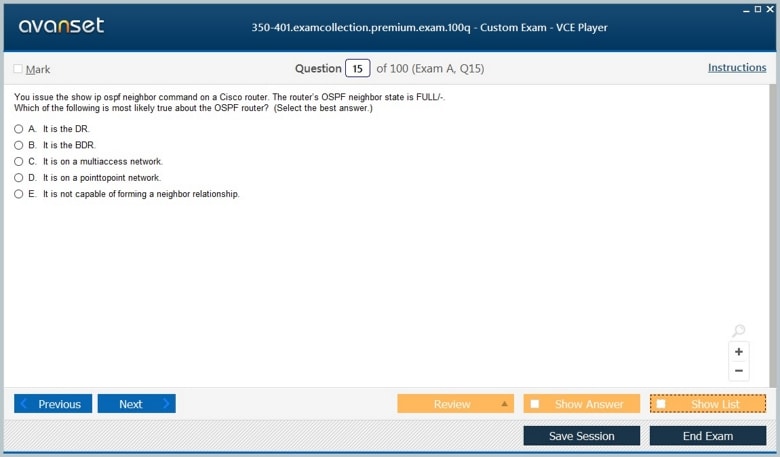
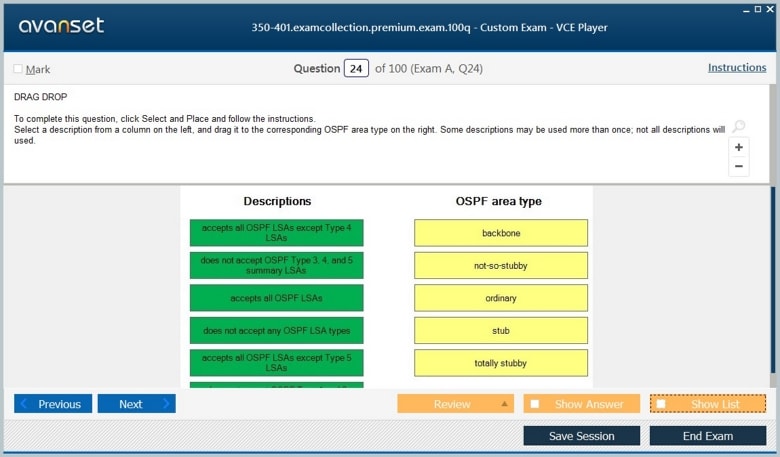
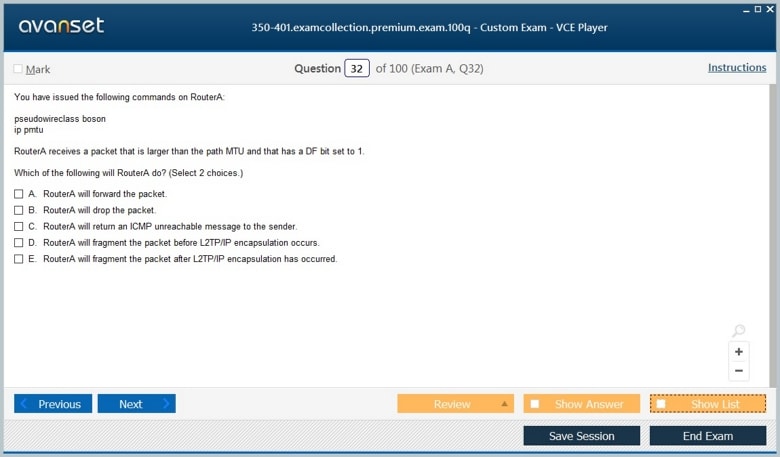
Cisco CCIE Enterprise Wireless Certification Exams Screenshots

CCIE Enterprise Wireless Product Reviews
Download Free CCIE Enterprise Wireless Practice Test Questions VCE Files
| Exam | Title | Files |
|---|---|---|
Exam 350-401 |
Title Implementing Cisco Enterprise Network Core Technologies (ENCOR) |
Files 2 |
Cisco CCIE Enterprise Wireless Certification Exam Dumps & Practice Test Questions
Prepare with top-notch Cisco CCIE Enterprise Wireless certification practice test questions and answers, vce exam dumps, study guide, video training course from ExamCollection. All Cisco CCIE Enterprise Wireless certification exam dumps & practice test questions and answers are uploaded by users who have passed the exam themselves and formatted them into vce file format.
CCIE Enterprise Wireless: Understanding the Legacy Path to CCIE Wireless
CCIE Enterprise Wireless was Cisco's expert certification for enterprise wireless networking from 2020 until the dedicated wireless certification track replaced it in 2026. The historical path used 350-401 ENCOR as the qualifying core exam and the CCIE Enterprise Wireless lab. As of September 2026, new candidates should not treat that structure as current: Cisco now awards CCIE Wireless through the dedicated 350-101 WLCOR exam and the CCIE Wireless lab v1.1.
The older certification page still has editorial value because it represents an important transition in Cisco's wireless program. It also helps professionals understand why older study plans, books, and courseware emphasize ENCOR. Within the broader Cisco certifications ecosystem, the key is to preserve that history without confusing it with the active 2026 path.
Why Enterprise Wireless existed
When Cisco restructured certifications in 2020, wireless expertise was placed inside the enterprise family. Candidates used the broad ENCOR core exam, which covered enterprise infrastructure, virtualization, assurance, security, automation, and at the time included wireless topics. The lab then tested expert wireless skills directly.
That model reflected a reasonable architectural idea: enterprise wireless depends on enterprise switching, routing, policy, security, and automation. A wireless engineer cannot ignore the wired network because every access point, controller, service, and client ultimately relies on it.
However, the structure also meant that the core exam had to serve both wired infrastructure and wireless expert candidates. Cisco later separated the tracks so wireless professionals could use a core exam devoted specifically to wireless technologies.
The March 2026 transition changed the current route
Cisco announced a dedicated wireless certification track in 2025 and launched it on March 19, 2026. The new structure introduced CCNP Wireless and renamed the expert route CCIE Wireless. WLCOR became the shared wireless core, while the expert lab evolved to reflect newer wireless platforms and technologies.
This change matters for any current preparation plan. Older references that say ENCOR is the qualifying exam for CCIE Enterprise Wireless describe the historical program, not the current one. Cisco's current certification catalog identifies 350-101 WLCOR as the core exam for CCIE Wireless.
The transition also removed wireless coverage from the newer ENCOR direction. Cisco's current ENCOR training explicitly notes that wireless content from the older version has moved to dedicated wireless certifications. That makes a clean distinction between the wired enterprise and wireless tracks.
Radio fundamentals remain the base layer
Certification names can change, but wireless physics does not. Expert engineers still need a strong model of RF behavior, channel use, interference, signal strength, noise, modulation, roaming, and the practical consequences of 802.11 standards. A controller cannot compensate for every poor design decision at the physical layer.
Wireless troubleshooting is difficult because the medium is shared and invisible. Client experience can change with location, device capability, interference, building materials, neighboring networks, and load. That is why expert work depends on measurement rather than assumption.
Coverage should also be distinguished from capacity. An area can show acceptable signal strength and still perform poorly because too many clients share airtime. Design decisions need to consider client density, application behavior, roaming, and expected concurrency.
Wi-Fi 6 and Wi-Fi 7 belong in the current expert conversation
The dedicated CCIE Wireless track reflects newer technologies more explicitly, including Wi-Fi 6, Wi-Fi 7, and modern enterprise wireless operations. Historical Enterprise Wireless material may discuss earlier standards correctly but should not be used as the complete technology baseline for a 2026 candidate.
Concepts such as OFDMA, multi-user scheduling, channel planning, and client capability matter because improvements on paper depend on real deployment conditions. ExamCollection's Wi-Fi 6 can help frame the evolution, but expert study should go further into how newer capabilities affect design, troubleshooting, and client behavior.
The current program also includes Meraki technologies, reflecting the reality that enterprise wireless management now spans controller-based and cloud-managed models.
Roaming is an end-to-end user experience problem
A wireless network can have excellent static connectivity and still fail users who move. Roaming depends on RF design, client decisions, authentication, security, controller behavior, and application tolerance. Voice and real-time applications expose those weaknesses quickly.
Expert troubleshooting should identify whether a roaming problem comes from insufficient overlap, sticky clients, authentication latency, policy change, controller state, or the wired path. Packet captures, controller telemetry, client events, and RF measurements each reveal different parts of the process.
The goal is not to force clients to roam according to a diagram. It is to design conditions in which clients can make good decisions and the infrastructure can complete the transition quickly enough for the application.
Security must preserve mobility
Enterprise wireless security involves identity, authentication, encryption, segmentation, guest access, device posture, and policy. The challenge is to apply these controls without making connectivity fragile or creating long delays during onboarding and roaming.
Expert engineers should understand how authentication methods affect user experience, how guest and corporate traffic are separated, how certificates and identity systems become dependencies, and how failures in those systems appear to clients. Security policy also needs consistent enforcement when a user moves between access points or sites.
The best design is not simply the strongest individual control. It is the strongest architecture that still meets availability, usability, and operational requirements.
Automation and assurance are now core wireless skills
Modern WLANs can contain hundreds or thousands of access points and many more clients. Manual observation does not scale. Controllers and management platforms collect RF, client, path, and performance data that can help identify patterns before users open tickets.
The WLCOR blueprint explicitly includes automation and AI, reinforcing that wireless experts are expected to use programmatic and analytical tools. APIs can collect inventory, verify configuration, correlate client problems, and support consistent change. AI-assisted features can highlight anomalies, but engineers still need to understand the underlying evidence before trusting a recommendation.
Automation is most valuable when it strengthens repeatability. A script that gathers the same client and AP state during every incident can improve diagnosis even if it never changes configuration.
Historical CCNP Enterprise material can still fill gaps
Under the old structure, wireless concentrations sat within CCNP Enterprise. Older candidates may therefore have prepared with enterprise wireless design and implementation concentration material before moving toward the expert lab. That content can still contain useful fundamentals, but its certification mapping is historical.
ExamCollection's article on how the Cisco wireless certification structure changed is useful background, as is the earlier discussion about CCIE Enterprise Wireless. Current candidates should use those pieces to understand the transition rather than to determine today's exam requirements.
The practical rule is simple: legacy material can teach technology; current Cisco sources determine the certification path.
How to study this page in 2026
If you already hold or previously pursued CCIE Enterprise Wireless, this page provides historical context for the credential you encountered. If you are starting now, convert the old study map into a current one. Preserve RF fundamentals, WLAN design, roaming, security, troubleshooting, and automation skills; replace the old ENCOR qualification path with WLCOR and follow the current CCIE Wireless lab blueprint.
Professionals with a general networking foundation such as CCNA should also ensure that switching, routing, IP services, and security basics are strong enough to support wireless troubleshooting. A wireless failure often crosses into the wired infrastructure.
CCIE Enterprise Wireless remains an important chapter in Cisco's certification history. Its core lesson is still current: expert wireless engineering requires command of both the radio environment and the systems around it. The 2026 CCIE Wireless track simply gives that expertise a dedicated core and a more modern home.
The transition did not make wireless design a purely historical topic. Cisco's current CCNP Wireless track now includes 300-110 WLSD as its Wireless Design concentration; it replaced the retired 300-425 ENWLSD when the dedicated wireless track went live. This is a useful example of why exam codes, certification mapping, and technical knowledge should be tracked separately: the design domain remains current even though its place in Cisco's certification structure changed.
Security practice also needs to account for wireless-specific threats and user behavior. Rogue access points, weak authentication, poor guest isolation, and unsafe client assumptions can undermine an otherwise strong network design. ExamCollection's wireless security essentials provides supporting context, but expert Cisco study should connect those principles to enterprise identity, controller policy, monitoring, and roaming.
Site surveys and post-deployment validation deserve equal weight. Predictive designs are useful, but walls, furniture, interference, client devices, and real user density can produce different results. Expert engineers compare the predicted RF model with measured conditions, then adjust channels, power, placement, or capacity based on evidence.
Finally, treat the naming change as a curriculum change, not just branding. The new dedicated wireless core is a signal that Cisco expects deeper focus on modern WLAN operations, automation, AI-assisted management, Meraki, and newer Wi-Fi generations. Candidates who simply rename an old Enterprise Wireless study plan without rechecking the WLCOR blueprint risk missing exactly the material the new track was created to emphasize.
Client diversity should be part of that validation. Phones, laptops, scanners, IoT devices, and older adapters may support different standards and roaming behavior. An expert design accounts for the weakest realistic client population without allowing legacy requirements to prevent sensible modernization.
ExamCollection provides the complete prep materials in vce files format which include Cisco CCIE Enterprise Wireless certification exam dumps, practice test questions and answers, video training course and study guide which help the exam candidates to pass the exams quickly. Fast updates to Cisco CCIE Enterprise Wireless certification exam dumps, practice test questions and accurate answers vce verified by industry experts are taken from the latest pool of questions.


Cisco CCIE Enterprise Wireless Video Courses

Top Cisco Certifications






Top Cisco Certification Exams
- 200-301
- 350-401
- 300-410
- 350-701
- 350-601
- 810-110
- 350-101
- 300-415
- 300-420
- 300-715
- 200-901
- 350-801
- 400-007
- 350-501
- 300-620
- 100-150
- 350-201
- 300-710
- 200-201
- 500-220
- 350-901
- 820-605
- 300-110
- 800-150
- 300-745
- 300-640
- 100-160
- 300-815
- 300-610
- 500-442
- 300-435
- 700-805
- 300-440
- 300-220
- 300-215
- 300-830
- 500-560
- 300-510
- 300-425
- 100-140
- 300-445
- 300-730
- 010-151
- 700-242
- 300-820
- 300-615
- 300-740
- 500-443
- 700-246
- 700-750
- 300-120
- 300-515
- 300-430
- 300-635
Site Search:



