

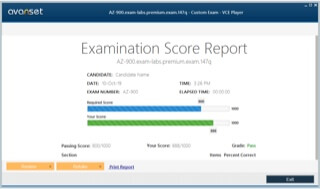

Premium File
50 Q&A
$76.99$69.99
Cisco 500-560 Exam Questions & Answers, Accurate & Verified By IT Experts
Instant Download, Free Fast Updates, 99.6% Pass Rate
50 Questions & Answers
Last Update: Sep 12, 2026
$69.99
Cisco 500-560 Practice Test Questions in VCE Format
| File | Votes | Size | Date |
|---|---|---|---|
File Cisco.examanswers.500-560.v2026-08-11.by.molly.7q.vce |
Votes 1 |
Size 18.94 KB |
Date Aug 11, 2026 |
Cisco 500-560 Practice Test Questions, Exam Dumps
Cisco 500-560 (Cisco Networking: On-Premise and Cloud Solutions (OCSE)) exam dumps vce, practice test questions, study guide & video training course to study and pass quickly and easily. Cisco 500-560 Cisco Networking: On-Premise and Cloud Solutions (OCSE) exam dumps & practice test questions and answers. You need avanset vce exam simulator in order to study the Cisco 500-560 certification exam dumps & Cisco 500-560 practice test questions in vce format.
Cisco 500-560 OCSE, Cisco Networking: On-Premise and Cloud Solutions, is a current partner exam for engineers supporting smaller business customers. Cisco identifies switching, routing, wireless, cloud, and security as the major solution areas and associates the exam with the Cisco Networking Express Specialization. The breadth is intentional: smaller environments often need one engineer to understand the complete solution rather than a narrow infrastructure layer.
The architectural challenge is not to shrink an enterprise design mechanically. Smaller businesses usually have tighter budgets, fewer IT staff, less tolerance for operational complexity, and a strong need for predictable support. A technically impressive design can be the wrong answer if the customer cannot operate it or if licensing and lifecycle overhead exceed the value delivered.
Candidates who need a foundation can connect OCSE with 200-301 CCNA and the wider CCNA track. OCSE applies many of the same networking fundamentals but asks engineers to shape them into a coherent business solution.
A small organization may have only one or two technical staff members, sometimes supported by a managed service provider. That changes the value of simplicity. Standard hardware, centralized visibility, repeatable configuration, clear failure behavior, and straightforward support paths can matter more than advanced features that are rarely used.
Resilience should be matched to business impact. A retailer that loses payment connectivity has a different tolerance for downtime than a small office whose most critical applications are cloud hosted. The engineer should identify the essential services, decide which components require redundancy, and avoid both under-design and unnecessary duplication.
Access switching must support endpoint density, Power over Ethernet needs, uplink capacity, VLAN or segmentation requirements, management, and future growth. The practical design question is not only how many ports are needed today but how new phones, cameras, access points, printers, and workstations will be added without creating a support problem.
Layer 2 design should remain intentionally simple where possible. Clear VLAN purpose, predictable trunking, loop protection, and documented uplinks reduce troubleshooting time. For very small sites, the best architecture may be compact; for multi-floor or growing environments, distribution and uplink resilience may justify a more structured hierarchy.
Many smaller organizations rely heavily on SaaS and cloud applications, which makes internet connectivity part of the production architecture. Engineers should consider circuit reliability, public addressing, NAT, VPN requirements, DNS, and whether a secondary connection is justified. A backup link provides little value if failover is untested or critical services still depend on a single firewall or power source.
Routing should also be no more complicated than the environment requires. Static routes may be appropriate in a small predictable design, while dynamic routing becomes useful when there are multiple sites, redundant paths, or more complex segmentation. The decision should reduce operational risk rather than maximize protocol sophistication.
In many small businesses, employees and guests interact with the network mainly through Wi-Fi. Coverage, capacity, interference, authentication, and guest separation therefore deserve the same design attention as switching. Placing access points based only on floor area can fail when walls, neighboring networks, device density, or voice applications change the RF requirement.
Cloud-managed platforms can simplify administration, especially for organizations without dedicated wireless specialists. 500-220 ECMS provides a strong adjacent example of cloud-managed networking through Cisco Meraki, where design and operational visibility are closely connected.
Voice, cameras, printers, point-of-sale systems, and building devices can complicate segmentation in a smaller network because they often have different support models and security capabilities. Grouping devices by business function and access need is usually more maintainable than allowing every endpoint to communicate freely. Even a simple VLAN and firewall policy can reduce the blast radius of a compromised device.
Power and physical design matter too. Access points, phones, cameras, and sensors may depend on PoE budgets that are easy to overlook when counting only ports. Small wiring closets can have limited cooling, UPS capacity, or rack space. An engineer should confirm those constraints before selecting a switch stack that is electrically or physically impractical.
A small business still needs segmentation, secure administration, protected internet access, strong authentication, software maintenance, and visibility into suspicious activity. The difference is that controls must be manageable by a smaller team. A security architecture that requires constant expert tuning may create operational gaps when the business cannot sustain it.
Engineers should think in layers: secure the edge, restrict unnecessary internal communication, protect administrative access, update infrastructure, and maintain backups of critical configuration. Broader network security threats and countermeasures provide useful context for why these controls matter without turning OCSE into a dedicated security certification.
Cloud services can reduce the amount of infrastructure a small business hosts locally, but they increase dependence on connectivity, identity, DNS, and vendor service availability. Engineers should understand the difference between on-premises, cloud-managed, and cloud-hosted services so they can explain which operational tasks remain the customer’s responsibility.
A practical design asks where data lives, how users authenticate, what happens during an internet outage, and how remote users connect. The editorial introduction to cloud computing fundamentals can reinforce the service-model concepts that sit behind these architecture choices.
Hybrid work introduces another set of practical questions. Remote staff need secure access to applications, but the business may not want to operate a complex remote-access environment. SaaS identity, VPN, secure access services, endpoint posture, and collaboration tools should be considered together so that the user experience does not depend on a fragile chain of manual steps.
Cloud-managed networking can reduce on-site maintenance, but it also makes internet reachability and account security critical. Administrative identity should use strong authentication, ownership should be documented, and subscription renewal should be tracked. Losing control of the management tenant can be as disruptive as losing access to a local console.
Centralized dashboards, alerting, configuration backups, inventory, and remote troubleshooting can be especially valuable in small environments because there may be no on-site specialist at every location. The goal is not to collect every possible metric; it is to surface conditions that require action and make common changes consistent.
Remote management must also be secured. Administrative accounts should be separated from ordinary user access, strong authentication should be used, and remote support paths should be logged and controlled. Simplicity is not the same as weak governance.
A network for thirty users may become a network for one hundred users, a second site, cloud applications, more cameras, and hybrid work. Addressing plans, switch capacity, wireless licensing, uplinks, firewall throughput, and management platforms should leave sensible room for growth without forcing the customer to buy enterprise-scale capacity prematurely.
The Cisco Small and Medium Business Engineer Specialization and its 700-750 SMBE exam sit in a related small-and-medium-business technical space, while 700-250 SMBS approaches the market from the sales side. These relationships are useful because strong SMB delivery depends on technical design and accurate expectation setting.
Cost discussions should include lifecycle, not only acquisition. Support contracts, subscriptions, replacement cycles, power consumption, installation labor, and the time required to troubleshoot all affect total cost. A slightly more expensive design may be the better fit if it substantially reduces operational effort for a small team.
Documentation is especially important when support is shared with an MSP or part-time administrator. Keep diagrams, addressing, credentials procedures, support contacts, inventory, warranty information, and known dependencies current. A small environment may not have enough institutional knowledge to recover quickly when those details exist only in one person’s memory.
Service-provider and internet dependencies should be documented explicitly. A small organization may rely on one ISP, one DNS provider, one cloud identity platform, or one SaaS application for a critical workflow. Identifying those single points of dependency allows the engineer to discuss practical mitigation rather than discovering them during an outage.
Testing should include common operational events such as replacing an access point, adding a new VLAN, restoring a switch configuration, failing over an internet circuit, or onboarding a remote user. The design is only supportable when those routine tasks can be performed safely by the team that will actually own the network.
Vendor support and replacement logistics can be unusually important for a small business because there may be no spare hardware on site. The design should consider warranty level, replacement time, configuration restoration, and whether a temporary workaround exists. A simple documented recovery plan can be more valuable than an advanced feature that nobody knows how to restore during an outage.
Build several small-business designs rather than studying each technology in isolation. One scenario might be a professional office with cloud applications and remote staff; another could be a retailer with guest Wi-Fi, cameras, and strict uptime requirements; a third might be a growing company opening a second site. For each, choose switching, routing, wireless, security, and cloud-management approaches and explain why they fit.
Configuration standardization also reduces support cost. Naming, VLAN purpose, firmware policy, administrative access, alerting, and backup procedures should be consistent across sites whenever possible. Small environments gain disproportionately from this discipline because a limited support team cannot afford to relearn each location during every incident.
That integrated reasoning is the point of the exam. Cisco certifications include deeper specialist paths, but 500-560 rewards engineers who can assemble practical components into a supportable network for a smaller customer.
Go to testing centre with ease on our mind when you use Cisco 500-560 vce exam dumps, practice test questions and answers. Cisco 500-560 Cisco Networking: On-Premise and Cloud Solutions (OCSE) certification practice test questions and answers, study guide, exam dumps and video training course in vce format to help you study with ease. Prepare with confidence and study using Cisco 500-560 exam dumps & practice test questions and answers vce from ExamCollection.
Purchase Individually
Top Cisco Certifications




Top Cisco Certification Exams
Site Search:

SPECIAL OFFER: GET 10% OFF

Pass your Exam with ExamCollection's PREMIUM files!
SPECIAL OFFER: GET 10% OFF
Use Discount Code:
MIN10OFF
A confirmation link was sent to your e-mail.
Please check your mailbox for a message from support@examcollection.com and follow the directions.

Download Free Demo of VCE Exam Simulator
Experience Avanset VCE Exam Simulator for yourself.
Simply submit your e-mail address below to get started with our interactive software demo of your free trial.