



Premium File
102 Q&A
$76.99$69.99
Splunk SPLK-3001 Exam Questions & Answers, Accurate & Verified By IT Experts
Instant Download, Free Fast Updates, 99.6% Pass Rate
102 Questions & Answers
Last Update: Sep 18, 2026
$69.99
Splunk SPLK-3001 Exam Screenshots
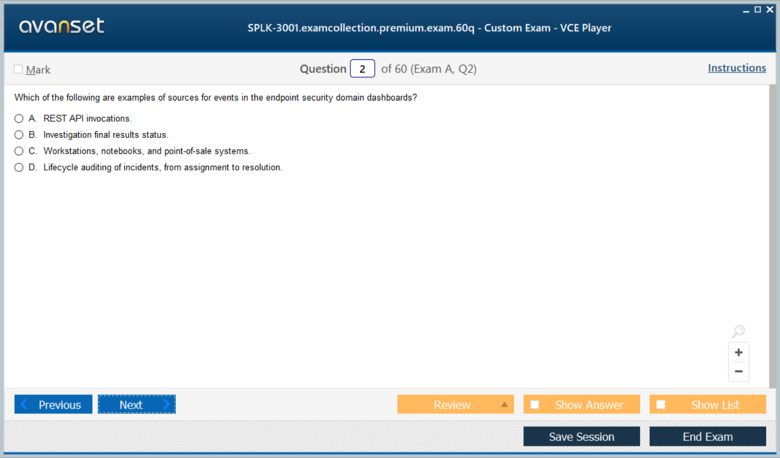
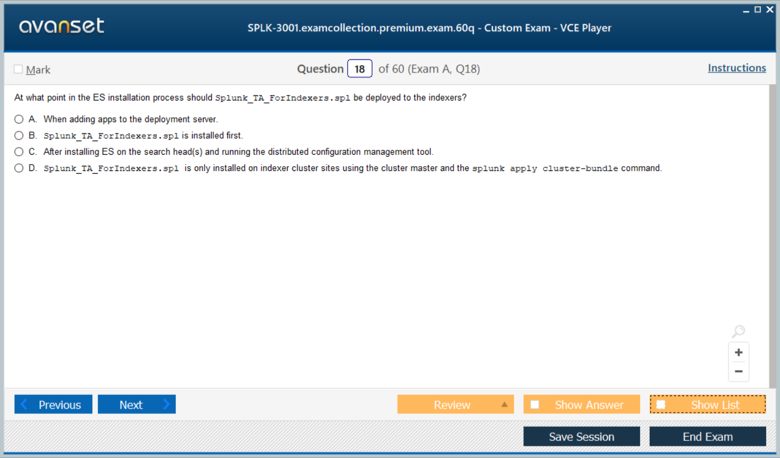
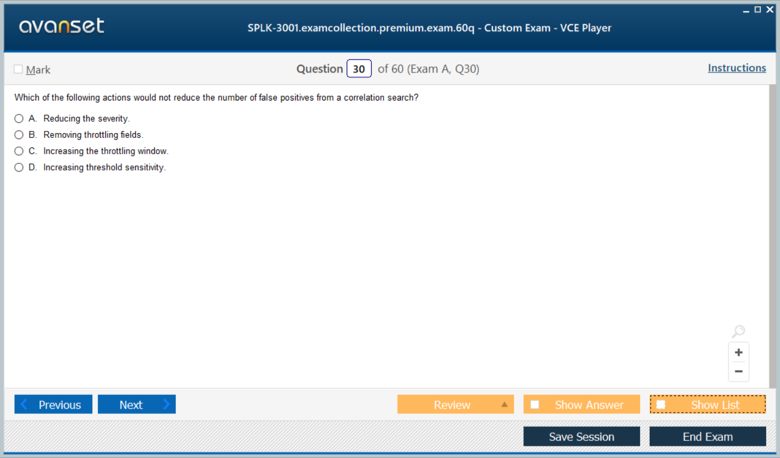
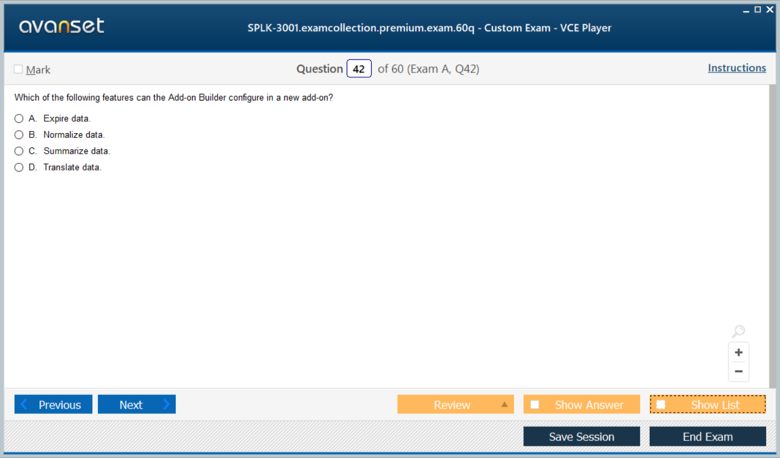
Splunk SPLK-3001 Practice Test Questions in VCE Format
| File | Votes | Size | Date |
|---|---|---|---|
File Splunk.selftestengine.SPLK-3001.v2026-08-01.by.zhangwei.45q.vce |
Votes 1 |
Size 58.79 KB |
Date Aug 01, 2026 |
File Splunk.selftestengine.SPLK-3001.v2021-07-19.by.giovanni.53q.vce |
Votes 1 |
Size 66.87 KB |
Date Jul 19, 2021 |
File Splunk.certkey.SPLK-3001.v2021-04-27.by.hanna.48q.vce |
Votes 1 |
Size 63.02 KB |
Date Apr 28, 2021 |
File Splunk.questionpaper.SPLK-3001.v2020-04-07.by.lucy.25q.vce |
Votes 2 |
Size 85.2 KB |
Date Apr 07, 2020 |
Splunk SPLK-3001 Practice Test Questions, Exam Dumps
Splunk SPLK-3001 (Splunk Enterprise Security Certified Admin) exam dumps vce, practice test questions, study guide & video training course to study and pass quickly and easily. Splunk SPLK-3001 Splunk Enterprise Security Certified Admin exam dumps & practice test questions and answers. You need avanset vce exam simulator in order to study the Splunk SPLK-3001 certification exam dumps & Splunk SPLK-3001 practice test questions in vce format.
SPLK-3001 is associated with Splunk Enterprise Security Certified Admin. Splunk still publishes the certification track and exam information, but its current certification catalog and recertification material label Enterprise Security Certified Admin as a legacy certification. Splunk explains that legacy certifications can remain valuable for some learners and organizations while their exam content is no longer actively maintained to track product changes. That status needs to be explicit because Enterprise Security continues to evolve even when the certification syllabus is frozen.
The credential’s core subject remains important: installing, configuring, and managing Splunk Enterprise Security, including event processing, technology add-ons, risk analysis, threat intelligence, correlation searches, and customization. The strongest foundation is still Splunk Enterprise administration, because ES depends on reliable ingestion, permissions, knowledge objects, data models, and search infrastructure. Security content cannot compensate for a poorly operated core platform.
Candidates or teams maintaining this legacy certification should therefore split preparation into two layers. First, understand the exam’s established ES concepts. Second, verify current product behavior in present Splunk documentation rather than assuming the legacy blueprint represents every newer feature. The broader Splunk certification family now includes newer cybersecurity defense credentials, so SPLK-3001 should be treated as a specialist historical/current-operations bridge rather than the only modern security path.
Correlation searches and dashboards rely on consistent fields across very different security sources. Firewalls, identity systems, endpoints, cloud services, and proxies may all represent users, addresses, actions, and outcomes differently. Enterprise Security uses data models and the Common Information Model to normalize that variation. An administrator must therefore understand whether source data is mapped correctly before treating a detection result as authoritative.
The discipline of reading raw logs for SIEM analysis remains essential. When a notable or risk event looks wrong, trace it back through the normalized field to representative source events. A clean dashboard can hide a broken extraction just as easily as a messy raw log can reveal one.
Technology add-ons provide field extractions, sourcetype knowledge, CIM mappings, and other content that helps ES understand source data. Installing an add-on is not the end of onboarding. Administrators need to verify the expected sourcetype, fields, tags, event types, and data model participation. Version compatibility also matters because an outdated add-on can behave differently from current product expectations.
Customization should be minimized where vendor-supported knowledge already exists. Local changes can be necessary, but they create upgrade obligations. If a field extraction is overridden, document why, test it against new versions, and confirm that downstream correlation logic still receives the intended semantics.
A correlation search is valuable when it expresses behavior that deserves investigation. Simply detecting a rare event is not enough; the search should have a reasoned relationship to risk. Administrators should understand the base search, suppression behavior, scheduling, thresholds, and notable or risk actions it produces. A detection that cannot be explained to an analyst will be difficult to tune responsibly.
The SIEM analysis perspective is useful here because detection quality depends on context. The same authentication failure can be benign or important depending on identity, volume, source, timing, and surrounding activity. Correlation logic should add meaningful context rather than simply multiplying alerts.
Risk-based alerting accumulates evidence around entities instead of treating each signal as an independent incident. That can reduce noise and surface multi-step behavior, but it depends on disciplined risk scoring and entity identification. If all detections assign high risk, the model loses differentiation. If entity fields are inconsistent, related activity may be split across multiple identities.
Administrators should understand why a detection contributes risk, how much, and to which entity. Risk modifiers should be reviewed alongside analyst outcomes so values can be tuned over time. The goal is not to make the risk index large; it is to make accumulated risk reflect meaningful escalation of concern.
Enterprise Security can use threat intelligence to compare observed indicators with known malicious infrastructure, hashes, domains, or other artifacts. Administrators need to consider feed quality, age, confidence, formatting, and matching scope. An indicator that was useful six months ago may no longer justify the same response, while a noisy feed can create large numbers of low-value matches.
Threat intelligence is strongest when it enriches a broader detection rather than being treated as absolute proof. Analysts should be able to see why an indicator matched and what surrounding activity occurred. Administrators should monitor feed health and remove or update sources that no longer provide reliable value.
Enterprise Security is used by people who triage, investigate, assign, and resolve security work. Administrative choices about statuses, urgency, suppression, ownership, and workflow fields influence that process. A detection can be technically accurate and still create operational friction if it lacks enough context for an analyst to decide what to do next.
The incident-response lifecycle provides a useful frame. Detections should feed investigation and response with evidence, not become an isolated queue. Administrators can improve outcomes by including useful entity context, links to supporting searches, and clear disposition choices.
Out-of-the-box detections are starting points. Environments differ in identity structure, network segmentation, administrative behavior, approved tools, and business hours. Tuning should therefore use actual analyst feedback and false-positive patterns. Disabling a noisy rule immediately may remove valuable coverage; better tuning might involve exclusions, thresholds, risk values, or improved source normalization.
Change control matters because detection adjustments alter security visibility. Record why a search was tuned, who approved the change, and what evidence will show whether the modification improved outcomes. This gives future teams a basis for revisiting assumptions when the environment changes.
Splunk’s legacy label means the exam content is no longer actively maintained with every product release. Candidates should therefore be careful with version-specific interface details, terminology, and features. The enduring concepts—normalization, correlation, risk, threat intelligence, security workflows, and tuning—remain valuable, but current documentation should be used for implementation decisions in a modern ES deployment.
This is particularly important as Splunk’s security certification program now includes cybersecurity defense analyst, engineer, and architect roles. A team may still value the ES Admin credential for product administration, while individuals seeking a current security progression should also examine those newer paths.
A legacy Enterprise Security administrator still needs to know why detections work, what data they depend on, how configuration affects analyst workflows, and where platform problems can undermine security outcomes. Security expertise without Splunk operational knowledge leads to fragile content; platform expertise without threat context leads to mechanically correct but low-value detections.
The strongest preparation joins those perspectives. Read source events, verify normalization, inspect correlation logic, trace risk and notable creation, follow the analyst workflow, and review how an incident is ultimately resolved. The incident-response program only benefits from SIEM tooling when the technology supports a coherent process rather than producing alerts in isolation.
Enterprise Security administrators should also understand how content changes are promoted. Correlation searches, risk rules, lookup data, macros, and dashboards may be edited during tuning, but production security content needs review and traceability. Treating detections as versioned operational logic makes it easier to compare behavior before and after a change and to restore a known-good state when an adjustment has unintended consequences.
Data-model acceleration and background security workloads can create substantial search pressure. ES administrators should coordinate with platform administrators when adding or modifying content that changes acceleration, scheduling, or concurrency. A security team cannot assume unlimited compute simply because a detection is important; instead, it should make workload cost visible and optimize the search without weakening the threat hypothesis.
Role and permission design deserves the same care as detection content. Security data can contain sensitive user, endpoint, and network information, while some ES actions can alter cases, suppression, or investigative state. Administrators should grant access based on responsibilities and test the effective permissions of analyst, investigator, and administrator roles. Excess privilege can create both confidentiality and change-control risks.
Finally, measure security content by outcomes. Useful questions include how often a rule produces actionable investigations, which detections repeatedly close as benign, whether risk aggregation improves prioritization, and how long analysts spend gathering context that could have been included automatically. Those measures turn tuning into a continuous improvement process rather than a one-time effort to silence noisy alerts.
Enterprise Security administrators should periodically map detections to coverage goals rather than evaluating rules one at a time. This can reveal that dozens of searches cluster around one threat behavior while another important technique has little visibility. Coverage review should include data-source availability, normalization quality, detection confidence, and analyst response capability. A theoretical rule is not meaningful coverage if the required data is unreliable or no one can investigate the alert when it fires.
The legacy status makes documentation of version context especially important. When an administrator follows older training material, note which ES concepts remain stable and which screens, field names, workflow objects, or product behaviors have changed in the deployed release. This prevents the team from mistaking an exam-era interface for a current operational requirement. It also helps experienced staff explain differences to newer analysts without discarding the useful security reasoning embedded in older content. Current ES teams should also map those lessons to the release they actually operate.
Go to testing centre with ease on our mind when you use Splunk SPLK-3001 vce exam dumps, practice test questions and answers. Splunk SPLK-3001 Splunk Enterprise Security Certified Admin certification practice test questions and answers, study guide, exam dumps and video training course in vce format to help you study with ease. Prepare with confidence and study using Splunk SPLK-3001 exam dumps & practice test questions and answers vce from ExamCollection.
Purchase Individually
Top Splunk Certifications

Top Splunk Certification Exams
Site Search:

SPECIAL OFFER: GET 10% OFF

Pass your Exam with ExamCollection's PREMIUM files!
SPECIAL OFFER: GET 10% OFF
Use Discount Code:
MIN10OFF
A confirmation link was sent to your e-mail.
Please check your mailbox for a message from support@examcollection.com and follow the directions.

Download Free Demo of VCE Exam Simulator
Experience Avanset VCE Exam Simulator for yourself.
Simply submit your e-mail address below to get started with our interactive software demo of your free trial.