



Premium File
142 Q&A
$76.99$69.99
Splunk SPLK-3003 Exam Questions & Answers, Accurate & Verified By IT Experts
Instant Download, Free Fast Updates, 99.6% Pass Rate
142 Questions & Answers
Last Update: Oct 05, 2026
$69.99
Splunk SPLK-3003 Exam Screenshots
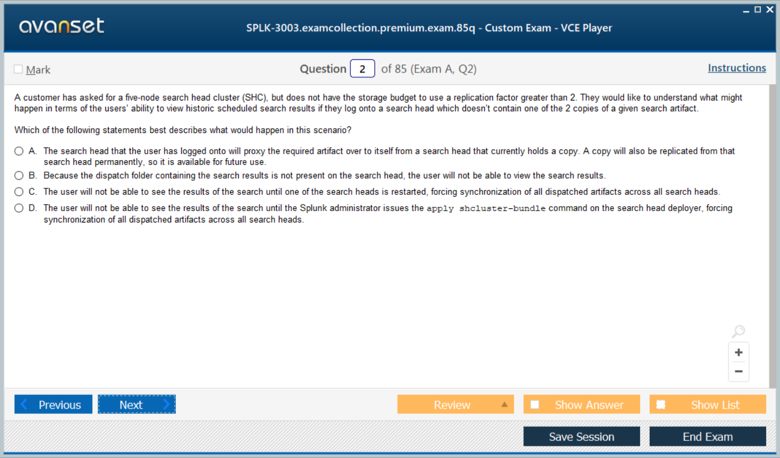
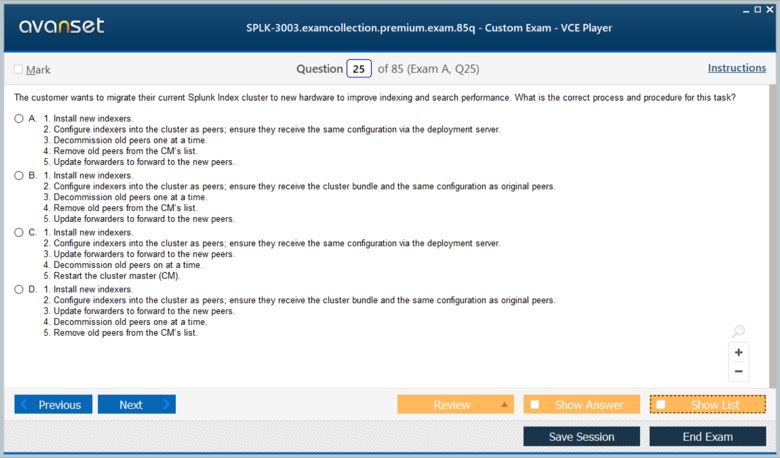
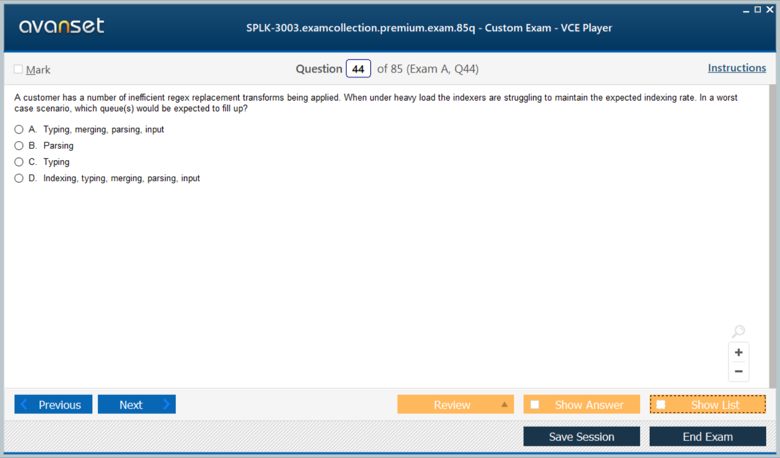
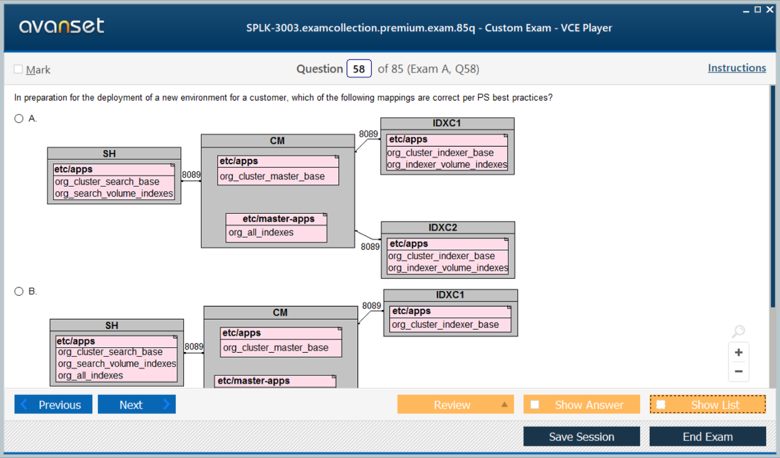
Splunk SPLK-3003 Practice Test Questions in VCE Format
| File | Votes | Size | Date |
|---|---|---|---|
File Splunk.pass4sures.SPLK-3003.v2026-09-05.by.marc.51q.vce |
Votes 1 |
Size 281.16 KB |
Date Sep 05, 2026 |
File Splunk.examlabs.SPLK-3003.v2020-11-23.by.wangmin.48q.vce |
Votes 1 |
Size 372.7 KB |
Date Nov 23, 2020 |
Splunk SPLK-3003 Practice Test Questions, Exam Dumps
Splunk SPLK-3003 (Splunk Core Certified Consultant) exam dumps vce, practice test questions, study guide & video training course to study and pass quickly and easily. Splunk SPLK-3003 Splunk Core Certified Consultant exam dumps & practice test questions and answers. You need avanset vce exam simulator in order to study the Splunk SPLK-3003 certification exam dumps & Splunk SPLK-3003 practice test questions in vce format.
SPLK-3003 is the exam associated with Splunk Core Certified Consultant, the expert-level track for professionals who size, install, implement, and advise on substantial Splunk deployments. Splunk currently requires a deep prerequisite stack that includes Power User, Advanced Power User, Enterprise Admin, Enterprise Architect, and required implementation coursework. That structure matters: this is not an exam about recalling isolated settings. It tests whether a practitioner can connect architecture, data, clustering, deployment practices, troubleshooting, and client requirements into a coherent implementation.
The broader Splunk certification family contains many narrower roles, but consulting sits where those specialties converge. A consultant may need to discuss business objectives with a stakeholder in the morning, validate indexer-cluster behavior in the afternoon, and explain a migration risk to an operations team before the day ends. Technical correctness is only one part of the job; the implementation must also be supportable, appropriately sized, documented, and aligned with how the customer will actually operate Splunk.
Preparation is strongest when candidates practice making defensible design decisions rather than memorizing a single reference architecture. The current consultant track explicitly builds on the Splunk Enterprise Certified Architect foundation. The consultant layer adds implementation judgment: when to preserve an existing pattern, when to redesign it, what evidence is needed before changing architecture, and how to leave a customer with an environment that can be maintained after the project team departs.
A deployment should not be sized from an abstract event-per-second number alone. Consultants need to understand daily ingest, retention, search concurrency, scheduled workloads, availability expectations, data-source growth, security boundaries, recovery objectives, and operational staffing. Two customers can ingest the same volume and still need different designs because one runs heavy security analytics while the other mainly performs historical troubleshooting. Good discovery converts business language into measurable technical constraints without pretending that every requirement carries equal weight.
Useful discovery also separates facts from assumptions. If a stakeholder says “search must always be fast,” the consultant should ask what searches, over what time ranges, for how many users, and with what acceptable delay. If the customer requests multi-site resilience, the discussion must include failure domains and network behavior rather than treating multi-site clustering as a checkbox. The quality of later architecture depends on the precision of these early conversations.
Consultants should also identify nonfunctional requirements that are easy to overlook during feature discussions. Change windows, regulatory retention, data residency, support ownership, upgrade cadence, and dependency on third-party identity or network services can all constrain the design. A technically valid topology that cannot be patched during the customer’s maintenance windows or that violates a data-location requirement is not an acceptable implementation. Capturing these constraints early prevents expensive redesign late in the project.
Splunk sizing combines ingest volume with retention, search demand, replication, data model acceleration, premium-app workloads, and infrastructure characteristics. Candidates should be comfortable reasoning about why extra retention increases storage pressure, why replication multiplies capacity requirements, and why a large number of concurrent searches can change CPU and memory needs even if ingest stays flat. The consultant should be able to explain which assumption is driving each part of the design.
A mature sizing process includes margin for realistic growth without using vague overprovisioning as a substitute for analysis. Document the source of every major estimate and identify which variables are most uncertain. That makes the design easier to revisit when the customer adds telemetry or changes retention. It also prevents a future operations team from inheriting numbers that look authoritative but cannot be traced back to actual requirements.
Capacity assumptions should be revisited after go-live with actual telemetry. Compare predicted ingest, search concurrency, storage growth, and resource use with observed values, then document meaningful variance. This turns sizing into a feedback loop instead of a one-time spreadsheet exercise and gives the customer evidence for future expansion decisions.
Implementation work frequently fails at the data boundary. Consultants must validate timestamps, sourcetypes, event breaking, line merging, host and source metadata, index selection, and expected volume before treating onboarding as complete. A source that appears in search can still be badly onboarded if events are broken incorrectly or metadata makes field extraction unreliable. Early validation is cheaper than repairing downstream dashboards, alerts, and data models built on inconsistent inputs.
The consultant should also decide where parsing work belongs. Heavy forwarders, universal forwarders, indexers, and intermediate collection tiers serve different purposes. The right placement depends on source behavior, topology, performance, and operational ownership. The objective is a stable pipeline whose behavior can be explained. A deployment with many undocumented exceptions becomes difficult to troubleshoot and expensive to maintain.
Indexer clustering provides replication and search availability, but candidates need to understand the behavior behind the vocabulary. Replication factor, search factor, manager responsibilities, peer communication, bucket states, fix-up activity, and site-aware placement all affect how the cluster responds to failures. A consultant should be able to reason from a failed peer or site to the expected recovery behavior instead of relying on the assumption that “clustered” automatically means resilient.
Failure testing is therefore a design activity, not just a post-installation task. The customer should know which component failures are tolerated, what degradation may occur, and which recovery actions are automatic versus operational. This is where the administrative experience represented by Splunk Enterprise Certified Admin becomes practical: cluster architecture only works when everyday configuration, monitoring, and maintenance are disciplined.
Search head clusters protect search-tier availability and coordinate knowledge objects, but they introduce their own operational model. Consultants should understand captaincy, deployer usage, configuration replication, application deployment, and the distinction between search-head state and indexed data. Treating search heads like interchangeable standalone servers can cause configuration drift or unsupported deployment practices.
Workload matters as much as node count. Scheduled searches, report acceleration, dashboards, and premium applications can create concentrated search pressure. A design should consider how users and scheduled activity behave at peak periods. The consultant should also know how to migrate configuration into a cluster cleanly rather than copying arbitrary local files and hoping replication produces a stable result.
A consultant needs evidence after deployment. Monitoring Console views, internal logs, license usage, search activity, resource saturation, indexing performance, and cluster health help verify whether the system behaves as designed. The important skill is interpreting these signals together. High CPU on a search head may be acceptable during a planned reporting window, while persistent skipped searches or growing queues may indicate a design or workload problem.
The same evidence supports handover. Baselines for normal ingest, search concurrency, queue behavior, and cluster state give the customer something concrete to compare against later. Without a baseline, every future change feels ambiguous. Consultants should leave monitoring in a condition that helps operators distinguish normal variation from genuine degradation.
Identity integration should be planned alongside topology, not left until the end. Consultants may need to work with LDAP, SAML, local accounts, role inheritance, index restrictions, and capability assignment. The challenge is to preserve least privilege while keeping support practical. A technically correct role model can still fail if nobody understands how users are mapped or if emergency access procedures are missing.
Authentication protocols also affect availability and troubleshooting. If an external identity provider becomes unreachable, the customer should know which administrative paths remain available and how to prove whether the problem is in Splunk or the identity system. Good architecture treats identity as a dependency with operational behavior, not merely a login screen.
Moving from a standalone environment into clustering, replacing aging hardware, consolidating sites, or changing deployment topology all require dependency discovery. Apps, authentication, deployment apps, scripted inputs, indexes, custom configurations, scheduled searches, and external integrations can behave differently after migration. Consultants should map these dependencies before choosing a sequence and should use rollback points where a failed change would otherwise be difficult to reverse.
A migration plan must also respect data continuity. If forwarders are redirected, what happens to queued data? If search heads change, which knowledge objects must be preserved? If indexers are replaced, how will historical buckets remain searchable? The strongest plans answer these operational questions before maintenance begins and define evidence that proves each stage succeeded.
Cutover sequencing should define which teams are responsible at each stage and what evidence allows the project to continue. For example, after redirecting one forwarder tier, validate event counts, timestamp quality, and destination indexes before moving the next tier. This controlled progression limits blast radius. A consultant should be willing to pause when validation fails rather than preserve the schedule by carrying an unexplained defect into later stages.
SPLK-3003 readiness means being able to explain not only what configuration to use but why it fits the customer’s constraints. A candidate should be able to compare alternatives, identify risks, request missing evidence, and predict operational consequences. This makes the exam different from a pure administration assessment. Consulting requires technical depth plus the ability to translate that depth into a design another team can operate.
Hands-on repetition remains essential. The article on developing deeper Splunk expertise is relevant because expert judgment grows from repeated observation of real behavior. Build clusters, break them deliberately, inspect internal evidence, migrate configuration, and document what changed. The goal is to turn platform knowledge into a reliable implementation method rather than a collection of remembered commands.
Go to testing centre with ease on our mind when you use Splunk SPLK-3003 vce exam dumps, practice test questions and answers. Splunk SPLK-3003 Splunk Core Certified Consultant certification practice test questions and answers, study guide, exam dumps and video training course in vce format to help you study with ease. Prepare with confidence and study using Splunk SPLK-3003 exam dumps & practice test questions and answers vce from ExamCollection.
Purchase Individually
Top Splunk Certifications

Top Splunk Certification Exams
Site Search:

SPECIAL OFFER: GET 10% OFF

Pass your Exam with ExamCollection's PREMIUM files!
SPECIAL OFFER: GET 10% OFF
Use Discount Code:
MIN10OFF
A confirmation link was sent to your e-mail.
Please check your mailbox for a message from support@examcollection.com and follow the directions.

Download Free Demo of VCE Exam Simulator
Experience Avanset VCE Exam Simulator for yourself.
Simply submit your e-mail address below to get started with our interactive software demo of your free trial.