

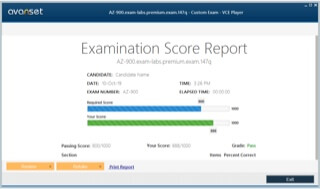

Premium File
80 Q&A
$98.99$89.99
Test Prep SNUSAT Test Questions & Answers, Accurate & Verified By IT Experts
Instant Download, Free Fast Updates, 99.6% Pass Rate
80 Questions & Answers
Last Update: Aug 29, 2026
$89.99
Test Prep SNUSAT Practice Test Questions in VCE Format
| File | Votes | Size | Date |
|---|---|---|---|
File Test Prep.examanswers.SNUSAT.v2026-09-08.by.lilly.7q.vce |
Votes 1 |
Size 18.54 KB |
Date Sep 08, 2026 |
Test Prep SNUSAT Practice Test Questions, Exam Dumps
Test Prep SNUSAT (Shiv Nadar University Scholastic Aptitude Test) exam dumps vce, practice test questions, study guide & video training course to study and pass quickly and easily. Test Prep SNUSAT Shiv Nadar University Scholastic Aptitude Test exam dumps & practice test questions and answers. You need avanset vce exam simulator in order to study the Test Prep SNUSAT certification exam dumps & Test Prep SNUSAT practice test questions in vce format.
The Shiv Nadar University Scholastic Aptitude Test (SNUSAT) is one of the undergraduate admission routes used by Shiv Nadar University Delhi NCR. For the 2026 cycle, the university describes SNUSAT as an online, home-proctored test with two sections: Quantitative Reasoning and Logical Reasoning. Each section contains 20 questions and lasts 45 minutes, for a 90-minute total.
SNUSAT should not be confused with the Academic Proficiency Test (APT), which is required alongside SNUSAT for specified programs such as BTech and BS Computer Science routes. The 2026 APT structure uses 20 Mathematics questions in 30 minutes and 20 Physics questions in 30 minutes. Candidates should therefore build preparation around the admission route and program they actually selected.
Forty questions in 90 minutes gives candidates enough time to reason, but not enough to explore every problem from several angles. The exam is designed to evaluate aptitude rather than recall of one school textbook. Quantitative questions reward numerical reasoning and efficient setup; logical questions reward structured analysis of relationships, conditions, patterns, and conclusions.
Preparation should begin with a timed diagnostic split into the two sections. A combined score can hide a large imbalance. If Quantitative Reasoning is strong but Logic is weak, equal study time is inefficient. Use section-level accuracy and time per question to decide where the next week of work belongs.
Quantitative aptitude problems often depend on ratios, percentages, averages, rates, basic algebra, number properties, interpretation of data, and translating words into relationships. Candidates should be comfortable manipulating numbers without turning every question into a long formal derivation. Estimation can eliminate options and expose arithmetic mistakes before they become expensive.
Create a small toolkit: fraction-percent conversions, ratio scaling, average relationships, distance-rate-time, work-rate reasoning, linear equations, and basic counting or probability where relevant. Then practice choosing the tool rather than applying one favorite method to every problem. The fastest solution usually begins with recognizing the structure correctly.
Logic questions become difficult when candidates try to hold every rule in memory. Translate conditions into short symbols, tables, sequences, or diagrams. Mark fixed relationships first, then derive consequences before inspecting the answer choices. This reduces the chance of accepting an option that satisfies one rule while quietly violating another.
For argument-style questions, distinguish fact, assumption, and conclusion. Ask what must be true, what could be true, or what would strengthen a stated claim. The wording matters because “must” and “could” require different proof. Timed practice should train the candidate to identify that logical demand before doing detailed work.
Candidates applying to programs that require SNUSAT plus APT need a separate plan for Mathematics and Physics. APT is not simply another aptitude section; it tests academic proficiency in subject areas relevant to the program. That means formulas, concepts, and problem-solving from the applicable school curriculum deserve structured review.
Keep SNUSAT and APT diagnostics separate. A candidate may be quick at quantitative reasoning but rusty in physics, or strong in school mathematics but slow at logic games. Combining every question into one “entrance-test” error log makes those differences harder to see. Program-specific planning is more accurate and less stressful.
Shiv Nadar University lists multiple 2026 routes for undergraduate programs, including SNUSAT and, depending on the program, scores such as JEE Main, College Board SAT, ACT, or CUET. The availability of alternatives does not mean every program uses every route in the same way. Applicants should read the current program page rather than assume one university-wide formula.
Candidates considering a valid SAT score as an alternative should compare the program’s current admission rules before deciding which exam to prioritize. The SAT measures a different set of tasks and requires much longer preparation for many students. Choose the route strategically based on eligibility, timeline, existing scores, and the requirements of the intended degree.
Because SNUSAT is delivered online with remote proctoring, candidates should test the computer, webcam, microphone, power supply, and internet connection before the appointment. The testing space should meet the university’s current instructions, and distractions should be removed. Technical uncertainty can consume attention that should be used on reasoning.
Do at least one timed practice session on the same device and in a similar environment. Use the same scratch-work approach that will be permitted, keep the screen arrangement familiar, and avoid switching study tools during the final week. A stable setup turns the home environment into a controlled test space rather than an additional variable.
A SNUSAT practice test becomes useful when missed questions are categorized. In Quantitative Reasoning, note whether the problem was arithmetic, algebra, interpretation, or setup. In Logical Reasoning, distinguish missed condition, incorrect inference, weak diagram, or time pressure. Each category suggests a different fix.
Review questions answered correctly but slowly. A candidate who takes four minutes to solve a ratio problem may be accurate but not yet ready for a 45-minute section. Rewrite the solution using the shortest defensible method. Efficiency should come from better representation and recognition, not from skipping steps so aggressively that accuracy collapses.
Forty-five minutes for 20 questions averages a little more than two minutes per item, but real questions will vary. Set a soft threshold for leaving a problem that has not produced a clear path. Mark the useful work, move forward, and return if the platform and exam rules permit. One difficult puzzle should not consume the time needed for several accessible questions.
In the final minutes, prioritize items where partial work already exists. Re-reading a completely untouched complex problem may have lower value than finishing two nearly solved questions. Timed sets should be used to refine that judgment so the decision feels routine rather than desperate on the actual exam.
Quantitative and Logical Reasoning should be timed separately during practice because the same raw score can hide very different pacing problems. A candidate may be comfortable with arithmetic and algebra yet lose time translating word problems, while another may solve logical conditions accurately but spend too long redrawing cases. Section-level logs should record both accuracy and minutes spent. The objective is not to force identical speed on every question; it is to prevent a few slow problems from consuming the time needed for the rest of the section.
Applicants whose program also requires the APT should keep that preparation distinct from the general SNUSAT plan. The additional mathematics and physics components are program-specific academic tests, whereas the main SNUSAT focuses on quantitative and logical reasoning. Combining all three into one undifferentiated question bank makes it harder to see which requirement needs attention. A better calendar assigns separate diagnostic sets and then brings the components together only when the candidate is rehearsing the full admissions-testing sequence.
SNUSAT formats have changed across admission cycles, so candidates should be wary of old web pages describing different sections. For 2026, preparation should center on the current 20-question Quantitative Reasoning and 20-question Logical Reasoning structure, with APT added only when the program requires it. The official admission page controls when older advice conflicts.
Use the final week to stabilize arithmetic, logic representation, pacing, and the testing setup. Review the error log, take one or two realistic simulations, and confirm the admissions route and appointment details. The strongest preparation is specific: current format, current program, current route, and a repeatable method for solving the reasoning tasks actually being tested.
Quantitative drills should deliberately include approximation and option testing. Some multiple-choice problems can be solved faster by comparing answer choices, estimating magnitude, or testing a simple case than by completing a long algebraic derivation. The candidate should still understand the mathematics; efficiency comes from choosing the shortest valid representation, not from guessing.
Logical Reasoning review should identify recurring structures. Sequencing, grouping, conditional relationships, argument evaluation, and pattern recognition each benefit from a different diagram or notation. Build a small set of visual conventions and reuse them consistently. Constantly inventing a new notation system costs time and increases the chance of overlooking a condition.
For candidates who also need APT, the 60-minute subject test deserves its own timed simulations. Twenty Mathematics and twenty Physics questions leave little room for slow recall of formulas. Review core concepts, then practice selecting an equation or principle quickly from the information given. SNUSAT reasoning strength does not compensate for unprepared subject knowledge.
Alternative admission routes should be compared before the final application strategy is fixed. A candidate with a strong existing SAT, ACT, JEE Main, or CUET result may have a different decision from someone starting without a usable score. The university’s current program page should determine which routes are available and how they are considered for the intended course.
Remote-proctoring preparation should include a contingency mindset. Charge the device, use stable power, close unnecessary applications, test the webcam and microphone, and follow the current room requirements. The goal is not to predict every technical problem but to eliminate the preventable ones and know how to follow proctor instructions if an interruption occurs.
Near the exam, use one final mixed set to confirm that Quantitative and Logical Reasoning can both be completed within their own 45-minute limits. Then return to the error log rather than searching for new question types. Familiar decision processes, current-format knowledge, and a reliable home-testing setup provide a stronger finish than a last-minute expansion of the syllabus.
Go to testing centre with ease on our mind when you use Test Prep SNUSAT vce exam dumps, practice test questions and answers. Test Prep SNUSAT Shiv Nadar University Scholastic Aptitude Test certification practice test questions and answers, study guide, exam dumps and video training course in vce format to help you study with ease. Prepare with confidence and study using Test Prep SNUSAT exam dumps & practice test questions and answers vce from ExamCollection.
Purchase Individually
Top Test Prep Certifications
































Top Test Prep Certification Exams
Site Search:

SPECIAL OFFER: GET 10% OFF

Pass your Exam with ExamCollection's PREMIUM files!
SPECIAL OFFER: GET 10% OFF
Use Discount Code:
MIN10OFF
A confirmation link was sent to your e-mail.
Please check your mailbox for a message from support@examcollection.com and follow the directions.

Download Free Demo of VCE Exam Simulator
Experience Avanset VCE Exam Simulator for yourself.
Simply submit your e-mail address below to get started with our interactive software demo of your free trial.