
Pass Your Test Easy!
Test Questions & Answers, Accurate & Verified By IT Experts
Instant Download, Free Fast Updates, 99.6% Pass Rate.

American College Testing: English, Math, Reading, Science, Writing
Includes 1037 Questions & Answers
$69.99
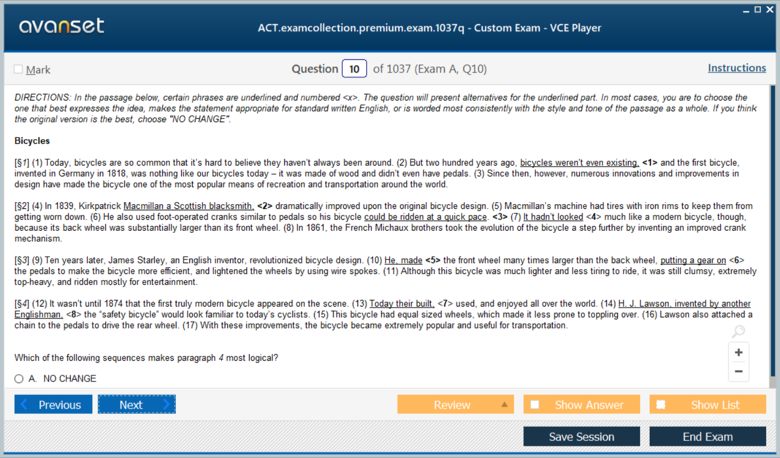
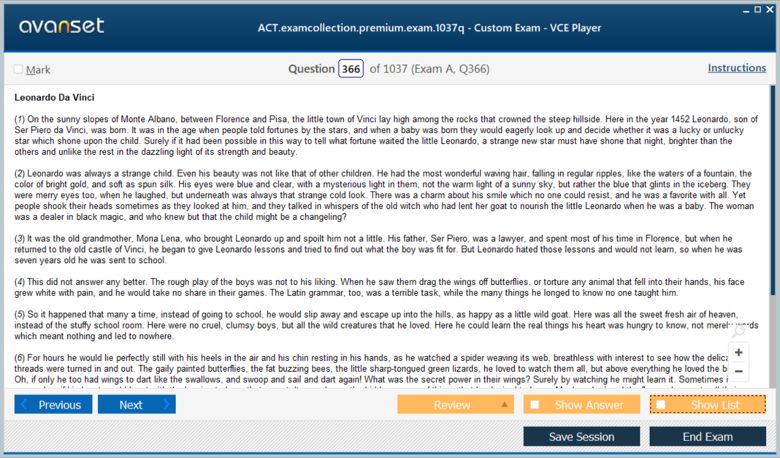
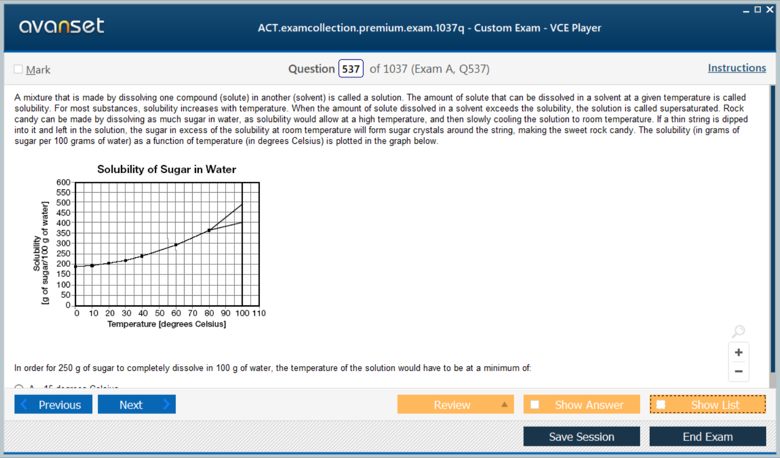
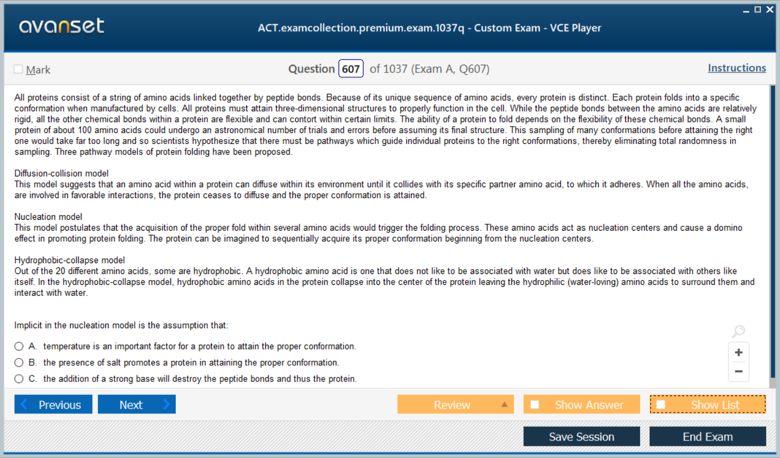
Test Prep ACT Certification Exams Screenshots
ACT Product Reviews
Download Free ACT Practice Test Questions VCE Files
| Exam | Title | Files |
|---|---|---|
Exam ACT Test |
Title American College Testing: English, Math, Reading, Science, Writing |
Files 10 |
Test Prep ACT Certification Exam Dumps & Practice Test Questions
Prepare with top-notch Test Prep ACT certification practice test questions and answers, vce exam dumps, study guide, video training course from ExamCollection. All Test Prep ACT certification exam dumps & practice test questions and answers are uploaded by users who have passed the exam themselves and formatted them into vce file format.
ACT Practice in 2026: Preparing for the Shorter, More Flexible Test
ACT preparation changed materially with the enhanced test format. The current ACT uses English, mathematics, and reading as the required core, while science and writing are optional add-ons for national testing. ACT reports the Composite score from English, math, and reading, and the enhanced format gives students fewer questions and more time per question than the older version. That means older practice can still help with many content skills, but timing plans and full-length simulations should match the current structure.
A strong ACT preparation plan should begin with the official current section design: English has 50 questions in 35 minutes, math 45 in 50 minutes, reading 36 in 40 minutes, and optional science 40 in 40 minutes. Writing remains a 40-minute optional essay. State and district administrations can have local requirements around science, so students testing through a school should confirm what their administration includes.
The strategic consequence is important: practice should no longer be built around racing through the legacy question counts. The goal is to use the additional time per item to improve accuracy, passage management, mathematical setup, and evidence-based reasoning while still maintaining a steady pace across the section.
Build your baseline with one timed section at a time before taking full-length tests
A full practice test is useful only when you know what produced the score. Begin by taking current-format English, math, and reading sections separately under official timing. Record not just right and wrong answers, but error type: concept gap, misread question, time pressure, careless arithmetic, weak passage mapping, or uncertainty between two choices. That turns the baseline into a diagnostic profile. A student with strong accuracy but slow completion needs a different plan from a student who finishes early and misses foundational concepts. The foundation for ACT practice should therefore be measured in repeatable skills, not in how many full tests you can complete in a weekend.
English practice should focus on editing decisions inside a passage, not isolated grammar trivia
The English section asks students to make revision and editing decisions in context. Practice grammar, punctuation, sentence structure, agreement, modifiers, pronouns, and usage, but also rhetorical skills such as organization, relevance, transitions, concision, and purpose. When reviewing a missed item, read the surrounding sentences and explain what job the tested phrase performs in the passage. This prevents rule memorization from becoming detached from meaning. Build an error log that distinguishes mechanical conventions from rhetorical choices; progress often accelerates once you can see whether the problem is a rule you do not know or a passage-level decision you are making too quickly.
Math improvement comes from recognizing structure before reaching for a formula
The current math section has 45 questions in 50 minutes and now uses four answer choices rather than five. Content still draws on mathematics typically learned through the beginning of grade 12, so preparation should combine algebra, functions, geometry, statistics, probability, and trigonometric ideas with efficient problem setup. Before calculating, identify what is known, what is being asked, and whether estimation or answer choices can simplify the work. Keep a separate list of recurring “translation” errors where the algebra was easy once the words were converted correctly. Calculator fluency matters, but the calculator should confirm reasoning rather than replace it. Practice enough nonroutine problems that you can recognize when a diagram, table, or equation contains extra information.
Reading rewards a passage map that is light enough to preserve time for evidence
Reading performance improves when students know where ideas live without trying to memorize every line. After each paragraph, note its function in a few words: introduce conflict, give evidence, shift perspective, explain mechanism, provide example. Then return to the passage for precise support when answering. The current format gives 40 minutes for 36 questions, which creates more breathing room than older ACT pacing, but it does not reward slow rereading. Practice distinguishing main idea, detail, inference, function, and comparison questions because each type asks for different evidence. When two choices seem plausible, ask which one is supported by the passage as written rather than by background knowledge or personal agreement.
Optional science is still an evidence-reasoning test, not a memorization contest
Students who take science receive a separate science score and, when math is also attempted, a STEM score. The section uses data representations, research summaries, and conflicting viewpoints or similar scientific scenarios to test interpretation, experimental reasoning, and evaluation of claims. Advanced subject knowledge is not the main target, although general science background can help. Practice reading axes, units, legends, variables, controls, and trends before reading every word of a passage. Ask what the experiment changed, what it measured, what stayed controlled, and which conclusion is actually supported. ACT’s current science blueprint also gives explicit attention to engineering and design contexts, so practice should include tradeoffs and constraints as well as traditional experiments.
The optional writing test needs a clear position and organized reasoning under 40 minutes
Students who choose writing should practice planning quickly, taking a defensible position, developing reasons with relevant examples, addressing complexity, and leaving enough time to revise. The essay does not improve simply because it is long. A concise thesis, purposeful paragraphs, specific support, and controlled language are more valuable than filling pages with repeated claims. Use a five- to seven-minute planning routine, then write with paragraph roles already decided. During review, check whether each example actually advances the argument and whether the conclusion does more than restate the introduction. Because colleges differ in how they use writing scores, confirm whether the add-on serves a real application requirement before building the study plan around it.
Timing practice should be based on decision points rather than a rigid seconds-per-question rule
Average time per question can guide pacing, but ACT questions vary in complexity. A better system uses checkpoints and skip decisions. Know roughly where you should be at several points in the section, but allow easy items to create time for difficult ones. If a problem has consumed too much time without a clear path, mark it, choose the best remaining option if necessary, and move on. The enhanced test gives more time per question, which makes disciplined thinking more valuable, not less. The relationship between practice, strategy, and confidence is strongest when timing habits reduce avoidable decisions on test day.
Old ACT materials are useful only after you translate them into the current blueprint
Legacy questions can still train grammar, algebra, reading comprehension, and scientific reasoning, but legacy full-test pacing does not represent the 2026 exam. Separate content practice from simulation. Use older questions for skill drills, then use current-format sets for timing, section length, and stamina. The current digital ACT changes and the new-format ACT preparation approach are especially useful when students have inherited prep books, school worksheets, or online banks built around the previous design.
Full-test review should produce a short list of actions for the next week
After a full simulation, do not immediately take another one. Review every missed and guessed question, then group them into a few patterns. Choose two or three high-impact actions for the next practice cycle: relearn linear-function modeling, improve punctuation rules, practice paired evidence questions, or reduce science graph-reading errors. Then drill those areas before the next full test. The decision to use the ACT should ultimately connect to application goals, available testing dates, and the student’s own performance pattern. Practice is most efficient when each test changes what you do next.
The enhanced ACT is shorter and more flexible, but it still rewards the same core discipline: read precisely, reason from evidence, translate quantitative information correctly, and manage time without panic. Optional science and writing also mean students can build a test configuration that reflects their circumstances rather than treating every administration as identical.
Use practice tests as measurement instruments. Establish a current-format baseline, diagnose errors, train specific skills, retest under realistic timing, and track whether the same mistakes are disappearing. That cycle is more valuable than chasing a target number of practice exams because it turns every session into evidence about what to study next.
Score review should be as structured as content review. ACT section scores remain on the familiar 1–36 scale, and superscoring is still supported, but the enhanced Composite is based on English, math, and reading. That creates a different preparation priority from the older four-section Composite. Track each required section separately and treat science as its own strategic decision when it is optional for your administration. If a college, scholarship, or program has a specific expectation, let that requirement determine whether an optional section deserves substantial preparation time. Otherwise, concentrate first on the three required sections that directly drive the Composite.
Practice with the interface you expect to use. The content skills are transferable, but screen layout, navigation, calculator behavior, breaks, and section transitions can affect pacing if they feel unfamiliar. Use official or current-format digital materials often enough that test-day mechanics no longer consume attention. The goal is not to become fast at clicking; it is to preserve working memory for the reading, mathematics, and evidence decisions that determine the score.
ExamCollection provides the complete prep materials in vce files format which include Test Prep ACT certification exam dumps, practice test questions and answers, video training course and study guide which help the exam candidates to pass the exams quickly. Fast updates to Test Prep ACT certification exam dumps, practice test questions and accurate answers vce verified by industry experts are taken from the latest pool of questions.


Top Test Prep Certifications























Top Test Prep Certification Exams
Site Search:




please let me know how much ACT test preparation guide costs
wonderful! i av used act vce files together with vce simulator and it worked so perfectly for me. it saves time and you can do the selective topical questions
@chemutai, please have the act study guide with you because it will guide you on the right track to follow as you prepare for the exam
lets share the best prep materials for act. i know it is never gonna be easy without them
@chemutai, i believe you have attended the act training first. if not yet kindly do because the exam will be so tough for you dear
who has the best act test prep materials to share with us here plz. exams are around the corner
i am thinking of doing act exam but i feel very unprepared. someone share the best materials here. i am deeply in need here
@kamau, that is a good idea that will make your act practice look wonderful. however i will recommend you to have a vce exam simulator because it has free demo which you can use to see whether it works perfect for you
i have used act online prep when i was preparing for the exam, it helped me so much in my preparation . cause I had no much time for that.
i really need my act prep to be very beneficial. which are the best materials to help me pass so highly.
i am trying to simulate my act test but finding it hard. have downloaded several software but needs subscription even before i try using it
i am very happy that act practice test helped me pass the exam. it is very valid that almost all the questions were indirect repetition. i am recommending to you without doubt