Premium File
930 Q&A
$76.99$69.99
Test Prep SAT Test Test Questions & Answers, Accurate & Verified By IT Experts
Instant Download, Free Fast Updates, 99.6% Pass Rate

SAT Test Premium File: 930 Questions & Answers
Last Update: Sep 21, 2026
SAT Test Training Course: 18 Video Lectures
SAT Test PDF Study Guide: 899 Pages
$79.99
Test Prep SAT Test Exam Screenshots
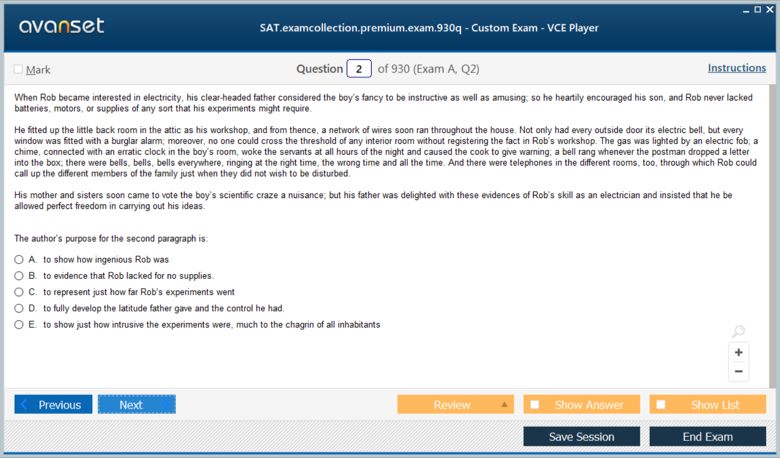
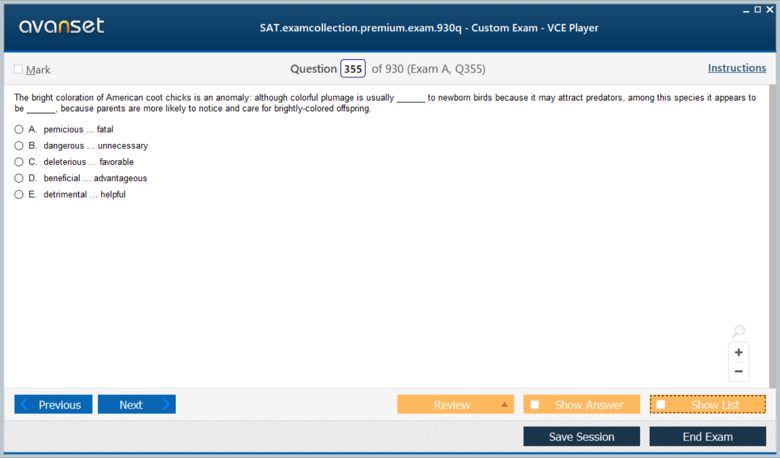
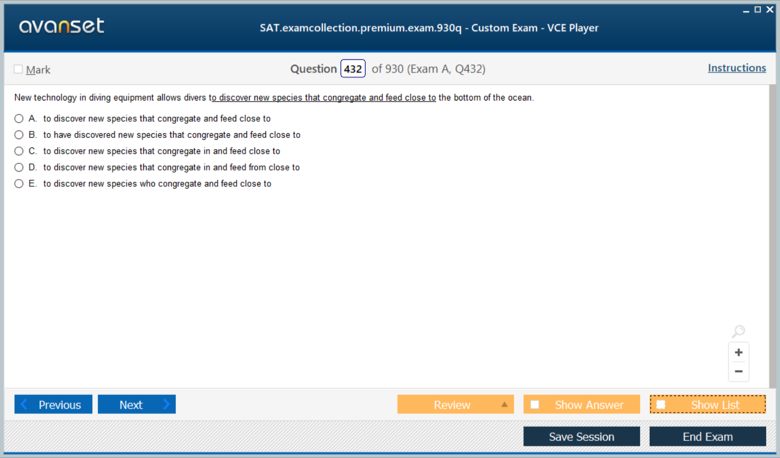
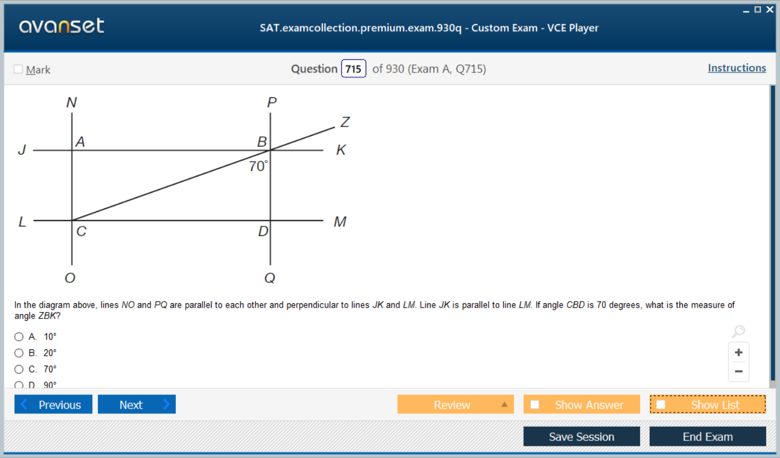
Test Prep SAT Test Practice Test Questions in VCE Format
| File | Votes | Size | Date |
|---|---|---|---|
File Test Prep.practicetest.SAT Test.v2026-07-31.by.oliver.495q.vce |
Votes 1 |
Size 5.74 MB |
Date Jul 31, 2026 |
File Test Prep.questionpaper.SAT Test.v2020-10-08.by.zachary.478q.vce |
Votes 2 |
Size 5.79 MB |
Date Oct 08, 2020 |
Test Prep SAT Test Practice Test Questions, Exam Dumps
Test Prep SAT Test (Scholastic Assessment Test: Reading, Writing and Language, Mathematics) exam dumps vce, practice test questions, study guide & video training course to study and pass quickly and easily. Test Prep SAT Test Scholastic Assessment Test: Reading, Writing and Language, Mathematics exam dumps & practice test questions and answers. You need avanset vce exam simulator in order to study the Test Prep SAT Test certification exam dumps & Test Prep SAT Test practice test questions in vce format.
The SAT is now a digital, multistage-adaptive assessment built around two sections: Reading and Writing, followed by Math. The standard test contains 98 questions and lasts 2 hours and 14 minutes, not counting the break. Reading and Writing has 54 questions in 64 minutes; Math has 44 questions in 70 minutes.
Those numbers define the preparation problem more accurately than older memories of a long paper SAT with separate Reading, Writing and Language, and no-calculator sections. The current test uses Bluebook, divides each section into two modules, allows calculator use throughout Math, and routes the second module based partly on performance in the first. Current-format practice is therefore essential.
Each section begins with a module containing a range of question difficulty. Performance influences the second module’s difficulty. Students cannot choose the route and should not waste time trying to diagnose it during the exam. A hard second module is not a guarantee of a particular score, and an easier-feeling module should not trigger panic. The task remains to answer the current question as accurately as possible.
Pacing should be managed within each module. A student who saves large amounts of time for a later return may discover that the module ends before every difficult item can be reconsidered. Build a habit of making a reasonable first decision, flagging only questions with a plausible path to improvement, and protecting time for the final few items.
The Reading and Writing section uses brief texts and questions across Information and Ideas, Craft and Structure, Expression of Ideas, and Standard English Conventions. Students move rapidly from inference to vocabulary, evidence, rhetorical purpose, transitions, synthesis, grammar, and punctuation. The short format reduces long-passage fatigue but increases the number of mental switches.
Preparation should isolate those switches. For inference, identify what the text actually supports. For words in context, substitute a plain-language meaning that fits the sentence. For grammar, map the clause structure before judging punctuation. For rhetorical synthesis, identify the writer’s goal and then select only the notes that serve it. Repeated skill-level diagnosis is more efficient than simply reading more passages.
The Math section covers Algebra, Advanced Math, Problem-Solving and Data Analysis, and Geometry and Trigonometry. Questions include multiple choice and student-produced responses, and an approved calculator can be used throughout. The built-in Desmos environment is powerful, but it works best when the student recognizes what equation, graph, table, or transformation should be entered.
Practice deciding among algebra, graphing, substitution, estimation, and numerical testing. A quadratic intersection may be faster on a graph; a simple linear relationship may be faster by hand. In contextual questions, define the quantity represented by each expression and keep track of units. Many high-level errors are not computational—they come from solving a related but different quantity.
An article on the digital SAT format is most useful when it changes actual study behavior. Students should practice in Bluebook, become comfortable with the timer and annotation tools, and know how the calculator behaves before test day. A student who is technically strong but unfamiliar with the interface is adding avoidable cognitive load.
Paper worksheets still have value for drilling algebra, grammar, and vocabulary, but full simulations should resemble the real delivery environment. Use the same device setup, take the scheduled break, silence notifications, and complete both modules without pausing. The purpose is to make exam-day logistics boring and predictable so attention can stay on reasoning.
Students who previously took the PSAT/NMSQT already have experience with the same broad digital architecture. Their score report can identify domains that deserve priority. However, the SAT should not be approached as a replay of one PSAT result. Coursework, practice, and skill development can change the profile significantly.
Use prior data as a starting hypothesis. If the PSAT showed weak Advanced Math, test that area again with current SAT-level questions. If Reading and Writing was strong, preserve it with short maintenance sets rather than abandoning it for months. A focused plan converts earlier assessment evidence into efficient SAT preparation.
A SAT practice test is not just a score generator. Before starting, decide what the simulation is meant to measure: pacing stability, endurance, score trend, calculator workflow, or the effect of recent remediation. Afterward, review the result in those terms instead of immediately taking another test.
The strongest review includes wrong answers, guessed correct answers, and questions that consumed too much time. Classify each by domain and failure type. An algebra concept gap needs content review; a misread inequality needs attention control; a correct answer reached after four minutes needs a more efficient method. This is why full-length SAT practice matters most when followed by analysis.
Students often believe they must learn “everything” to raise an SAT score. In practice, an error log frequently reveals clusters: punctuation boundaries, command-of-evidence questions, nonlinear equations, unit conversions, or rushed endings of modules. Fixing several recurring patterns can produce more reliable gains than collecting hundreds of unrelated tips.
For each cluster, write a short rule and a decision process. Example: for punctuation, identify the clauses before evaluating the mark; for an exponential model, identify the initial value and growth factor before calculating. Then practice several variations until the process works without prompting. The article on strategic SAT practice is valuable when practice is used this deliberately.
The digital SAT gives limited time, but rushing from the first question creates avoidable errors. Start at a sustainable pace, use the easy-to-medium questions to accumulate accurate work, and prevent one difficult problem from consuming the module. If the method is not emerging after a reasonable attempt, mark the item and move forward.
For Reading and Writing, return to the exact sentence or evidence needed rather than relying on memory. For Math, estimate the answer’s scale before trusting the calculator. When entering a student-produced response, verify sign, units, and whether the question asks for a value, percentage, rate, or expression. These small checks are faster than recovering from a chain of careless mistakes.
The embedded calculator changes strategy only when the student knows what it is good for. Graphing can reveal intersections, zeros, and behavior; numerical evaluation can check an algebraic result; and regression or table views can make a pattern visible. None of those tools replaces the need to translate the question into mathematics. Practice should include deciding when a quick symbolic manipulation is faster than opening a graph and when the calculator provides a valuable check against an avoidable arithmetic mistake.
Adaptive testing also makes emotional control part of pacing. A second module that feels difficult does not provide a trustworthy real-time score prediction, and spending mental energy guessing what the routing means can reduce performance. Students should be trained to treat each new question as a fresh task. The only useful feedback during the exam is operational: whether time is being protected, whether the prompt has been read accurately, and whether the chosen method is producing a defensible answer.
In the last week, reduce experimentation. Use one familiar calculator workflow, one annotation style, and one pacing plan. Review recurring errors, a concise set of formulas and grammar rules, and one final realistic simulation far enough from test day to learn from it. A strong SAT mindset is built from evidence that the process works, not from motivational slogans alone.
On the actual exam, treat each module as a contained task. Read carefully, reason from the information provided, use digital tools when they save time, and accept that a few questions may feel difficult. Consistency across 98 questions matters more than brilliance on any one item. The digital SAT rewards students who combine academic skill with controlled execution.
The digital SAT score report should be mined for patterns after every official-style practice test. A total score can rise while one domain weakens, or remain flat while important skills improve and careless errors offset the gain. Track Reading and Writing and Math separately, then review the finer content categories so the next study block has a specific purpose.
Reading and Writing accuracy improves when students separate comprehension from answer-choice wording. First decide what the passage, graph, or rhetorical goal requires in plain language. Only then compare choices. This reduces the tendency to be pulled toward a polished option that uses familiar words but overstates the evidence or changes the author’s purpose.
In Math, students should practice using Desmos as a reasoning tool rather than a universal shortcut. Graphing systems, testing points, and visualizing functions can be efficient, but some questions are faster through algebra or number sense. Timed drills should include a second question after each solution: was this method the fastest reliable method for this problem type?
The final full-length simulation should happen early enough to review it thoroughly. The value comes from the post-test work: rebuild missed solutions, identify why the wrong choice was attractive, and decide what process will change next time. Taking a practice test the night before the real SAT leaves little opportunity to convert the result into improvement.
Physical preparation matters too. Use the final days to stabilize sleep, device readiness, identification and admission requirements, and the morning routine. Academic skill is the main driver of performance, but avoidable logistical stress can consume working memory. A calm start helps the student execute the methods already developed in practice.
Go to testing centre with ease on our mind when you use Test Prep SAT Test vce exam dumps, practice test questions and answers. Test Prep SAT Test Scholastic Assessment Test: Reading, Writing and Language, Mathematics certification practice test questions and answers, study guide, exam dumps and video training course in vce format to help you study with ease. Prepare with confidence and study using Test Prep SAT Test exam dumps & practice test questions and answers vce from ExamCollection.
Purchase Individually


Test Prep SAT Test Video Course
Top Test Prep Certifications


































Top Test Prep Certification Exams
Site Search:

SPECIAL OFFER: GET 10% OFF

Pass your Exam with ExamCollection's PREMIUM files!
SPECIAL OFFER: GET 10% OFF
Use Discount Code:
MIN10OFF
A confirmation link was sent to your e-mail.
Please check your mailbox for a message from support@examcollection.com and follow the directions.

Download Free Demo of VCE Exam Simulator
Experience Avanset VCE Exam Simulator for yourself.
Simply submit your e-mail address below to get started with our interactive software demo of your free trial.