
Pass Your Test Easy!
Test Questions & Answers, Accurate & Verified By IT Experts
Instant Download, Free Fast Updates, 99.6% Pass Rate.

Graduate Management Admission Test: Analytical Writing Assessment (AWA), Quantitative section, Verbal section
Includes 683 Questions & Answers
$69.99
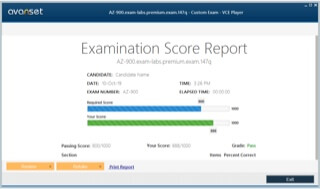
Test Prep GMAT Certification Exams Screenshots
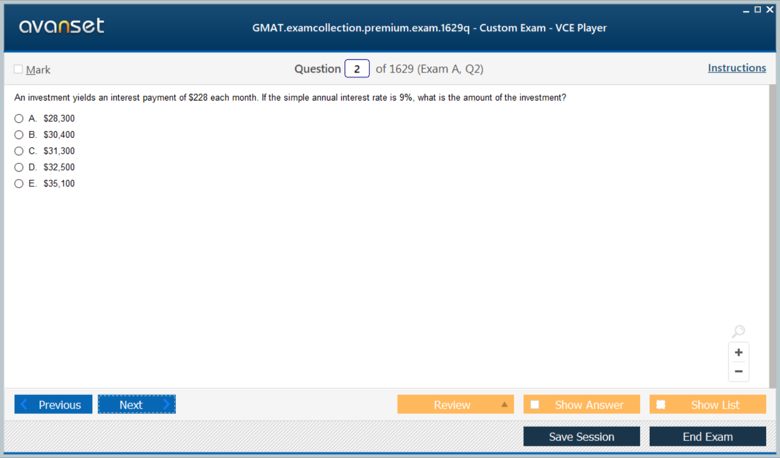
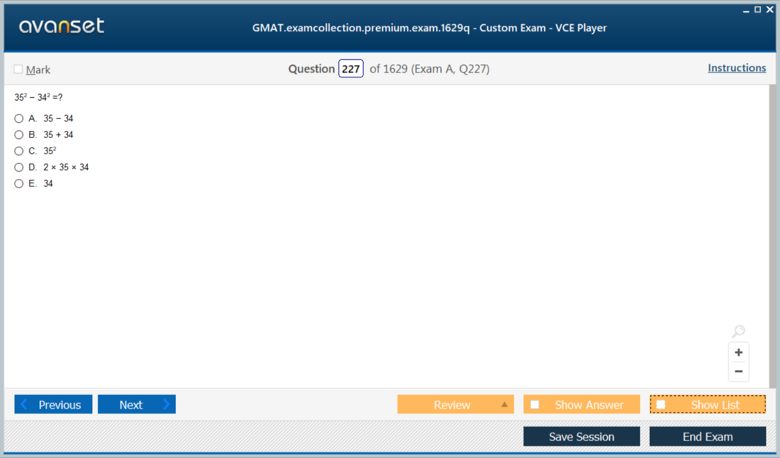
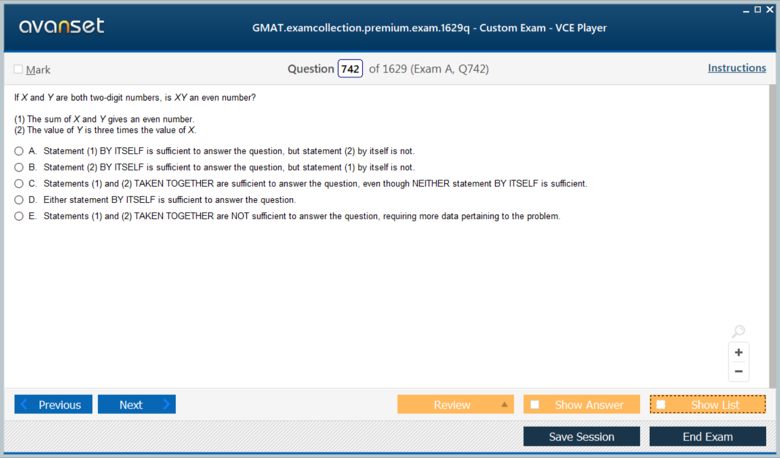
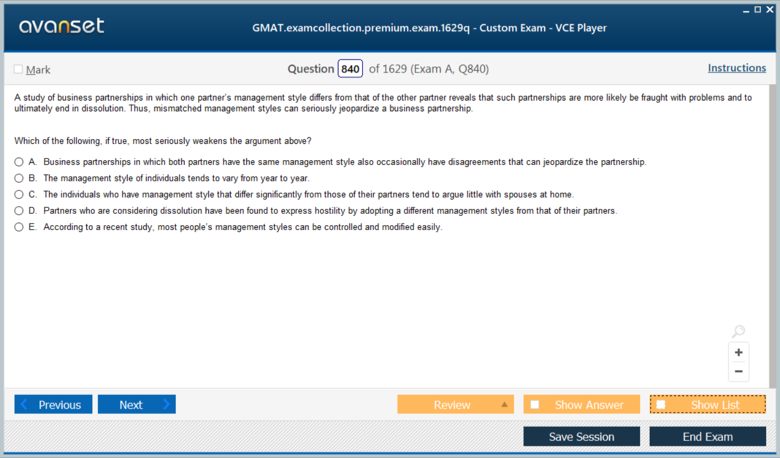
GMAT Product Reviews
Download Free GMAT Practice Test Questions VCE Files
| Exam | Title | Files |
|---|---|---|
Exam GMAT Test |
Title Graduate Management Admission Test: Analytical Writing Assessment (AWA), Quantitative section, Verbal section |
Files 6 |
Test Prep GMAT Certification Exam Dumps & Practice Test Questions
Prepare with top-notch Test Prep GMAT certification practice test questions and answers, vce exam dumps, study guide, video training course from ExamCollection. All Test Prep GMAT certification exam dumps & practice test questions and answers are uploaded by users who have passed the exam themselves and formatted them into vce file format.
GMAT Practice: Training for the 64-Question, Three-Section Exam
The current GMAT is a compact, three-section exam: Quantitative Reasoning, Verbal Reasoning, and Data Insights. GMAC lists 64 questions in 2 hours and 15 minutes, with each section receiving 45 minutes: 21 Quantitative questions, 23 Verbal questions, and 20 Data Insights questions. Candidates can choose their section order, take one optional ten-minute break, and use the Question Review & Edit feature to change up to three answers in a section after completing it if time remains.
Preparation should therefore center on the current GMAT, not the older format with Analytical Writing and a separate Integrated Reasoning section. The current total score ranges from 205 to 805 and draws equally from all three sections. Weakness in Data Insights can no longer be treated as a side issue; it directly affects the headline score.
A good practice program trains knowledge, pacing, section-order decisions, and review behavior together. The exam is short enough that small inefficiencies matter, yet adaptive scoring rewards thoughtful accuracy. The goal is not merely to finish more questions. It is to make consistently strong decisions while preserving enough time to use the exam’s review features intelligently.
Quantitative practice should emphasize reasoning with arithmetic and algebra, not a formula inventory
Current Quantitative Reasoning focuses on problem solving with arithmetic and elementary algebra. The work is less about advanced mathematics than about translating conditions correctly, choosing efficient operations, and resisting distractors built from common mistakes. Practice ratios, rates, percentages, exponents, equations, inequalities, number properties, and word problems until the relationships are more important than the notation.
After each problem, write the fastest valid solution you can see in hindsight. Sometimes algebra is best; sometimes estimation, plugging in values, or recognizing proportional structure is faster. This post-solution comparison gradually creates a toolbox of approaches, which is more useful under 45-minute section pressure than memorizing a single procedure for every topic.
Verbal practice should connect reading structure with argument logic
Current Verbal Reasoning tests reading comprehension and critical reasoning. For passages, identify purpose, organization, viewpoint, and the role of evidence before chasing details. For arguments, separate premises from conclusions and identify the assumption that connects them. Both question types reward disciplined reading rather than broad background knowledge.
Use the GMAT decision-making mindset as a reminder that confidence should come from process. When an answer is wrong, explain which word, inference, or logical relationship invalidates it. This makes verbal review an exercise in evidence rather than intuition.
Data Insights deserves equal study weight because it contributes equally to the total score
Data Insights combines quantitative and verbal interpretation across data sufficiency, multi-source reasoning, table analysis, graphics interpretation, and two-part analysis. The challenge is often deciding what information matters before calculating anything. Practice extracting a claim from a table, reconciling sources, recognizing when data are sufficient, and avoiding calculations that do not change the decision.
Build sets that mix formats rather than practicing one type for an entire week. On the live exam, the cognitive switch between a graph, a two-part decision, and a multi-source prompt is part of the challenge. The smarter practice-test approach is to review the decision path as closely as the final answer.
Section order is a strategic choice that should be tested, not guessed
The current GMAT allows candidates to choose the order of the three sections. That flexibility can reduce anxiety or help a candidate place a strong section when concentration is highest, but there is no universally best order. Test two or three plausible sequences under full timing and compare accuracy, pacing, and mental fatigue.
If Data Insights performance collapses when taken last, moving it earlier may help. If Quantitative provides a confidence-building start, that may be worth preserving. The optional break can be placed after the first or second section, so practice the break location too. A section-order decision should be based on repeated evidence rather than one unusually good mock exam.
The Review & Edit feature changes how candidates should handle uncertainty
At the end of a section, candidates can review questions and edit up to three answers, provided time remains. That makes bookmarking useful, but it does not justify careless first-pass decisions. You may not have time to revisit everything, and changing an answer without new reasoning can turn a correct response into a wrong one.
Practice a simple rule: bookmark only when there is a specific unresolved issue, such as an arithmetic check, a close verbal distinction, or a data table you want to re-read. During review, change an answer only when you can identify the error in the original reasoning. The feature should reward disciplined uncertainty management, not second-guessing.
Adaptive scoring makes early panic and random guessing especially unhelpful
The GMAT uses adaptive methods, so candidates often become preoccupied with guessing which questions are “important.” That speculation is distracting. The practical response is to treat every item as a chance to demonstrate ability, maintain pacing, and avoid strings of preventable errors. You cannot reverse-engineer the scoring algorithm during the test.
Timed practice should therefore focus on stable decision thresholds. Know how long you will wrestle with a difficult item before choosing the best remaining option. Track consecutive misses in review, because clusters often reveal fatigue or pacing collapse. The aim is a controlled section from beginning to end, not perfection on the hardest question you encounter.
Error logs should record decision failures, not just content labels
A useful GMAT error log distinguishes at least four causes: knowledge gap, setup error, reasoning error, and execution error. Add a fifth category for pacing if time pressure caused the mistake. “Quant” or “Verbal” is too broad to guide the next session. A candidate who knows the math but repeatedly mistranslates constraints needs a different intervention from someone who cannot solve the underlying equation.
Review the log weekly and look for patterns. If most verbal misses come from extreme answer language, practice evaluating scope. If Data Insights errors come from reading the wrong column, slow the extraction step. This is how practice tests become diagnostic tools rather than repeated score checks.
Full-length mocks should reproduce the current format closely
Use 64-question, three-section practice sessions with the same 45-minute section limits, one optional break, chosen section order, and realistic review behavior. Avoid mixing in old-format essays or treating Integrated Reasoning as a separate fourth section. A mock that rehearses the wrong structure can create pacing habits that work against you on test day.
The road to GMAT success is easier to manage when full mocks are spaced out. Use them to test the complete system, then return to targeted drills for several days. Constant full-length testing can measure the same weakness repeatedly without fixing it.
Final preparation should emphasize repeatability rather than chasing one peak score
In the final phase, look for a band of results across several realistic mocks rather than celebrating one unusually high score. Stable performance suggests that pacing, section order, stamina, and decision rules are working together. Large swings usually point to a process problem that needs investigation.
Use the GMAT’s role in the MBA journey to keep the score in perspective. The exam is one part of an application. A strong preparation process should produce a score that represents your ability without consuming attention that also belongs to school selection, essays, recommendations, and career planning.
The current GMAT is shorter than the previous exam, but it is not simpler in the sense of requiring less disciplined preparation. Three equally weighted sections, tight 45-minute blocks, Data Insights, flexible section order, and limited answer editing make strategy part of the tested experience.
Practice should make those choices routine. Build reasoning skills first, then add timing, section order, review rules, and full mocks. When the process is stable, the 64 questions become a sequence of familiar decisions rather than a series of surprises.
Practice analytics become more useful when difficulty and confidence are recorded together. After a timed set, mark each response as confident, uncertain, or guessed before looking at the answer. A confident miss usually signals a misconception or an unreliable shortcut; an uncertain correct answer may still deserve review because the process is fragile. This creates a richer picture than accuracy alone and helps candidates decide whether the next session should focus on content, decision rules, or pacing.
Candidates should also rehearse the administrative choices around score sending and test-day planning separately from content study. Knowing the current score scale, section structure, optional break, and review mechanics prevents unnecessary cognitive load. A strong final mock should feel operationally boring: the candidate knows the sequence, how to bookmark, when to move on, and where the break fits. That leaves attention available for the actual reasoning rather than for rediscovering the interface under pressure.
Question selection during review deserves its own rehearsal. If several questions are bookmarked but only a few minutes remain, rank them by the likelihood that additional work will change the answer. A quant problem with a suspected arithmetic slip may be a better use of review time than a verbal item where two choices still appear equally plausible after careful reading. Practicing this triage makes the edit feature more valuable. It teaches candidates to spend scarce time where new evidence can improve the decision rather than revisiting uncertainty for its own sake.
ExamCollection provides the complete prep materials in vce files format which include Test Prep GMAT certification exam dumps, practice test questions and answers, video training course and study guide which help the exam candidates to pass the exams quickly. Fast updates to Test Prep GMAT certification exam dumps, practice test questions and accurate answers vce verified by industry experts are taken from the latest pool of questions.

Test Prep GMAT Video Courses

Top Test Prep Certifications
































Top Test Prep Certification Exams
Site Search:




yes good
@besto, do not regret using them because you do not have to use one material and expect to pass . i would advise you to go through several gmat braindumps so that you can excel easily
kindly utilize gmat practice questions if you wanna pass. some of the questions in it are usually twisted but are all the same concept
i regret using gmat test sample because the quizzes are really irrelevant . there were very few questions that were extracted from it
i am very prepared now. gmat exam dumps helped me to solve many complex problems that were giving me an headache while preparing
if someone has sampled the best gmat questions please share them here, i have exam coming tomorrow.
i am very happy after realizing that gmat books has all the answers that were appropriate in the main exam. i hope all of you will refer to it when looking for answers
@milley, i have used several materials and i can say 95% are the best. as a result i will recommend to you the gmat sample questions they are the best
anyone who has utilized gmat practice test. plz share your experience with us. i am finding the questions very difficult
anyone with the best materials for gmat prep? i would like to start preparing as the exam is in 2 months time
here is a secret, gmat test has all you need to know before you do the exam. do not worry about exam anymore, the solution is here with you
i have successfully completed gmat exam . all you need to do is to prepare well and all will be well with you