



Premium File
859 Q&A
$76.99$69.99
Test Prep NCLEX-RN Test Questions & Answers, Accurate & Verified By IT Experts
Instant Download, Free Fast Updates, 99.6% Pass Rate
NCLEX-RN Premium File: 859 Questions & Answers
Last Update: Sep 15, 2026
NCLEX-RN Training Course: 27 Video Lectures
NCLEX-RN PDF Study Guide: 330 Pages
$79.99
Test Prep NCLEX-RN Exam Screenshots
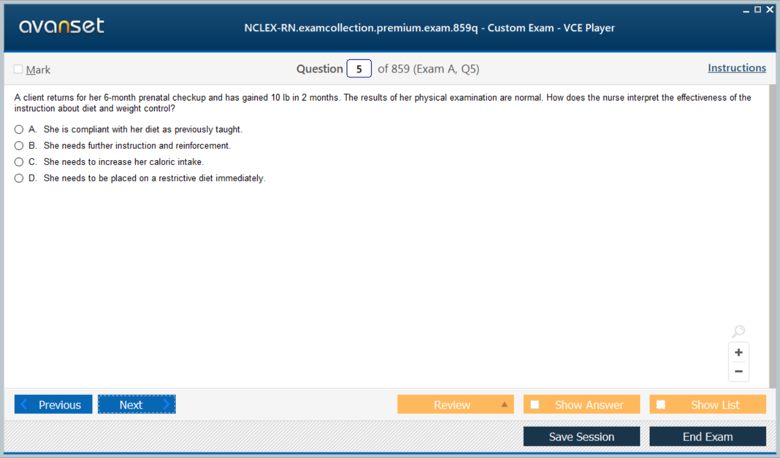
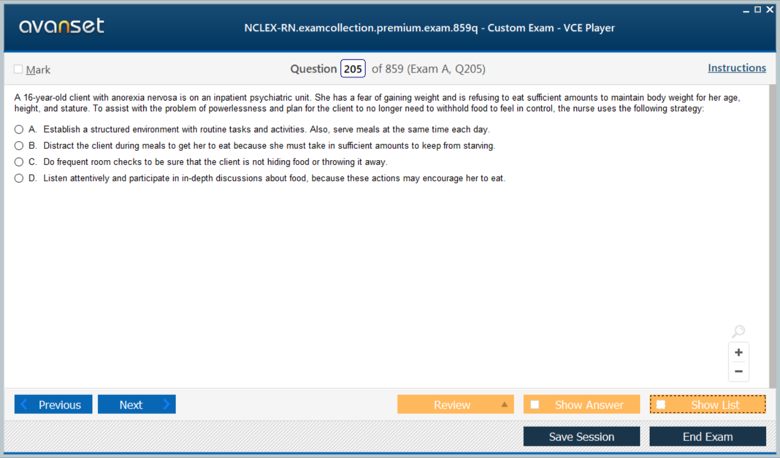
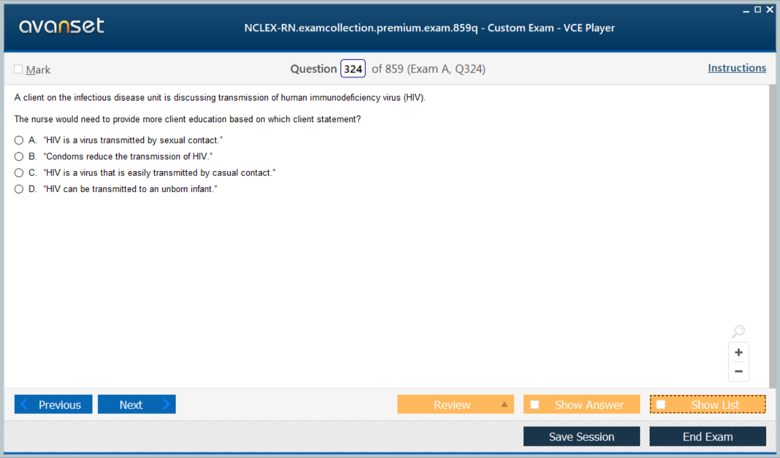
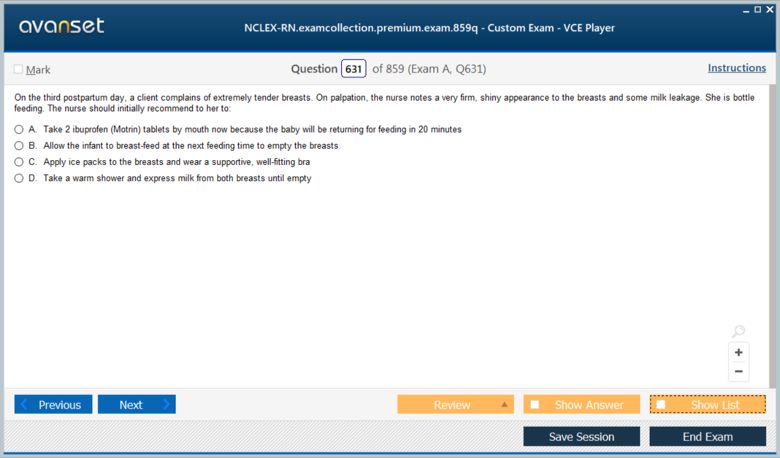
Test Prep NCLEX-RN Practice Test Questions in VCE Format
| File | Votes | Size | Date |
|---|---|---|---|
File Test Prep.testking.NCLEX-RN.v2026-07-27.by.zoe.488q.vce |
Votes 1 |
Size 1.06 MB |
Date Jul 27, 2026 |
File Test Prep.testking.NCLEX-RN.v2020-04-22.by.henry.485q.vce |
Votes 2 |
Size 1.04 MB |
Date Apr 22, 2020 |
File NCLEX.Actualtests.NCLEX-RN.v2015-03-20.by.Mary.828q.vce |
Votes 8 |
Size 1.69 MB |
Date Mar 20, 2015 |
Test Prep NCLEX-RN Practice Test Questions, Exam Dumps
Test Prep NCLEX-RN (National Council Licensureination - NCLEX-RN) exam dumps vce, practice test questions, study guide & video training course to study and pass quickly and easily. Test Prep NCLEX-RN National Council Licensureination - NCLEX-RN exam dumps & practice test questions and answers. You need avanset vce exam simulator in order to study the Test Prep NCLEX-RN certification exam dumps & Test Prep NCLEX-RN practice test questions in vce format.
The NCLEX-RN is designed to determine whether a candidate can begin registered-nursing practice safely, and the current 2026 test plan makes clinical judgment inseparable from that decision. Effective April 1, 2026 through March 31, 2029, the plan continues computerized adaptive testing and the Next Generation NCLEX model. Candidates need broad nursing knowledge, but the scoring target is not encyclopedic recall; it is the ability to recognize risk, prioritize, intervene, delegate appropriately, and evaluate outcomes.
Registered-nursing questions also reflect a wider management and coordination role than the PN blueprint. The RN candidate must think about assignment, delegation, care planning, client advocacy, education, transitions, complex physiological changes, medication safety, and interprofessional collaboration. Preparation should therefore combine content repair with repeated practice making decisions across several competing client needs.
The current NCLEX-RN can contain from 85 to 150 items within a five-hour appointment. Because the exam is computer adaptive, the system estimates ability as the candidate responds and selects subsequent items under the constraints of the test plan. Different candidates can therefore receive different content sequences and different examination lengths while being evaluated against the same passing standard.
Candidates should avoid interpreting item count, perceived difficulty, or a run of unfamiliar topics as a prediction of the final result. Adaptive testing intentionally presents challenging material around the candidate’s estimated ability. Emotional reactions to difficulty can consume working memory and lead to careless errors on questions that would otherwise be manageable.
Practice should build tolerance for uncertainty. Complete mixed blocks without checking answers after every item, use case studies that require sustained attention, and learn to reset after a difficult question. The examination is not asking for a running self-estimate; it is asking for the best nursing decision on the current item.
The 2026 RN test plan distributes questions across eight Client Needs subcategories. Management of Care is 15–21 percent and Safety and Infection Prevention and Control is 10–16 percent. Health Promotion and Maintenance and Psychosocial Integrity are each 6–12 percent. The physiological areas include Basic Care and Comfort at 6–12 percent, Pharmacological and Parenteral Therapies at 13–19 percent, Reduction of Risk Potential at 9–15 percent, and Physiological Adaptation at 11–17 percent.
Those ranges show why RN preparation cannot be reduced to disease review. A large share of the examination asks candidates to organize and coordinate care safely while also handling medication, changing physiology, risk reduction, teaching, and psychosocial needs. The nursing process and clinical judgment operate through every category.
Use the percentages as a planning signal rather than a prediction of exact item counts. Maintain competence across all categories and spend extra remediation time where a high-weight area also matches a personal weakness.
The NGN clinical judgment model asks candidates to recognize cues, analyze cues, prioritize hypotheses, generate solutions, take action, and evaluate outcomes. The current plan includes case-study items and stand-alone clinical-judgment items, making it essential to practice with changing data rather than only single-sentence recall questions.
For an unfolding case, first create a mental baseline. Which findings are expected for the diagnosis, treatment, age, and phase of care? Then identify what changed. A new oxygen requirement, altered mental status, falling urine output, changing pain pattern, abnormal rhythm, or unexpected laboratory trend may matter more than a long list of stable chronic findings.
After acting, define what improvement should look like. If the nurse gives an intervention but cannot identify the expected response or necessary follow-up, the reasoning loop is incomplete. Evaluation questions reward candidates who understand that nursing care is iterative rather than a one-time action.
Build the same habit into laboratory and diagnostic data. A value is not important merely because it is outside the reference range; its urgency depends on the client, trend, treatment, symptoms, and potential consequence. Practice comparing current data with baseline and asking what complication the nurse is trying to detect. This reduces reflexive “abnormal equals priority” thinking and supports the pattern recognition expected in complex RN assignments.
Registered nurses must decide which tasks can be delegated, which clients can be assigned to different team members, and what remains the RN’s responsibility. That makes delegation one of the most useful areas for scenario practice. A correct decision depends on client stability, task predictability, required assessment or judgment, team-member competence, and the need for RN evaluation.
A detailed review of delegation in nursing practice can reinforce these distinctions, but candidates should avoid memorizing rigid lists without context. An apparently routine task may become inappropriate to delegate when the client is unstable or when assessment and teaching are central to the task.
Remember that delegation does not transfer accountability for nursing judgment. The RN must provide appropriate direction, ensure the task is within the delegatee’s role, and follow up. Questions often hinge on that continuing responsibility.
Assignment questions also require workload judgment. Two team members may both be legally able to care for a client, yet one assignment can be safer because of acuity, continuity, specialized competence, or competing responsibilities. Review delegation and assignment separately: delegation focuses on transferring a task while retaining accountability, whereas assignment distributes responsibility for care within each team member’s authorized role.
Priority questions frequently include several clients who all need care. Start with instability and immediate threats, then consider acute versus chronic change, unexpected versus expected findings, time-sensitive treatment, safety, and the consequences of delay. Airway, breathing, circulation, neurological change, severe bleeding, and rapid deterioration are powerful signals, but no single mnemonic should override the actual data.
A postoperative client with a small expected change may be lower priority than a medically stable-looking client who has a new sign of sepsis. A high pain score matters, but a silent change in respiratory effort may matter more. Train yourself to compare risk of harm rather than emotional intensity.
When options are actions rather than clients, determine whether assessment must precede intervention. Some emergencies require immediate action, while other situations demand more data before changing treatment. The word “first” makes sequence part of the clinical question.
The RN pharmacology category includes medication administration and broader parenteral-therapy responsibilities. Study common classes, major mechanisms, indications, high-risk adverse effects, interactions, relevant laboratory values, infusion principles, patient teaching, and nursing monitoring. The strongest recall cue is the clinical consequence of the drug, not an isolated brand-name fact.
High-alert medications deserve repeated scenario practice. Anticoagulants, insulin, opioids, vasoactive medications, chemotherapy, electrolytes, and other high-risk therapies often require specific assessment and monitoring. Learn what finding makes the nurse hold a dose, clarify an order, intervene immediately, or increase surveillance.
When reviewing a medication error, identify whether the root problem was knowledge, calculation, route, timing, contraindication, patient identification, interaction, monitoring, or failure to evaluate response. This converts pharmacology from endless memorization into a safety system.
Candidates sometimes overinvest in acute medical-surgical content and neglect development, prevention, maternity, pediatrics, mental health, communication, and health teaching. The blueprint prevents that narrow approach. Registered nurses must recognize normal development, screen for risk, support adaptation, and communicate therapeutically across the lifespan.
Psychosocial items often reward listening, clarification, validation, boundaries, safety, and client-centered communication rather than advice-giving. If an answer changes the subject, gives false reassurance, asks “why” in an accusatory way, or makes the nurse’s feelings central, examine it critically.
Teaching questions should account for readiness, literacy, culture, development, and the need to verify understanding. Education is not complete because the nurse delivered information; it is complete when the client can use it safely.
Use NCLEX-RN practice questions in two modes. Focused sets repair a defined weakness, while mixed sets test whether the candidate can identify the type of problem without a chapter heading. Both are necessary. Exclusive topic practice can create an illusion of mastery because the category itself provides a clue.
A broader discussion of NCLEX readiness and common preparation pitfalls can help candidates keep practice connected to real nursing judgment. After every missed or uncertain item, record the reason: content gap, prioritization, delegation, safety, cue recognition, pharmacology, calculation, or misreading.
Late preparation should include full mixed sessions and NGN-style cases under realistic timing. Review should become increasingly selective, driven by actual errors and the current test plan rather than anxiety-driven rereading of everything ever learned in nursing school.
A candidate can know thousands of facts and still struggle if those facts are not organized around nursing priorities. NCLEX-RN repeatedly asks what matters now, what the RN should do, who can safely perform a task, which finding requires escalation, and whether the client improved after intervention.
Build the study plan from the 2026–2029 RN test plan, use clinical judgment as the thread connecting every content area, and practice management-of-care decisions often enough that delegation and prioritization become disciplined rather than intuitive guesses. The examination is broad because registered nursing is broad.
On test day, resist the urge to diagnose the adaptive algorithm. Diagnose the client problem instead. Read the stem precisely, identify the highest-risk cue, choose the action that fits RN responsibility, and evaluate the likely outcome. That is the kind of reasoning the licensure exam is designed to protect.
Go to testing centre with ease on our mind when you use Test Prep NCLEX-RN vce exam dumps, practice test questions and answers. Test Prep NCLEX-RN National Council Licensureination - NCLEX-RN certification practice test questions and answers, study guide, exam dumps and video training course in vce format to help you study with ease. Prepare with confidence and study using Test Prep NCLEX-RN exam dumps & practice test questions and answers vce from ExamCollection.
Purchase Individually

Test Prep NCLEX-RN Video Course

Top Test Prep Certifications






























Top Test Prep Certification Exams
Site Search:

SPECIAL OFFER: GET 10% OFF

Pass your Exam with ExamCollection's PREMIUM files!
SPECIAL OFFER: GET 10% OFF
Use Discount Code:
MIN10OFF
A confirmation link was sent to your e-mail.
Please check your mailbox for a message from support@examcollection.com and follow the directions.

Download Free Demo of VCE Exam Simulator
Experience Avanset VCE Exam Simulator for yourself.
Simply submit your e-mail address below to get started with our interactive software demo of your free trial.