



Premium File
492 Q&A
$76.99$69.99
Test Prep TEAS Test Test Questions & Answers, Accurate & Verified By IT Experts
Instant Download, Free Fast Updates, 99.6% Pass Rate

TEAS Test Premium File: 492 Questions & Answers
Last Update: Sep 11, 2026
TEAS Test PDF Study Guide: 353 Pages
$74.99
Test Prep TEAS Test Exam Screenshots
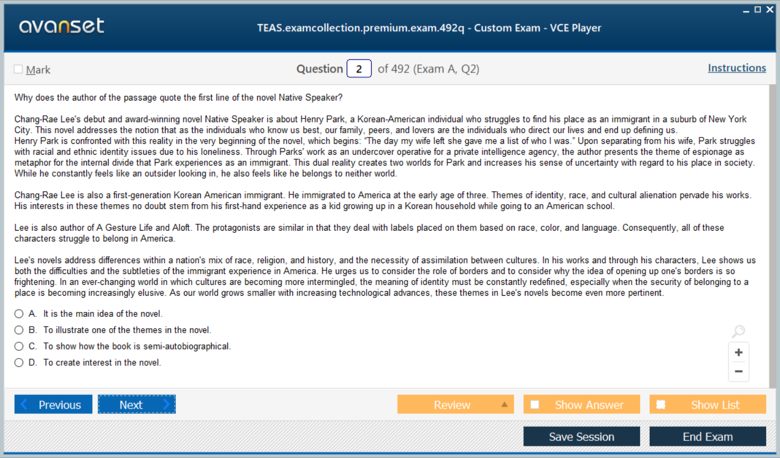
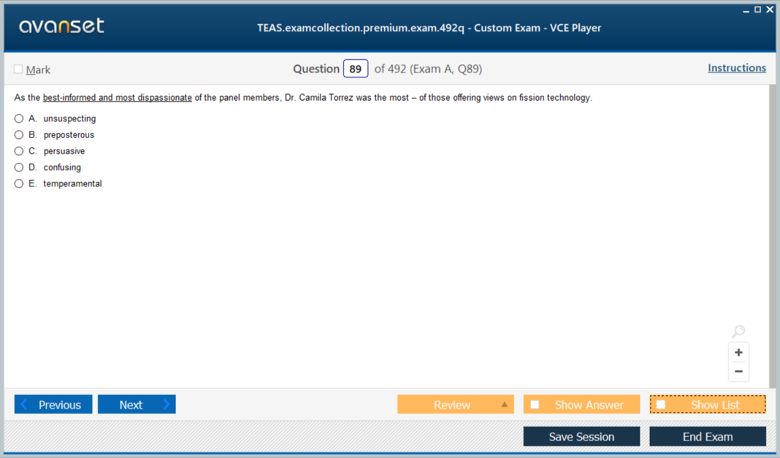
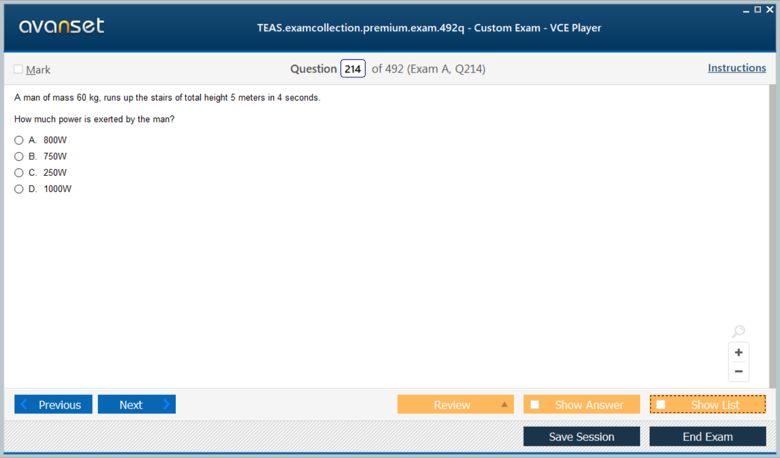
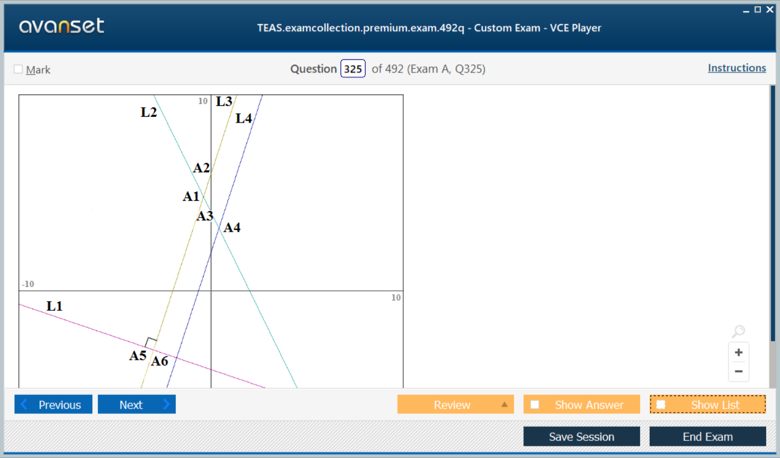
Test Prep TEAS Test Practice Test Questions in VCE Format
| File | Votes | Size | Date |
|---|---|---|---|
File Test Prep.testkings.TEAS Test.v2026-05-11.by.zoe.263q.vce |
Votes 1 |
Size 2.08 MB |
Date May 11, 2026 |
File Test Prep.passit4sure.TEAS Test.v2020-09-21.by.luke.251q.vce |
Votes 2 |
Size 1.46 MB |
Date Sep 21, 2020 |
Test Prep TEAS Test Practice Test Questions, Exam Dumps
Test Prep TEAS Test (Test of Essential Academic Skills: Reading Comprehension, Sentence Correction, Math Problem Solving, Sentence Completion) exam dumps vce, practice test questions, study guide & video training course to study and pass quickly and easily. Test Prep TEAS Test Test of Essential Academic Skills: Reading Comprehension, Sentence Correction, Math Problem Solving, Sentence Completion exam dumps & practice test questions and answers. You need avanset vce exam simulator in order to study the Test Prep TEAS Test certification exam dumps & Test Prep TEAS Test practice test questions in vce format.
The ATI TEAS is an admissions-readiness assessment used by many nursing and allied-health programs. ATI TEAS Version 7 remains the current format in 2026. It contains 170 total questions across Reading, Mathematics, Science, and English and Language Usage, with 209 minutes of allocated testing time. The exam also includes unscored items, so candidates should approach every question as if it contributes to the score.
TEAS preparation is unusual because it asks one candidate to shift among four academic modes in a single sitting. Reading rewards evidence and structure, mathematics rewards accurate setup, science requires both content knowledge and scientific reasoning, and English tests conventions and effective language use. A study plan that treats one strong subject as compensation for three neglected subjects is therefore risky.
The most useful starting point is a diagnostic followed by targeted practice. The TEAS practice test can support that process, but practice should always lead to review. A raw score tells you that something is weak; error analysis tells you what to do next.
The Reading section includes work with key ideas and details, craft and structure, and integration of knowledge and ideas. Candidates should practice finding the central claim, distinguishing evidence from opinion, interpreting text features, and combining information across a passage or graphic. The difficulty often comes from answer choices that contain true statements but do not answer the precise question.
A practical reading method is to identify purpose and structure first, then return to the passage for evidence. Candidates should avoid relying on memory when the relevant lines can be checked. Timed sets should track whether errors come from misunderstanding the passage, overlooking a qualifier in the question, or choosing an answer that goes beyond the evidence.
Because reading is timed at 55 minutes, candidates should practice moving from broad comprehension to targeted evidence without repeatedly starting the passage over. The goal is not maximal annotation. It is a light structure that makes the supporting sentence easy to find when a question narrows the task.
TEAS mathematics includes numbers and algebra together with measurement and data. Candidates need dependable arithmetic, proportions, percentages, equations, geometry, conversions, and interpretation of tables or graphs. The most common barrier is not advanced mathematics; it is losing control of a multistep setup or making an avoidable arithmetic mistake after the correct method was chosen.
Practice should include unit labeling, estimation, and alternate solution methods. A percentage answer that is larger than the original total should trigger a check when the context does not support an increase. A dimensional mismatch should be caught before the answer is submitted. These habits are fast and reduce the number of points lost to preventable slips.
Math practice should include the calculator conditions and interface that apply to the candidate’s actual administration. Tool familiarity can save time, but candidates should still estimate before entering calculations. Estimation catches misplaced decimals and impossible outputs that a calculator will reproduce without warning.
Science is the largest TEAS content area by total questions. ATI’s outline includes human anatomy and physiology, biology, chemistry, and scientific reasoning. Candidates commonly focus almost entirely on anatomy because it feels most directly connected to healthcare, but that can leave avoidable gaps in basic biology, chemistry, experimental design, and interpretation of evidence.
The strongest science review moves between facts and mechanisms. Do not only memorize that an organ performs a function; explain how structure supports that function and what would change if part of the system failed. In chemistry and biology, connect vocabulary to processes. In scientific reasoning, identify variables, controls, trends, and what a result does or does not justify.
Anatomy review is most effective when organized by systems and relationships rather than disconnected labels. Follow blood flow, nerve signals, hormonal feedback, gas exchange, filtration, or digestion as processes. Mechanistic understanding makes it easier to answer unfamiliar questions that describe a consequence instead of naming the structure directly.
The English and Language Usage section measures conventions of standard English, knowledge of language, and the ability to use language and vocabulary effectively. Grammar review should therefore move beyond naming rules. Candidates need to recognize which revision makes a sentence clearer, more precise, and grammatically sound in context.
A useful editing routine is to read for one problem at a time: sentence boundaries, agreement, pronouns, punctuation, modifier placement, and word choice. When every sentence is scanned for every possible error simultaneously, candidates can over-edit correct language. Focused passes during practice help build faster recognition on test day.
English review also improves from reading sentences aloud when possible during study. Awkward agreement, fragments, run-ons, and misplaced modifiers are sometimes easier to hear than to see. Test day still requires silent judgment, but auditory practice can strengthen the internal sense of standard sentence structure.
TEAS Version 7 includes multiple-choice, multiple-select, fill-in-the-blank numeric, ordered-response, and hot-spot items. Candidates who practice only conventional four-option multiple choice may understand the content but feel slower when the interface asks them to construct, order, or select more than one element.
The solution is not to invent special tricks for each format. It is to translate the question into a clear task before responding. For multiple-select, evaluate each option independently. For numeric responses, estimate first and check units. For ordered-response, identify dependencies before arranging steps. Format familiarity should reduce cognitive load so the content remains the main challenge.
Candidates should practice alternate item types early enough that they stop feeling special. A hot-spot or ordered-response item should trigger the same content reasoning as a multiple-choice item. Familiarity prevents the format from consuming attention that should be spent on the concept.
The TEAS should be distinguished from the HESI A2, another admissions assessment whose required sections can vary by school, and from the NCLEX-RN, which is a licensure examination taken after nursing education. Confusing those purposes can produce the wrong study priorities.
TEAS preparation is primarily about demonstrating academic readiness for a health-science program. It does not require the clinical judgment expected on licensure exams. Candidates should master the academic foundations in the current ATI outline rather than prematurely spending large amounts of time on nursing-management scenarios that belong later in the pathway.
Admissions programs can differ in whether they emphasize total score, section scores, retest limits, or prerequisite coursework. Keeping a simple requirements table for target schools prevents a candidate from preparing toward the wrong benchmark or missing a deadline while focusing only on content.
There is no single admissions target that applies to every program using TEAS. Schools can set their own minimums, competitiveness standards, deadlines, and retest policies. Candidates should therefore begin by checking the requirements of each intended program and working backward from the earliest application deadline.
That planning is part of reducing test anxiety. The guidance in TEAS test readiness is most useful when confidence is built on evidence: repeated timed practice, improving weak-domain scores, and a realistic margin above the program’s minimum rather than vague reassurance.
Confidence is most useful when it is calibrated. Candidates who know which domains are strong and which remain weak can allocate final-week time rationally. Overconfidence can hide a science gap; low confidence can waste time re-studying material that practice already shows is stable.
Short sets can sharpen individual skills, while the article on using simple TEAS practice questions illustrates why even small practice samples can be useful when reviewed carefully. The important question after practice is not “How many did I get right?” but “What pattern explains the misses?”
Keep a domain-based error log and revisit mistakes after a delay. A corrected question that is remembered only because the answer was just reviewed does not prove mastery. Re-solving a similar problem days later is a stronger test. Full-length practice should then confirm whether those gains survive fatigue and switching among subjects.
Full-length practice has a second purpose beyond prediction: it reveals how performance changes after two or three hours of concentration. Candidates can test snack, break, and pacing routines where allowed so the final section is not the first time they experience accumulated fatigue.
A useful overview of the exam’s role in healthcare admissions is what the TEAS test measures for nursing candidates. In practical terms, final preparation should become narrower: review recurring errors, complete realistic mixed sections, practice the official interface style, and protect sleep and concentration before the test.
Readiness is visible when no section is being carried entirely by another. The candidate can read closely without excessive rereading, set up common math problems reliably, explain core science mechanisms, and edit English with consistent rules. That balanced competence is exactly what a broad academic-readiness assessment is designed to reveal.
The day before the exam should be lighter than the weeks before it. Review concise error notes and a few representative problems rather than attempting another marathon. The exam measures accumulated preparation; last-minute exhaustion can interfere with the very reading, calculation, and recall skills the candidate has spent weeks building.
A final diagnostic should also distinguish content weakness from execution weakness. A science miss caused by forgotten anatomy needs different remediation from a science miss caused by overlooking a qualifier in the stem. The same distinction applies in math, reading, and English. During the last several practice sessions, label errors by cause as well as subject: knowledge, setup, interpretation, pacing, or careless execution. That extra layer of analysis helps candidates avoid spending scarce time re-learning material they already know. It also makes the final review more balanced, because the plan can combine targeted content refreshers with deliberate practice in reading stems, checking units, managing time, and verifying answers.
Go to testing centre with ease on our mind when you use Test Prep TEAS Test vce exam dumps, practice test questions and answers. Test Prep TEAS Test Test of Essential Academic Skills: Reading Comprehension, Sentence Correction, Math Problem Solving, Sentence Completion certification practice test questions and answers, study guide, exam dumps and video training course in vce format to help you study with ease. Prepare with confidence and study using Test Prep TEAS Test exam dumps & practice test questions and answers vce from ExamCollection.
Purchase Individually

Top Test Prep Certifications





















Top Test Prep Certification Exams
Site Search:

SPECIAL OFFER: GET 10% OFF

Pass your Exam with ExamCollection's PREMIUM files!
SPECIAL OFFER: GET 10% OFF
Use Discount Code:
MIN10OFF
A confirmation link was sent to your e-mail.
Please check your mailbox for a message from support@examcollection.com and follow the directions.

Download Free Demo of VCE Exam Simulator
Experience Avanset VCE Exam Simulator for yourself.
Simply submit your e-mail address below to get started with our interactive software demo of your free trial.