



Premium File
70 Q&A
$76.99$69.99
Google Google Analytics Exam Questions & Answers, Accurate & Verified By IT Experts
Instant Download, Free Fast Updates, 99.6% Pass Rate

Google Analytics Premium File: 70 Questions & Answers
Last Update: Sep 18, 2026
Google Analytics Training Course: 21 Video Lectures
$74.99
Google Google Analytics Exam Screenshots
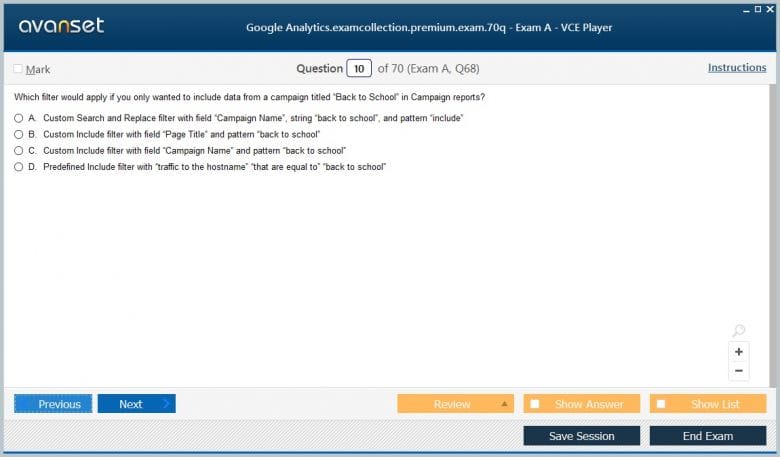
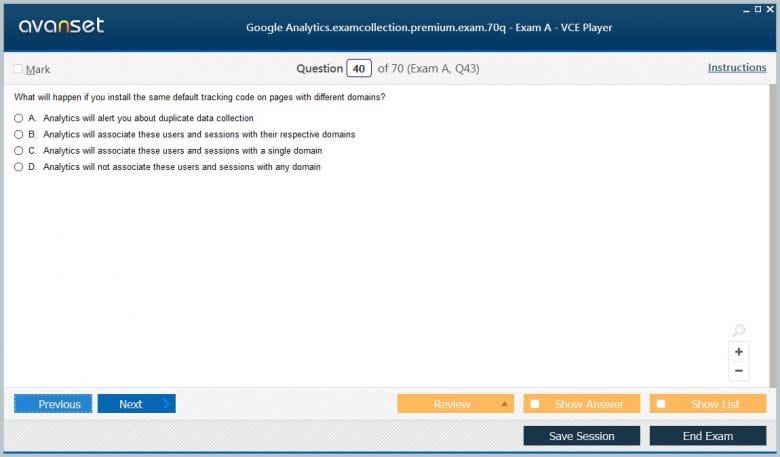
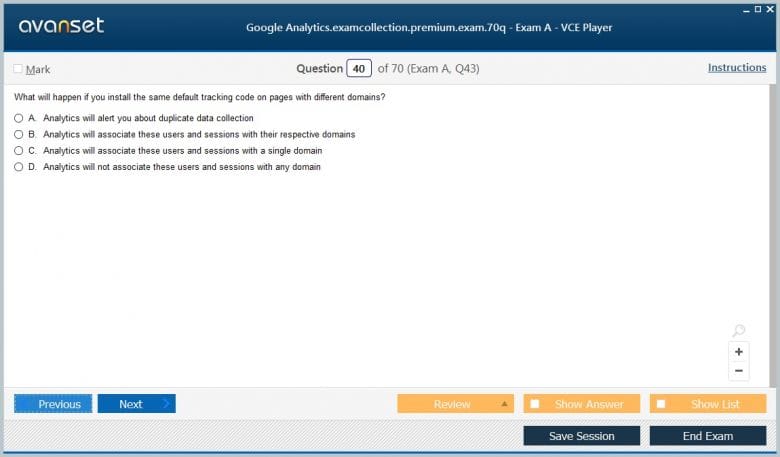
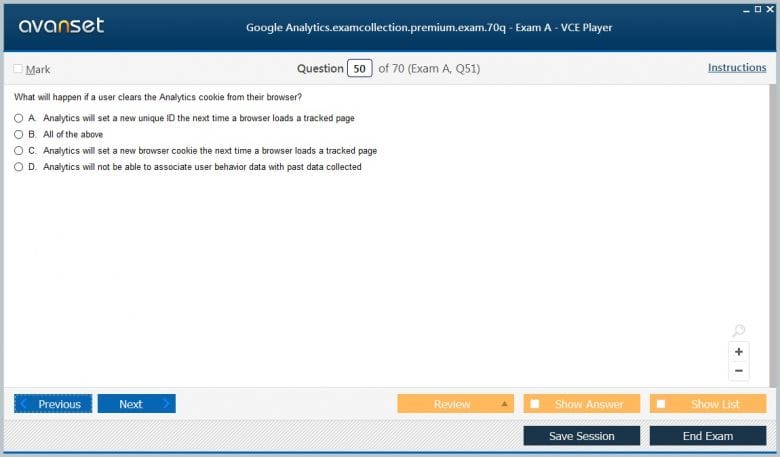
Google Google Analytics Practice Test Questions in VCE Format
| File | Votes | Size | Date |
|---|---|---|---|
File Google.pass4sures.Google Analytics.v2026-08-29.by.lottie.34q.vce |
Votes 1 |
Size 29.85 KB |
Date Aug 29, 2026 |
File Google.Test-king.Google Analytics.v2019-02-22.by.Olivia.36q.vce |
Votes 3 |
Size 30.02 KB |
Date Feb 24, 2019 |
Google Google Analytics Practice Test Questions, Exam Dumps
Google Google Analytics (Google Analytics Individual Qualification (IQ)) exam dumps vce, practice test questions, study guide & video training course to study and pass quickly and easily. Google Google Analytics Google Analytics Individual Qualification (IQ) exam dumps & practice test questions and answers. You need avanset vce exam simulator in order to study the Google Google Analytics certification exam dumps & Google Google Analytics practice test questions in vce format.
Google Analytics remains an active Google measurement product, and Google currently provides Analytics Academy training plus a Google Analytics certification through Skillshop. The modern context is GA4 rather than the Universal Analytics model that shaped many older study resources. A useful preparation plan therefore starts with events, parameters, users, sessions, audiences, conversions, attribution, explorations, advertising integrations, and data quality rather than trying to memorize screens from an older interface.
The certification matters most when candidates can explain what a measurement design tells the business and what it cannot tell without additional evidence. Google Analytics can describe behavior across websites and apps, but the quality of the analysis depends on implementation choices made before reports are opened. The neighboring Google Analytics Individual Qualification page is best understood as historical context, while current learning should focus on GA4 measurement and the present Skillshop certification.
A strong analytics implementation starts by identifying the decisions the organization needs to make. An ecommerce team may care about product discovery, cart abandonment, checkout completion, repeat purchase, and campaign profitability. A subscription product may care about activation, feature adoption, retention, upgrades, and churn. Those are business questions first. The analytics plan then defines events and properties that make those questions observable without collecting unnecessary data.
This approach prevents a common failure: implementing dozens of events simply because the platform can receive them. Events should represent meaningful behavior, use consistent naming, and include parameters that answer likely follow-up questions. If a team records “purchase” but omits value, currency, product context, or transaction identifiers, the event exists but the measurement model may still be too weak for commercial analysis.
GA4 records interactions as events and uses event parameters to add detail. Some events are collected automatically, some are available through enhanced measurement, some follow recommended naming conventions, and others may be custom. Candidates should understand why following recommended structures is useful: standardized naming can unlock expected reporting behavior and makes integrations easier to maintain across teams.
Event design also requires restraint. Creating separate events for every minor variation can make reporting fragmented, while putting every difference into one event can make analysis difficult. A good schema separates the action from the context. The action might be a sign-up, search, file download, form submission, or purchase; parameters can capture the page, item, method, content type, or other dimensions needed to interpret it.
A measurement specification should document more than the event name. Teams need to agree on the trigger, required parameters, allowed values, ownership, and the business question the event supports. That discipline matters when multiple developers, tag managers, mobile teams, and agencies contribute to one property. Without a shared specification, two implementations can appear correct in isolation while producing incompatible data once reports combine them.
Validation should happen before a reporting deadline. DebugView, browser tools, tag diagnostics, test traffic, and controlled transactions can confirm whether events fire once, carry the expected parameters, and preserve the intended identifiers. Analysts also need a process for detecting regressions after releases. A checkout redesign, consent change, or tag-container edit can alter measurement even when the customer-facing feature appears healthy.
Analytics reports can use different identity signals to connect activity, and those choices affect user counts and journey interpretation. Candidates should know that a “user” in a report is an analytical construct based on available signals, not a guaranteed real-world person. Device changes, consent restrictions, authentication state, browser behavior, and implementation quality can all change what the platform is able to connect.
Sessions still matter, but GA4 is not organized around the old Universal Analytics session model. Analysts should understand engagement, acquisition, returning behavior, and event sequences without forcing every question into session counting. That becomes especially important when comparing old and new reports: a number that shares a familiar label may be calculated differently enough that a direct historical comparison is misleading.
Important events can be designated as key outcomes, but the measurement system becomes less useful if every interaction is promoted to equal importance. A purchase, qualified lead, completed onboarding milestone, or high-value subscription action may deserve direct optimization attention. A page view or minor button click usually belongs as diagnostic behavior unless the business has a specific reason to treat it as an outcome.
Google Ads and Analytics can work together, but teams should understand which system is being used for bidding, reporting, and attribution. Importing Analytics outcomes into advertising can make campaign optimization more aligned with onsite behavior, yet poor event quality simply carries the problem downstream. The most useful certification practice is to reason from the business outcome to the event, then to the reporting and activation decision.
Standard reports are useful for recurring views, but explorations support deeper analysis such as funnels, paths, segments, cohorts, and free-form breakdowns. The analyst should know when a custom exploration is more appropriate than repeatedly modifying a general report. A funnel can reveal where users abandon a defined process, while path analysis can show what people actually do before or after an event without requiring the analyst to assume the sequence in advance.
Segments and comparisons should be built around a hypothesis. Device category, geography, acquisition source, customer status, content group, or product family can all be useful, but slicing data randomly creates noise. The goal is to find a difference that changes a decision: perhaps mobile checkout performance is weak, returning users behave differently, or a campaign attracts traffic that engages but rarely converts.
Traffic-source analysis asks how users arrived and which marketing interactions contributed to important outcomes. Campaign tagging should therefore be consistent. Uncontrolled UTM naming can split one source into multiple variants, contaminate channel reporting, and make trends appear more complex than they are. Teams should document naming conventions and prevent ordinary internal navigation from overwriting acquisition information.
Attribution models distribute credit across interactions, but attribution is not the same as causal proof. A channel can receive credit because it appears in a path without being the reason the customer chose the product. Mature analysis combines attribution with experiments, business context, incremental testing, and knowledge of how campaigns are targeted. The certification is easier when candidates treat attribution as a reporting framework rather than an unquestionable statement of cause.
Organizations often need to combine behavioral analytics with orders, CRM data, support history, product usage, or operational records. That is where exported or connected data can support deeper analysis. BigQuery analytics is especially relevant for teams that need custom SQL analysis, longer retention strategies, or joins with data that does not belong naturally inside the standard Analytics reporting interface.
This broader data perspective also helps candidates understand why definitions must be governed. Revenue in an accounting system, purchase revenue in Analytics, and attributed conversion value in an advertising platform can differ for legitimate reasons. Analysts should know the source, transformation, time zone, currency, refund treatment, and identity logic behind a metric before reconciling two dashboards or declaring one system wrong.
Data quality is also a governance problem. Teams should define which environments feed production reporting, how internal traffic and test activity are treated, who may change event definitions, and how sensitive information is excluded from collection. Changes should be documented with dates so an analyst can explain a sudden break in a trend instead of interpreting an instrumentation change as customer behavior.
Effective preparation is practical. Configure a test GA4 property, inspect automatically collected events, define a few custom events, build audiences, mark meaningful outcomes, create explorations, and trace traffic from acquisition through conversion. Then deliberately break parts of the setup: change a parameter, remove a tag, create inconsistent campaign names, or compare users across different identity assumptions. Diagnosing those problems builds stronger skill than memorizing menu locations.
The broader set of Google certifications includes cloud and workspace credentials with very different objectives, so learners should keep Analytics preparation focused on measurement. A useful final check is whether you can explain why a metric changed, what evidence supports the explanation, what uncertainty remains, and what action the organization should take next. That is the difference between operating an analytics interface and using measurement to improve decisions.
A useful capstone exercise is to build a measurement plan for one real customer journey from first acquisition through a meaningful outcome. Write the event names, required parameters, expected traffic sources, audience definitions, and reporting questions before implementing anything. Then compare the plan with the data that actually arrives. Differences between the intended design and observed data reveal whether the problem is tagging, naming, identity, consent, channel classification, or the original analytical assumption.
Candidates should also practice explaining the same finding to different audiences. An engineer may need the exact event and parameter defect, a marketing manager may need to know which campaign decision is affected, and an executive may need the business consequence and confidence level. Certification knowledge becomes professionally useful when the analyst can move from collection detail to decision impact without overstating what the data proves.
Consent and privacy constraints should be part of that diagnostic thinking. When observed traffic changes after consent configuration, browser restrictions, or regional policy changes, the analyst should not assume customer behavior changed by the same amount. Compare implementation dates, consent signals, modeled versus directly observed data where relevant, and other business systems before interpreting the movement. Measurement quality includes knowing where the dataset has become less complete.
Go to testing centre with ease on our mind when you use Google Google Analytics vce exam dumps, practice test questions and answers. Google Google Analytics Google Analytics Individual Qualification (IQ) certification practice test questions and answers, study guide, exam dumps and video training course in vce format to help you study with ease. Prepare with confidence and study using Google Google Analytics exam dumps & practice test questions and answers vce from ExamCollection.
Purchase Individually

Google Google Analytics Video Course

Top Google Certifications














Top Google Certification Exams
Site Search:

SPECIAL OFFER: GET 10% OFF

Pass your Exam with ExamCollection's PREMIUM files!
SPECIAL OFFER: GET 10% OFF
Use Discount Code:
MIN10OFF
A confirmation link was sent to your e-mail.
Please check your mailbox for a message from support@examcollection.com and follow the directions.

Download Free Demo of VCE Exam Simulator
Experience Avanset VCE Exam Simulator for yourself.
Simply submit your e-mail address below to get started with our interactive software demo of your free trial.