



Premium File
225 Q&A
$76.99$69.99
Google AdWords Fundamentals Exam Questions & Answers, Accurate & Verified By IT Experts
Instant Download, Free Fast Updates, 99.6% Pass Rate

AdWords Fundamentals Premium File: 225 Questions & Answers
Last Update: Oct 21, 2026
AdWords Fundamentals Training Course: 176 Video Lectures
$74.99
Google AdWords Fundamentals Exam Screenshots
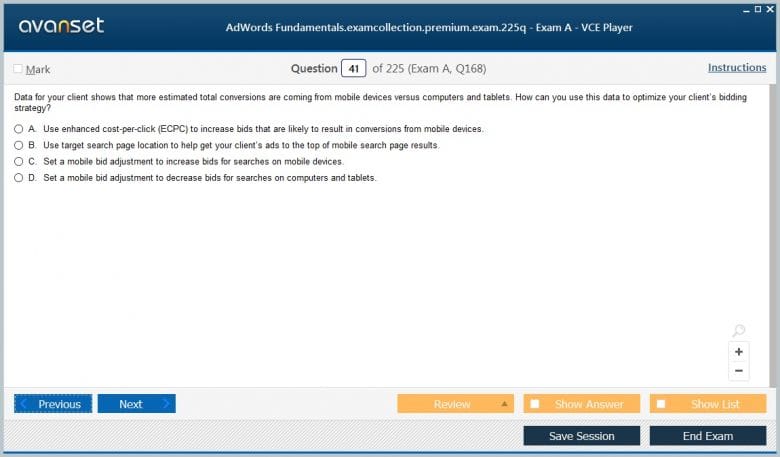
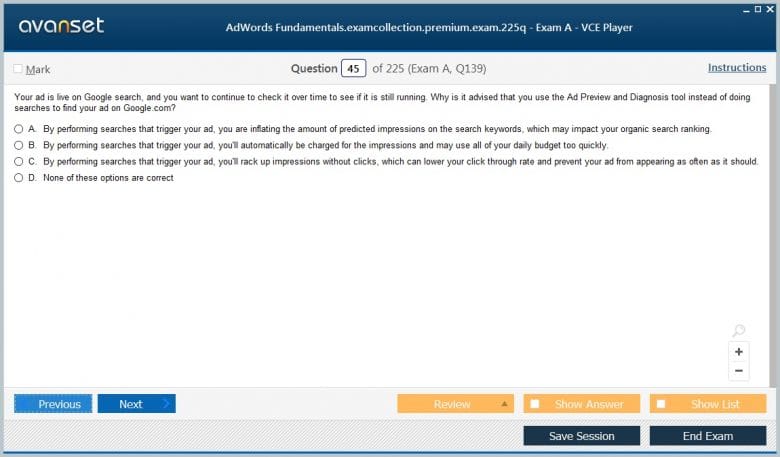
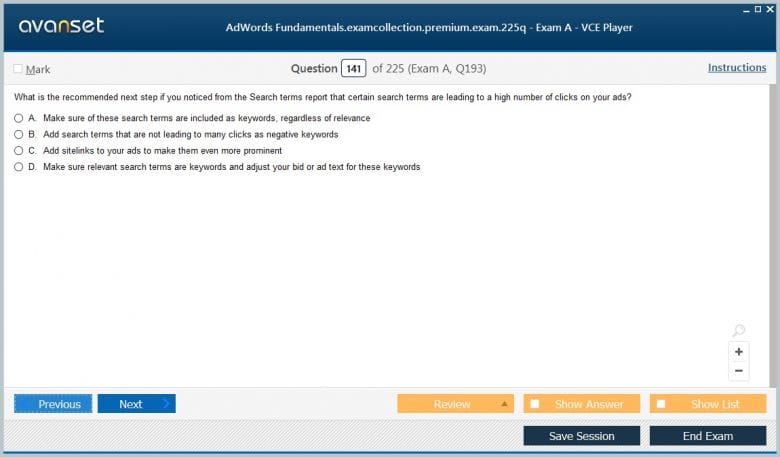
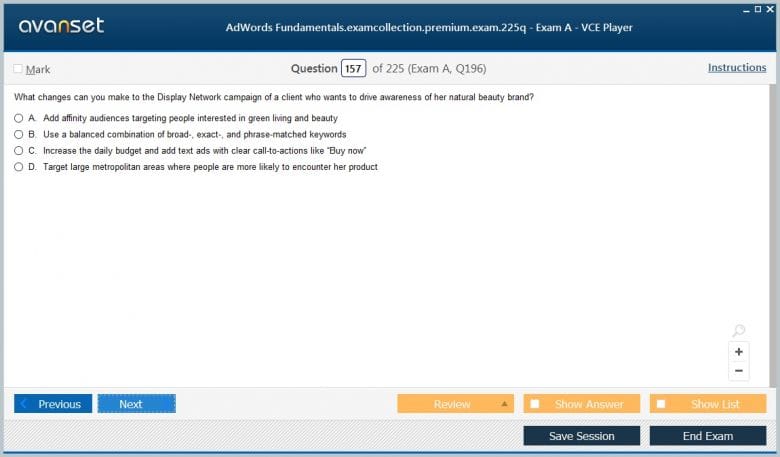
Google AdWords Fundamentals Practice Test Questions in VCE Format
| File | Votes | Size | Date |
|---|---|---|---|
File Google.Test-king.AdWords Fundamentals.v2026-08-22.by.Giulia.111q.vce |
Votes 3 |
Size 119.02 KB |
Date Aug 25, 2026 |
Google AdWords Fundamentals Practice Test Questions, Exam Dumps
Google AdWords Fundamentals (Google AdWords Fundamentals) exam dumps vce, practice test questions, study guide & video training course to study and pass quickly and easily. Google AdWords Fundamentals Google AdWords Fundamentals exam dumps & practice test questions and answers. You need avanset vce exam simulator in order to study the Google AdWords Fundamentals certification exam dumps & Google AdWords Fundamentals practice test questions in vce format.
AdWords Fundamentals is a retired certification assessment from the earlier Google Advertising Professionals and AdWords certification structure. Google stopped offering the standalone Fundamentals assessment years ago, and candidates cannot earn a current Google Ads certification by looking for that old exam. In the modern Skillshop model, certification is organized around product areas such as Search, Display, Video, Shopping, and Apps, with Google’s current help material describing those credentials as professional accreditations that remain valid for one year.
The old AdWords certification material still has historical value because the foundation topics—auction mechanics, account structure, targeting, budgets, bidding, quality, conversion measurement, and policy—remain part of competent paid-search and paid-media work. The key is to separate enduring advertising principles from obsolete certification mechanics. Readers should use current Skillshop resources for live certification requirements and legacy pages only to understand the older program.
Google Ads does not operate as a simple highest-bid-wins marketplace. Advertisers compete in auctions where bid, expected performance, relevance, quality, context, and other factors influence whether and where an ad can appear. A practitioner therefore needs to understand that raising bids cannot compensate indefinitely for a poor offer, weak relevance, or an unsuitable landing experience.
The useful mental model is economic rather than mechanical: an advertiser is paying for access to opportunities where user intent and business value can align. Bidding decisions should reflect expected value, conversion probability, margins, and strategic goals. Automation can make those decisions at scale, but it still depends on the objective and data the advertiser supplies.
Ad Rank and auction eligibility also depend on context. Device, location, query, time, competitive conditions, and the expected usefulness of assets can all affect what happens in a specific auction. This is why advertisers should be careful with blanket explanations such as “our average position fell because a competitor raised bids.” Modern auction behavior is dynamic, and diagnosis should use multiple signals rather than one simplified cause.
Campaigns and ad groups organize budgets, targeting, bidding, creative, and reporting. A strong structure reflects meaningful differences in objective, geography, product line, audience, or intent without creating unnecessary fragmentation. Extremely granular structures can starve automation of data and create management overhead, while overly broad structures can make budgets and messages difficult to control.
Naming, ownership, and change discipline matter as accounts grow. Teams should be able to understand why a campaign exists, what outcome it serves, and which settings are intentionally different from neighboring campaigns. Structure is not an aesthetic preference; it affects optimization, governance, and the ability to diagnose performance.
In search advertising, keywords express how an advertiser wants to participate in auctions, while search terms are the actual queries users enter. Match behavior, negative keywords, intent, language, and automated matching all affect the relationship between the two. Practitioners should review search-term data to understand whether the account is reaching useful intent or paying for traffic that only looks superficially relevant.
The old Search Advertising exam separated this topic into a specialized track, and that specialization still exists in the current Google Ads Search certification. The durable skill is interpreting intent and aligning it with an appropriate offer, landing page, and conversion goal rather than building enormous keyword lists for their own sake.
Negative keywords and exclusions are as strategic as positive targeting because they define what demand the advertiser does not want. Exclusions should be based on intent and economics rather than reflexively blocking every poor-performing term after a small sample. A mature account develops a pattern library of irrelevant themes while leaving room for matching systems to discover valuable queries that were not predicted manually.
Quality-related systems encourage advertisers to create useful, relevant experiences, but practitioners should avoid treating a diagnostic score as the business objective. Strong ads reflect the user’s need, communicate a credible benefit, and lead to a page that continues the same promise. Improving relevance should make the experience better, not merely manipulate a metric.
Creative testing should therefore compare meaningful propositions, calls to action, and message framing. Small wording changes can matter, but tests are more informative when they are tied to a hypothesis about the audience. The winning ad is not simply the one with the highest click rate; it is the one that contributes to the intended business result at an acceptable cost and quality level.
Assets such as sitelinks, callouts, structured snippets, images, and location information can expand the usefulness of an ad when they match the user’s intent. They should not be added simply to occupy more space. Each asset should answer a likely question or shorten the path to a valuable action. This is another example of a durable principle that survived the old Fundamentals exam: platform features work best when they improve the customer decision, not when they are enabled mechanically.
A budget is a constraint, while a bidding strategy is a decision rule for spending within that constraint. Manual and automated approaches each require the advertiser to understand what an action is worth and how much uncertainty the business can tolerate. Automated strategies become more effective when conversion tracking is stable, volume is sufficient, and the optimization goal matches real value.
Poor inputs create poor optimization. If every page view is counted as a primary conversion, the system can learn to maximize low-value behavior. If high-value and low-value leads are treated identically, cost-per-acquisition targets can hide quality problems. Fundamentals therefore include measurement design, not just the mechanics of setting a bid.
Budget pacing also has an opportunity-cost dimension. A campaign limited by budget may be leaving profitable demand unserved, but increasing spend is sensible only if marginal conversions remain valuable. Conversely, a campaign that can spend more is not automatically healthy. The practitioner should distinguish “the platform can use more money” from “the business should buy more of this outcome at the expected incremental return.”
Clicks and impressions are platform activity, while conversions and value connect activity to outcomes. Practitioners need to understand tags, attribution, conversion windows, duplicate events, offline outcomes, and the difference between an action that indicates interest and one that creates real business value. Measurement should be planned before campaigns scale because reconstructing missing historical data later is difficult.
Google Analytics can complement advertising data by showing broader user behavior across a site or app. The current certification context is GA4 rather than the older Universal Analytics-era GAIQ. The systems may attribute conversions differently, so the goal is not forced numerical equality. The goal is a coherent explanation of how users move from exposure to meaningful action and which data source answers each question.
Offline conversion import and CRM feedback can close a gap that ordinary web tracking leaves open. Lead-generation businesses often discover that campaigns producing the cheapest form fills do not produce the best customers. Feeding qualified-lead, sale, or revenue outcomes back into analysis—and, where appropriate, bidding—helps align platform optimization with actual business value rather than front-end volume.
The standalone Fundamentals exam was removed when Google reorganized its learning program. Current Google guidance directs candidates to product-area certifications rather than requiring a common foundation assessment first. Search, Display, Video, Shopping, and Apps can each count toward Google Partners certification requirements, and the credential is tied to the specific product area the individual has passed.
That change means a learner should not spend time trying to locate an old Fundamentals assessment. Instead, build a general foundation through current learning content and then choose the product certification that matches actual work. Display Advertising and Video Advertising remain useful legacy reference points for understanding how those specialties developed, but current Skillshop material governs current certification.
Account hygiene remains part of those fundamentals. Old experiments, redundant campaigns, stale conversion actions, conflicting negatives, unused assets, and inherited settings can make an account difficult to reason about even when individual campaigns still spend. Periodic cleanup improves both human oversight and machine learning because the optimization system receives clearer objectives and less contradictory configuration. A well-maintained account makes it easier to explain why spend moved and whether the change was intentional.
Today’s Google Ads environment uses more automation, richer audience signals, broader matching, and machine-learning-driven bidding than the AdWords era in which the Fundamentals exam was created. That increases the importance of sound inputs: business goals, clean conversion data, creative assets, exclusions, value signals, and policy-compliant landing experiences. Automation reduces manual control in some areas while increasing the need for strategic oversight.
A practical study plan should therefore start with the auction, account structure, objectives, targeting, creative, bidding, budgets, measurement, and policy, then apply those principles inside one current product area. The old exam is gone, but “fundamentals” still exist as professional knowledge. They are now learned and demonstrated within the context of the current Google Ads products rather than through a separate universal assessment.
Policy knowledge should also sit inside the foundation. Advertisers are responsible for destination quality, restricted products and services, misrepresentation rules, and data-use requirements. Policy cannot be treated as a final compliance check after the campaign is built because it affects offer design, targeting, claims, landing pages, and sometimes whether a business can advertise at all. Current certification study should include that operational reality.
Go to testing centre with ease on our mind when you use Google AdWords Fundamentals vce exam dumps, practice test questions and answers. Google AdWords Fundamentals Google AdWords Fundamentals certification practice test questions and answers, study guide, exam dumps and video training course in vce format to help you study with ease. Prepare with confidence and study using Google AdWords Fundamentals exam dumps & practice test questions and answers vce from ExamCollection.
Purchase Individually

Google AdWords Fundamentals Video Course
Top Google Certifications
















Top Google Certification Exams
Site Search:

SPECIAL OFFER: GET 10% OFF

Pass your Exam with ExamCollection's PREMIUM files!
SPECIAL OFFER: GET 10% OFF
Use Discount Code:
MIN10OFF
A confirmation link was sent to your e-mail.
Please check your mailbox for a message from support@examcollection.com and follow the directions.

Download Free Demo of VCE Exam Simulator
Experience Avanset VCE Exam Simulator for yourself.
Simply submit your e-mail address below to get started with our interactive software demo of your free trial.