



Premium File
79 Q&A
$76.99$69.99
Google Professional Collaboration Engineer Exam Questions & Answers, Accurate & Verified By IT Experts
Instant Download, Free Fast Updates, 99.6% Pass Rate
79 Questions & Answers
Last Update: Sep 24, 2026
$69.99
Google Professional Collaboration Engineer Exam Screenshots
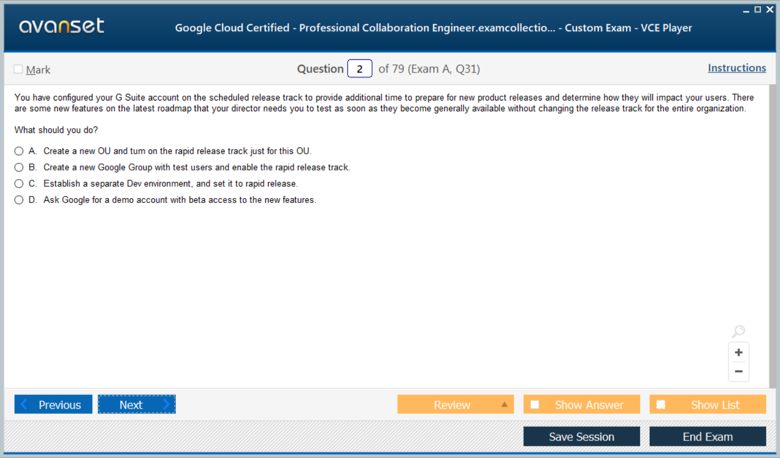
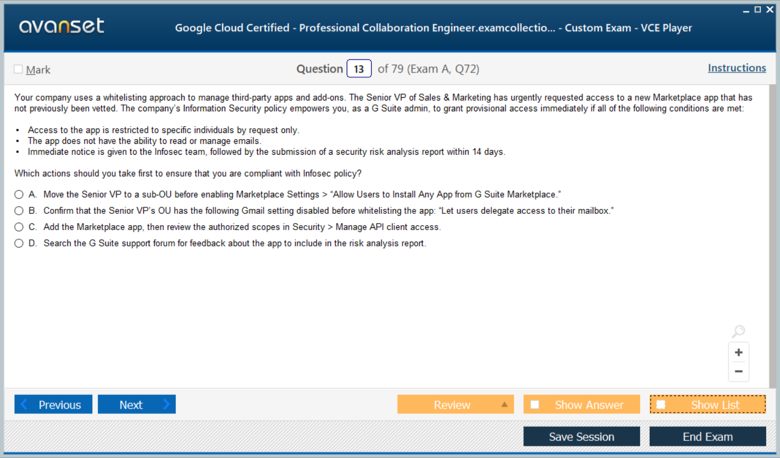
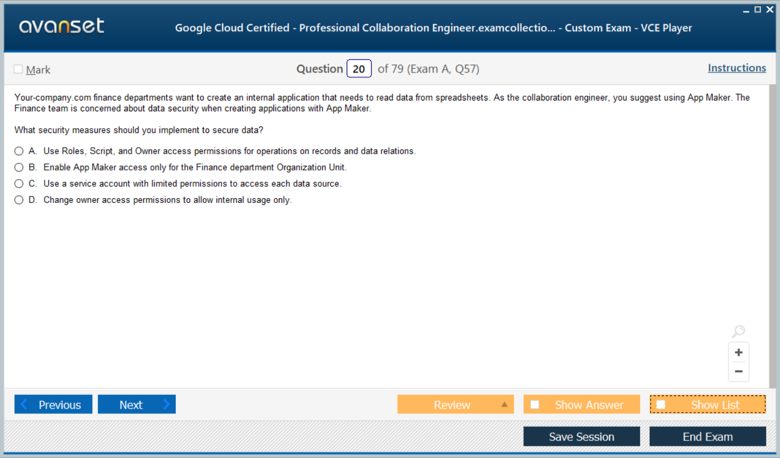
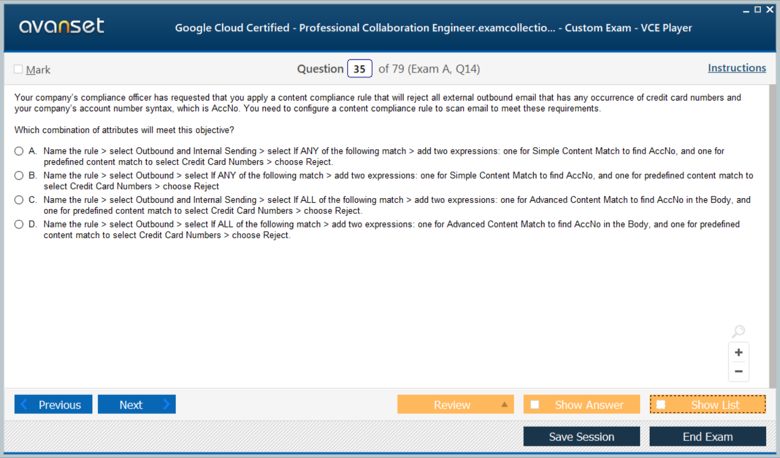
Google Professional Collaboration Engineer Practice Test Questions in VCE Format
| File | Votes | Size | Date |
|---|---|---|---|
File Google.onlinetest.Professional Collaboration Engineer.v2026-06-01.by.eva.43q.vce |
Votes 1 |
Size 85.29 KB |
Date Jun 02, 2026 |
File Google.actualtests.Professional Collaboration Engineer.v2020-05-07.by.callum.38q.vce |
Votes 2 |
Size 74.72 KB |
Date May 07, 2020 |
Google Professional Collaboration Engineer Practice Test Questions, Exam Dumps
Google Professional Collaboration Engineer (Professional Collaboration Engineer) exam dumps vce, practice test questions, study guide & video training course to study and pass quickly and easily. Google Professional Collaboration Engineer Professional Collaboration Engineer exam dumps & practice test questions and answers. You need avanset vce exam simulator in order to study the Google Professional Collaboration Engineer certification exam dumps & Google Professional Collaboration Engineer practice test questions in vce format.
Professional Collaboration Engineer is a historical Google credential rather than a current certification exam. Google introduced the certification for G Suite administrators and collaboration specialists, then rebranded it on April 29, 2022 as Professional Google Workspace Administrator without changing the level or core exam program. The professional-tier Workspace Administrator exam was later retired on December 31, 2024. Candidates searching the older Collaboration Engineer name in 2026 should therefore use it to understand the lineage and skills, not to plan a new exam booking.
The old role remains useful because it captured a real enterprise responsibility: translate business requirements into user, content, service, access, security, and integration controls that let people collaborate safely. The current certification route is the Associate Google Workspace Administrator, supported by the Google Workspace Administrator certification material. Historical preparation for Collaboration Engineer is best reframed around enduring administration skills and the changes in Google’s credential structure.
When Google launched Professional Collaboration Engineer, the intent was broader than routine account administration. The role included deploying, configuring, supporting, managing, and monitoring G Suite operations while using scripting, networking, security, and integration knowledge to improve collaboration. That framing recognized that enterprise productivity platforms touch identity, mail flow, information governance, endpoints, applications, and support processes at the same time.
The historical scope is still relevant to experienced Workspace administrators because large organizations need more than console familiarity. Administrators must understand how changes propagate across users and services, how external collaboration affects data exposure, how identity providers and devices influence access, and how mail security or retention policy can alter business workflows. The certification name changed, but those cross-functional responsibilities did not disappear.
Google explicitly described the April 2022 change as a rebranding of Professional Collaboration Engineer to Professional Google Workspace Administrator, accompanied by an updated learning path. It was not a separate higher or lower certification at that moment. Candidates who earned or studied for the earlier name were working within the same professional-level administration lineage, with terminology updated to reflect Google Workspace rather than G Suite.
That history explains why older documentation, badges, study notes, and job descriptions may use both names for substantially the same professional role. The Professional Google Workspace Administrator page is therefore the direct historical successor, but it too is now retired. Current learners should avoid treating either professional title as a live 2026 registration option.
Enterprise collaboration depends on a well-managed directory. Users, groups, organizational units, shared resources, aliases, and delegated administrator roles need a lifecycle that matches HR events and business ownership. Provisioning should be automated where possible, but automation must handle transfers, suspensions, departures, role changes, and recovery without creating orphaned accounts or excessive privileges.
Delegation should follow job function. Help-desk staff may need password-reset or user-support rights without the power to alter security settings for the entire organization. Service administrators may need authority over one product but not billing or domain configuration. This separation reduces both accidental change and the impact of compromised administrator credentials.
Domain management was another enterprise concern. Organizations could have primary and secondary domains, aliases, acquisitions, or brands that needed consistent identity and mail behavior. Administrators had to understand how domain verification, user addresses, groups, and service availability interacted so a migration did not strand users or create ambiguous identity records.
Mail is one of the highest-risk collaboration services because it carries external content, authentication flows, confidential information, and business records. Administrators need to understand routing, aliases, groups, spam and malware protection, spoofing defenses, domain authentication, compliance rules, and how gateway or journaling configurations interact with message delivery. A mail rule can solve one business request while unexpectedly affecting an acquisition domain or automated application sender.
Operational troubleshooting should follow message evidence. Headers, authentication results, routing logs, quarantine status, recipient rules, and domain configuration provide more reliable answers than repeatedly changing settings. Administrators should test changes with representative senders and recipients and keep a rollback plan for rules that affect the whole organization.
Collaboration creates value because users can share information quickly, but that same convenience can produce uncontrolled external access. Administrators should distinguish personal My Drive content from shared drives owned by the organization, configure sharing boundaries, manage external collaborators, and understand how groups can amplify access. Sensitive content may require classification, data-loss controls, or restricted sharing patterns rather than a blanket organization-wide rule.
Lifecycle is equally important. When employees leave, organizations need a reliable process for ownership transfer, shared-drive membership, account suspension, retention, and deletion. A technically successful offboarding process that accidentally removes business records or leaves confidential files externally shared is not a successful administration outcome.
Information-sharing rules should be tested from the user perspective. A policy that appears correct in the Admin console can behave differently when a document is moved into a shared drive, a group contains external members, or a user creates a link with broader visibility. Administrators should use representative test accounts and verify effective access rather than relying only on configured settings.
Passwords alone are inadequate for high-value enterprise administration. Two-step verification, phishing-resistant factors where appropriate, single sign-on, context-aware access, session controls, and recovery processes all contribute to a stronger identity posture. Administrators should also distinguish emergency access from ordinary administration and protect break-glass accounts so they remain available without becoming a daily shortcut.
Endpoint management extends the trust decision beyond the user identity. Mobile and desktop devices may need enrollment, screen-lock requirements, encryption, certificate deployment, app controls, or remote account removal depending on organizational risk. The objective is not to manage every personal device identically; it is to apply controls proportionate to the data and privileges available through that device.
Application integrations add another trust boundary. OAuth clients, marketplace applications, scripts, service accounts, and APIs can automate valuable workflows while also gaining broad access to mail or Drive data. Administrators should review scopes, ownership, verification status, and business need, and remove integrations that no longer have an accountable owner.
Administrators need visibility into sign-ins, admin changes, file sharing, mail activity, device events, and suspicious behavior. Audit logs should support both operational troubleshooting and security investigation. A sudden external-sharing spike may indicate a legitimate project, an automation change, or account compromise; the evidence must allow teams to distinguish those cases without assuming the worst.
Reports are also useful for adoption and support. Low use of a service may indicate that employees need training, that a legacy tool still dominates the workflow, or that access has been configured incorrectly. The Google Workspace administrator role is therefore partly technical and partly organizational: success includes secure, usable collaboration rather than simply enforcing settings.
Support processes also reveal systemic problems. Repeated account lockouts, sharing questions, mail-routing incidents, or device-enrollment failures may indicate a policy or usability issue rather than isolated user error. Categorizing support demand helps administrators decide whether the right response is training, documentation, configuration change, or a deeper security control.
Anyone maintaining a legacy study plan should preserve useful skills—directory lifecycle, Gmail controls, Drive governance, identity, devices, monitoring, APIs, and user adoption—but should not memorize retired exam logistics as if they still apply. Google’s current certification catalog places Workspace administration at the associate level, so new candidates should verify the latest Associate Google Workspace Administrator exam information before scheduling.
The historical Collaboration Engineer page remains valuable for understanding how the profession evolved from G Suite administration toward integrated identity, security, automation, and collaboration engineering. The current route validates a newer credential level, while the underlying operational challenge remains familiar: enable people to work together quickly without losing control of access, data, devices, or administrative accountability.
For candidates reading old Professional Collaboration Engineer material, dates and product names should be treated carefully. G Suite became Google Workspace, administrative interfaces changed, and the certification itself moved through a rename and retirement. Durable concepts are worth preserving, but current product documentation should replace screenshots, limits, and enrollment steps that belonged to the original exam era.
Administration scenarios should also include organizational change. Mergers, domain changes, contractor programs, reorganizations, and new regulatory requirements can force directory and sharing models to evolve. A design that works for a stable 200-person company may become difficult to operate after multiple acquisitions, so naming, ownership, delegation, and lifecycle rules should anticipate growth.
Troubleshooting practice should cross service boundaries. A user who cannot access a shared file may have a group-membership problem, context-aware access block, device-policy issue, OAuth restriction, or simple sharing mistake. The administrator should gather evidence from identity, group membership, audit logs, and service settings before relaxing a broad security control to solve one user ticket.
The historical professional role also emphasized automation because large tenants cannot be managed safely through repetitive manual clicks. Candidates reviewing older material can still benefit from learning how directory operations, reporting, group management, and service administration can be scripted with controlled credentials and error handling. The enduring lesson is scale: administration processes should remain understandable and auditable when the organization grows beyond the point where one person can remember every exception.
That distinction should also appear in titles, introductions, and study notes so readers are not led from a legacy search term into an obsolete registration plan.
Go to testing centre with ease on our mind when you use Google Professional Collaboration Engineer vce exam dumps, practice test questions and answers. Google Professional Collaboration Engineer Professional Collaboration Engineer certification practice test questions and answers, study guide, exam dumps and video training course in vce format to help you study with ease. Prepare with confidence and study using Google Professional Collaboration Engineer exam dumps & practice test questions and answers vce from ExamCollection.
Purchase Individually
Top Google Certifications






Top Google Certification Exams
Site Search:

SPECIAL OFFER: GET 10% OFF

Pass your Exam with ExamCollection's PREMIUM files!
SPECIAL OFFER: GET 10% OFF
Use Discount Code:
MIN10OFF
A confirmation link was sent to your e-mail.
Please check your mailbox for a message from support@examcollection.com and follow the directions.

Download Free Demo of VCE Exam Simulator
Experience Avanset VCE Exam Simulator for yourself.
Simply submit your e-mail address below to get started with our interactive software demo of your free trial.
Someone who has taken the exam, you can confirm if it is valid, I have scheduled to take it this week.Regards
Can anyone confirm if the premium dump is 100% valid, has anyone taken the exam?
Hello everyone, the premium exam is valid, please confirm?
Anybody have test about this exam?