
Pass Your LPIC-2 Certification Easy!
LPIC-2 Certification Exams Questions & Answers, Accurate & Verified By IT Experts
Instant Download, Free Fast Updates, 99.6% Pass Rate.

$89.98
Or Purchase LPIC-2 Exams Individually
| 201-450 | LPIC-2 Exam 201 | $69.99 | Add to cart |
| 202-450 | LPIC-2 Exam 202 | $69.99 | Add to cart |
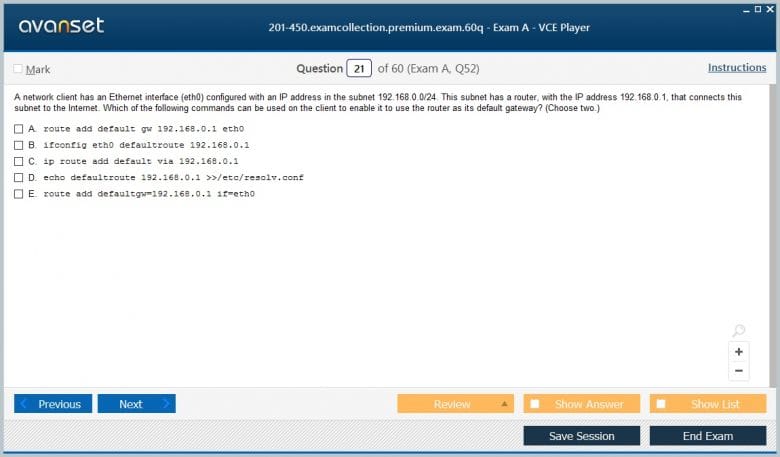
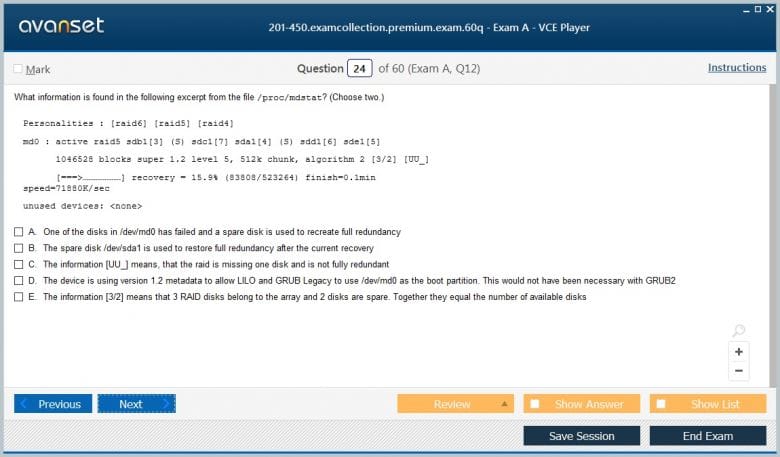
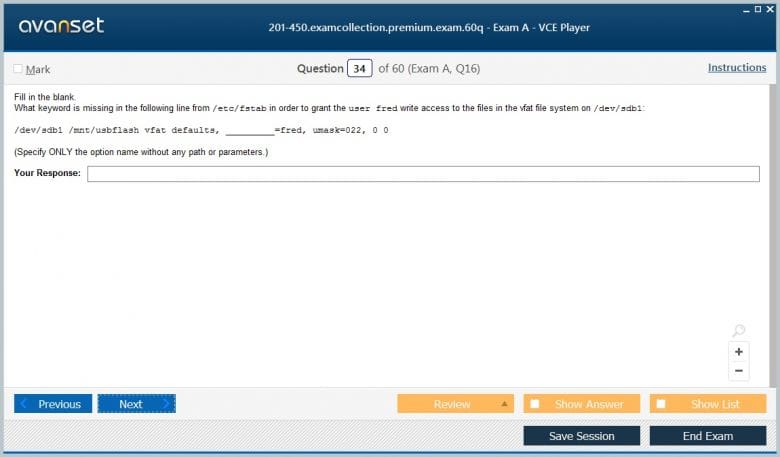
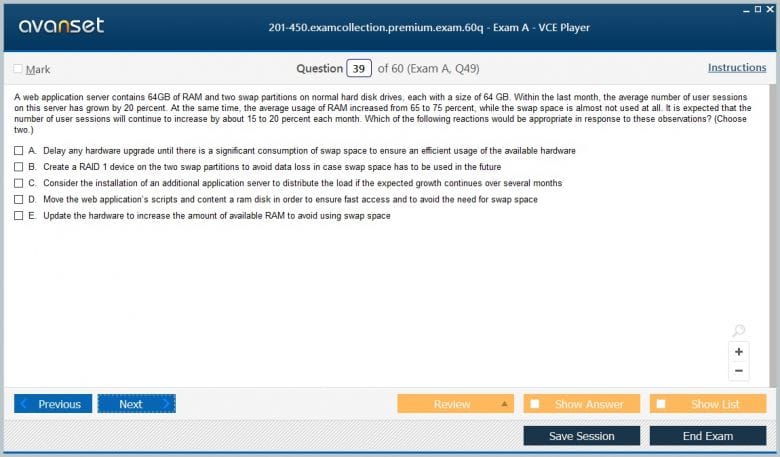
LPIC-2 Certification Exams Screenshots


LPIC-2 Product Reviews
Download Free LPIC-2 Practice Test Questions VCE Files
| Exam | Title | Files |
|---|---|---|
Exam 201-450 |
Title LPIC-2 Exam 201 |
Files 7 |
Exam 202-450 |
Title LPIC-2 Exam 202 |
Files 6 |
LPIC-2 Certification Exam Dumps & Practice Test Questions
Prepare with top-notch LPIC-2 certification practice test questions and answers, vce exam dumps, study guide, video training course from ExamCollection. All LPIC-2 certification exam dumps & practice test questions and answers are uploaded by users who have passed the exam themselves and formatted them into vce file format.
LPIC-2 in 2026: Advanced Linux Administration Across Mixed Networks
LPIC-2 is the second professional certification in the Linux Professional Institute’s vendor-neutral Linux track. The current version is 4.5 and requires passing 201-450 and 202-450. Each exam is 90 minutes with 60 multiple-choice and fill-in-the-blank questions. Candidates can take the exams in either order, but they must hold an active LPIC-1 certification before LPIC-2 is awarded. The credential is valid for five years.
LPIC-2 sits within the broader set of LPI certifications and is aimed at administrators who can operate small to medium-sized mixed networks rather than only a single Linux host. That distinction matters. LPIC-1 proves that a candidate can administer Linux fundamentals; LPIC-2 expects the candidate to make systems boot reliably, manage advanced storage, configure network services, troubleshoot failures, secure services, and understand how several machines interact.
Exam 201 moves from Linux basics into system engineering
The 201 half of LPIC-2 concentrates on capacity planning, the Linux kernel, startup and recovery, filesystems and devices, advanced storage administration, networking configuration, and system maintenance. These topics are connected by one operational question: can the administrator keep a Linux system healthy when the environment becomes more complicated than a default installation?
Preparation should therefore move beyond memorizing commands. Candidates need to understand why kernel modules load, how boot targets and service dependencies affect startup, what happens when filesystems fail, and how storage layers interact. A good lab includes multiple virtual disks, several filesystems, LVM, network interfaces, boot configuration, and intentionally broken services. The goal is to create evidence, diagnose the problem, and repair it.
Kernel and boot knowledge becomes practical troubleshooting
LPIC-2 expects candidates to understand kernel components, modules, runtime parameters, hardware information, and the mechanisms that influence system startup. This is not kernel-development training. It is administrator-level knowledge that helps explain why a device is not available, why a module behaves incorrectly, or why a system does not reach its expected state after boot.
Practice listing loaded modules, examining hardware and kernel information, changing runtime parameters safely, and tracing the path from firmware through the bootloader into the kernel and service manager. Recovery exercises are particularly valuable: break a boot entry in a disposable virtual machine, enter a recovery environment, identify the error, and restore normal startup. Those exercises turn abstract boot concepts into operational judgment.
Storage administration is broader than creating a filesystem
At LPIC-2 level, storage includes partitioning, filesystems, LVM, RAID concepts, device management, mounting, backup considerations, and the ability to recognize performance or capacity constraints. Candidates should understand how these layers fit together rather than treating every storage command as an isolated objective.
A useful lab starts with raw virtual disks and builds upward. Create partitions, initialize physical volumes, build volume groups and logical volumes, format filesystems, mount them persistently, expand capacity, and test recovery procedures. Add snapshots where appropriate and compare what they protect with what a real backup protects. That distinction matters in production: storage flexibility is not the same as recoverability.
Networking must be understood from configuration through diagnosis
LPIC-2 requires stronger networking knowledge than LPIC-1 because an administrator is expected to configure and troubleshoot hosts that provide services to other systems. Candidates should be comfortable with addressing, routes, interfaces, name resolution, network troubleshooting tools, and the logic of packet flow.
Study problems by symptom. If local communication works but remote subnets fail, inspect routes and gateways. If an IP address works but a hostname does not, investigate name resolution. If a service is listening but clients cannot connect, check the application, local firewall, network path, and access controls. Building this layered diagnostic habit is more valuable than memorizing a long list of utility flags.
Exam 202 is where Linux becomes a network services platform
The 202 exam shifts toward domain name services, web services, file sharing, network client management, email services, system security, and related administration. This half of LPIC-2 is especially important because it tests whether a candidate can configure Linux as part of a functioning multi-system environment.
DNS should be studied as an architecture, not only as configuration syntax. Understand authoritative data, recursive resolution, zones, record types, delegation, caching, and common failure patterns. Then configure a small DNS environment and test it from clients. The same principle applies to web and proxy services: build them, inspect logs, change access rules, and troubleshoot incorrect behavior.
File sharing and mixed environments reward protocol understanding
Linux administrators often work in environments where Unix-like systems, Windows systems, appliances, and cloud services coexist. LPIC-2 therefore includes technologies that allow Linux to provide or consume shared services across operating-system boundaries. Candidates should know why a protocol is used, how authentication and permissions interact, and where configuration or logging evidence can be found.
Do not study file sharing as a copy-and-paste configuration exercise. Create a share, connect from another host, test read and write behavior, deliberately create a permission conflict, and explain which layer denied access. That approach builds the troubleshooting mindset needed later for LPIC-3 Mixed Environments, where Samba and identity integration receive much deeper treatment.
Security appears throughout the certification rather than in one isolated chapter
LPIC-2 includes system security topics, but security also appears implicitly in almost every service domain. A web server needs appropriate permissions and TLS awareness. DNS configuration must avoid unsafe exposure. Remote administration needs strong authentication. Mail and file services need access control. Network services should run only when required and should expose only the intended interfaces and ports.
Use least privilege in the lab. Separate administrative actions from ordinary user activity, review service accounts, inspect listening sockets, and understand how authentication, authorization, network filtering, and logging work together. The more security is treated as part of normal administration, the less likely candidates are to memorize isolated “security facts” without knowing how to apply them.
One of the strongest ways to prepare for LPIC-2 is to break a working environment deliberately. Stop a service, alter a route, introduce an incorrect DNS record, fill a filesystem, change a permission, remove a mount entry, or modify a configuration file. Then diagnose the failure without immediately reversing the change.
Keep a short troubleshooting journal using the pattern “symptom → evidence → hypothesis → test → fix → verification.” This trains candidates to distinguish observation from assumption. It also makes fill-in-the-blank questions easier because the commands and file locations become associated with problems the candidate has actually solved.
The two exams should be prepared as one operating environment
Although 201 and 202 are separate exams, preparing them on the same persistent lab creates useful continuity. The storage configured while studying 201 can host services studied for 202. Network interfaces and routes become the foundation for DNS, web, and file-sharing tests. Boot and maintenance skills help when later service changes cause a machine to fail.
Use the official objectives as the final checklist, but organize day-to-day study around systems. Build a Linux server, make it boot correctly, give it resilient storage, attach it to a network, provide services, secure those services, and troubleshoot them. That sequence mirrors the way real administrators work and reduces the temptation to treat the objectives as unrelated trivia.
LPIC-2 is the gateway to enterprise Linux specialization
LPIC-2 is valuable as a standalone advanced administration credential, but it is also the prerequisite level for LPIC-3. The four current LPIC-3 specialties allow candidates to move toward mixed environments, security, virtualization and containerization, or high-availability and storage clustering. Candidates who know they want enterprise Linux specialization should use LPIC-2 to discover which operational problems interest them most.
Someone drawn to identity integration and Samba may prefer the mixed-environment path. Administrators who enjoy cryptography, access control, and hardening may prefer security. Those working with virtual machines and containers may choose virtualization, while infrastructure engineers interested in clustering and distributed storage may prefer high availability. LPIC-2 is broad by design because it creates the platform from which those deeper choices make sense.
For final review, do not ask only whether you recognize an objective. Ask whether you can explain it, configure it, verify it, and recover from a basic failure. If the answer is yes across the 201 and 202 domains, the knowledge is much closer to professional Linux administration than to short-term exam memorization.
Capacity planning is another place where LPIC-2 separates reactive administration from professional operations. Candidates should be able to observe processor, memory, disk, and network behavior, identify a resource that is approaching a practical limit, and decide whether the answer is configuration, cleanup, tuning, or additional capacity. The point is not to memorize one monitoring command. It is to correlate several measurements with the workload that produced them.
Build simple baselines in the lab. Record normal memory use, storage growth, service response, process activity, and network behavior before creating load. Then change one variable and observe what moves. This makes performance data meaningful and teaches an important production habit: compare a suspected problem with a known-good state instead of treating every high number as a fault.
Backup and recovery deserve the same operational treatment. A backup is valuable only if it can be restored, and a configuration copy is different from application-consistent data protection. Practice backing up configuration and user data, restoring it to a clean location, and verifying ownership, permissions, timestamps, and service behavior. The exercise connects storage, filesystems, security, scheduling, and maintenance into one realistic task.
Service configuration should also be studied with change control in mind. Before editing a production-style configuration, capture the current state, understand how syntax will be validated, make one controlled change, reload or restart only what is necessary, and confirm the result from the client side. This workflow is more professional than editing several files and rebooting until a problem disappears.
Historical coverage of LPIC-2 exam changes can help explain how the certification evolved, but current preparation should remain anchored to the 201-450 and 202-450 objectives. Version awareness matters because Linux administration concepts persist while the tools and emphasis around them change.
Finally, practice explaining your decisions aloud. Why use one filesystem layout instead of another? Why place a service behind a particular access rule? Why is a DNS symptom not necessarily a DNS-server failure? Why is a storage snapshot not a substitute for an independent backup? Candidates who can answer those questions clearly tend to perform better because they understand relationships rather than isolated facts.
ExamCollection provides the complete prep materials in vce files format which include LPIC-2 certification exam dumps, practice test questions and answers, video training course and study guide which help the exam candidates to pass the exams quickly. Fast updates to LPIC-2 certification exam dumps, practice test questions and accurate answers vce verified by industry experts are taken from the latest pool of questions.


Top LPI Certifications



Top LPI Certification Exams
Site Search:



