



Premium File
120 Q&A
$76.99$69.99
LPI 202-450 Exam Questions & Answers, Accurate & Verified By IT Experts
Instant Download, Free Fast Updates, 99.6% Pass Rate

202-450 Premium File: 120 Questions & Answers
Last Update: Oct 20, 2026
202-450 PDF Study Guide: 964 Pages
$74.99
LPI 202-450 Exam Screenshots
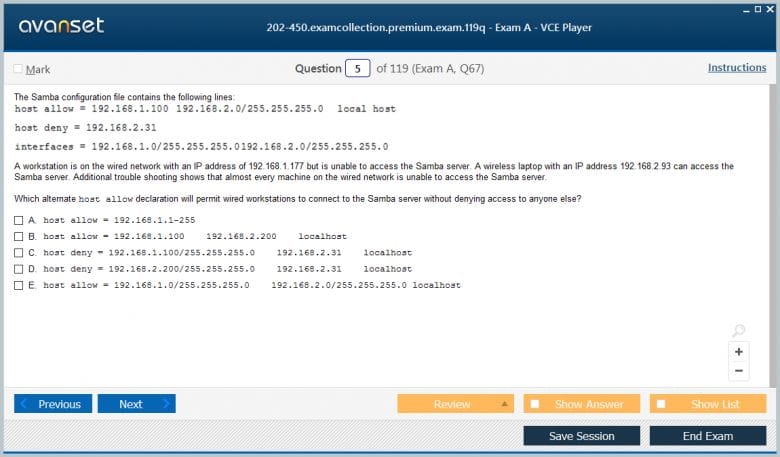
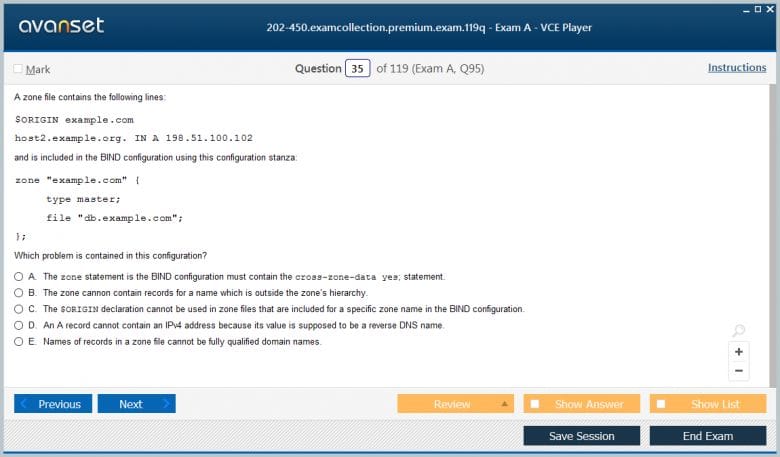
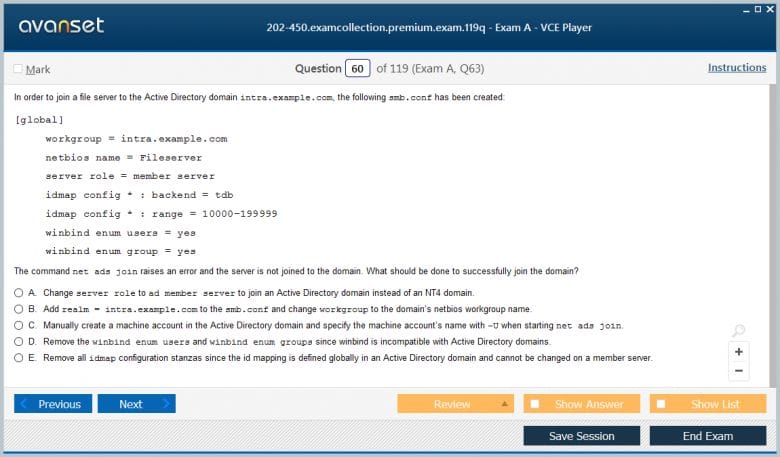
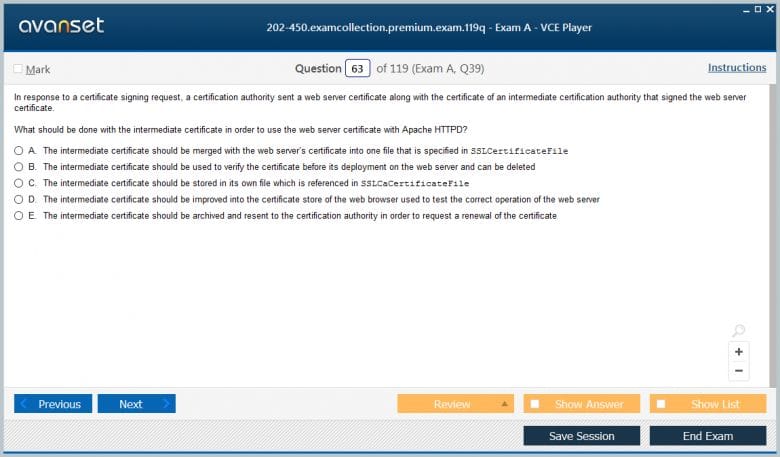
LPI 202-450 Practice Test Questions in VCE Format
| File | Votes | Size | Date |
|---|---|---|---|
File LPI.examlabs.202-450.v2026-05-03.by.lijuan.65q.vce |
Votes 1 |
Size 535 KB |
Date May 02, 2026 |
File LPI.Selftesttraining.202-450.v2019-02-20.by.Mark.65q.vce |
Votes 6 |
Size 397.8 KB |
Date Feb 24, 2019 |
File LPI.Selftestengine.202-450.v2018-04-28.by.Andre.30q.vce |
Votes 10 |
Size 349.5 KB |
Date Apr 28, 2018 |
LPI 202-450 Practice Test Questions, Exam Dumps
LPI 202-450 (LPIC-2 Exam 202) exam dumps vce, practice test questions, study guide & video training course to study and pass quickly and easily. LPI 202-450 LPIC-2 Exam 202 exam dumps & practice test questions and answers. You need avanset vce exam simulator in order to study the LPI 202-450 certification exam dumps & LPI 202-450 practice test questions in vce format.
LPIC-2 exam 202-450 is the service-administration half of Linux Professional Institute’s current LPIC-2 version 4.5 certification. Candidates need an active LPIC-1 certification to receive LPIC-2 and must pass both 201-450 and 202-450, although the exams can be taken in either order. Where 201-450 concentrates on the operating system itself, 202-450 asks whether an administrator can turn Linux hosts into reliable network services.
That distinction matters. The exam spans DNS, web services, file sharing, network client management, e-mail, and system security. Each topic has its own tools, but production failures rarely respect topic boundaries. A web application may depend on DNS, TLS, LDAP, mail relays, routing, and firewall rules at the same time. The LPIC-2 level therefore rewards administrators who can reason across service boundaries instead of treating every daemon as a separate island.
The DNS objectives cover BIND as an authoritative server and as a recursive caching resolver. Candidates should understand where configuration and zone data live, how changes are validated, and how a running server is reloaded without guessing. It is useful to build separate authoritative and recursive roles in a lab because the security and troubleshooting questions are different. An authoritative server answers for zones it owns; a resolver follows the delegation chain for clients.
Zone work requires more than memorizing record types. Create forward and reverse zones, add hosts, delegate a subdomain, and check the result with dig or host. A serial number that was not advanced, a broken SOA, or a bad delegation can make a syntactically valid change operationally useless. Exercises around DNS zone-transfer exposure also make the security consequences of careless authoritative configuration concrete.
Exam 202 expects candidates to recognize that name service is part of the security boundary. BIND can be isolated with reduced privileges or a chroot-style layout, and transfers or control operations can be authenticated. TSIG protects specific DNS transactions between trusted parties, while DNSSEC provides a chain of signed DNS data that resolvers can validate. DANE builds on authenticated DNS data to publish certificate-related information.
A productive lab does not need a public domain. Two virtual machines are enough to create a small signed zone, query the relevant records, and observe what changes when validation fails. The important lesson is diagnostic: a DNS answer can be absent because the record does not exist, because delegation is broken, because a policy blocks recursion, or because validation rejects the data. Those are different failures with different evidence.
Apache HTTP Server remains the main web-server reference in the LPIC-2 objectives. Candidates should understand virtual hosts, authentication, access control, logging, TLS, resource limits, modules, and the relationship between a request and the configuration that handles it. A strong lab hosts several names on one server, gives them different access policies, enables TLS, and then proves which virtual host actually answered a request.
Reverse proxies and web caching broaden the operating model. A front-end service can terminate TLS, route requests, cache content, or shield an application server. That means troubleshooting should separate client-to-proxy behavior from proxy-to-backend behavior. Status codes, server logs, certificate details, listening sockets, and packet paths are more useful than repeatedly restarting Apache.
File sharing is a classic source of layered permission mistakes. Samba must translate between SMB semantics and Linux ownership, groups, modes, and access-control lists, while NFS has its own export and identity behavior. A share can be reachable over the network and still deny access correctly because the underlying filesystem refuses the operation. Conversely, permissive filesystem modes can undermine an apparently careful service configuration.
Practice with a small matrix of users, groups, directories, and share definitions. Test the same files locally and over the network, then change only one layer at a time. This exposes whether a denial comes from the service, the host filesystem, the client’s identity mapping, or the network. It also prepares candidates for the mixed-environment reasoning that becomes central in the LPIC-3 Mixed Environments 300-300 exam.
The network-client objectives are broader than obtaining an IP address. DHCP requires understanding ranges, static assignments, relays, lease behavior, logs, and the interaction with IPv6 mechanisms. Authentication then moves into PAM, NSS, SSSD, LDAP clients, and a basic OpenLDAP server. These pieces determine how an identity becomes visible to the system and how authentication decisions are made.
Build a lab in which local and directory-backed identities can be compared with getent, PAM behavior, and LDAP queries. The point is not to reproduce a large enterprise directory; it is to understand the path from directory data to account lookup to authentication. A practical OpenLDAP installation can provide the mechanics, while the exam requires the administrator to understand LDIF, directory structure, access controls, and client behavior rather than follow a recipe blindly.
The e-mail objectives use Postfix as the main mail-transfer reference and Dovecot for IMAP and POP access. Candidates should understand aliases, virtual domains, quotas, relaying, queues, logging, and basic TLS. Mail filtering introduces Sieve concepts, while awareness of other MTAs keeps the exam distribution-neutral rather than tied to a single package.
Troubleshooting mail is easiest when the path is broken into stages: name resolution, TCP connectivity, SMTP dialogue, relay policy, queueing, local delivery, filtering, mailbox storage, and client access. A message sitting in a queue for a DNS failure requires a different fix from one rejected by relay policy. Logs and queue inspection should explain the state before configuration is changed.
System security in 202-450 includes configuring a Linux host as a router, enabling forwarding, applying NAT, and managing packet-filter rules for IPv4 and IPv6. The historical objectives emphasize iptables and ip6tables. Even on systems that increasingly use nftables or higher-level front ends, the reasoning still matters: understand direction, state, source and destination, protocol, port, forwarding, and translation.
The best firewall practice begins with a written traffic requirement, not a command. Define which flows must work and which must not, implement the smallest rule set that satisfies the requirement, then verify from both allowed and blocked paths. The foundations of iptables and Linux firewalls are easier to retain when rules are tied to a concrete topology rather than memorized in isolation.
OpenSSH appears across professional Linux work because it combines remote login, key authentication, port forwarding, restricted access, and operational convenience. Exam preparation should include server and client configuration, host keys, user keys, root-login policy, forwarding behavior, and the difference between proving identity and authorizing an action. A working SSH connection is not automatically a well-secured SSH service.
Use a lab to compare password and key authentication, restrict accounts, inspect verbose client output, and deliberately create host-key or permission problems. That makes authentication failures interpretable. It also reinforces a wider LPIC-2 principle: secure administration depends on understanding the state of the service before applying hardening changes.
The companion 201-450 exam covers capacity, kernel work, startup, storage, networking, and maintenance. Exam 202 builds on that platform and asks the administrator to deliver named, authenticated, shared, routed, mailed, and secured services over it. The active LPIC-1 prerequisite remains important because the advanced objectives assume confidence with shell work, packages, permissions, processes, and baseline networking.
A useful final lab is a small mixed network rather than a sequence of unrelated tutorials. Run authoritative DNS, publish a TLS-enabled web service, create a shared directory, authenticate a client through a directory service, relay test mail, restrict traffic with a firewall, and administer the machines through SSH. Then break one dependency at a time. That workflow turns 202-450 into what it is meant to test: the ability to operate a coherent Linux service environment under real constraints.
For DNS, practice delegation and caching separately. Create a child zone on another server, verify glue and authoritative responses, then query through a recursive resolver and observe TTL behavior. Clear the cache and repeat. This reveals the difference between an authoritative data problem and stale recursive state, a distinction that often saves time when a record looks correct on one host but not another.
For web and mail services, add certificate renewal and log rotation to the lab. A service that works only until a certificate expires or a filesystem fills with logs is not operationally complete. Confirm that configuration tests are run before reloads, that log files rotate without losing permissions, and that the service can be restarted after a reboot without manual steps.
Finally, practice change sequencing. If DNS, firewall, TLS, and application configuration all change at once, a failure is difficult to isolate. Make one controlled change, verify it from the client side, and keep a rollback step ready. That habit is as relevant to LPIC-2 as any individual utility because service administration is mostly the management of dependencies under change.
Credential and certificate file permissions should be included in every service lab. A daemon may fail because its process cannot read a private key, while making the file world-readable creates a worse security problem. Verify the service account, group membership, ownership, mode bits, and any mandatory-access controls before changing the application configuration. This joins ordinary Linux permissions with the service-security objectives.
Keep a short dependency diagram for the final environment. Draw clients, DNS, directory services, web and mail servers, firewall boundaries, and the management path. During troubleshooting, mark where the request stopped and which evidence proved it. The diagram becomes a study tool for seeing why an apparently local failure can originate in a shared service.
Go to testing centre with ease on our mind when you use LPI 202-450 vce exam dumps, practice test questions and answers. LPI 202-450 LPIC-2 Exam 202 certification practice test questions and answers, study guide, exam dumps and video training course in vce format to help you study with ease. Prepare with confidence and study using LPI 202-450 exam dumps & practice test questions and answers vce from ExamCollection.
Purchase Individually

Top LPI Certifications




Top LPI Certification Exams
Site Search:

SPECIAL OFFER: GET 10% OFF

Pass your Exam with ExamCollection's PREMIUM files!
SPECIAL OFFER: GET 10% OFF
Use Discount Code:
MIN10OFF
A confirmation link was sent to your e-mail.
Please check your mailbox for a message from support@examcollection.com and follow the directions.

Download Free Demo of VCE Exam Simulator
Experience Avanset VCE Exam Simulator for yourself.
Simply submit your e-mail address below to get started with our interactive software demo of your free trial.
@Francisco_PA, the materials from ExamCollection are always valid and these questions and answers for 202-450 exam are no exception! they’ve jus helped me ace my exam… I didn’t struggle much on any questions. these materials will certainly help you even if there’s a lack of time, just make as many attempts with these files as you can. wish you luck!
are these braindumps for LPI 202-450 exam still actual? my exam which is only a few days away, hope they can help in such a limited time…
sharing is caring…I wanna say that the practice questions and answers for 202-450 exam are what you need to ace the exam from the first attempt……they helped me pass my exam today!! all the best everyone!
some advise for those seeking preparation materials for this exam… do not leave LPI 202-450 exam dumps behind. they are valid and contain correct answers… i also used some other resources but can say that these dumps are the ones that made the exam so easy for me!
are these 202-450 vce files useful in the real exam?
@bryan_andres, these 202-450 practice tests are worth using, they helped me tackle the exam questions and pass with ease because almost 90% of the tasks were familiar to me. I recommend you use these files, they are actual
Anyone passed this test recently?
90% of the exam questions on LPI.Examskey.202-450.v2018-11-21.by.Nolan.60q.vce are valid. I took the test in january and failed because I psyched myself out but plan on taking the test again this weekend
Anyone taken this test recently?
Is dump still valid?