



Premium File
129 Q&A
$76.99$69.99
LPI LPIC-3 304-200 Exam Questions & Answers, Accurate & Verified By IT Experts
Instant Download, Free Fast Updates, 99.6% Pass Rate
129 Questions & Answers
Last Update: Sep 06, 2026
$69.99
LPI LPIC-3 304-200 Exam Screenshots
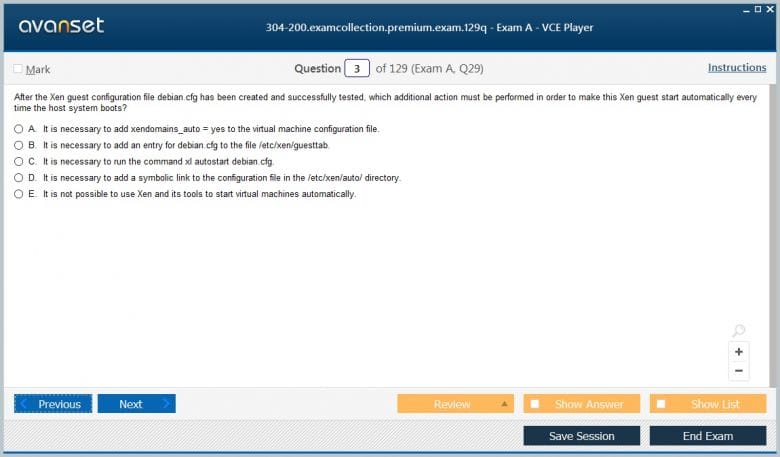
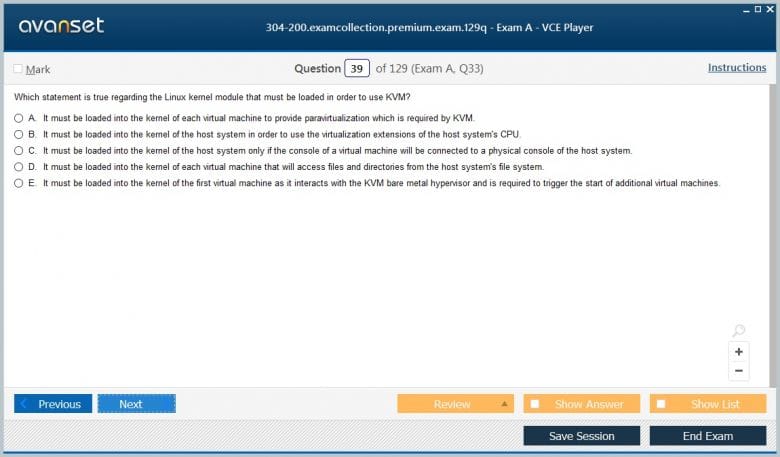
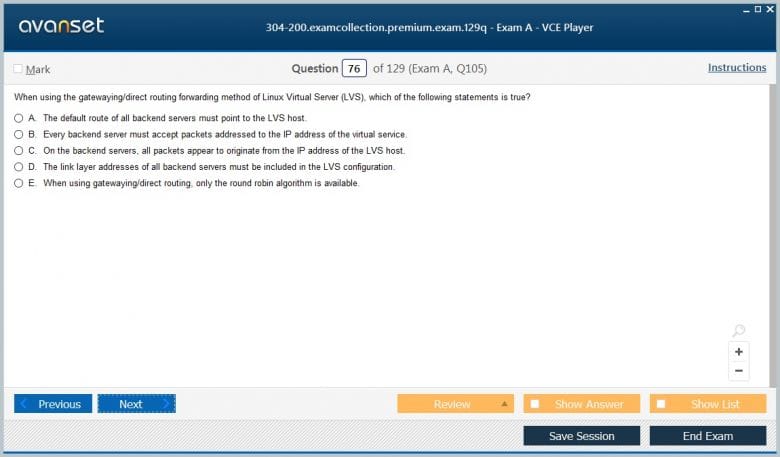
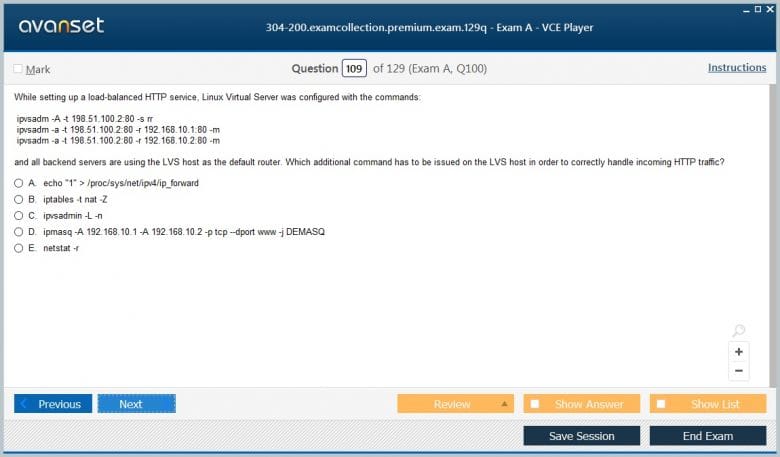
LPI LPIC-3 304-200 Practice Test Questions in VCE Format
| File | Votes | Size | Date |
|---|---|---|---|
File LPI.test-king.304-200.v2026-08-14.by.stanley.71q.vce |
Votes 1 |
Size 89.3 KB |
Date Aug 13, 2026 |
File LPI.Test4prep.304-200.v2019-05-20.by.Levi.76q.vce |
Votes 4 |
Size 95.78 KB |
Date May 24, 2019 |
File LPI.BrainDumps.304-200.v2016-04-07.by.SergioBusquets.102q.vce |
Votes 9 |
Size 107.69 KB |
Date Apr 07, 2016 |
LPI LPIC-3 304-200 Practice Test Questions, Exam Dumps
LPI 304-200 (LPIC-3 Virtualization & High Availability) exam dumps vce, practice test questions, study guide & video training course to study and pass quickly and easily. LPI 304-200 LPIC-3 Virtualization & High Availability exam dumps & practice test questions and answers. You need avanset vce exam simulator in order to study the LPI LPIC-3 304-200 certification exam dumps & LPI LPIC-3 304-200 practice test questions in vce format.
LPIC-3 exam 304-200 is a retired version 2.0 specialty exam that combined virtualization with high availability. Linux Professional Institute lists the old 304 version as available until June 20, 2022. Its content was then split: virtualization and containerization moved into the current 305-300 exam, while high availability and storage clustering moved into 306-300. The 304-200 page should therefore be read as a historical blueprint, not a current registration target.
The old exam is still valuable because it captured an unusually broad enterprise Linux role. Candidates were expected to understand Xen and KVM, libvirt, disk images, migration, cloud-management platforms, Pacemaker-style clustering, quorum and fencing, replicated block storage, clustered filesystems, load balancing, and the operational meaning of service-level targets. It tied compute virtualization directly to the problem of keeping applications available through failures.
Version 2.0 began with hypervisor concepts, hardware-assisted virtualization, paravirtualization, emulation, physical-to-virtual migration, virtual-to-virtual migration, resource isolation, and the trade-offs of consolidating workloads. Candidates needed to understand why virtualization changes failure domains rather than simply how to create a virtual machine.
That design perspective remains useful. Putting several services on one host can simplify deployment while concentrating risk. Snapshots can speed recovery while creating consistency problems if they are mistaken for backups. Live migration can reduce planned downtime while depending on shared storage, network reachability, and compatible CPU features. Good administrators identify those dependencies before trusting the feature.
304-200 included detailed Xen architecture, domains, networking, storage, xl tooling, migration, and troubleshooting. KVM received similar attention through kernel virtualization modules, QEMU, virtual disks, networking, and migration. The point was not to declare one stack superior but to prove that the candidate could recognize how each stack connects guest resources to the Linux host.
A historical lab can still usefully compare them, but current software should be documented carefully because versions have changed substantially. The durable skills are identifying the control process, the guest definition, the storage backing, the network path, and the evidence available when a guest fails to start or migrate.
The exam covered libvirt architecture, virsh, virtual networks, storage, domain configuration, and the relationship between libvirt and underlying hypervisors. This abstraction is operationally important because it lets administrators manage different back ends through a common API and set of tools while still understanding that the actual execution happens below libvirt.
Troubleshooting should therefore move through layers. If a libvirt domain fails, inspect the domain definition and libvirt logs, then move downward into QEMU, KVM, storage, or networking as needed. Abstractions improve consistency but do not remove the need to understand the components they orchestrate.
Version 2.0 included awareness of OpenStack, CloudStack, Eucalyptus, OpenNebula, Packer, Vagrant, and other provisioning approaches. These topics signaled a shift from manually maintained virtual machines toward image pipelines and programmable infrastructure. The current 305-300 exam continues that evolution with deeper container and image-provisioning coverage.
A modern lab can use image building and declarative provisioning to recreate the old objective’s intent. Define a base image, instantiate it repeatedly, change a configuration input, and verify that the resulting guests are consistent. The exact tool matters less than understanding reproducibility, image lifecycle, and the boundary between a template and instance-specific state.
The HA section asked candidates to understand active/passive and active/active designs, shared-nothing and shared-disk architectures, cluster resources, quorum, split brain, fencing, redundancy, MTBF, MTTR, SLAs, disaster recovery, and replication. These are architectural ideas before they are Pacemaker commands.
Quorum answers who is allowed to act; fencing prevents a failed or isolated node from continuing to write where it can corrupt shared state. A cluster without reliable fencing can be more dangerous than a single server because two nodes may believe they both own the same service. Build small failure scenarios in a lab and observe the cluster’s decision process instead of assuming failover is always automatic and safe.
Pacemaker, Corosync, resource agents, constraints, and cluster state were central to the historical exam. Candidates needed to define resources, ordering, colocation, preferred locations, and recovery behavior. A database may need storage mounted before it starts; an IP address may need to move with an application; a resource may be allowed only on nodes with specific attributes.
The most useful practice is to model one service with explicit dependencies and then fail each layer. Stop the application, disconnect a network, make storage unavailable, and isolate a node. Review why the cluster moved or did not move the service. That discipline is more valuable than memorizing a set of resource-creation commands.
304-200 included DRBD, clustered LVM, clustered filesystems, and storage technologies used to keep data available across nodes. Replication does not automatically create application consistency. Administrators must understand write ordering, split-brain risk, filesystem expectations, primary ownership, and how the cluster coordinates storage state with service state.
Practice with disposable data. Replicate a small block device, break connectivity, restore it, and inspect what happens to roles and synchronization. The objective is to understand the failure modes before they contain valuable data. Similar care applies to clustered filesystems, where several nodes may access shared storage but still require correct locking and fencing.
High availability is not only about moving a service after a crash. Load balancers can distribute traffic across healthy back ends, while bonding, multipath storage, redundant power, and service supervision can remove single points of failure inside one node. The old exam expected administrators to think about availability as a chain of dependencies rather than as one cluster product.
This is also where service-level thinking becomes practical. If the application can tolerate a minute of restart time but not data loss, the design should optimize differently than a stateless web tier that can simply remove a failed node from a pool. Availability architecture begins with recovery objectives and user impact, not with a preferred technology.
LPI’s version 3.0 redesign split the old objective set. The current 305-300 exam covers full virtualization, container virtualization, and VM deployment and provisioning. The separate 306-300 exam covers high-availability cluster management, clustered storage, distributed storage, and single-node availability. Together, the two current specialties divide the old 304-200 scope into clearer virtualization and availability tracks.
The broader LPIC-3 context and active LPIC-2 prerequisite still explain the level of expertise expected. Virtualization and clustering assume the candidate already understands Linux networking, storage, services, and troubleshooting. Without those foundations, every hypervisor or cluster symptom looks like a product-specific mystery.
For historical study, 304-200 is best approached as an architecture exercise. Build virtual machines, move them, break their storage or network, place a small service under cluster control, test fencing, and observe what happens to data during failure. For certification, move to the current specialty exams and objectives. The old code’s lasting value is the way it forces compute, storage, network, and availability to be considered together.
The historical exam also expected candidates to understand load balancers such as Linux Virtual Server and HAProxy in the wider availability design. A load balancer can remove a failed backend from service quickly, but it introduces its own health checks, state, network paths, and potentially a new single point of failure. Availability improves only when every layer of the request path is considered.
Pacemaker-style clusters should be tested with realistic resource agents rather than a dummy resource alone. Put a small web service behind a floating address, tie its filesystem and service dependencies together, and then fail the node. Verify not just that resources move but that clients can reconnect and data remains correct. Recovery time should be measured from user impact, not from the moment the cluster reports 'started'.
Storage clustering also raises backup questions. Replication protects against some hardware failures but faithfully replicates deletion, corruption, and malicious change. Clustered availability and backup solve different problems. A strong design combines service failover with independent, tested recovery copies and clearly defined recovery-point objectives.
If you are comparing old 304 material with the current specialties, map each objective explicitly. Virtualization concepts, libvirt, containers, images, and provisioning belong with 305. Quorum, fencing, Pacemaker, clustered storage, and distributed storage belong with 306. That mapping prevents older study books from leaving gaps after the split.
A cluster also depends on monitoring that can distinguish resource failure from node failure. If an application-specific health check fails while the operating system remains healthy, restarting the service may be enough; moving the entire stack can add unnecessary disruption. Define what each monitor proves and set timeouts with realistic startup and recovery behavior.
Virtualization changes backup and HA testing because a guest can be restarted or moved rapidly while its external dependencies remain unavailable. Include DNS, storage, load balancers, and client routes in failover tests. The most useful availability metric is the user-visible interruption measured from an external observer, not merely the time a cluster manager takes to update its internal state.
Capacity planning belongs in availability design as well. A failover node that cannot carry the surviving workload is not real redundancy. Measure CPU, memory, network, and storage demand under normal operation, then test the cluster with one node removed. Reserve enough headroom for recovery conditions and include the extra latency or bandwidth created by replication and migration.
Go to testing centre with ease on our mind when you use LPI LPIC-3 304-200 vce exam dumps, practice test questions and answers. LPI 304-200 LPIC-3 Virtualization & High Availability certification practice test questions and answers, study guide, exam dumps and video training course in vce format to help you study with ease. Prepare with confidence and study using LPI LPIC-3 304-200 exam dumps & practice test questions and answers vce from ExamCollection.
Purchase Individually
Top LPI Certifications



Top LPI Certification Exams
Site Search:

SPECIAL OFFER: GET 10% OFF

Pass your Exam with ExamCollection's PREMIUM files!
SPECIAL OFFER: GET 10% OFF
Use Discount Code:
MIN10OFF
A confirmation link was sent to your e-mail.
Please check your mailbox for a message from support@examcollection.com and follow the directions.

Download Free Demo of VCE Exam Simulator
Experience Avanset VCE Exam Simulator for yourself.
Simply submit your e-mail address below to get started with our interactive software demo of your free trial.
is wonderfull ...i passed !!!! but need to studed very